
If you’re hearing more and more about AGI—or Artificial General Intelligence—you’re not alone. But what does it really mean, and, more importantly, what does it mean for your business? Let’s look beyond the textbook definitions to understand why the real opportunity isn’t in the future—it’s already here, today.
AI is the almost science-fiction-like concept of a machine capable of learning, reasoning, and applying knowledge in a flexible way, just as a human being would. It is the ultimate goal of research, but beware: it is not the technology that is already changing the game for businesses.
The giant leaps in AI you see today have put this future in the spotlight, but it’s crucial not to confuse the two. There is a vast difference between the long-term vision and the powerful tools available to you right now. In this guide, we’ll clarify the difference between AGI and specialized AI, show you why the real opportunity for your business lies in adopting today’s solutions, and provide practical steps to get started.
To grasp the true potentialof AGI (Artificial General Intelligence), we must first draw a clear distinction between a hypothetical future and the day-to-day operational reality. The artificial intelligence that gives companies a competitive edge today is not "general" but specialized (often referred to as "Narrow AI").
This concept map is an excellent starting point for visualizing the journey: it begins with today’s AI, trained for specific tasks, and leads to the AGI of the future, which is expected to possess cognitive abilities similar to our own.
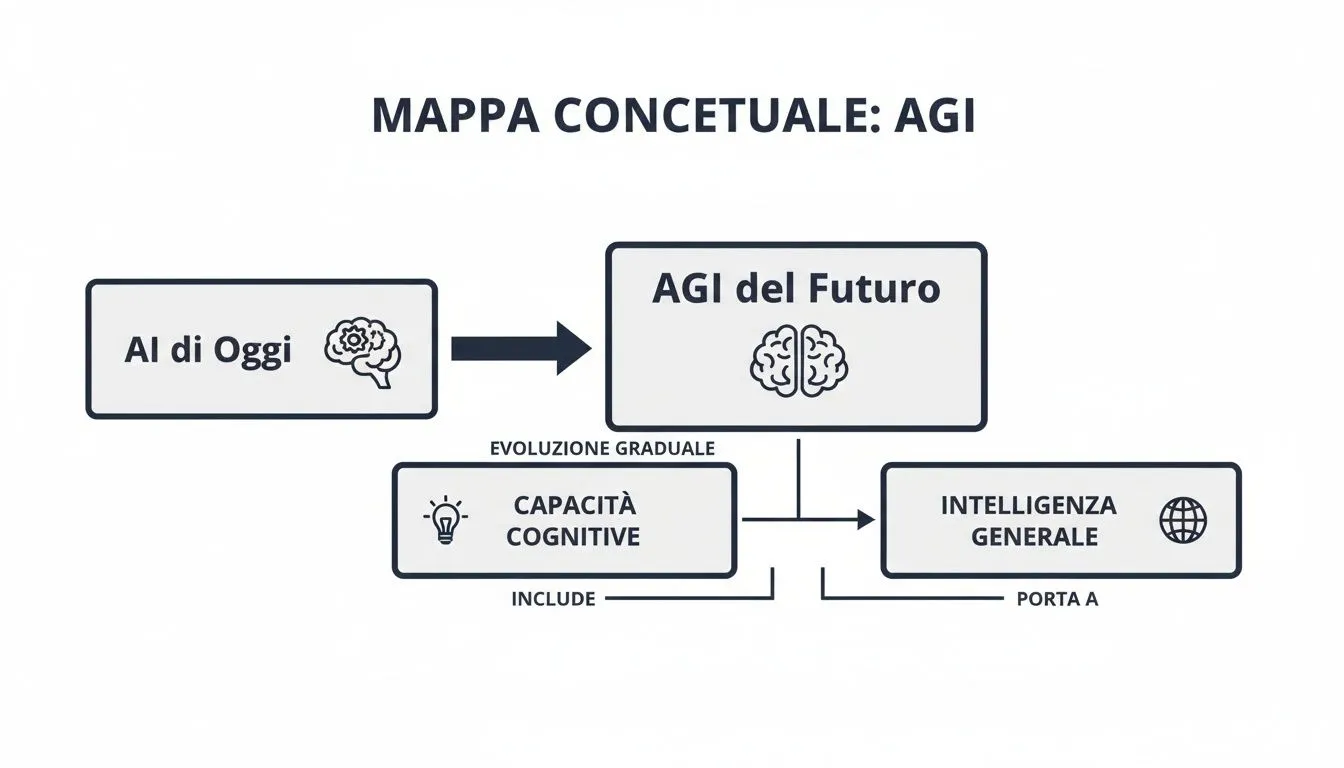
As you can see, while current AI excels at predefined tasks, AGI aims for autonomous, flexible intelligence capable of navigating even completely new and unexpected scenarios.
The real difference—the one that impacts your business decisions—lies in the scope of application. Specialized AI is like a master craftsman who excels at a single skill: for example, analyzing sales data to predict future trends. It is incredibly efficient and precise in its task.
On the contrary, an AGI would be like a person capable of learning any profession, from accounting to strategic marketing, and even combining them in novel ways.
The most common mistake today is to mistake the impressive advances in generative AI for the imminent arrival of AGI. They are two very different things. The AI available today does not "think" independently, but it performs complex tasks with superhuman precision.
This table helps you quickly grasp the key differences between the artificial intelligence we use every day and the still-theoretical concept of AGI.
Narrow AI excels at a specific task—such as predictive analytics or image recognition—and learns from structured datasets to perform a defined task. It is rigid by nature: it cannot adapt to tasks for which it has not been trained. This is the technology we use every day, and it is also present in platforms such as ELECTE.
AGI (Artificial General Intelligence), on the other hand, is capable of understanding, learning, and applying knowledge across any intellectual domain. It learns from experience and can transfer knowledge between completely different tasks, making it highly flexible and adaptable even to entirely new situations. To date, it remains a theoretical concept, the subject of research and academic debate.
Understanding this distinction is not merely a technical exercise. It is the first, essential step toward making informed strategic decisions—avoiding the temptation to chase a distant future and focusing instead on the tangible value that specialized AI can bring to your company today.
Imagine the artificial intelligence we use today as an Olympic athlete—an absolute champion in a single discipline. It’s unbeatable at weightlifting, but if you sat it down in front of a chessboard, it wouldn’t know where to start. Its strength and value lie precisely in this extreme focus.
AGI, on the other hand, would be like a decathlete—a well-rounded athlete capable of excelling in ten different disciplines with impressive agility and cross-disciplinary understanding. Although this vision of a flexible and autonomous intelligence is fascinating, it is crucial to understand that this is not the technology that is currently delivering tangible results for businesses.
Business intelligence tools are the perfect example of this successful specialization. ELECTE, an AI-powered data analytics platform for SMEs, does not "think" independently and certainly does not aspire to develop a consciousness.
Its function is far more practical and immediately valuable: it performs predictive analytics, uncovers hidden market trends in your data, and automates complex reports. And it does so with a speed and accuracy that no human team, no matter how skilled, could ever match.
This brings us to a crucial point: you don’t have to wait for “conscious” AI to deliver extraordinary value. The real power today lies in applying specialized AI to solve real and urgent problems.
Think about how this technology translates into direct benefits for the various areas of your business. Each application is an example of "narrow intelligence" that has a huge impact.
These are not tasks that require general intelligence, but rather activities that benefit greatly from advanced and extremely fast statistical analysis.
Waitingfor artificial intelligence to become widespread before investing in technology is like refusing to drive a car today because flying cars might exist in the future. You miss out on all the immediate benefits offered by current technology.
The real paradigm shift isn’t having a machine that thinks, but one that transforms the chaos of data into strategic clarity. For an SME, this means being able to compete with larger companies not on the basis of resources, but on the agility and precision of their decisions.
ELECTE isn't just give you numbers—it provides actionable insights. The platform doesn’t just show you what happened; it helps you understand why it happened and what might happen next.
This is the heart of AI for business today. It’s about enhancing human intelligence, not replacing it. It gives your teams—from marketing managers to financial analysts—the tools to ask better questions and get answers backed by hard evidence.
News about advances in artificial intelligence can easily give the impression that AGI is just around the corner. Tech giants are investing billions to overcome current limitations, but the truth is that the road to creating true artificial general intelligence (AGI) is still very long and fraught with obstacles.
Despite their astonishing capabilities, the large language models (LLMs) that dominate the scene today lack a true understanding of the world. They are masters at replicating statistical patterns uncovered in vast amounts of text, but they lack a fundamental ability: causal reasoning. In other words, they know what usually follows what in a sentence, but they don’t understand why.
This distinction is everything. Today’s models are learning to mimic human intelligence, not to truly understand it. An LLM can write a poem or generate code, but it doesn’t “feel” the emotion of the poem or understand the underlying logic of the algorithm.
This lack of understanding of the real world and of common sense is the biggest barrier to AGI. It is an obstacle that cannot be overcome simply by adding more data or more computing power. It requires a paradigm shift in research, as we explored in our article on thethe illusion of progress toward general artificial intelligence.
In this context, a statistic on the acceleration of AI investment in Italy is particularly revealing. The Italian artificial intelligence market has reached a record value of 1.2 billion euros, with an impressive 58% growth in just one year. This boom has been driven primarily by concrete projects in specialized AI, which account for nearly all of the investment. You can learn more by consulting the full report from the Artificial Intelligence Observatory at the Politecnico di Milano.
The smartest companies aren’t betting on the imminent arrival of AGI. Instead, they’re investing heavily in the adoption of specialized AI technologies—which are already available and proven—that deliver measurable results today.
This is the pragmatic approach that wins out. While academic research pursues the dream of AGI, the most competitive companies focus on what works right now.
For an SME, the lesson is crystal clear: focusing on the promiseof AGI means missing out on the enormous opportunities available today. True competitive advantage isn’t built by daydreaming about an uncertain future, but by implementing solutions now that solve real problems.
Think about the daily challenges your company faces:
These are problems that specialized AI can solve effectively—and immediately. Platforms like ELECTE designed precisely for this purpose: to transform your business data into ready-to-use insights, without requiring a team of data scientists or waiting for futuristic technologies.
Let’s set aside the theoryabout AGI and look at the reality: the impact that specialized AI is having today. This accessible and effective technology is the real driver of transformation for SMEs.

The real revolution isn’t something that’s coming—it’s already here, in the practical applications that generate tangible value. These are real-world examples of how companies achieve a measurable return on investment by turning data into a clear competitive advantage. Adopting artificial intelligence is no longer a luxury reserved for large corporations, but a fundamental strategic lever for growth.
An e-commerce manager, for example, no longer has to rely solely on intuition. By using a platform like ELECTE, they can accurately predict which products are about to sell out, optimizing inventory to avoid both losses from excess stock and missed sales.
Similarly, a finance team can automate anti-money laundering (AML) risk monitoring, freeing up valuable hours of manual work and drastically reducing the risk of human error.
Today's artificial intelligence doesn't require you to completely overhaul your business. It gives you the tools to make it run better, faster, and more accurately, enhancing the decisions you already make every day.
A business analyst, even without knowing how to write a single line of code, can generate complex sales forecasts with just one click. This means turning raw data into actionable strategies in minutes, not weeks. To learn more about how more agile models are driving this democratization, you can read our article on specialized AI models and their revolution in business.
This trend is backed by concrete data. The adoption of artificial intelligence in Italian companies has, in fact, doubled in pace. The percentage of companies with at least 10 employees that use AI technology has jumped from 8.2% to 16.4%.
The most interesting figure concerns SMEs: the figure stands at 15.7%, up from 7.7% the previous year. This is a clear sign that small and medium-sized enterprises are rapidly catching up. AI is no longer seen as a gamble, but as a necessary investment for remaining competitive today.
Specialized AI is ideal for SMEs because it is affordable and targeted. You don’t need a solution that “handles” everything, but rather tools that solve specific problems extremely efficiently. Here are the key benefits:
Ignoring these tools today, while waiting for future artificial intelligence, means ceding a huge competitive advantage to competitors.
Developing an AI strategy isn’t about preparing for a sci-fi future—it’s about taking action today. True preparation doesn’t mean waiting for AGI; it means building a solid, data-driven corporate culture right now. This proactive approach sets apart the companies that will lead the market from those that will fall behind. The path is built on three fundamental pillars.
The first and most important step is to stop treating data as an operational cost and start seeing it for what it is: your most valuable strategic asset. All too often, vital information is scattered across different systems, isolated Excel spreadsheets, and databases that don’t communicate with one another. To be ready, you need to consolidate and organize this asset. Clean, centralized, and accessible data is the fuel for any artificial intelligence initiative.
The second step is to choose the right tools. You don’t need a team of data scientists to get started. Platforms like ELECTE designed specifically for SMEs, offering the power of predictive analytics in an intuitive way. The goal is to democratize access to insights. You need to empower your teams to explore data and find answers without technical barriers, fostering agility and fostering an analytical mindset throughout the organization.
The third and most crucial pillar is your team. Technology alone isn’t enough. It’s essential to invest in their training so they can learn to ask the right questions of the data and correctly interpret the answers provided by AI. They need to develop the critical thinking skills that turn analysis into concrete business action. For a detailed plan, check out our 90-day roadmap for integrating artificial intelligence.
The real preparation for the AI era is not a technological issue, but a cultural one. It means building an organization where decisions are data-driven and every person is empowered to contribute their analysis and insights.
This awareness is already widespread among business leaders in Italy. According to an Accenture report, an impressive 92% of Italian executives plan to increase their investment in AI. Even more interesting is that 57% of these leaders intend to focus on upskilling and reskilling to prepare their employees, compared to 46% of their European counterparts. You can read the full report on AI investments in Italy for more details.
The most forward-thinking leaders know that technology is merely an enabler. The real competitive advantage lies in the skills of the people who use it.
The message of this guide is simple: while the world is still dreamingabout AGI, the most competitive companies are taking action—right here, right now—with the AI that works today.
The real opportunity isn’t waiting for a perfect, all-knowing technology that may or may not arrive someday. It’s using the tools we already have at our disposal to transform raw data into strategic decisions that drive growth. Specialized artificial intelligence isn’t a distant dream, but a powerful tool for optimizing operations, gaining deep insights into your customers, and anticipating market trends.
Don’t just read up on artificial intelligence. Start using it to solve the real-world problems your company faces every day. The technology is ready. The real question is: are you?
The fear of a hostile superintelligence is a fascinating topic, but for now, it’s a distraction. Ethical concerns about AI are real and urgent, but they pertain to the technology we use today: ensuring transparency in algorithms, avoiding bias, and making sure there is always human accountability. The problem isn’t a robot rebelling tomorrow, but an opaque algorithm making the wrong decisions today.
No one knows for sure. Experts’ predictions range from “a few decades” to “maybe never.” The scientific hurdles to creating digital consciousness are enormous, and it’s not certain that they can be overcome simply with more data or computing power. Instead of fixating on such an uncertain future, the smart move is to focus on what specialized AI can do for you right now.
Absolutely. The idea that AI is a luxury reserved for multinational corporations is a myth that has long since been debunked. For an SME, artificial intelligence is a fundamental strategic tool for optimizing resources, uncovering hidden opportunities in data, and accelerating decision-making. Platforms like ELECTE level the playing field, allowing you to compete based on the agility and precision of your decisions, not just the size of your budget.
Ready to turn your company’s data into a real competitive advantage? With ELECTE, the power of predictive analytics is already at your fingertips—no need to hire a team of data scientists. Discover how ELECTE shed light on your business’s strategic decisions.

.svg)


.svg)
.svg)



.webp)