
You’re probably facing a very real-life scenario. You’ve implemented an analytics system for sales forecasting, a customer scoring engine, or a tool for sorting job applications. Then you read “AI Act,” “high-risk,” “penalties,” and the feeling hits you right away: more complexity, more costs, more risk.
That reaction is understandable, but the real issue is something else. The AI Act doesn’t punish those who use AI. It punishes those who use it without understanding where its impact becomes significant for people, rights, and security. For an SME, this distinction changes everything. It prevents you from treating every AI project as an unmanageable legal problem and allows you to focus your time and budget only where it’s truly needed.
There is also a strategic reason to address this now. Italian SMEs account for 95% of businesses, but only 15% have implemented advanced AI systems for analytics, representing a 40% gap compared to the EU average due to regulatory barriers, according to data cited in the analysis of Article 6 of the AI Act. In practice, many companies hold back not because AI isn’t needed, but because compliance seems unclear.
This guide does one simple thing: it translates high-risk classifications into actionable decisions for Italian SMEs. No unnecessary jargon. No scaremongering. Just clear guidance on what to look for, how to assess your situation, and where to take action.
A retail entrepreneur implements an AI system to forecast demand and inventory. A finance manager uses a model to evaluate credit applications. An HR manager tests software that sorts through resumes. None of them realize they are entering a highly regulated area. Yet this is precisely where the problems begin.
The challenge does not lie in the text of the law itself. It lies in the fact that many SMEs view their tools as mere operational automations, when in reality some of these tools influence access to employment, essential services, or decisions that have significant impacts on people. The AI Act addresses precisely that issue.
You don’t have to be a software company to fall under the scope of the AI Act. All you have to do is use AI in processes that really matter.
If you use analytics, scoring, ranking, or predictive systems, the question isn’t whether the AI Act applies to you. The right question is: which of your systems might fall under the high-risk classification, and what operational consequences that would entail.
The good news is that the logic isn’t arbitrary. There is a clear structure. If you understand it, you can distinguish between ordinary cases and sensitive ones, thoroughly document exceptions, and establish compliance as a manageable business process. For an ambitious SME, this is much more than a legal formality. It’s a way to safeguard growth, reputation, and the ability to use AI with confidence.
The AI Act should be viewed as a European guide to the responsible use of artificial intelligence. It is not intended to stifle innovation. Rather, it is designed to tailor regulations to the level of risk involved. The greater the impact an AI system has on safety or fundamental rights, the greater the obligations become.

Many small and medium-sized businesses make a fundamental mistake. They think the regulation applies only to those who build AI models. That’s not the case. If you use AI systems to support key business decisions, you’re already subject to the regulation.
The right analogy is that of seat belts. If you’re driving slowly in a parking lot, the level of protection required is minimal. If you’re speeding down the highway, the safety measures must be strict. The same applies to AI. A system that recommends similar products has a limited impact. A system that influences access to credit, hiring decisions, or essential services falls into a different category.
For a more comprehensive introductory overview of the regulation, you may also want to read this ELECTE guide on the European AI Act.
For an Italian SME, the AI Act affects three very specific areas:
Rule of thumb: If your AI system affects people, access to opportunities, or security, treat it as a governance issue before considering it an IT issue.
This approach is more useful than the usual regulatory panic. It leads you to thoroughly map out use cases and understand where compliance is a strict requirement and where a well-documented assessment is sufficient.
The "high-risk" classification is not a moral judgment on the technology. It does not mean that the system is flawed, inherently dangerous, or should be avoided. It means that it operates in contexts where an error, a bias, or an opaque decision can have significant consequences for real people.
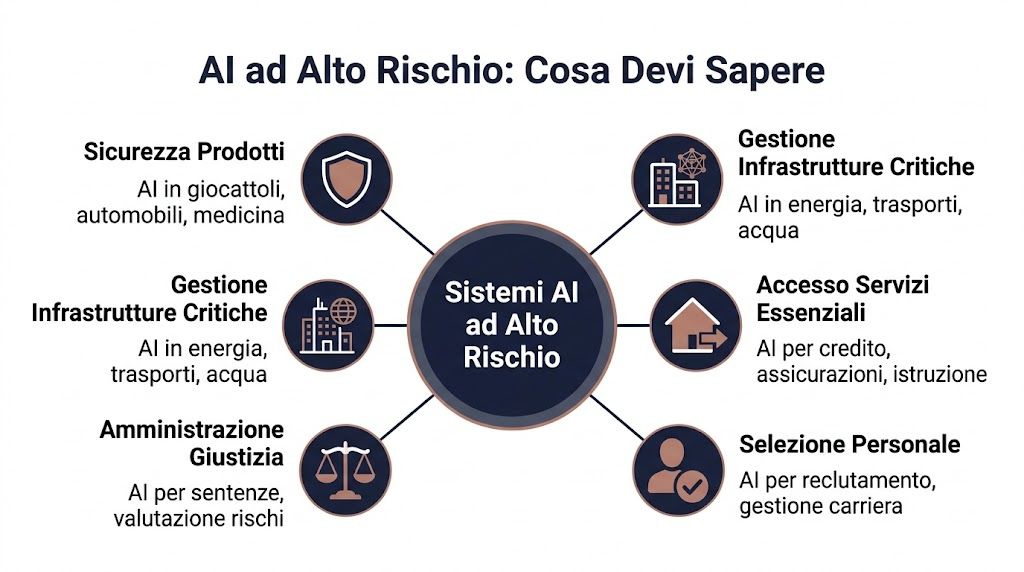
An algorithm that recommends a movie to you can make a mistake without any major consequences. At worst, you might lose a few minutes. A system that evaluates a mortgage application, screens candidates, or supports healthcare decisions doesn’t have that leeway. If it makes a mistake, it doesn’t just cause inconvenience. It can limit access to opportunities, services, or protections.
This is the logic to keep in mind. The AI Act focuses on the context of use and the significance of the consequences. It’s the right approach. All too often, companies focus on the technical capabilities of the model and overlook the central question: what impact does that decision have on people’s lives?
For those who want to move beyond theory and explore real-world applications in business, these practical case studies on artificial intelligence in SMEs are also useful, as they demonstrate how use cases vary in terms of value and risk depending on the context.
The core ofthe EU AI Act’s high-risk classification guide is here. The regulation follows two main paths. According to the EU AI Act’s high-risk classification guide, an AI system is classified as high-risk if:
Article 6 introduces this dual framework. And it does something smart. It doesn’t just focus on sensitive sectors, but also on products where AI becomes part of the overall security.
There is also a point that many SMEs misunderstand. There are exceptions if the system does not pose significant risks, but these are not automatic shortcuts. They must be justified and formally documented by the provider. If you say “it’s not high-risk,” you must be able to prove it.
If your argument is “there’s still a human involved in the process,” that’s not enough. What matters is how much that system actually influences the final decision.
This distinction marks the line between a genuine assessment and mere compliance.
The right question isn’t “Should we use AI?” It’s “Does this AI affect safety, rights, or access to essential opportunities?” That’s where a serious classification begins.
For an SME, this step should be treated as a business decision, not as a legal formality. If you approach the system the wrong way, you’ll get your priorities, documentation, and investments wrong. If you approach it the right way, you can design proportionate controls and use the data collected to better manage processes, suppliers, and internal responsibilities.
Annex III is the first operational filter. The regulatory summary of the AI Act identifies eight areas in which AI systems may fall into the high-risk category:
For many small and medium-sized businesses, this is the real issue. Classification depends on the system’s actual impact, not on the software’s marketing label.
A scoring engine, a document classifier, or a case prioritization system may seem like neutral tools. They are not if they significantly influence a decision regarding access to credit, personnel selection, or the differential treatment of customers and users. In projects similar to those described in the fintech cases based on analytics and decision monitoring, traceability makes all the difference: knowing what data goes in, which logic carries the most weight, and where a human operator can actually correct the outcome.
The second channel is often underestimated. Yet it is the one that surprises the most companies.
If AI is a safety component of a product already covered by harmonized EU legislation, the assessment changes immediately. You are no longer just analyzing a model that generates output. You are analyzing a function that contributes to the overall safety of the product or process.
This point also applies to SMEs that do not manufacture hardware. Simply integrating AI modules into broader solutions—or providing software that affects controls, alarms, thresholds, or safety mechanisms—is enough to bring a company into a much more demanding regulatory and technical environment.
There are exceptions, but they must be supported by verifiable evidence. It is not enough to say that the system plays a preparatory role or that a person remains in the loop.
Use a simple rule:
Here, a data analytics platform goes beyond simply supporting compliance. It becomes a strategic asset. It allows you to map use cases, reconstruct decision-making processes, track model versions, and produce defensible evidence—all without turning your team into a makeshift legal department.
SMEs that operate this way make better use of their budget. They don’t just follow the rules. They build a foundation for AI governance that can withstand audits, support growth, and accommodate new use cases.
Monday morning. A small-to-medium-sized credit firm approves or rejects applications in a matter of minutes. Another blocks suspicious transactions to comply with AML requirements. In both cases, the question isn’t “Should we use AI?” The question is much more practical: Does the system’s output actually influence a decision that affects customers, access to services, or control measures?

Let’s start with a scenario that many SMEs are familiar with. A retailer uses an AI system to estimate demand, inventory turnover, and reorder lead times. If the model is used to improve purchasing, logistics, and sales planning, you’re generally not dealing with the classic “high-risk” scenario under the AI Act.
The situation changes if that same system is used in processes where an error could disrupt operational continuity, affect sensitive controls, or impact functions related to service security. At that point, you’re no longer evaluating a forecasting tool in the abstract. You’re evaluating its actual role within a critical process.
Here’s a useful rule for SMEs: focus on the use case, not the software label.
In the credit industry, the margin for error is very narrow. If an AI system assesses creditworthiness, segments customers by risk, or significantly influences the outcome of an application, you must treat it as a high-risk candidate and take a serious approach from the very beginning.
The reason is simple. Here, you’re not optimizing a marketing campaign or a restocking order. You’re affecting access to a financial service. Under the AI Act, this distinction matters.
The typical mistake is to fall back on the phrase “decision support.” That’s not enough. If the human manager tends to confirm the score generated by the model, if exceptions are rare, or if processing times make a critical review unlikely, the system does indeed play a significant role in the final decision.
For an SME, the right approach isn’t to endlessly debate the definition. It’s to rebuild the decision-making process with verifiable evidence: what data goes into the model, what score comes out, who can modify it, in what cases they actually do so, and for what reason. A well-designed analytics platform helps you do just that. It brings together traceability, logs, model versions, and operational justifications. Compliance ceases to be an isolated cost and becomes a foundation for managerial control.
To see how industry players are implementing similar processes, check out ELECTE’s fintech case studies.
In lending, “support” matters little if the model produces predictable and consistent results.
Anti-money laundering requires more discipline and fewer slogans. An algorithm that flags anomalies or suspicious patterns should not automatically be treated as a system that makes independent decisions about customers or transactions. It must be evaluated based on its actual function, level of automation, and operational impact.
Ask yourself four straightforward questions:
This is where many SMEs go wrong due to organizational habits. On paper, there is human oversight. In reality, the model’s alert becomes the primary filter, and no one documents why a flag is confirmed or dismissed. This is the issue that needs to be addressed.
The smart choice is to use data analytics as a governance framework. You need it to see which alerts lead to decisions, which variables really matter, where the team simply validates the model, and where it actually exercises real control. It’s a matter of compliance, but also of strategy. It reduces friction with auditors and partners, improves the quality of investigations, and prevents you from discovering too late that a “purely internal” system was already influencing sensitive decisions.
When a system falls into the high-risk category, the worst mistake is to treat compliance as a pile of documents to be produced at the last minute. It doesn’t work well. And it costs more. Compliance requirements should be used as a framework for governing the system.
Annex III outlines a set of key requirements for providers and high-risk systems. The most important ones for an SME are as follows:
Effective compliance doesn't slow down business. It eliminates the gray areas that can hinder audits, partnerships, and scaling.
| Requirement (Section of the AI Act) | Key Description | Practical Steps for an SME |
|---|---|---|
| Risk Management (Art. 9) | Ongoing management of AI system risks | Create a risk register for each AI use case and update it whenever you change the model, data, or purpose |
| Data governance (Art. 10) | Relevant, representative, and verified data | Document the data source, cleaning criteria, known limitations, and checks for errors or discrepancies |
| Technical documentation | Formal evidence of operation and purpose | Create a system chart that includes the system's purpose, users, inputs, outputs, constraints, logic, and controls |
| Traceability | Reconstruction of system operations | Keep logs, model versions, relevant parameters, and related human decisions |
| Human surveillance | Effective oversight of decisions | Appoint an internal manager who can halt, review, or correct the outputs |
An SME doesn’t need a massive compliance department. It needs a method. If this method is integrated into analytics, product, and operations processes, compliance stops being a hindrance and becomes a more mature way to use AI.
Monday morning. An enterprise client asks you how you classify your scoring engine, who oversees it, and what evidence you have to show that it isn’t a high-risk system. If you find yourself scrambling for files, emails, and informal responses at that moment, the problem isn’t the algorithm. It’s governance.
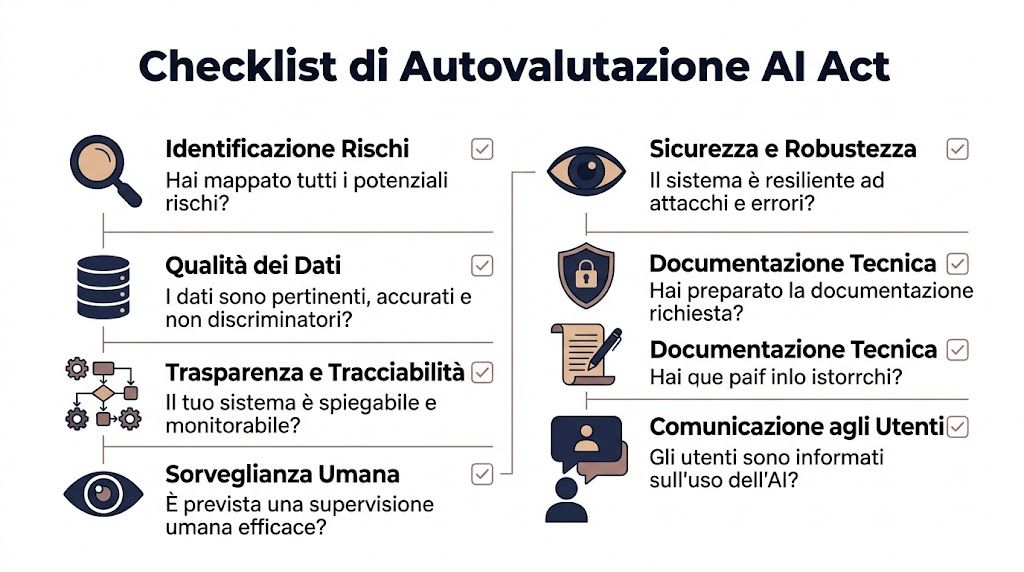
For an SME, the initial assessment must result in an actionable decision, not a vague document. You need to know three things: where you use AI, how much it influences decisions, and what evidence you can provide if an auditor, a partner, or management asks you to account for the classification. This is where a solid analytics framework makes all the difference. It helps you inventory your systems, link data, models, and processes, and reduce the time wasted on ad-hoc checks.
Use this checklist as a management tool rather than a legal one.
Do you have an up-to-date inventory of all the AI systems in use?
Include in-house models, AI features integrated into third-party software, and scoring, ranking, forecasting, anti-fraud, and automation systems that impact operational workflows.
For each system, have you described its specific function in a clear sentence?
“Analytics” isn’t enough. Describe the actual effect: evaluates credit applications, sorts leads, flags anomalies, sets priorities, blocks transactions, supports onboarding.
Does the output affect people, access to services, or significant economic decisions?
If the answer is yes, the review must be escalated. Systems that influence credit, insurance, hiring, access to services, or security checks warrant immediate attention.
Is the human role substantive or merely formal?
If supervisors almost always approve the output without the tools, time, or authority to challenge it, you are not engaging in true supervision.
Can you explain why the system isn’t high-risk using verifiable internal evidence?
We need documents, logs, decision criteria, stated thresholds, and a consistent rationale. Without this evidence, the classification is weak.
Do you know what data powers the system and what risks it entails?
Data sources, quality, updates, sensitive variables, known errors, and dependencies on third-party providers must be tracked. If you don’t know them, you’re not assessing the risk. You’re simply bearing the brunt of it.
Some cases should not be handled based on general common sense. They should be immediately referred to the compliance, legal, risk, or management departments.
If you can't defend the classification in front of an important client or an auditor, the classification isn't ready.
Ultimately, you don’t need a list of uncertainties. You need a clear outcome for each system: ruled out, requires further investigation, or should be treated as potentially high-risk until proven otherwise. This approach avoids the typical mistake made by ambitious SMEs. They grow quickly, adopt useful AI tools, but leave classification in a gray area that ends up slowing down sales, partnerships, and scaling.
If you already have a foundation for reporting and data management, you can structure this process much more effectively. A well-designed platform helps you link use cases, data, outputs, and responsibilities in a way that’s easy to understand, even for non-technical users. To learn how to establish this foundation within your company, you may find this guide to business intelligence software for SMEs helpful.
Compliance becomes a burden when data is scattered, processes aren’t tracked, and model outputs aren’t tied to clear accountability. This is where a well-designed analytics platform can make a difference—not as a regulatory shortcut, but as a framework for order.
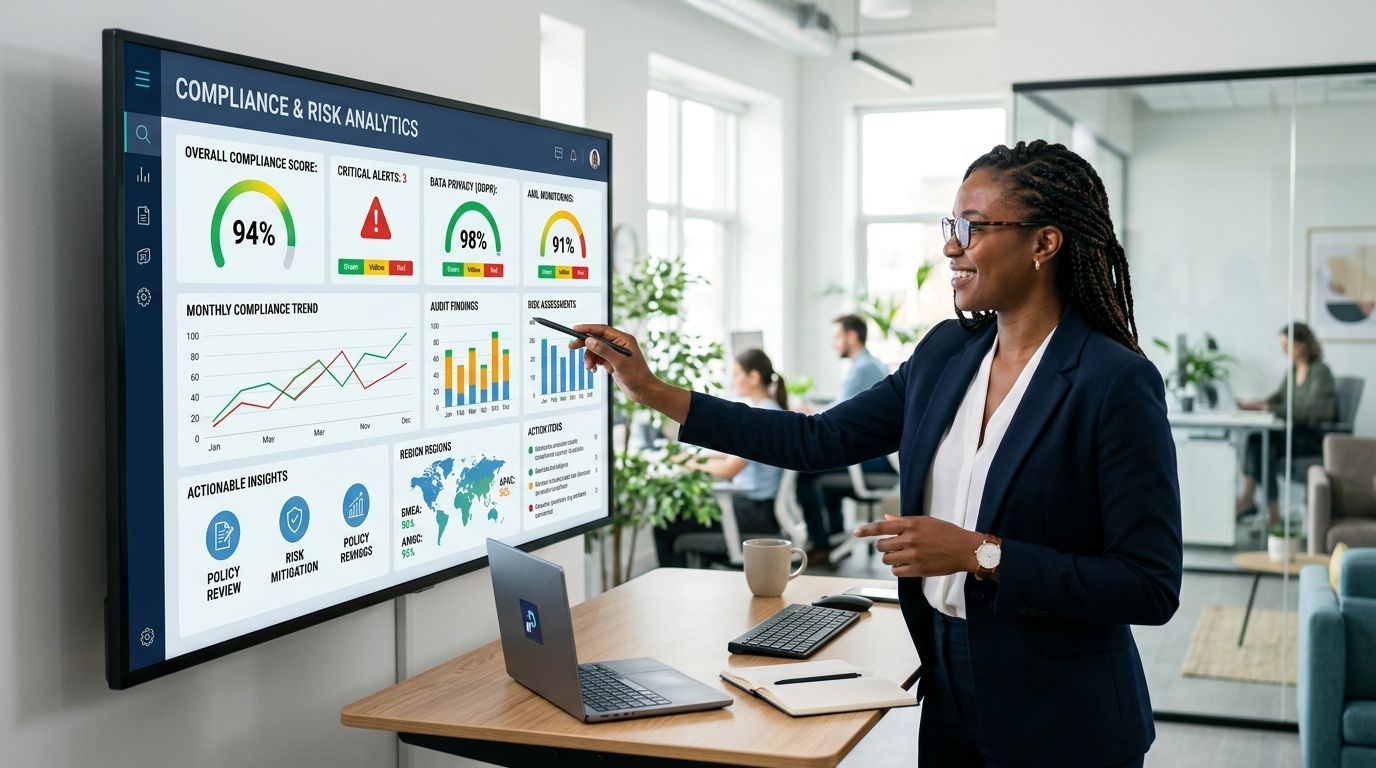
A modern platform is particularly helpful in four key areas:
Anyone who already works with business intelligence tools will immediately see the benefit. If you’d like to better understand this step, this in-depth article by ELECTE on business intelligence software for corporate decision-making is also helpful.
Many companies keep these two worlds too separate. On one hand, the data team wants performance. On the other, the compliance team wants controls. It’s an inefficient division.
The best approach is to integrate these two objectives. A well-governed AI system not only produces better insights but also leads to more stable, auditable, and externally credible processes. In other words, compliance isn’t just about avoiding problems. It’s about creating an environment where AI can be adopted more quickly and with less internal friction.
This is something many SMEs realize too late. Proper documentation, traceability, and clarity regarding usage are not just unnecessary red tape. They are the foundation for truly leveraging AI in a scalable way.
The AI Act is particularly alarming to those who view it as a punitive measure. That is a narrow interpretation. The more useful interpretation is this: the regulation requires companies to better understand their systems, their data, and the real-world impact of automated decisions.
If you adopt this approach, the “high-risk” classification ceases to be a vague threat. It becomes an actionable criterion. You know where strict controls are needed, where you can document an exception, and where your SME can innovate without moving forward blindly.
The AI Act High-Risk Classification Guide is designed to do exactly that: cut through the fog, set priorities, avoid major mistakes, and build AI that is more reliable, more defensible, and more useful to businesses.
SMEs that grasp this early on will not only be more compliant. They will be more credible, more organized, and better positioned to scale up.
If you want to turn scattered data into clear, traceable insights that enable more confident decision-making, discover ELECTE, an AI-powered data analytics platform for SMEs. It’s a practical way to bring more control, visibility, and structure to the processes that really matter.

.svg)


.svg)
.svg)