
Many European SMEs are approaching AI from the wrong angle. According to data cited by Eurostat and the Qonto 2025 survey , 46% are already using AI tools such as ChatGPT, but only about 25% have adopted digital accounting solutions. The point isn’t that the enthusiasm is misplaced. The point is that, without a solid digital foundation, AI risks remaining an interesting experiment but one with little transformative power.
This is the real crux of the barriers to AI adoption among European SMEs. It is not merely a list of technical obstacles, but an operational paradox: many companies try out advanced tools before they have organized their data, processes, and internal responsibilities. On the surface, it looks like speed. In practice, it is often fragility.
For an SME, the issue isn’t simply “adopting AI” in the abstract. It’s about understanding the right order in which to do so. First, you consolidate your data; then, you identify use cases; and finally, you automate repetitive analyses and decisions. This is where a solution designed for SMEs can prove valuable—not as a magic shortcut, but as a tool for turning existing capabilities into tangible results.
Europe is going through an interesting phase. On the one hand, the adoption of AI is becoming part of everyday business vocabulary. On the other hand, a significant number of SMEs have not yet completed the less visible but crucial work that makes AI truly useful: reliable data, consistent digital processes, and integrated management tools.
The paradox is clear. AI is often treated as a cutting-edge application, while the company’s underlying structure remains fragmented. In that context, the algorithm does not fix the problem. It amplifies it.
The adoption of technology only creates an advantage when it follows an industrial logic. Not when it simply adds up isolated tools.
This is why the debate on the barriers to AI adoption among European SMEs concerns the actual competitiveness of these businesses. It is not enough to simply ask whether AI holds promise. We need to understand why so many companies remain stuck between mere curiosity, occasional trials, and projects that fail to scale.
Twenty percent of EU companies with at least 10 employees use artificial intelligence technologies. Taken on its own, however, this figure risks being misinterpreted.
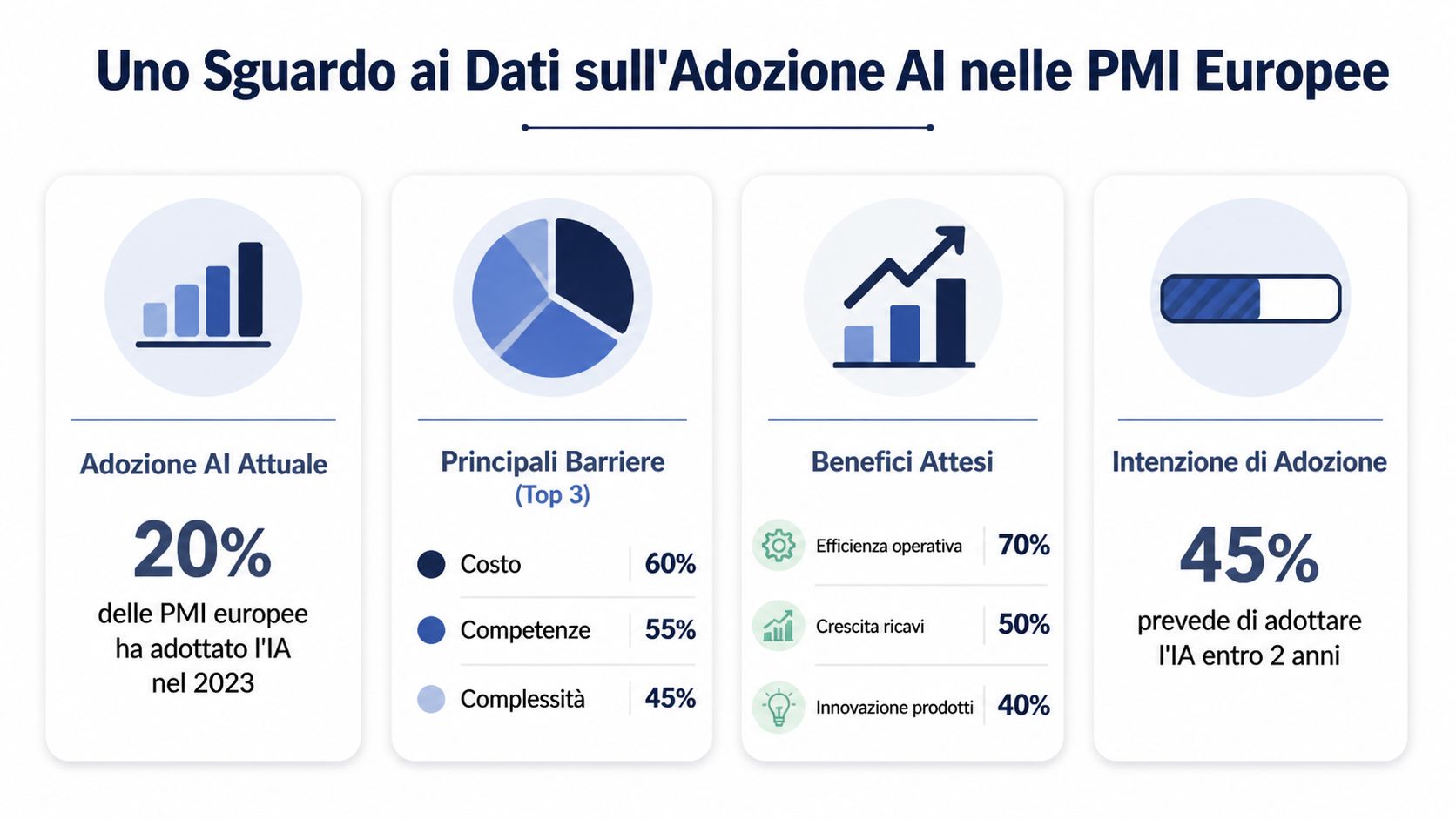
The European average encompasses a wide range of situations. Within that 20%, large companies with already structured data coexist with SMEs that use AI on an ad hoc basis, often through consumer-grade tools. The point is not merely how widespread AI is. What matters is where it is applied and the operational foundations on which it is based.
This is where the true paradox of adoption comes to light. In many SMEs, AI is first applied to visible tasks—such as writing, summarizing, and sales support—rather than to less conspicuous but more profitable processes over time, such as data quality, system integration, and workflow standardization.
A study by the European Investment Bank provides a clear picture of the situation: European companies are investing in digitalization, but their ability to translate these investments into productivity remains uneven, with the gap being most pronounced between large and small companies. For an SME, therefore, the relevant question is not whether it “is using AI.” The question is whether AI is being applied to reliable processes or to fragmented data.
This changes the managerial assessment. Many companies aren’t standing still. They’re experimenting. The problem is the sequence.
If a company uses a generative AI assistant to prepare sales proposals but continues to manage sales, accounting, and reporting across disconnected systems, the economic impact remains limited. While it may appear to increase speed on the surface, it does not ensure consistency in decision-making. In such cases, AI improves individual tasks, not the company’s overall system.
This is also why data analysis must be linked to regulatory considerations. SMEs that implement AI tools without clarifying data governance, internal accountability, and usage criteria risk adding complexity rather than reducing it. For this reason, it is advisable to complement operational testing with a practical understanding of the European framework of the AI Act for SMEs.
| Indicator | What does it really suggest? |
|---|---|
| Average Adoption of AI in the EU | The interest is genuine, but the media does not distinguish between regular and occasional use |
| The gap between large and small businesses | The benefit depends on the organization, not just on the technology purchased |
| The proliferation of consumer AI tools | The cultural threshold was crossed before the infrastructure threshold |
Rule of thumb: if your business data still requires manual steps, the correct approach is to first streamline the data flow, then expand the use of AI.
The competitive impact is less obvious than it seems. SMEs that first establish a solid digital foundation may adopt AI more slowly at first, but with more cumulative results. Those that accumulate tools without integration risk the opposite effect: many experiments, few replicable processes, and little economic return.
This also presents a real opportunity. The advantage for an SME does not come from copying the budgets of large companies. It comes from prioritizing the right elements—reliable data, interconnected processes, and measurable use cases—and only then implementing platforms capable of accelerating execution. In this process, those who build a solid foundation can catch up faster than aggregate statistics suggest.
In European SMEs, the real obstacle is rarely a single technology. The problem arises when companies experiment with AI tools on an ad hoc basis, often starting with consumer-facing applications, while data, processes, and responsibilities remain fragmented. This is where the adoption paradox emerges: interest grows faster than the ability to translate it into operational results.
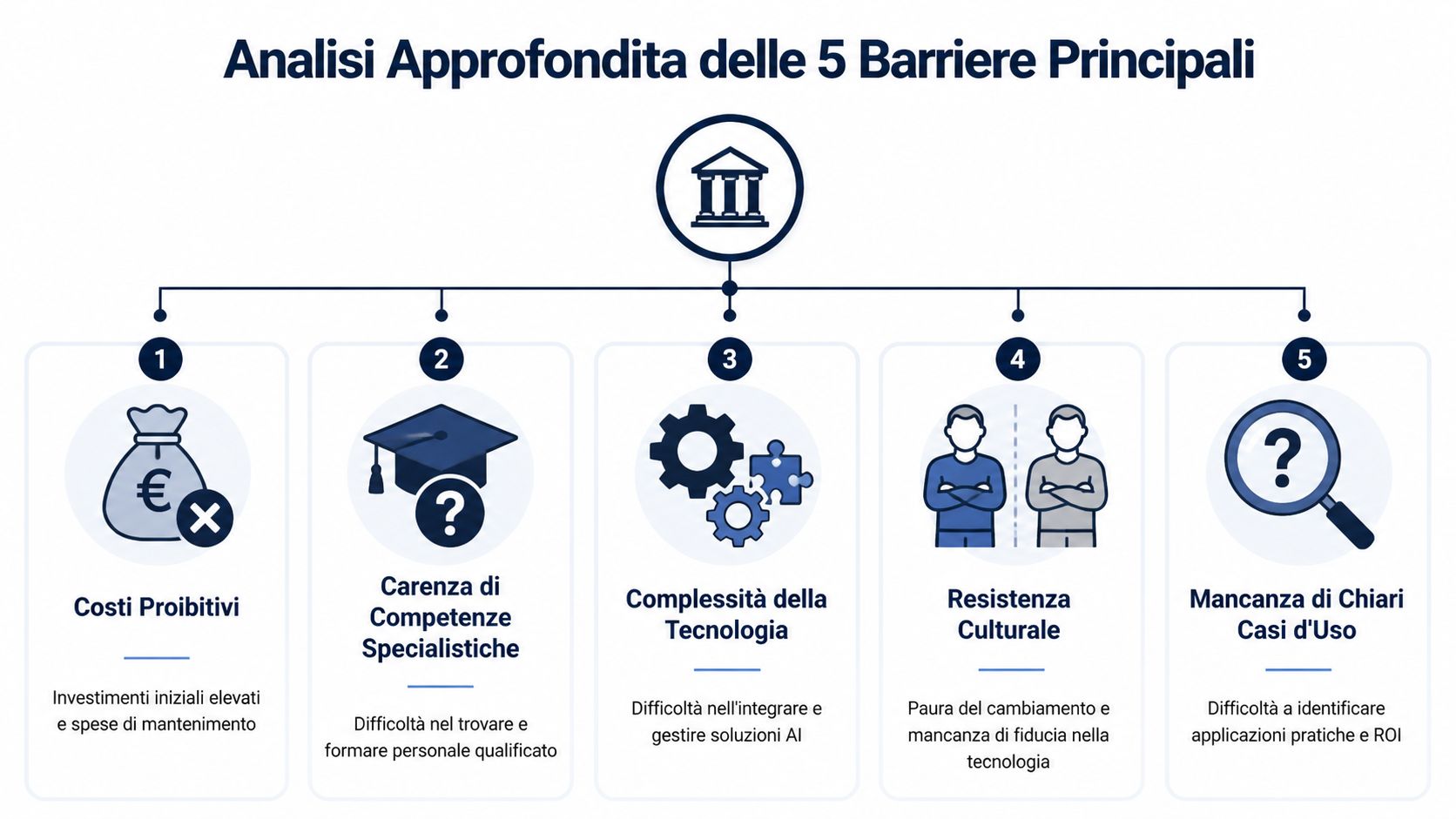
The five main barriers do not all carry the same weight, but they almost always follow a recognizable sequence.
The first is data quality. If customer records, orders, price lists, profit margins, and inventory are stored in separate systems, AI will produce incomplete results. This may seem like a technical limitation. In reality, it is a managerial problem, because it stems from processes that have evolved through ad-hoc additions rather than by design.
The second point concerns expertise. Many SMEs do not need, at least initially, a team of data scientists. They need people who can ask the right questions, prioritize processes, verify the reliability of the output, and assign clear accountability to the business. Without this ability to interpret data, even accessible tools remain underutilized.
Then there are costs and expected returns. The crux of the matter isn’t just how much the software costs. What matters is how much it costs to prepare the data, integrate data flows, resolve exceptions, train staff, and measure the economic impact over time. That’s why many projects look promising in demos but are far less convincing on the bottom line.
The fourth barrier is integration with existing systems. In SMEs, information assets are often scattered across outdated ERP systems, spreadsheets, vertical software, and manual processes. Under these conditions, every new use case requires constant adjustments. The project gets underway. Then it grinds to a halt due to invisible but costly tasks: data cleansing, code alignment, manual checks, and reconciliations.
The fifth barrier is cultural. It is not simply a general resistance to change. More often than not, it reflects very concrete concerns: loss of control, mistakes that are difficult to explain, dependence on the supplier, and doubts about privacy and decision-making authority. If these issues are not addressed from the outset, the project is treated as a side project rather than an operational choice.
When viewed in sequence, the chain of events is clear. Weak data erodes confidence. Low confidence makes it harder to invest. The lack of investment prevents improvements in integration and skills. At that point, AI remains confined to individual trials, which are useful for learning but insufficient for growth.
For a European SME, compliance is not a separate issue from adoption. It affects the selection of use cases, the choice of vendors, internal documentation, and the level of human oversight required. In practice, it comes into play much earlier in the project than many entrepreneurs expect.
This issue is particularly significant for companies that handle sensitive commercial data, financial information, HR documents, or processes that may affect customers, employees, or partners. In these contexts, the question is not simply “Can I use AI?” The correct question is more specific: with what data, for what purpose, with what level of traceability, and under what managerial oversight.
A practical interpretation of the European AI Act framework for SMEs helps avoid a common mistake: putting everything off out of fear of the regulations, or moving forward without identifying risks, roles, and controls.
The takeaway for an SME is less pessimistic than it seems. The barriers are real, but they don’t all need to be tackled at once. It’s best to start in the right order. First, data and process. Then, minimal governance. Only after that, more advanced tools. It is this approach that transforms the adoption of AI from an interesting experiment into a replicable capability, and paves the way for integrated platforms like ELECTE, which only make sense when the data foundation is already organized enough to support continuous use.
The barriers become truly apparent when they enter the daily workflow. In highly operational sectors, AI does not fail due to a lack of potential. It fails when it encounters unreliable data, unclear responsibilities, and poorly defined use cases.

In retail, many managers start with a simple question: “Can I better forecast sales and inventory?” The technical answer is often yes. The managerial answer depends on the quality of the data.
If the catalog isn’t clean, if promotions aren’t recorded consistently, or if returns aren’t properly accounted for in the workflow, even the best model will produce unreliable results. The problem, then, isn’t the algorithm. It’s the data environment in which the algorithm operates.
A common mistake is to think that simply hiring a technical expert will solve everything. In reality, even a strong team will perform poorly if the company hasn’t defined priorities, data sources, and business responsibilities.
In the financial services sector, the situation is even more delicate. Here, AI can assist with tasks such as forecasting, risk monitoring, reporting, and compliance support. But precisely for this reason, traceability, oversight, and clarity regarding processes are essential.
When regulations slow down access to advanced models, or when a provider lacks sufficient transparency, the issue isn’t just about the pace of innovation. It’s about operational trust. A finance team cannot base a critical decision on a result it cannot put into context.
The assumption we need to challenge is this: it is not true that the only way forward is to set up a small in-house data science team. For many SMEs, the most sensible approach is different. Standardize essential data, identify a few recurring use cases, and choose platforms that make the analyses understandable even to non-technical staff.
The biggest hurdle isn’t always the budget. Often, it’s the assessment. If the team lacks the expertise to understand where AI can add value, it becomes nearly impossible to build a credible business case. Without a business case, the investment is delayed. Without investment, expertise doesn’t grow.

The research is quite clear. Fifty-seven percent of EU companies report difficulties in hiring new staff with the right skills, as summarized in the Progressive Policy Institute’s paper. The same report highlights that, in SMEs, internal capabilities are the strongest predictors of AI adoption.
There is a strategic implication that is rarely discussed. If internal expertise matters more than anything else, then the priority is not simply to “recruit specialists.” It is to equip the existing team with the tools they need to reduce their reliance on rare expertise.
The same source also highlights a key point: companies with clear AI strategy plans are twice as likely to see AI-driven revenue growth. For many SMEs, this finding should not be interpreted as a call to produce formal strategic documents. Rather, it should be seen as a call to make a clear choice: where do we want to use AI, with what data, for what decisions, and using what operational metrics?
The most realistic way to resolve the skills-ROI paradox is to start with activities where the value is clear even without a dedicated technical team.
Cases like these work well:
Practical tip: Don’t ask AI to “transform the company.” Ask it to improve a decision that is currently being made too slowly or with incomplete information.
In SMEs, ROI is more easily demonstrated when the use case is closely tied to day-to-day operations. It is much simpler to measure the value of a more accurate forecast or a report generated with a single click than to justify a large-scale, vague project that is difficult to oversee.
The mature adoption of AI doesn’t start with abstract promises. It starts with repetitive problems that consume managerial time. That’s when AI stops being a demo and becomes an operational advantage.

Sales Forecasting.
For those working in retail, distribution, or e-commerce, forecasting is the first real test. A well-designed model helps identify seasonal trends, promotions, and variances. The practical benefit is planning that is less reactive and more disciplined.
Automated Management Reporting.
Many SMEs face a hidden problem: the data exists, but it arrives too late. If sales figures, profit margins, costs, and business performance end up in manually compiled files every time, management loses momentum. Automating reports and dashboards reduces friction and improves the quality of internal analysis.
Customer segmentation and targeted campaigns.
Even without sophisticated systems, AI can help group customers by purchasing behavior, frequency, value, or churn risk. This doesn’t replace marketing. It makes it more targeted.
Forecasting and monitoring in finance.
Budgeting, cash planning, anomaly detection, and trend analysis can be supported by models that transform raw data into actionable insights. For finance teams, the real value lies in freeing up time from repetitive tasks and focusing it on analysis.
Once the use cases have been clarified, it is helpful to see a concrete demonstration of the kind of interaction a modern platform can offer.
Not all use cases are suitable for an SME at the same time. It’s a good idea to narrow down the options by asking three very simple questions:
Here , a platform matters more than individual features. A solution like ELECTE—an AI-powered data analytics platform for SMEs—can be valuable when the goal is to connect data sources, automatically prepare the data, and generate customized reports, forecasts, and insights that are accessible even to non-technical teams. The value, in this case, isn’t in adding yet another tool. It lies in bridging the gap between available data and actionable decisions.
Building a patchwork of disconnected tools creates a distributed complexity that consumes time, makes data unreliable, and slows down decision-making. This is where many SMEs find themselves caught in the adoption paradox. They experiment with AI applications that are easy to try out, but leave unresolved the operational foundation on which those tests should generate sustainable value.
The problem, then, isn’t choosing the most sophisticated tool. The problem is the sequence.
AI tends to deliver measurable results when it works with accessible, consistent data that is linked to business processes. If, on the other hand, sales, margins, inventory, and cash flow remain scattered across files, unintegrated systems, and manual reports, even a good application will produce outputs that are difficult to verify and even harder to use in day-to-day decision-making.
For an SME, an integrated platform makes sense precisely here. It reduces the intermediate steps between data source, preparation, analysis, and managerial interpretation. In practice, it replaces a fragmented chain of micro-solutions with a more streamlined workflow. This lowers the organizational cost of adoption, which is often just as significant as the software cost.
The most common mistake is to start with the visible interface—such as chatbots, isolated automations, or custom-built dashboards—rather than the data architecture. But the real acceleration comes later. First, data sources, definitions, and responsibilities are aligned. Then, AI-enhanced analytics are introduced. Finally, use cases that have already demonstrated impact are scaled up.
This sequential approach also helps avoid a common misconception. Many SMEs believe they must choose between simplicity and ambition. In reality, the more ambitious path is often the more disciplined one at the outset. A clear data scope allows you to start small and scale with less friction, rather than accumulating exceptions, manual checks, and dependencies on individual people.
That is why a platform like ELECTE—mentioned earlier as an AI-powered data analytics solution for SMEs—can serve as a strategic accelerator if implemented at the right stage of the process. Not as a technological showcase, but as an operational infrastructure to connect data, automate data preparation and reporting, and make insights and forecasts more accessible to business teams.
When evaluating an integrated platform, it’s better to focus less on the list of features and more on the concrete impact on your work:
One final criterion is often overlooked. The platform must adapt to the actual pace of the SME—not to the organizational model of a large corporation.
That’s why it’s important to pair your technology choice with a clear implementation plan, such as this 90-day roadmap for integrating artificial intelligence into small and medium-sized businesses. In practice, the difference between isolated tests and a competitive advantage almost always comes down to this: a more organized database, a well-chosen initial use case, and a platform that reduces complexity rather than adding to it.
For many small and medium-sized businesses, the challenge isn’t deciding whether to invest in AI. It’s figuring out how to do so without wasting time, budget, or internal trust. The most solid approach remains a gradual one.
Conduct an audit of the available data
. Identify where your sales, customer information, costs, inventory, margins, and financial data are located. If they’re scattered, your first task is to organize them.
Choose a business problem, not a technology
Start with a decision that’s causing problems today. Forecasting, reporting, sales planning, cost control.
Launch a pilot project with clear results
The test should be small enough to be manageable and meaningful enough to change internal behavior.
Build up the skills of the team you already have
Don’t wait for the perfect candidate. Focus on hands-on training and tools that make analysis more accessible.
Adopt a clear, scalable roadmap
An action plan like this roadmap for AI integration helps prevent improvisation.
The SMEs that will make the best use of AI won’t be the ones that experiment the most. They will be the ones that best organize their data, priorities, and responsibilities.
In European SMEs, the real paradox isn’t access to AI. It’s the gap between experimentation and adoption that delivers results. Many companies try out user-friendly generative tools but put off the less visible work that enables AI to impact margins, decision-making times, and operational quality.
This is where the competitive edge lies. Companies that get their data, processes, and responsibilities in order no longer start off slowly. They create the conditions to scale up with less waste, fewer siloed projects, and more realistic expectations regarding return on investment.
For an SME, AI is valuable when it improves a specific decision. More reliable forecasts. Faster reporting. More precise control over costs, customers, and inventory.
In this context, an integrated platform can also have a practical impact, as it reduces data fragmentation and makes the analysis more actionable for management. If you want to turn scattered data into clear, actionable insights, you can see how it works ELECTE and assess whether it’s right for your next step.
The bottom line is simple. For a European SME, the benefit comes from making better use of technology that is relevant to its objectives.

.svg)


.svg)
.svg)