
AI agents are transitioning from experimental tools to operational infrastructure. The critical issue is that many companies still treat them as if they were merely advanced chatbots, when in reality they access data, use business applications, and can perform actions with a degree of autonomy that alters the risk profile.
The strongest indication comes from the numbers. In 2026, 88% of companies reported security incidents related to AI agents in the previous year, while only 6% of security budgets were allocated to this risk, according to this analysis of the gap between incidents and budgets for AI agents. This is not a theoretical problem. It is a problem of governance, prioritization, and operational control.
For business leaders, the message isn’t “stop AI agents.” It’s the opposite. Use them with clear rules, technical boundaries, and real oversight. When these are lacking, automation also accelerates errors. When governance is well-designed, however, AI becomes a reliable multiplier of productivity, analysis, and decision-making.
One statistic should be a wake-up call for management: incidents involving AI agents are growing faster than the controls companies use to manage them. For many businesses, the problem isn’t recognizing that the risk exists. It’s realizing too late that an agent with operational access has already infiltrated processes where an error can impact data, money, customers, and compliance.
AI agents are entering business processes at a pace that few security programs can keep up with. They analyze data, prepare reports, query systems, trigger workflows, and, in some cases, interact with customers or sensitive processes without continuous supervision. For those evaluating AI agent solutions for operational and decision-making processes, the point is not to slow down adoption. The point is to first determine where autonomy creates value and where it requires clear boundaries.
This explains why the issue of AI agent security risks in the enterprise isn’t just a concern for the IT team. It concerns the board, the CFO, the compliance officer, and anyone who approves automation for critical processes. If an agent can access the CRM, use financial tools, consult document repositories, and trigger actions across multiple platforms, a misconfiguration isn’t limited to a single tool.
The crisis is silent for a specific reason. Many problems don’t start with an obvious breach, but with an overly permissive policy, an API connection granted in haste, a misinterpreted prompt, or a workflow approved without adequate logging. In an Italian SME, where the same vendor often manages ERP, email, BI, and automation, this effect is amplified: efficiency improves immediately, while governance and role segregation come later.
There is also a concrete opportunity here. SMEs don’t have the budgets of large companies, but they can move more quickly if they establish a few clear rules: an inventory of active agents, minimal access privileges, human approval for high-impact tasks, and contractual verification of suppliers. This is a risk management approach with measurable returns, because it reduces costly errors without hindering automation.
An AI agent in a business shouldn’t be thought of as a chatbot that answers questions. It’s more like a hands-on digital collaborator. It is given a task, consults data, selects tools, performs intermediate steps, and produces a result. It can work on forecasting, reconciliations, document classification, ticket management, promotional analysis, or risk monitoring.
A useful analogy is that of the “super-intern” with a universal access badge. If you give them clear instructions, strictly limited access, and a supervisor, they’ll be a great help. But if you let them open cabinets, copy documents, and make decisions on their own, the problem isn’t malice. It’s the lack of boundaries.
To see how this model is applied in analytics operations, simply look at the role of AI agents in decision-making and analytical processes.
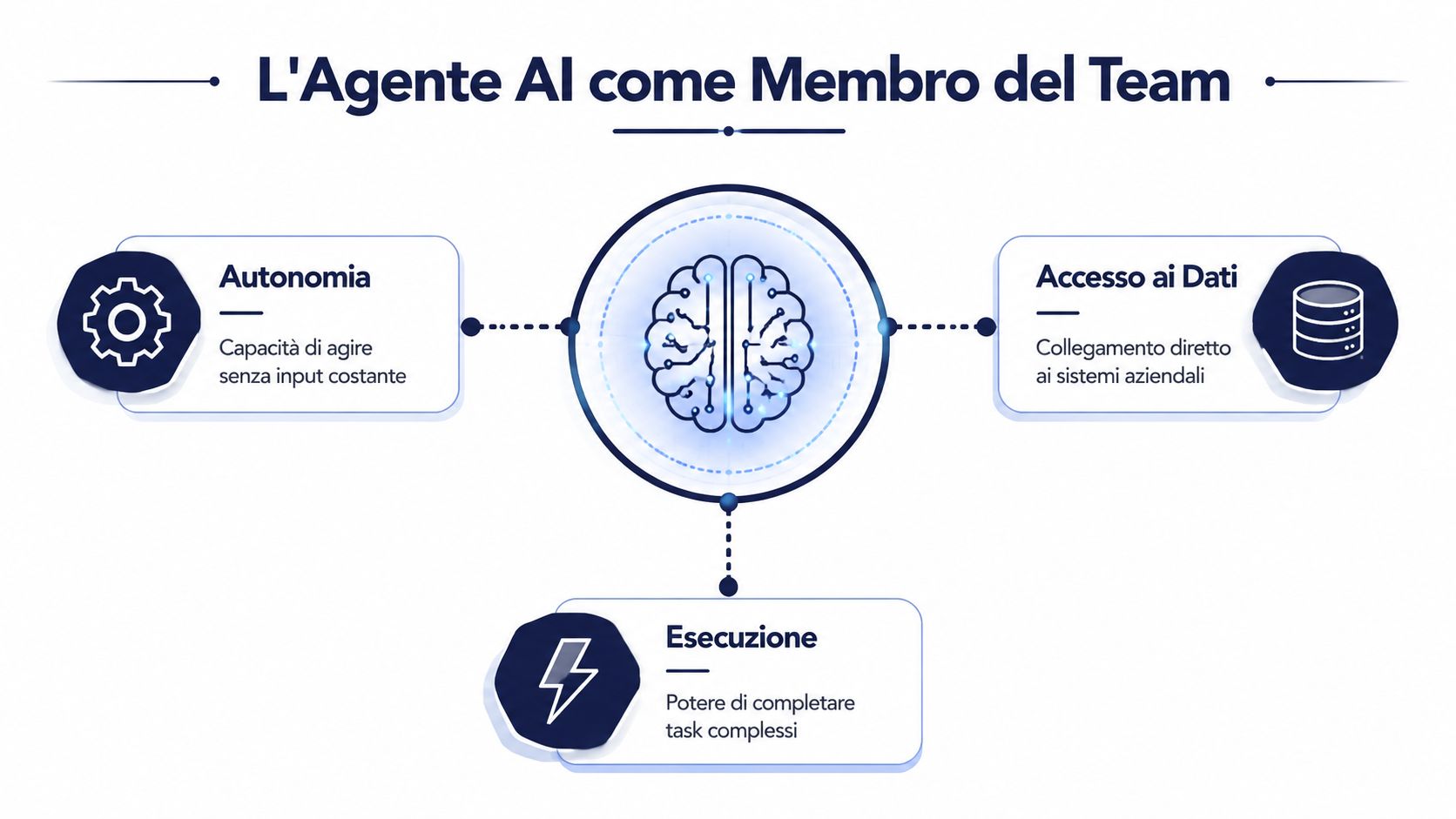
In traditional software, risk is often tied to predictable functions. An app does exactly what it was programmed to do. An AI agent, on the other hand, interprets context and objectives. This makes it useful, but also harder to manage using traditional controls.
The three properties that affect risk are as follows:
Rule of thumb: If a system can read, decide, and act, it should be treated as a privileged entity, not as a mere software function.
Many companies apply the same controls to agents as they do to API integrations or automation bots. It’s a start, but it’s not enough. Agents combine natural language processing, working memory, integrations, and autonomy. This means that the same input can produce different results depending on the context, current instructions, and available tools.
For a business leader, the right question isn’t “Is the agent safe?” The right question is a different one:
If there is no clear answer to any of these three points, the risk is already present.

Attacks on AI agents follow a simple logic: they target the point at which the agent observes, interprets, or acts. For an Italian SME, this is not just a theoretical issue. A single agent connected to a CRM, PEC, ERP, or order management system can concentrate risks—which were previously spread across multiple applications and roles—into a single workflow.
The most direct vector remains the inadvertent disclosure of sensitive information. A sophisticated breach isn’t necessary. All it takes is an agent with cross-functional access to data, an ambiguously worded query, and weak output controls.
A typical example involves the sales team. The sales representative reviews the CRM, open tickets, and contract documentation to prepare a client summary. If the request prompts the system to “include everything that might be useful,” the output may combine data that, taken individually, was appropriate but that, when taken together, becomes excessive: financial terms, operational notes, personal references, and contractual exceptions.
For a medium-sized company, this risk comes at a tangible cost. It can lead to a privacy breach, expose confidential business information, and create friction with customers or suppliers. The problem isn’t just the data that’s revealed. It’s the agent’s ability to act as a conduit between sources that the organization had kept separate for a specific reason.
Prompt injection works like a hidden instruction embedded within the material that the agent processes on a daily basis. It can be found in an email, an attachment, a knowledge base, a product page, or the response from an external API. The agent interprets it as part of the operational context and adjusts its behavior accordingly.
If the agent uses other tools, the problem becomes even more widespread. A malicious input can disrupt document searches, influence classification, trigger a workflow, or pass an error on to a second agent. In companies with streamlined processes, this effect is particularly insidious, because speed and automation reduce the time available to detect the deviation.
In practice, the controls that work best are these:
Relying solely on the system’s initial prompt is a poor choice. Static instructions help, but they aren’t enough if the agent continues to read untrustworthy content throughout the process.
An agent connected to multiple instruments presents a distributed attack surface. Each integration adds a new point to monitor.
This is one of the most overlooked risks in real-world projects. The agent starts out with limited permissions. Then a new “temporary” connector is added, a shortcut to speed up a test, or an urgent integration requested by the business. Within a few months, the agent ends up with more access than the team can remember or justify.
Obsidian Security has reported that many agents in enterprises are already operating beyond their initially intended scope of authorization, as explained in this in-depth analysis of privilege escalation in AI agents.
The pattern is a recurring one:
| Situation | Operational impact | Risk |
|---|---|---|
| New SaaS integration | The agent gets new scopes | Increase the contact area |
| Failure to undergo periodic inspection | Permits remain in effect even if they are no longer needed | Useless privilege is on the rise |
| Exposed tokens or credentials | An attacker inherits already open connections | Possible sideways movement |
For an SME, the point is not to build a cumbersome bureaucratic system. The point is to prevent an employee whose job is to read invoices from also ending up modifying master data, creating orders, or authorizing exceptions. The most effective measures are simple to define and require consistent application:
A significant portion of the risk does not stem from a direct attack. It stems from agents who successfully accomplish their assigned objective, but in a way that is inappropriate for the corporate context.
A realistic example involves retail or distribution. A sales representative is tasked with reducing slow-moving inventory and improving promotional conversion rates. If constraints related to profit margins, brand positioning, or seasonality aren’t clearly defined, they may suggest overly aggressive discounts, push the wrong products, or rely on incomplete data. From a technical standpoint, they’ve done their job correctly. From an operational standpoint, they’ve caused harm.
Three signs warrant immediate attention:
For this reason, agent security must also be treated as an operational priority. It is necessary to define objectives, limits, escalation procedures, and post-hoc controls. In smaller Italian companies, where IT, operations, and business work closely together, this can become a competitive advantage. Rules can be established more quickly, processes can be corrected sooner, and the return on investment is more visible when starting with use cases involving data, payments, and approval processes.

In a financial firm, an AI agent supports the risk team by gathering information from transactions, customer records, and internal reports. Its job is to flag cases that warrant attention for auditors. In theory, it speeds up the work. In practice, if it receives manipulated input or operates with overly broad permissions, it can skew the prioritization of controls or present an incomplete view.
In this sector, the damage rarely stops at the IT department. It affects compliance, audits, reputation, and response times to regulators or customers. This is why data loss and exfiltration are the top concern for 83% of CISOs, while 53% of organizations report that AI agents exceed their permissions, as revealed by the CSA-Zenity survey on AI agent security.
In retail, risk takes on a different form. An agent can interact with pricing, inventory, e-commerce analytics, and promotional campaigns. If it misinterprets an instruction, or if someone manipulates its input, the result can quickly lead to unsustainable discounts, unbalanced product assortments, or the exposure of customer data in reports and dashboards.
Here, speed is a game-changer. An error in a single manual process remains isolated. An error in an agent connected to multiple channels can quickly spread to the catalog, inventory, and promotions.
In the finance and retail sectors, the wrong agent doesn't just cause a technical glitch. It leads to a wrong business decision—one that's faster and has broader implications.
The first is that role boundaries must be strictly defined. An analyst should not be able to approve, publish, or edit without additional controls.
The second point is that we need to monitor behavior, not just technical logs. In finance, this means watching for deviations in priorities, exclusions, and sensitive workflows. In retail, it means monitoring for unusual patterns in prices, inventory, promotions, and access to customer data.
In the debate over AI-related security risks for enterprises, the discussion often assumes that all companies have mature SOCs, structured processes, and dedicated budgets. Italian SMEs operate in a different reality. They have fewer staff, less time, heterogeneous application stacks, and intense pressure to deliver a quick return on investment.
That is why the risk is not just technical. It is organizational. According to a report by Confindustria Digitale from the first quarter of 2026, 67% of Italian SMEs use AI agents, but only 22% have implemented identity management for them. Furthermore, AGID found that 45% of AI breaches in Lombardy-based SMEs stem from unmonitored agents, with average losses of €150,000 per incident, as detailed in this in-depth analysis of the risks posed by AI agents and their local implications.
These figures highlight a typically Italian tension. Adoption is outpacing governance. And when there is a lack of even basic standards regarding identity, monitoring, and ownership, automation becomes a source of risk that is hard to spot until something goes wrong.
In my practice, I encounter four recurring vulnerabilities:
For Italian SMEs, it is useful to consider governance in light of developments in European legislation, including the framework discussed in ELECTE’s commentary on the European AI Act.
SMEs don’t need a copy of the corporate model. They need controls that are easy to manage and proportionate. The right questions are very practical:
If these answers are vague, the risk is not merely theoretical. It is already built into the solution.

A robust framework isn't meant to slow down adoption. It's meant to prevent adoption from becoming unmanageable. When governance is well-designed, the business gains greater agility because it knows which agents it can use, on what data, and within what limits.
The first rule is simple: you can’t manage what you don’t know you have. Many companies only discover these agents when they have to investigate unusual behavior. By then, it’s too late.
The inventory must include:
A useful inventory is not a static list. It must include at least four pieces of information: owner, data sources, related tools, and criticality level.
This is the crux of the matter. Every agent must have its own identity, separate from that of the user who created it. If an agent is granted overly broad access, every action it takes also carries that risk.
The sensible decisions here are very practical:
| Governance choice | Effect |
|---|---|
| A unique identity for each agent | Clear assignment of responsibilities |
| Minimum permissions per task | Reduced impact in the event of an error |
| Periodic review of access rights | Preventing privilege creep |
What doesn't work is using shared accounts, long tokens without rotation, or generic roles "for convenience." That initial convenience comes at the cost of lost visibility.
Guiding principle: The agent must have sufficient access to perform their work, not general access to “prevent deadlocks.”
Technical logs are useful, but they aren’t enough. We need monitoring that tracks behavior. An agent who starts accessing unusual sources, increases the volume of requests, or changes their usual pattern of activity should trigger an alert even if all credentials appear to be valid.
A good audit plan includes:
Readability is also very important here. If only a senior technician can interpret the telemetry, governance remains fragile.
The most costly mistake is to think that “human in the loop” means approving everything manually. That’s not sustainable. Human supervision works when it sets intervention thresholds.
For example, the agent can work independently on low-impact tasks, but must stop when:
This oversight must be formalized in policies and incorporated into workflows. It cannot remain merely a good intention.
If your team doesn't know who can interrupt an agent, you don't have governance. You just have organized hope.
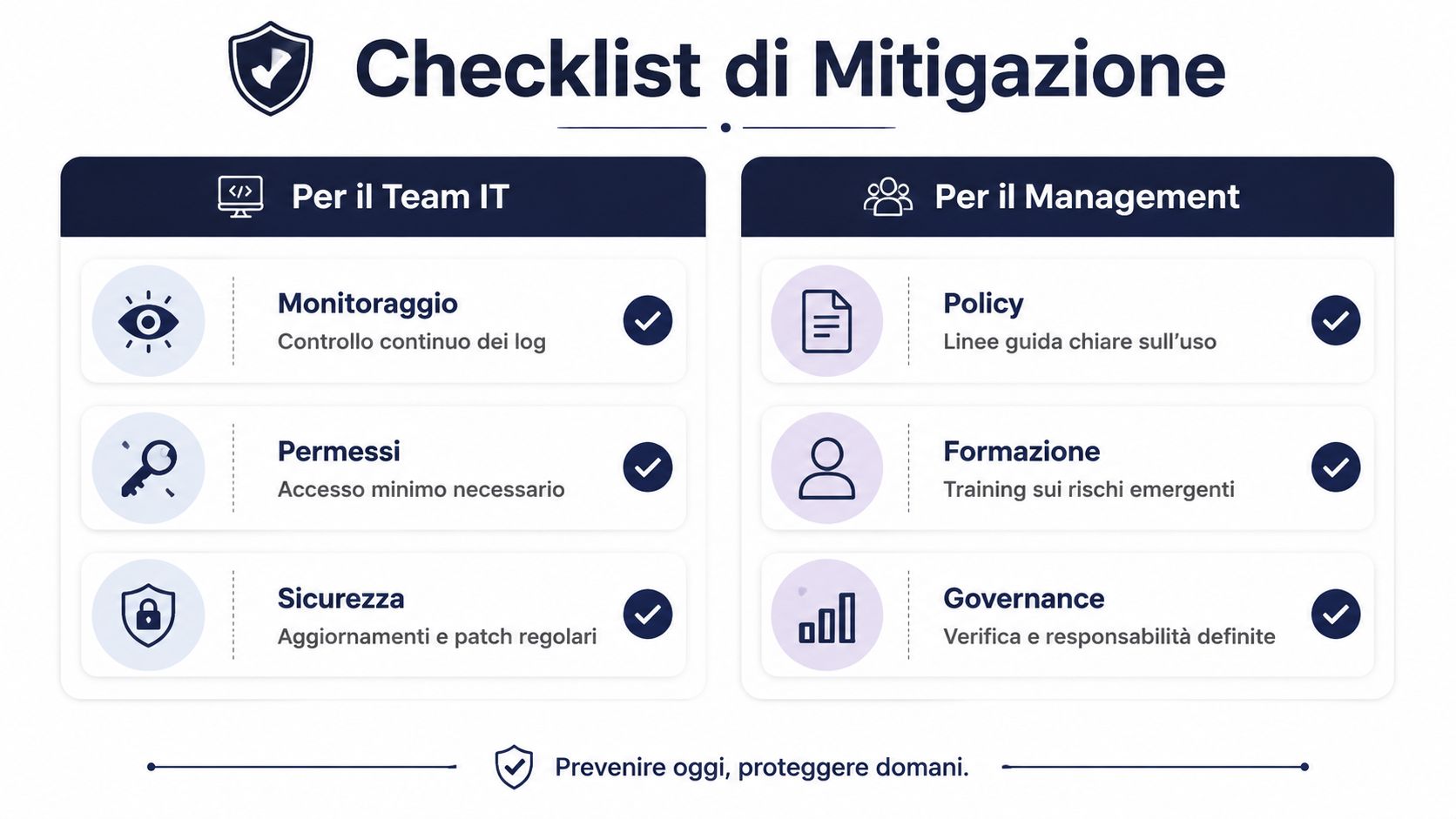
In Italian SMEs, risk mitigation for AI agents must remain proportionate. Too little oversight exposes the company to risk. Too much oversight stalls the project before it can generate value. The right approach is to reduce operational risk through measures that the team can actually sustain over time.
To achieve this, business and IT must operate on the same foundation. The technical team understands integrations, logs, and permissions. Management sets priorities, risk thresholds, and budgets. If either of these two components is missing, the agent ends up operating in a gray area.
It helps to start with clear principles—such as a zero-trust security model applied to modern digital systems—and translate them into controls that are easy to verify.
This list serves as a good minimum baseline for agents that read business data, query internal systems, or trigger workflows.
Two areas require constant attention. The first is prompt injection, which alters the agent’s behavior through seemingly legitimate inputs. The second is the ripple effect across connected tools and systems. In practice, a small initial error can propagate to CRM, ERP, ticketing systems, or external channels if there are no filters, execution limits, or data flow checks in place.
For a CEO, COO, or department head, the right question isn’t just whether the agent works. The question is whether its margin for error is compatible with the process in which it operates.
For many Italian SMEs, this aspect determines the success of the project. There’s no need to copy the governance model of an international bank. What’s needed is to identify where a mistake truly costs money, damages reputation, or violates compliance, and to implement the strictest controls in those areas.
Three questions should be asked in every discussion with suppliers, system integrators, or internal teams:
An AI agent is only useful if it remains controllable even when it makes mistakes, faces operational pressure, or receives hostile input.
AI agents are already changing the way companies analyze data, make decisions, and carry out operational tasks. The risk does not stem from their existence. It arises when autonomy, access, and governance evolve at different speeds.
For this reason, the issue of AI agent security risks in enterprises must be addressed as a managerial discipline as well as a technical one. A clear inventory, well-defined identities, behavioral monitoring, and selective human supervision are the four elements that distinguish a scalable project from a constant source of exposure.
Italian SMEs face an additional challenge. They need to generate value quickly without building overly cumbersome structures. The answer isn’t to copy the models of large multinationals. It’s to implement essential, transparent, and sustainable controls.
Disclaimer: This article provides general information and does not constitute legal or compliance advice.
If you want to adopt analytics and AI agents in a more controlled way, you can see how ELECTE, an AI-powered data analytics platform for SMEs, helps teams turn data into actionable insights through an accessible experience designed to scale without adding unnecessary complexity.

.svg)


.svg)
.svg)