
AI promises speed. The key point is to understand what exactly you’re speeding up. In a study reported in 2025 by Polytechnique Insights, those who used ChatGPT to write an essay were 60% faster, but also showed a 32% reduction in relevant cognitive load; furthermore, 83% were unable to recall a passage they had just written, according to the analysis published by Polytechnique Insights. For a business, this is not an academic detail. It is an operational signal.
When a team uses AI to generate reports, summaries, forecasts, or explanations, efficiency can rise rapidly. But if that use becomes passive, cognitive work doesn’t disappear. It shifts. People do less independent analysis, less verification, and less building of their own arguments. The risk isn’t “becoming less intelligent.” The risk is losing practice in the very skills needed when the automated output is ambiguous, incomplete, or simply wrong.
This is why the issue of the decline in critical thinking skills due to AI is of particular concern to SMEs, analytics teams, the retail sector, finance, and operational departments. There’s no need to abandon AI. What’s needed is to design workflows that keep human judgment active. That’s where the real competitive advantage lies.
The adoption of AI in the workplace is often portrayed as simply a matter of productivity: faster processes, less manual labor, and more automation. This is only partly true. The more important question is this: if AI does the mental work for the team, what is actually left within the organization?
For an Italian SME, this question matters more than it seems. Reporting, forecasting, classification, decision support, and summary analysis are tasks increasingly delegated to generative systems. In the short term, the results appear positive. In the medium term, however, a less obvious cost may emerge: the loss of autonomy in understanding, verifying, and defending a decision.
The issue ofthe atrophy of critical thinking skills due to AI should be understood in this way: not as a crusade against technology, but as a challenge in organizational design. The most mature companies will not be those that automate everything. They will be those that make a clear distinction between the use of AI that enhances competence and the use of AI that replaces it.
Part of the risk associated with AI does not stem from spectacular failures. It stems from processes that work well enough that they are no longer questioned.
The term "AI-induced atrophy of critical thinking" describes exactly this: a selective weakening of skills that remain strong only if they are exercised consistently. We are not talking about a general decline in intelligence. We are talking about very specific abilities that are crucial in managerial and analytical work: formulating hypotheses, comparing alternative explanations, identifying inconsistencies, and defending a conclusion when the data is incomplete or ambiguous.
For an SME, the relevant question isn’t whether AI saves time. The relevant question is more practical: is the time saved reinvested in better decision-making, or is the decision-making process skipped entirely?
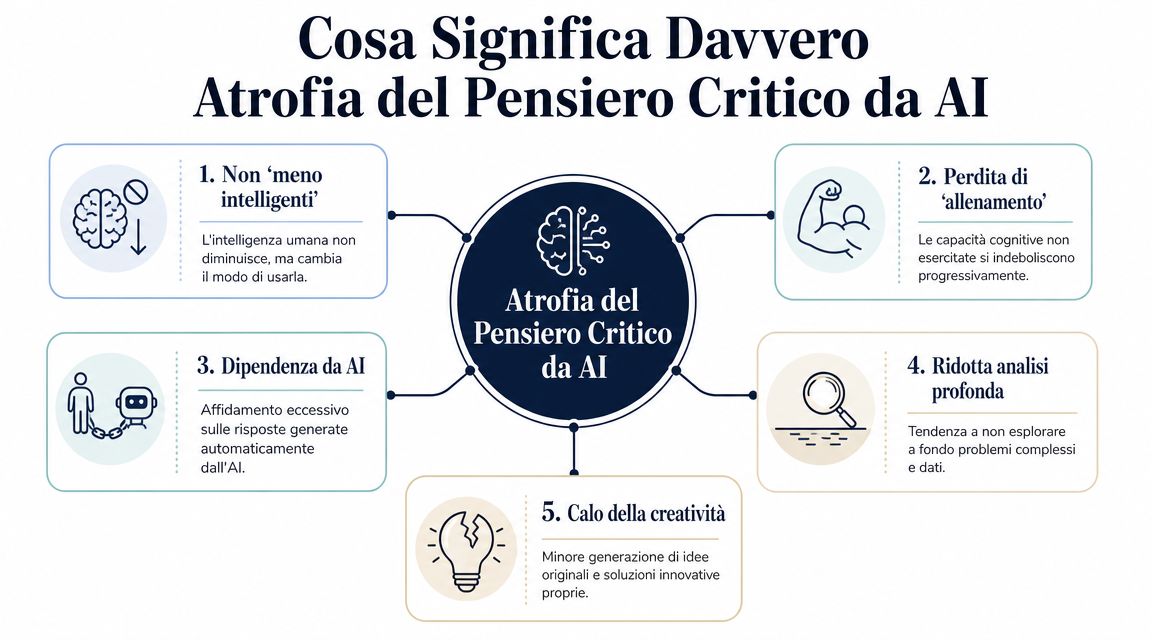
This is where the line that really matters for business lies. A finance team that uses AI to clean data, reorganize categories, or summarize meeting minutes is offloading low-cognitive-value tasks. A team that asks AI to interpret anomalies, assess risk, and suggest the final decision, on the other hand, is transferring to the machine the part of the work that builds internal expertise.
The useful distinction, therefore, is not “AI or no AI.” It is between assisted use and replacement use.
This difference seems subtle only on paper. In real-world processes, what changes is what the organization can do on its own.
Atrophy doesn't start when a team relies heavily on AI. It starts when they stop going through the mental steps in between.
If every analysis is presented already organized, annotated, and prioritized, people see the result but spend less time going through the process that leads to it. Over time, they practice fewer of the skills that make a judgment reliable: breaking down a problem, distinguishing between signal and noise, seeking counterevidence, and weighing trade-offs between imperfect options.
The risk, therefore, is not the automatic response itself. The risk is a workflow that causes the team to approve things without re-examining the reasoning behind them.
The right managerial question is simple: Who, within this process, is still required to form an independent judgment before approving the output?
The passive use of AI does not affect all skills equally. The first to decline are those that require cognitive friction—that is, slow, comparative, and verifiable mental work.
The point isn't to eliminate AI. The point is to prevent it from taking over the very part of the work where the team is supposed to question, compare, and verify.
The most useful research today does not serve to support the simplistic claim that AI “makes people stupid.” Rather, it serves to highlight a more tangible risk for those who manage people and processes: as cognitive automation grows, some users tend to delegate not only the execution but also the quality control to the system.
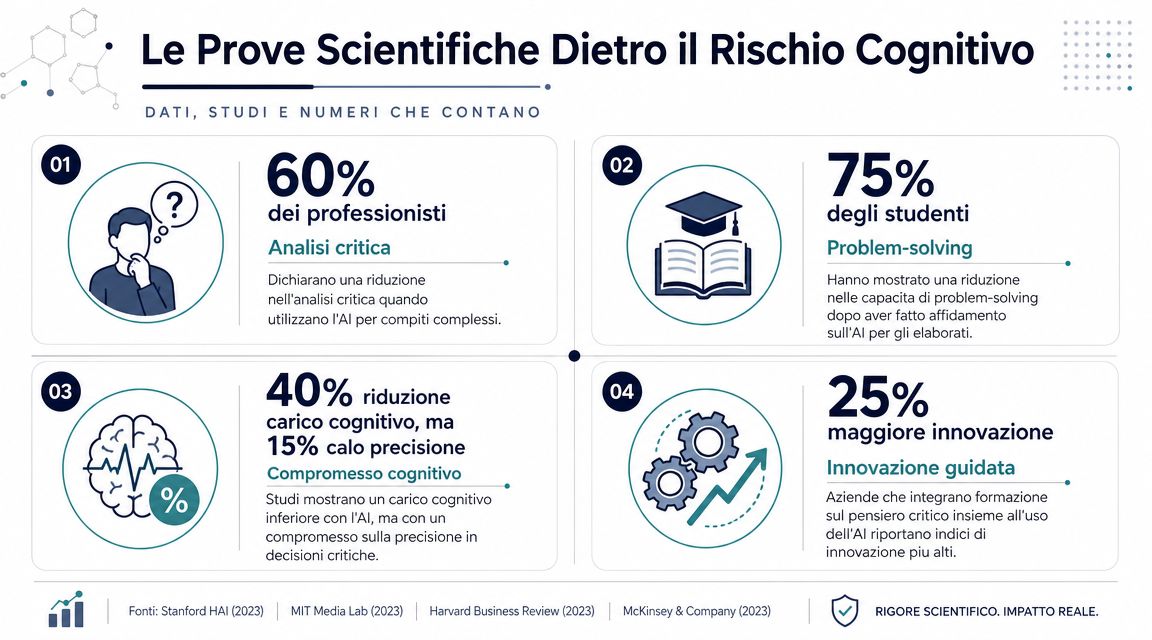
An example often cited in this debate is the Microsoft Research paper on the relationship between GenAI and critical thinking, which examines how frequent use of generative tools is associated with a decline in critical judgment in certain knowledge-intensive tasks. What is interesting for a manager is not the statistical formula itself, but the organizational mechanism that emerges: the more plausible the system’s response, the easier it becomes to mistake plausibility for reliability.
This changes the nature of the skills required. Value no longer lies with those who produce results more quickly, but with those who can assess the assumptions, limitations, and conditions of use. For businesses, the most important point is another. Adopting AI can boost productivity in the short term but reduce diagnostic capabilities in the medium term if the workflow does not include explicit verification steps.
That is why the most useful debate concerns not only the power of the model, but also the illusion of reasoning in the world of AI. A convincing output can appear to be thought. In many cases, it is merely a good linguistic representation of patterns that have already been observed.
A process tends to reinforce expertise when the AI provides an output, but the person must still articulate the underlying assumptions, check for relevant exceptions, consider at least one alternative, and justify the final choice.
A process tends to drain one's energy when a person reads, revises, and approves it.
That’s the whole difference. It’s not about the tool, but about how the work is designed.
A well-designed SME uses AI to improve the quality of decision-making, not to replace it altogether.
For an SME, risk rarely presents itself as a theoretical problem. It manifests as a decision approved too hastily, a forecast that no one challenges, or a dashboard that guides budget allocation without any real discussion of exceptions. The cost isn’t just a single mistake. It’s a gradual loss of the team’s ability to understand why a decision is sound, fragile, or wrong.
The key point is this: AI does not undermine skills across the board. It enhances them when it speeds up analysis while keeping assumptions, limitations, and alternatives visible. It undermines them when it delivers a ready-made conclusion and human work is reduced to approving, refining, and forwarding it.
An e-commerce manager receives a sales forecast generated by an AI system. The final figure appears consistent with recent trends, so it is used to plan reorders, promotions, and media budget allocation. The problem becomes apparent later. The model had either factored in a temporary spike caused by a one-off campaign, or it had misinterpreted the mix of channels, margins, and turnover rates for certain categories.
In these cases, the team does not fail because of a lack of preparation. It fails because the process prioritizes speed of approval over the quality of the review.
The operational consequences are immediate:
For a large corporation, these mistakes can be absorbed. For an SME, they can squeeze cash flow, profit margins, and responsiveness all within a single quarter.
In finance and risk reporting, the issue is more nuanced. An analyst uses an AI-powered report to prepare a compliance review or a risk summary. The document highlights patterns, exceptions, and priorities. The analyst quickly checks the format, terminology, and apparent consistency, then forwards the material to the manager.
The risk isn't just about the accuracy of the data. It's about the hierarchy of attention. If the model's output already determines what is relevant, the reader tends to pay closer attention to what has been highlighted and less attention to what has been left out. In many processes, the most costly exceptions are precisely those that lie on the periphery of the dominant pattern.
An analysis publishedby the IE Center for Health and Well-being on the cognitive effects of AI highlights a useful point for the business context: frequent use of AI without context or supervision can reduce the activation of critical thinking and increase reliance on cognitive shortcuts such as automation bias and passive acceptance of output. For this reason, in high-impact processes, substantial human review steps and interfaces that make sources, reliability levels, and areas of uncertainty visible are necessary.
When a system is well-structured, the team can stop looking for what isn't there.
Managers can identify the problem before it becomes systemic. The most useful indicators aren’t technical; they’re behavioral.
This is where a significant part of SMEs’ competitiveness comes into play. The mature adoption of AI does not consist of automating as many steps as possible. It consists of distinguishing between the steps where the machine accelerates analysis and those where humans must remain responsible for judgment, interpretation, and decision-making. A useful reference, from an organizational perspective, is ELECTE’s guide on building teams that thrive with workflows enhanced by artificial intelligence.
Effective mitigation starts with a managerial design choice. The goal is not to increase the number of tasks assigned to AI, but to protect the points in the process where judgment is formed. In SMEs, the real risk isn’t using too much AI. It’s using it at the wrong stages, to the point of turning competent people into mere validators of output.
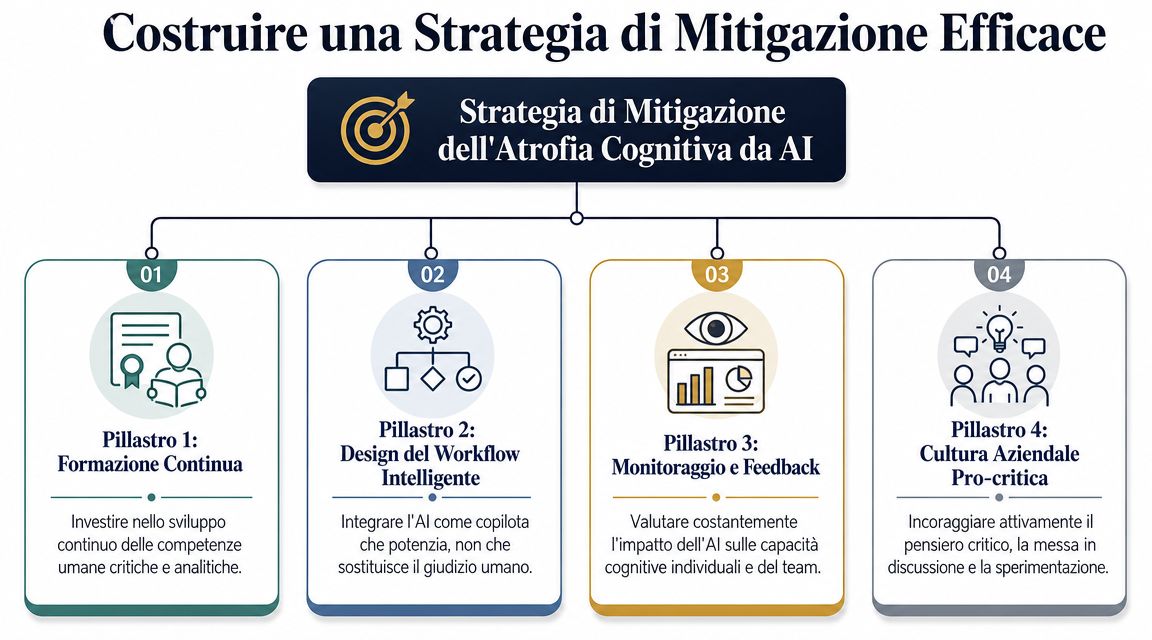
A useful strategy, therefore, distinguishes between two very different approaches. The first increases speed without compromising the quality of reasoning. The second reduces cognitive load in the short term but weakens the team’s ability to analyze ambiguous cases, exceptions, and trade-offs. That is why the right question is not “Where can we automate?” but “In which steps does automation improve the work without undermining expertise?”
First pillar: responsible use policy
A robust policy assigns clear responsibilities. It must clarify which decisions can be supported by AI, which require substantial review, and which should not be delegated at all. It is also advisable to define minimum traceability requirements: assumptions used, missing data, verification performed, and the name of the person responsible for the final decision. In this way, oversight is not left to implication.
Second pillar: redesigning workflows
This is where it is determined whether AI strengthens or weakens the team. A well-designed workflow uses the system to generate options, flag anomalies, simulate scenarios, and challenge initial assumptions. A poorly designed workflow, on the other hand, directly demands a ready-made conclusion. The operational difference is clear: in the first case, the employee must interpret; in the second, they must simply approve.
Third pillar: judgment-oriented training
Simply training people to use the tool is not enough. The team must be trained to assess conditions of validity, the model’s limitations, conflicts with internal data, and alternative explanations. This is even more important for junior roles. A useful approach is to incorporate moments of discovery-based learning into work processes, where individuals first perform an initial independent analysis before consulting the system.
Fourth pillar: monitoring decision-making behavior
Productivity metrics alone are not enough. If a team delivers faster but generates fewer of its own hypotheses, the improvement is only superficial. Managers should look at concrete indicators: the number of alternative scenarios discussed, the quality of explanations, the frequency of well-reasoned challenges to AI output, and the ability to identify exceptions without assistance.
The most delicate issue concerns those who are still developing their own work methods. For a senior professional, AI tends to be integrated into already established cognitive frameworks. For a junior professional, it can occupy that space even before personal criteria have been established.
This changes the way an SME should organize onboarding, mentoring, and evaluation. If a new hire uses AI to produce answers too quickly, the manager sees good execution speed but loses visibility into the underlying thought process. This is an operational risk, not just a training one. After a few months, the team may find itself with people who deliver acceptable results in standard situations but struggle as soon as the problem deviates from the script.
To reduce this risk, it is advisable to implement simple, verifiable rules:
A mature organization doesn't just measure how quickly a junior employee delivers results. It measures whether they are building skills that will remain useful even when automated outputs are incorrect, incomplete, or misleading.
The quality of an AI-driven workflow depends on a design choice: whether to use the system to generate a final answer or to enhance the quality of human judgment. For an SME, this distinction matters more than the tool chosen, because it determines whether the team builds expertise or becomes dependent.
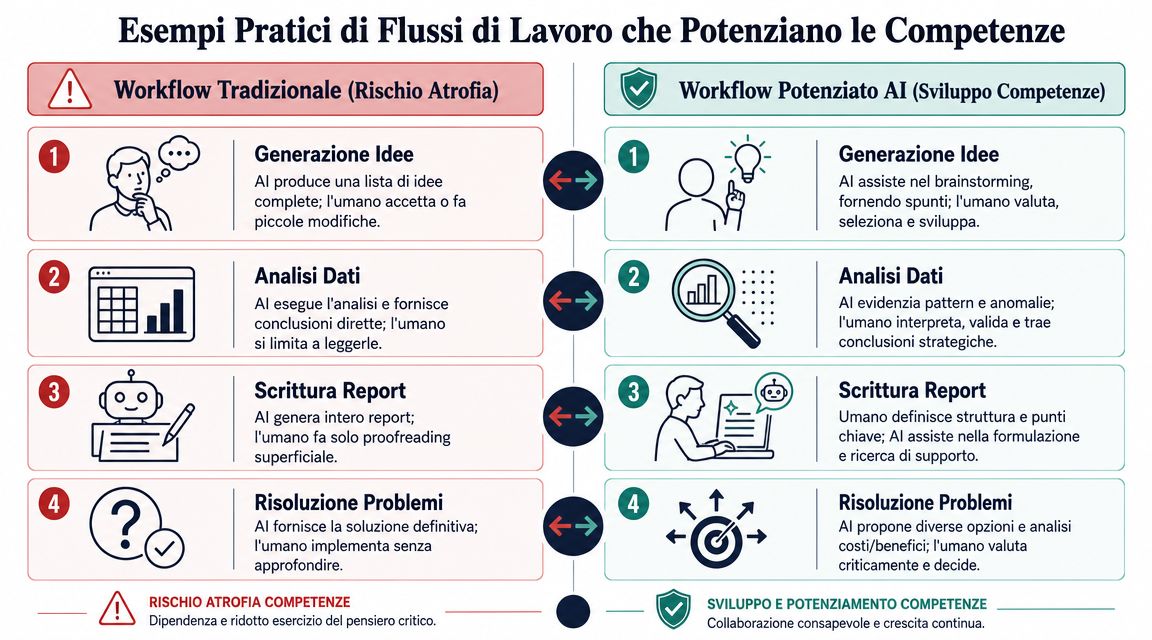
In the debate on AI, the least understood aspect is often the practical one. The risk does not stem from automation itself. It arises when a person stops formulating hypotheses, weighing alternatives, and testing assumptions because the system has already reached a conclusion. ANSI’s report on the relationship between AI and critical thinking highlights precisely this issue: the impact of AI varies depending on how it is integrated into the decision-making process.
For this reason, the useful distinction for effectively designing workflows is not “AI present” or “AI absent.” It is “assisted use” versus “replacement use.”
| Activities | Risky workflow (substitute use) | Empowering workflow (guided use) |
|---|---|---|
| Marketing Analysis | The AI writes the final campaign report, and the marketer reviews only the tone and style | AI identifies anomalies, unexpected clusters, and possible hypotheses. The marketer verifies, interprets, and draws conclusions |
| Supply Chain Forecast | The system generates a reorder proposal ready for approval | The system simulates alternative scenarios. The manager compares costs, constraints, and the likelihood of stockouts |
| Management reporting | The AI generates a summary for management | The AI prepares a draft that clearly outlines the assumptions and uncertainties. The manager confirms, corrects, or rejects it |
| Operational problem-solving | The user is asking for the best solution | The user requests options, trade-offs, exceptions, and checks to be performed before making a decision |
The difference may seem subtle. In terms of expertise, however, it is not.
A marketing analyst who receives a nearly finished report from AI works faster, but does little to develop the skill that creates value over time: understanding whether a drop in conversion rates is due to targeting, creative content, seasonality, or lead quality. If, on the other hand, they use AI to identify anomalous patterns, segments to isolate, and missing data, the system becomes an analysis accelerator, not a substitute for critical thinking.
The same applies to the supply chain. A manager who approves a plausible but opaque reorder proposal risks realizing too late that the model failed to account for a real constraint, such as an unstable lead time or an upcoming sales promotion. A well-designed workflow uses AI to generate scenarios, not to finalize the decision. Human work focuses on priorities, exceptions, and operational risk.
Here, a managerial principle that is rarely discussed comes to light. A good workflow does more than just reduce execution time; it keeps the point at which a decision is made clearly visible.
Three principles help in developing processes of this kind:
For teams that want to grow without turning AI into a cognitive shortcut, it’s worth revisiting the principlesof discovery learning. When applied to business workflows, this means designing interactions in which the system broadens the scope of questions and checks, rather than narrowing it down too soon.
At this point, the direction is clear. You don’t have to choose between productivity and critical thinking. You need to design a system in which productivity doesn’t quietly erode your judgment.
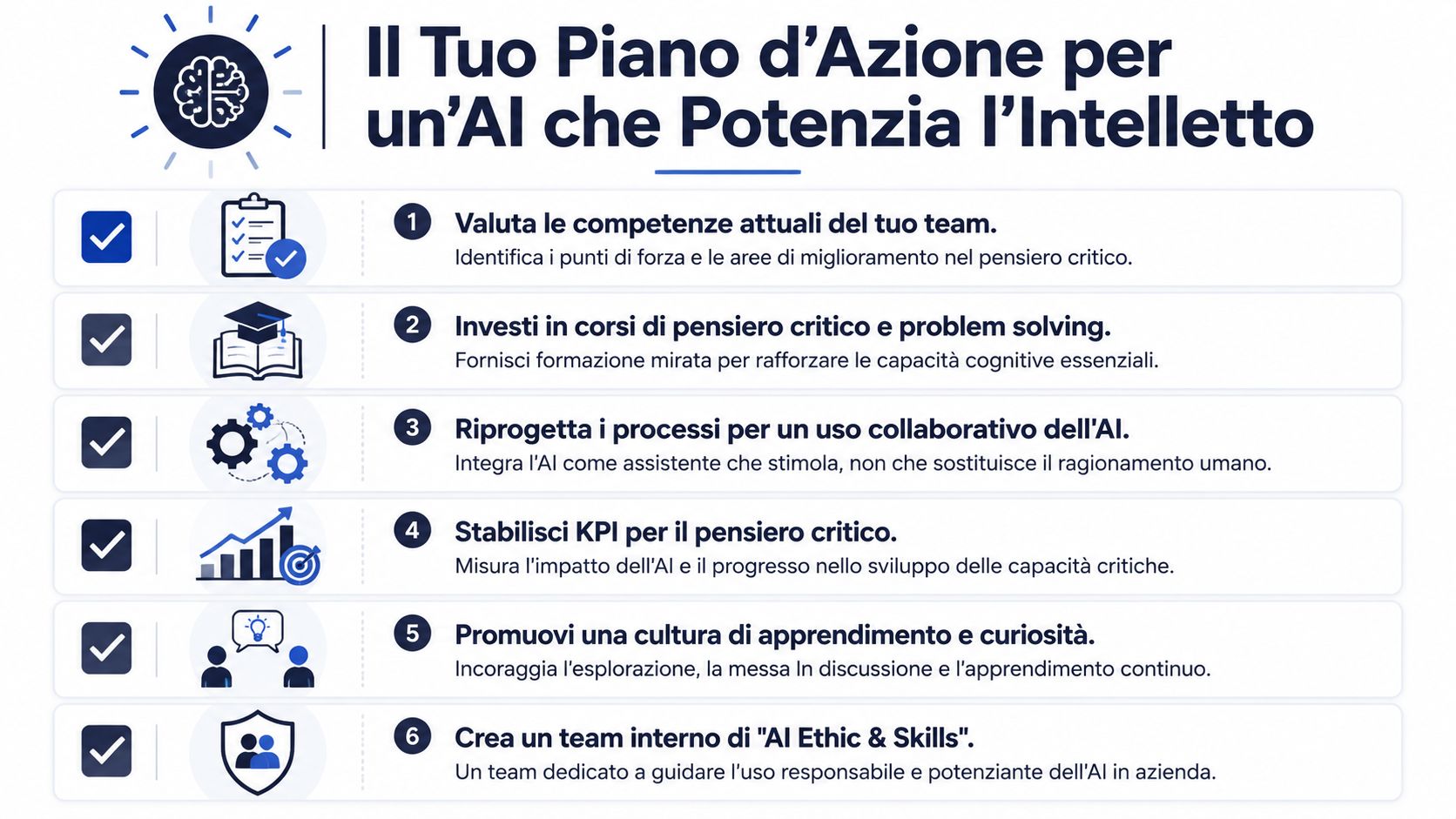
Map out the tasks where the team delegates too early
Review reports, forecasts, summaries, and classifications. Ask yourself where AI is already providing the final answer and where it is still supporting the reasoning process.
Classify workflows by decision-making impact
High-impact activities must include explicit human verification, comparison with internal benchmarks, and a record of assumptions.
Rewrite prompts and requests
Instead of asking “give me the conclusion,” ask “show me three possibilities,” “flag anomalies,” “point out what’s missing,” or “suggest alternative scenarios.”
Train the team to explain the reasoning behind their work
Every important deliverable should be able to be defended verbally by the person presenting it. If that doesn’t happen, the process is creating dependency.
Support the learning path for junior students
For younger students, AI should be used in a more structured way. Less direct substitution, more guided exercises focused on assessment, discussion, and reasoning.
Reward well-founded doubt
If an organization rewards only speed and delivery, the team will use AI to get the job done. If it also rewards the quality of interpretation, very different behaviors will emerge.
A company that uses AI effectively doesn’t create dependency. It empowers people to think more clearly, more quickly, and with a broader perspective. That is the difference between fragile automation and a lasting competitive advantage.
If you want to use AI to speed up decision-making without sacrificing transparency and analytical capabilities, you can see how ELECTE, an AI-powered data analytics platform for SMEs, helps teams transform raw data into clear, verifiable, and actionable insights. For those who want to grow without handing over decision-making to a machine, it’s a good place to start.

.svg)


.svg)
.svg)



.webp)