
By 2025, 39% of SMEs will already be using artificial intelligence applications—up from 26% in 2024—but only 8% will have achieved truly transformative integration (OECD research reported by Daijobu). This is the statistic that changes the conversation: the question is no longer whether AI is of interest to SMEs, but how to turn it into an operational advantage without wasting budget, time, and internal credibility.
For an Italian SME, the issue is even more pressing. Simply “adopting AI” isn’t enough. It must be done within a context marked by fragmented data, legacy systems, GDPR, the AI Act, small teams, and pressure on margins. A generic roadmap is of little use. What’s really needed is a sequence of practical decisions: where to start, what to measure, which use cases to avoid, when to scale up, and how to manage risk.
This guide follows exactly that approach. It does not treat AI as a passing fad or as an isolated IT project. Instead, it treats it as a measurable driver of transformation for forecasting, analytics, reporting, compliance, and decision-making.
In Italy, the business landscape is made up of small and medium-sized enterprises (SMEs). For this reason, the adoption of AI is not something to be observed from afar, but a decision that will impact profit margins, operational timelines, and the ability to remain competitive over the next 12 to 24 months.
In my work with SMEs in Lombardy and Emilia-Romagna, I see the same pattern: interest in AI is high, but the value only becomes apparent when the project addresses a real bottleneck. Slow quotes, customer support scattered across email and WhatsApp, unreliable production planning, and technical documents that are difficult to navigate. The most costly mistake isn’t starting late. It’s starting with the wrong use case, with incomplete data and unrealistic expectations.
For an Italian company, AI transformation must be viewed within the context of very real constraints. Data quality is often inconsistent. ERP and management systems are not always integrated. Budgets are limited. There are GDPR requirements and, from an operational perspective, the AI Act. In this context, there is no need to pursue the most ambitious project. Instead, companies should choose applications that measurably reduce time, errors, or costs, with a visible return on investment within a few months.
This is what distinguishes a useful roadmap from a well-crafted presentation.
In Lombardy, where many SMEs have already invested in process digitization, the advantage lies not in purchasing new tools, but in making existing ones work more effectively with better-organized data and more structured workflows. In Emilia-Romagna, particularly in manufacturing, the most successful cases tend to focus on support for technical departments, maintenance, quality, the supply chain, and internal knowledge. Local benchmarks matter because they influence priorities, adoption timelines, and the ROI threshold expected by management.
Even outside of strictly business contexts, AI is changing the way value is created and decisions are made. To understand just how quickly it is making inroads into creative and cultural fields as well, it may be helpful to read an in-depth article on art and artificial intelligence.
For a broader overview of the managerial context, this guide on digital transformation in businesses remains a useful resource.
The key point here is practical: for an Italian SME, AI works when it is based on clear business priorities, data reliable enough to support a pilot project, clearly defined responsibilities, and a minimum compliance threshold established from the outset. Without these elements, even good technology remains nothing more than an expensive experiment.
Most mistakes happen too early on. A company chooses a platform, launches a demo, tests a chatbot, or implements a predictive model. Only later does it realize that no one has clarified which processes to improve, which data to use, or who should lead the change.
A robust AI adoption framework is built on four pillars: technological infrastructure, strategy, corporate culture, and skills development. SMEs lag behind large companies precisely when they fail to align these elements, and a lack of AI literacy at the managerial level often prevents them from defining effective use cases and moving beyond the pilot phase (Canadian blueprint for AI adoption in SMEs).
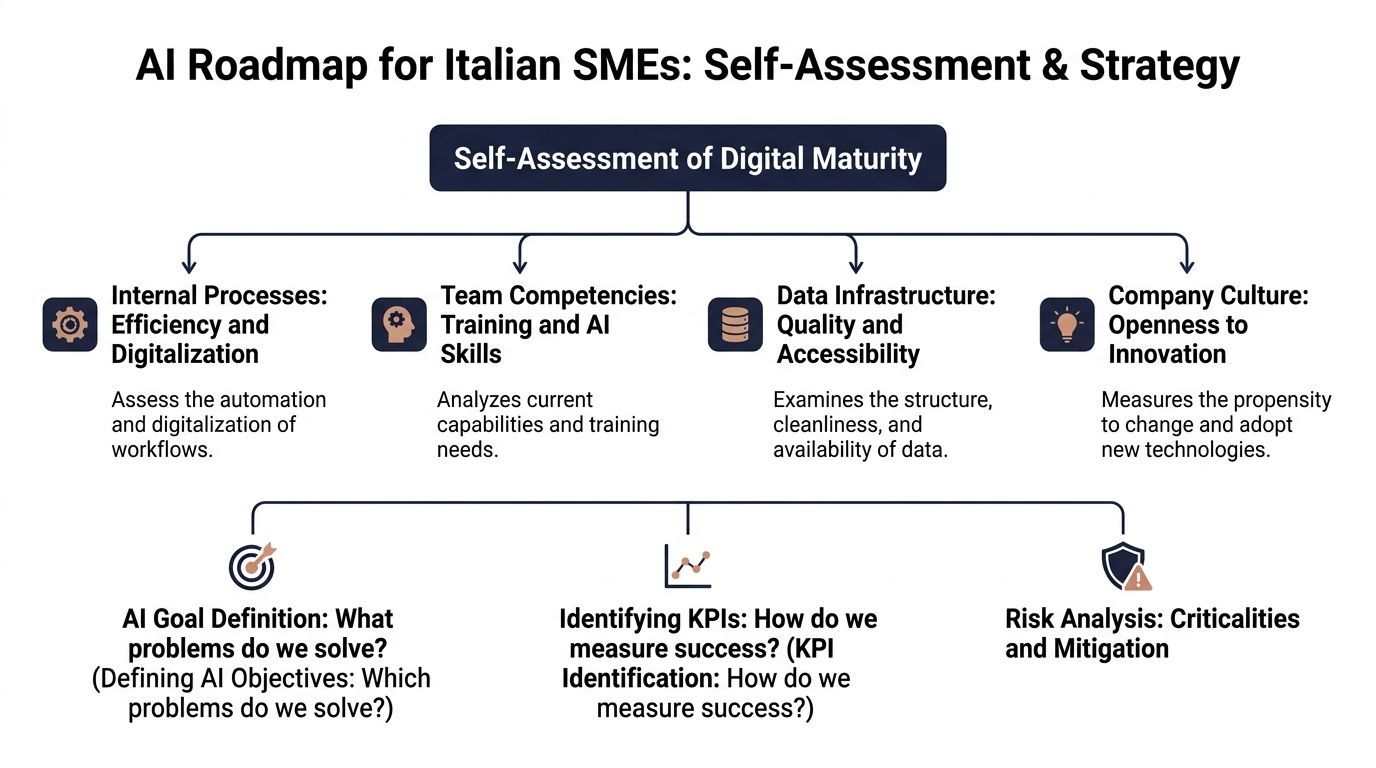
Start with a simple but thorough internal audit. You don’t need a perfect report. You need an honest snapshot.
Many leaders underestimate this last point. If the team perceives AI as a top-down initiative or as a vague threat, adoption slows down even when the technology works.
Rule of thumb: Don’t start with the tool. Start with the process that currently takes the most time, generates the most errors, or slows down recurring decisions.
A good assessment doesn't produce slogans. It produces actionable questions. For example:
| Area | Useful question | Warning sign |
|---|---|---|
| Reporting | How many decisions still depend on manual draws? | Reports generated late or in inconsistent versions |
| Sales | Are forecasts reliable, or do they depend on business intuition? | Forecasts updated late |
| Compliance | Who monitors anomalies, discrepancies, or risk indicators? | Manual and unrecorded checks |
| Operations | Where do recurring bottlenecks occur? | Duplicate tasks across departments |
If these questions reveal ten issues, don’t try to address them all. Pick two or three—the ones that directly impact margins, speed, or the quality of decision-making.
A useful strategy for SMEs almost always has the following characteristics:
SMEs succeed when they treat AI as part of their business strategy, not as a side project.
When building your AI-driven digital transformation roadmap for SMEs, the first decision isn’t a technical one. It’s a managerial one. You need to determine where AI should create value, who will be responsible for it, and what trade-offs you’re willing to accept. For example, a quick project using imperfect data can serve as a learning experience, but it can’t become the company’s standard without a subsequent consolidation phase.
Those who handle this phase well approach the pilot with a clear scope. Those who skip it end up discussing functionality instead of results.
In many Italian SMEs, AI projects don’t fail because of the model. They fail much earlier, when it becomes clear that data is scattered across Excel spreadsheets, ERP systems, CRMs, shared folders, and management systems that don’t integrate well.
In Lombardy , 62% of IT SMEs report a lack of plug-and-play integration with local tools, and 45% of initial attempts to adopt AI fail due to data that is not clean and not ready for analysis (analysis reported by Stanford Digital Economy). This is not a technical detail. It is the structural problem that determines almost everything else.

When I say “dirty data,” I’m not just talking about obvious errors. I’m talking about:
AI amplifies what it finds. If it finds a fragile foundation, it produces fragile outputs more quickly.
That’s why I always recommend taking stock of your data before discussing advanced use cases. You need to know:
| Question | What to check |
|---|---|
| Which sources really matter? | ERP, CRM, e-commerce, accounting, ticketing, AML systems |
| Who owns the data? | Department in charge and update frequency |
| How reliable is it? | Duplicates, gaps, inconsistent formats |
| How accessible is it? | APIs, manual exports, existing integrations |
The expected outcome is not a theoretical document. It is a basic roadmap to determine whether the lead pilot can proceed immediately or whether remedial action is required first.
This is where many companies go wrong—either out of technical pride or excessive caution. Some try to build everything in-house too soon. Others purchase a platform without verifying its integration, transparency, and adaptability.
The decision should be based on three specific criteria.
A good partner doesn’t sell you “magic.” They explain how the data is ingested, how it’s cleaned, where the workflow might break down, and who needs to step in.
In practice, a hybrid approach is often the best option for an SME. External platforms to accelerate analytics, forecasting, and reporting. Internal expertise to manage KPIs, data quality, and business priorities. This approach avoids two opposing pitfalls: total dependence on the vendor or an in-house development effort that is too burdensome for the company’s current level of maturity.
If you want to take a helpful step before deciding on tools and priorities, you should also consider how to structureyour analysis of business data based on the decisions that management actually needs to make.
The technological aspect of the AI digital transformation roadmap for SMEs should therefore be treated as a chain. Data sources, data cleansing, integration, access, security, and usability for the team. If any link in the chain is weak, the project may seem to get off the ground but will not hold up when the number of users increases or when management demands reliability.
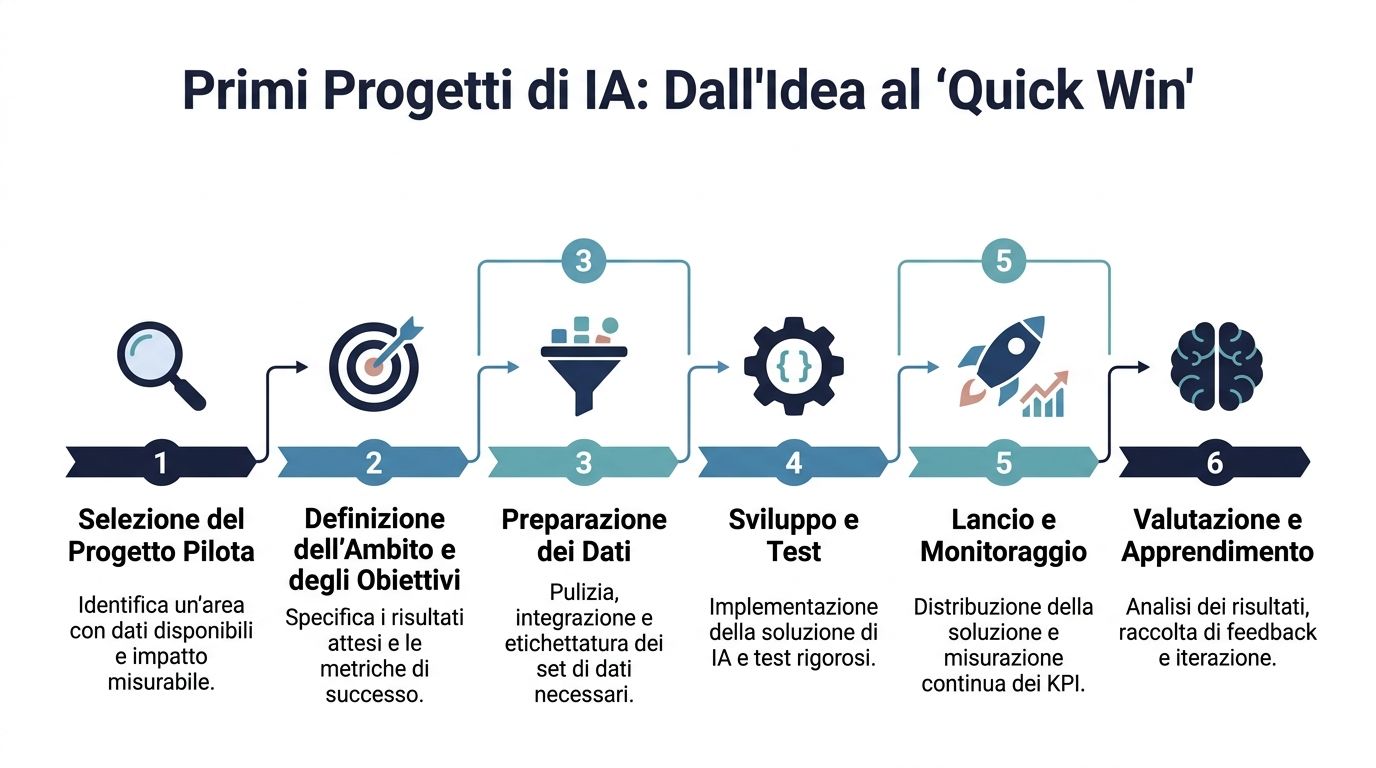
After strategy and data comes the phase where many SMEs stake the credibility of their program. The first project doesn’t have to prove everything. It must demonstrate that the company can use AI to improve a real-world process, with controlled risk and a clear outcome.
According to a methodology validated by the Made Smarter Italia program, an effective roadmap begins with a 3- to 6-month quick-win pilot. A typical example is sales forecasting, with a KPI such as a 40% reduction in the time required to gain insights. Furthermore, 68% of Italian SMEs that follow this approach complete their pilots with an ROI exceeding 20% (methodology reported by The Marketing Centre).
Let’s take a typical example of a retail SME. The sales team works with sell-out data, promotions, and inventory figures. Every week, someone has to extract files, clean them up, align them, and prepare a report to determine purchasing and reordering decisions. The problem isn’t just the time spent. It’s the delay in decision-making.
A well-chosen quick win here isn’t simply “implementing AI in retail.” It’s much more specific: using predictive models to generate a faster, more structured forecast, thereby reducing the time between data collection and decision-making.
The project works when the scope is narrow:
In finance or regulated services, the same logic applies to anomaly monitoring, case classification, and the automation of risk reporting. The mistake to avoid is starting with processes that are too broad, with too many exceptions and diffuse responsibilities.
Start with a use case that the business can grasp right away. If management doesn’t see the value within the first few months, the next project will have a harder time securing resources.
This calls for discipline. A driver without clear KPIs leads to subjective opinions. Some will say he’s promising, others that he’s not mature enough. No one will really be wrong. But the project will remain in limbo.
To avoid this, categorize your metrics into three groups.
Here is an example of a practical sequence:
| Week | Activities |
|---|---|
| 1–2 | Definition of objective, owner, dataset, and success criteria |
| 3–6 | Data cleaning and workflow configuration |
| 7–10 | Testing on real-world cases and comparison with the existing process |
| 11–12 | Review of KPIs and decision on whether to extend or adjust them |
A quick-win pilot doesn’t have to be perfect. It needs to be useful, measurable, and replicable. If it requires too much manual effort to keep it running, it’s not yet ready for scaling. If, on the other hand, it delivers tangible value within a few months, you’ve achieved the most important thing: organizational trust.
The pilot is just the beginning. In practice, many SMEs stop right there. They have a successful demo, a well-received initial use case, and some promising results. But they don’t turn that success into a widespread decision-making practice.
An agile approach to AI, adapted by Confindustria, shows that 55% of successful pilot projects are successfully scaled up. Key metrics include over 10 hours per week saved on analytics tasks and an average ROI of 3.2x over 18 months, with an initial investment of 4–6% of annual revenue. The main barriers to scaling are unprocessed data in 47% of cases and skills gaps in 29% (benchmarks reported by Earley).

The reason is simple. A pilot project often succeeds thanks to motivated people, carefully selected datasets, and strong managerial oversight. When you expand the scope, operational exceptions, less experienced users, departments with different needs, and processes that haven’t yet been standardized come into play.
That’s why I recommend measuring success on two levels.
Level 1. Direct ROI of the use case
Level 2. Readiness for scaling
If you only evaluate the first level, you risk promoting a driver who can’t hold his own outside the protected environment of testing.
Scaling up doesn’t mean copying a project to other departments. It means standardizing what has worked and adapting it without losing control.
There are four steps that work well for small and medium-sized businesses.
Document the workflow in a concise manner. Inputs, frequency, controls, owners, KPIs, exceptions. Without this formalization, the know-how remains in the minds of just a few people.
We don’t need an in-house training program. We need on-the-job training. Managers need to understand how to interpret the results. Analysts need to know how to investigate anomalies. Operational users need to understand how their daily work will change.
This video is also a useful resource on the topic, helping viewers consider the scalability of the transformation from a managerial perspective.
There’s no need for a cumbersome structure. All you need is a small team consisting of business owners, data leads, and management sponsors. This prevents each department from interpreting the KPIs in its own way or requesting exceptions that compromise the model.
Your second initiative doesn’t have to be the most ambitious one. It should build on what you’ve already learned. If you’ve already established a solid foundation in forecasting and reporting, it’s often better to expand into sales planning, inventory optimization, or risk monitoring—rather than immediately tackling a completely different area.
The true value of the AI digital transformation roadmap for SMEs becomes clear here. When the first use case ceases to be a novelty and becomes a standard practice. SMEs that succeed in scaling up no longer pursue AI as a technology. They use it as a decision-making infrastructure.
Many entrepreneurs view compliance and governance as a hindrance. This is a costly mistake. In Italian SMEs most exposed to regulatory risk, well-designed AI governance does not slow down adoption. It makes it credible, defensible, and easier to scale.
A 2026 Unioncamere study found that 52% of IT SMEs in Italy face regulatory risks related to the GDPR and the AI Act, but only 12% use AI for automated monitoring, including AML. In the same context, AI adoption in Lombardy’s financial sector increased by 40% in the first quarter of 2026 following the introduction of the AI Act (study reported by Multi Research Journal).

In short, good governance gives you three competitive advantages.
This is especially true in sectors such as IT services, finance, regulated retail, and roles involving sensitive data. If your model flags anomalies, prioritizes cases, or generates recommendations, you must be able to reasonably explain how it arrived at those conclusions and where human oversight comes into play.
Effective governance doesn't hold up business operations. It puts a stop to improvisation.
An SME doesn't need an overly bureaucratic structure. It needs a few clear rules that are properly enforced.
AI Use Case Registry: Lists where AI is used, for what purpose, and which team is responsible for it.
Classification of Processed Data
Distinguish between sensitive data, operational data, financial data, and external sources.
Human oversight of critical outputs
Specify when a manual review is required before making decisions that affect customers, suppliers, or risk.
Traceability and Auditability
Maintain a history of changes, template versions, and key decision criteria.
Internal Usage Policy The team needs to know what they can do, what they cannot do, and when they should report an issue.
For those developing processes in line with the European framework, it is also helpful to read a practical summary ofthe European AI Act, particularly to understand how governance, accountability, and compliance requirements are interconnected.
Another often-overlooked issue concernsexplainability. There’s no need to turn every SME into a research lab. However, it’s essential to avoid “black-box management”—that is, the use of systems that produce critical outputs without a logic that the business can understand. When a compliance, finance, or operations manager cannot explain why the system classified a case in a certain way, the problem isn’t just technical. It’s a governance issue.
The best governance is the one that is proportionate. The more sensitive the use case, the more robust the controls need to be. The simpler and more internal the use case, the lighter the framework can be. This balance makes the transformation sustainable.
If you want to turn this guide into an action plan, start here.
An effective roadmap doesn’t start with AI’s full potential. It starts with the most concrete business problem you can improve in a measurable way.
This is the right approach to developing an AI-driven digital transformation roadmap for SMEs that actually works in an Italian SME. Small scope, clear results, high-quality data, widespread expertise, and proportionate governance.
AI in SMEs doesn't reward those who act impulsively. It rewards those who build a solid foundation, choose the right use cases, and measure the impact with discipline.
The process works best when it stays simple. First, self-assessment. Then, data. Next, a credible quick win. Finally, scaling, training, and governance. That way, AI stops being a “special” project and becomes a faster, more reliable way to make decisions.
For an Italian SME, this is not just a theoretical transformation. It is a viable path, provided it is approached with realism. The goal is not to adopt more technology. It is to improve forecasting, analytics, compliance, and reporting without adding unnecessary complexity.
The future belongs to companies that can make artificial intelligence useful, understandable, and integrated into everyday work.
If you want to turn your data into actionable insights without adding unnecessary complexity, discover ELECTE, an AI-powered data analytics platform designed for SMEs. You can use it for forecasting, automated reports, risk analysis, and faster decision-making. It’s a great way to move from roadmap to concrete execution.

.svg)


.svg)
.svg)