
The game-changing factor isn’t the number of features available, but the speed at which the competitive gap is widening. By 2026, 72% of SMEs that have adopted AI report measurable productivity improvements within six months, with particularly noticeable effects in automated financial reporting, which reduces transaction categorization errors from 4–6% to less than 0.5% and shortens invoice payment delays by 8–12 days on average, according to Maia Brain’s guide on AI for SMEs (data insights).
For an Italian SME, this doesn’t mean chasing the latest tech trend. It means deciding whether to continue using reporting as a belated snapshot of last month or to transform it into a tool that guides cash flow, margins, risk, and business priorities in near real time. This point is even more relevant in a context where regulatory pressure, digital taxation, and policy updates are making corporate finance less tolerant of errors and delays. To understand the regulatory framework that will accompany this transition, it is also worth monitoring the 2026 Budget Law, because many of companies’ investment and compliance decisions will hinge on it.
The key issue, however, is not which tool to buy first. The real challenges in 2026 will be governance and data preparation. This is where the difference will lie between a pilot project that stalls and a corporate finance function that becomes faster, more transparent, and more strategic.
The year 2026 marks a clear turning point. Until recently, many small and medium-sized enterprises viewed financial reporting as an internal formality—useful for closing the books, meeting with the accountant, or preparing documents for banks and shareholders. Today, that same reporting is becoming the nerve center of operational decision-making.
The difference isn’t theoretical. It lies in how data is collected, analyzed, and turned into action. When banking, invoicing, sales, and costs remain in separate systems, management views the business through a delayed lens. But when those data streams are reconciled and interpreted by AI-powered systems, reporting stops merely recounting the past and begins to shape the future.
The real breakthrough isn’t “producing reports faster.” It’s being able to make decisions about cash flow, pricing, margins, and risk before anyone else does.
For many Italian companies, this transition takes place without a large IT department or data scientists on staff. That is precisely why the issue cannot be treated as a list of features. What is needed is an adoption strategy tailored to SMEs: less theory, more structure; less hype from demos, more discipline regarding data and accountability.
Here’s the simplest way to understand the difference. Traditional reporting is like a paper map. It tells you where you’ve been. AI-powered reporting is like an advanced GPS. It doesn’t just show you the route you’ve taken. It alerts you to traffic delays, suggests alternatives, and helps you predict what will happen next if you continue in the same direction.
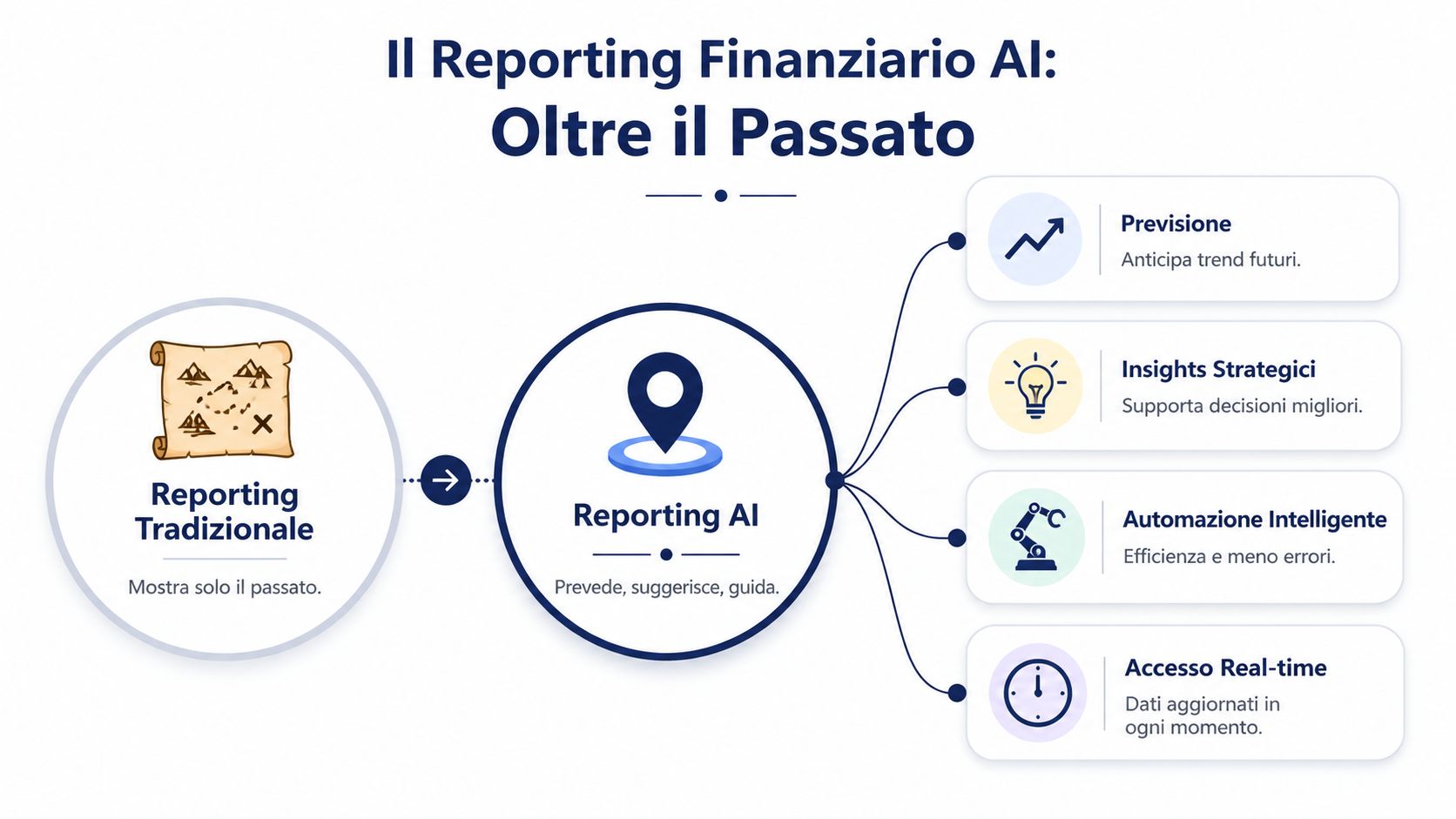
For years, reporting has primarily addressed one question: What happened?
By 2026, the most organized companies will be asking at least two more:
This transition can be interpreted in three ways.
| Level | Main question | Typical output |
|---|---|---|
| Description | What happened? | income statement, variances, historical cash flow |
| Predictive | What might happen? | indicators of revenue, cash requirements, and abnormal risk |
| Mandatory | What should we do? | priority on corrective actions, alerts, and decision-making scenarios |
An SME that still relies on disconnected Excel files may still produce good results. But it rarely manages to turn those results into a rapid decision-making process. The bottleneck is almost never the ability to “create formulas.” It’s the slowness in connecting different data sources, reconciling exceptions, and identifying patterns that emerge only when data interacts with one another.
In AI-driven reporting, financial data is no longer confined to the back office. It becomes accessible to those who lead business units, sales, operations, or procurement. In practice, the administrative manager does more than just produce a document; they contribute to a shared information base.
This changes the way we work in three very concrete ways:
Rule of thumb: if your report still requires a lengthy verbal explanation to be understood, you’re not looking at a decision-making tool. You’re looking at a document.
The point is not to replace human judgment. On the contrary. AI becomes useful precisely when it frees the finance team from repetitive tasks and gives them time to analyze, validate, and make decisions. For an SME, this can mean shifting from month-end closings that feel like a race against the clock to continuous monitoring that flags early on where margins are shrinking or where liquidity might be tightening.
In 2026, change will not come solely from software innovation. It will stem from the convergence of new tools, digital taxation, traceability requirements, and regulations on the responsible use of data. That is why AI-driven financial reporting for SMEs in 2026 is not a niche field for specialists. It is a matter for corporate leadership.

The most useful statistic for understanding the market is this: by 2026, 56% of finance leaders at Italian SMEs will be using AI for reporting and variance analysis—double the figure from 2023—with a focus on unified workflows and cloud-based data cores that streamline the monthly closing process into continuous, real-time operations, according to an analysis published by BILL (data on reporting and variance analysis).
It’s not just about increased adoption. It’s a redefinition of financial architecture. Companies are shifting their focus from periodic reports to continuous data flows, where accounting systems integrate more seamlessly with CRM, billing systems, banking, and operational data.
In practical terms, the most significant technological drivers are as follows:
For an Italian company, the benefit isn’t just speed. It’s accessibility. If reports remain readable only to those who create them, the advantage is limited. If, on the other hand, the information becomes accessible to multiple roles within the company, finance ceases to be a function that merely “reports” and becomes a function that drives the business.
The second factor is regulatory. SMEs operate in an environment that demands greater traceability, stricter access controls, and greater clarity regarding how data is processed and which decisions are automated. This applies to privacy, taxation, and, increasingly, to European regulations on AI systems.
For those looking to navigate this area, it is helpful to follow the developmentof the European AI Act as explained for businesses. Not for the sake of abstract compliance, but to understand a key operational principle: the more a system becomes involved in decision-making processes, the greater the need for clear roles, audit trails, and defined accountability.
Three implications for Italian SMEs:
An SME that digitizes without a clear structure risks creating chaos. An SME that digitizes with clear guidelines builds a competitive advantage that rivals struggle to replicate.
For an SME, the value of AI-driven financial reporting lies in the quality of the decisions made before problems arise. While the time saved on administrative tasks is important, what matters even more is the ability to detect early warning signs regarding cash flow, margins, and customer risk with a frequency that traditional reporting rarely provides.
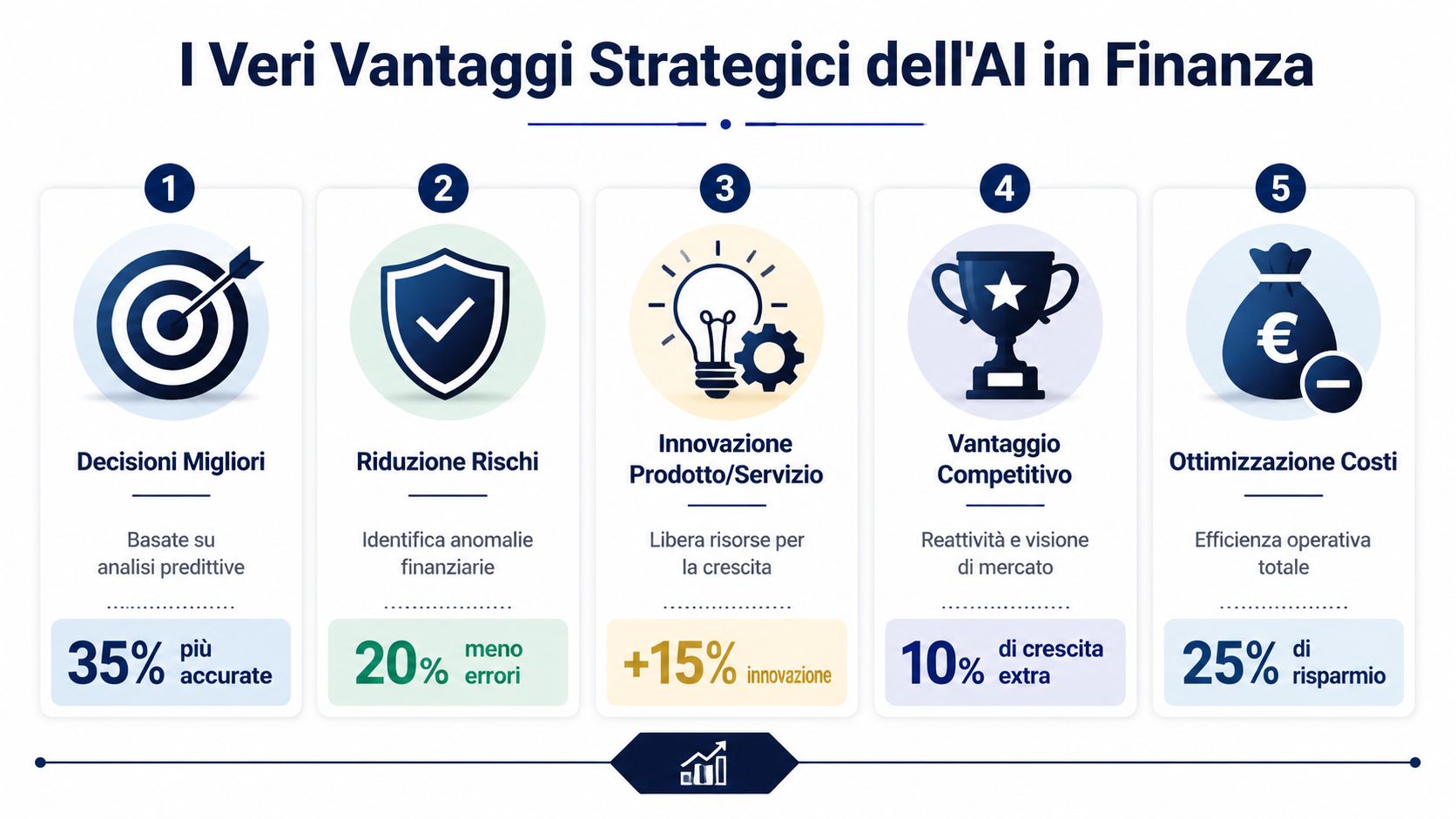
The market is already moving in this direction. In 2024, BARC found that organizations using AI and machine learning in analytics cite more accurate forecasting, faster decision-making, and better identification of patterns and anomalies as key benefits (BARC research on the use of AI and machine learning in analytics). For an Italian SME, the point is clear: a system that flags a deviation in collection times or the profitability of a business segment early on offers an operational advantage that impacts cash flow, pricing, and investment priorities.
The first strategic lever is resilience. In business, financial crises rarely strike out of the blue. They develop through small but repeated deviations: delayed invoices, costs that rise more than expected, and projects that eat into margins without making it obvious in the monthly income statement.
Consistent and well-managed reporting helps the finance team to:
This highlights an aspect that is often overlooked. Resilience does not depend solely on the algorithm, but on the quality of the data feeding the report and the rules used to validate it. If these foundations are solid, AI helps prevent misinterpretations. If they are not, it accelerates erroneous conclusions.
The second benefit relates to business insights. Many SMEs still analyze profit margins by customer or cost center, which lacks the necessary granularity to inform quick decisions. A well-configured AI reporting system, on the other hand, allows you to cross-reference purchase frequency, payment terms, discounts, service costs, and actual profitability.
The result is a more useful management view:
| Decision | With traditional reporting | With AI-powered reporting |
|---|---|---|
| Which customers tie up working capital without generating adequate margins? | becomes clear after the final tally | becomes apparent during the period |
| Which product lines are hurting profitability? | episodic analysis | more frequent monitoring |
| Which stocks are outperforming the market this quarter? | delayed intervention | early intervention |
The strategic advantage, therefore, lies in reducing the time lag between the signal and the action. In volatile markets, this time lag is more critical than administrative efficiency. A management team that receives reliable, consistent insights can adjust discounts, credit limits, customer mix, and business priorities before any deterioration appears in the closing figures.
There is a third effect, one that is less obvious but more significant in the medium term. When reporting becomes reliable, comparable, and searchable, the finance function stops merely producing financial statements and begins to contribute to operational decisions.
This happens, for example, when the CFO or the administrative manager is able to quickly answer questions that impact the business: which customers are effectively financing growth through late payments, which orders have seemingly good revenue but weak margins, and which costs are changing in structure—not just in volume. In this context, finance no longer functions merely as an archive of the past. It becomes a strategic resource that helps entrepreneurs and management make better decisions.
For Italian SMEs, the competitive advantage does not lie in having “more automation” in the abstract. It lies in having data that is sufficiently organized, accessible, and managed to make reporting a foundation for repeatable decisions. This is the distinction between adopting a tool and building managerial capability.
Most content on this topic starts with the wrong question: Which tool should you choose?
The right question is a different one: Is your company structured and prepared to use it effectively?

The most overlooked point was highlighted in the Journal of Accountancy: poor governance is more costly to AI ROI than issues related to skills or data preparation. In the same report, organizations with mature AI governance report revenue growth four times more frequently—58% versus 15%—and weak governance is the reason why 85% of pilot projects fail (analysis of causes of failure and AI governance).
In an SME, governance is not a bureaucratic exercise. It is the answer to very practical questions.
Who decides which processes can be automated?
Who validates the quality of the input data?
Who defines access levels?
Who is held accountable if an insight is incorrect or if a report is misinterpreted?
When these responsibilities are unclear, the project almost always runs into trouble in one of the following situations:
The result isn't just technical. It's managerial. The team loses confidence in the results, reverts to spreadsheets "just to be safe," and the pilot project remains confined to an internal demonstration with no real-world impact.
If AI is deployed in finance without clear ownership, without data regulations, and without a validation process, you’re not scaling intelligence. You’re scaling ambiguity.
There is also a challenge that is even less frequently discussed. Smaller businesses—which stand to benefit most from improved efficiency—are often the ones that struggle the most to derive value from AI reporting. Not because there is a lack of affordable solutions, but because they lack the basic infrastructure needed to implement them.
The problem isdata friction. A micro or small business tends to have:
In this scenario, even a good platform struggles to produce reliable insights. AI can process data quickly. But if the data is dirty, duplicated, or inconsistent, that speed only amplifies the problem.
That is why data preparation is not a minor technical step. It is the prerequisite that enables automation to build internal trust. Without this foundation, many SMEs view a tool as “disappointing” when it is actually just reflecting the level of disorganization present in their existing systems.
The power of AI in finance becomes clear when it influences day-to-day decisions. There’s no need for futuristic scenarios. Just look at how the work of those leading sales, administration, or treasury changes when data becomes more accessible and up-to-date.
A retail manager often works under constant pressure: to sell more without overstocking and without sacrificing profit margins. With fragmented reporting, data arrives late, and decisions about promotions are almost always made with an eye to the past.
With an AI-powered system, the way we analyze data changes. Sales figures can be correlated with inventory turnover, profit margins, returns, and collection times. At that point, the sales manager doesn’t just see that a product “is doing well.” They can see whether it’s growing profitably or whether it’s consuming too much cash and requiring excessive discounts.
Problem, solution, impact:
For those who want to see how these scenarios play out in practice, this collection of case studies on analytics and automation for businesses offers useful examples that can be applied in a practical context.
In service-based businesses, the main issue is often cash flow, not nominal revenue. You can have a healthy order backlog and still find yourself under pressure because your cash inflows and outflows aren’t in sync.
With smarter financial monitoring, business owners and CFOs can spot warning signs earlier. They don’t have to wait until the end of the month to discover that their cash flow profile has shifted. They receive more timely alerts about slow-paying customers, risk concentration, or costs that are outpacing revenue.
A small or medium-sized service company doesn’t run into trouble because it “doesn’t have reports.” It runs into trouble because the reports arrive when the window of opportunity to respond has already narrowed.
Here, the impact is primarily behavioral. Management can issue early reminders, review commercial terms, negotiate deadlines, or freeze non-essential spending before the pressure escalates into a crisis.
The third use case concerns the core of administrative work. In many small and medium-sized enterprises (SMEs), reconciliations, document reviews, and expense verification take up a disproportionate amount of time. The problem isn’t just the operational burden. It’s that this work diverts resources away from activities that create more value, such as analyzing variances or identifying spending trends.
With the help of AI, the administrative manager can shift their focus:
| Previous | After |
|---|---|
| chases down documents and reconciliations | monitors exceptions and priorities |
| Update the report manually | Review automatically generated insights |
| work to close | work to understand |
The most significant change is cultural. The finance function is no longer seen merely as a department that keeps records. It becomes the place where the company gains a clear understanding of what is happening.
Adopting AI in finance doesn’t require a dedicated machine learning department. It requires a methodical approach. The right sequence matters more than technical sophistication. An SME that starts small with a limited scope is far more likely to create value than a company that attempts a complete transformation without a solid foundation or clearly defined roles.
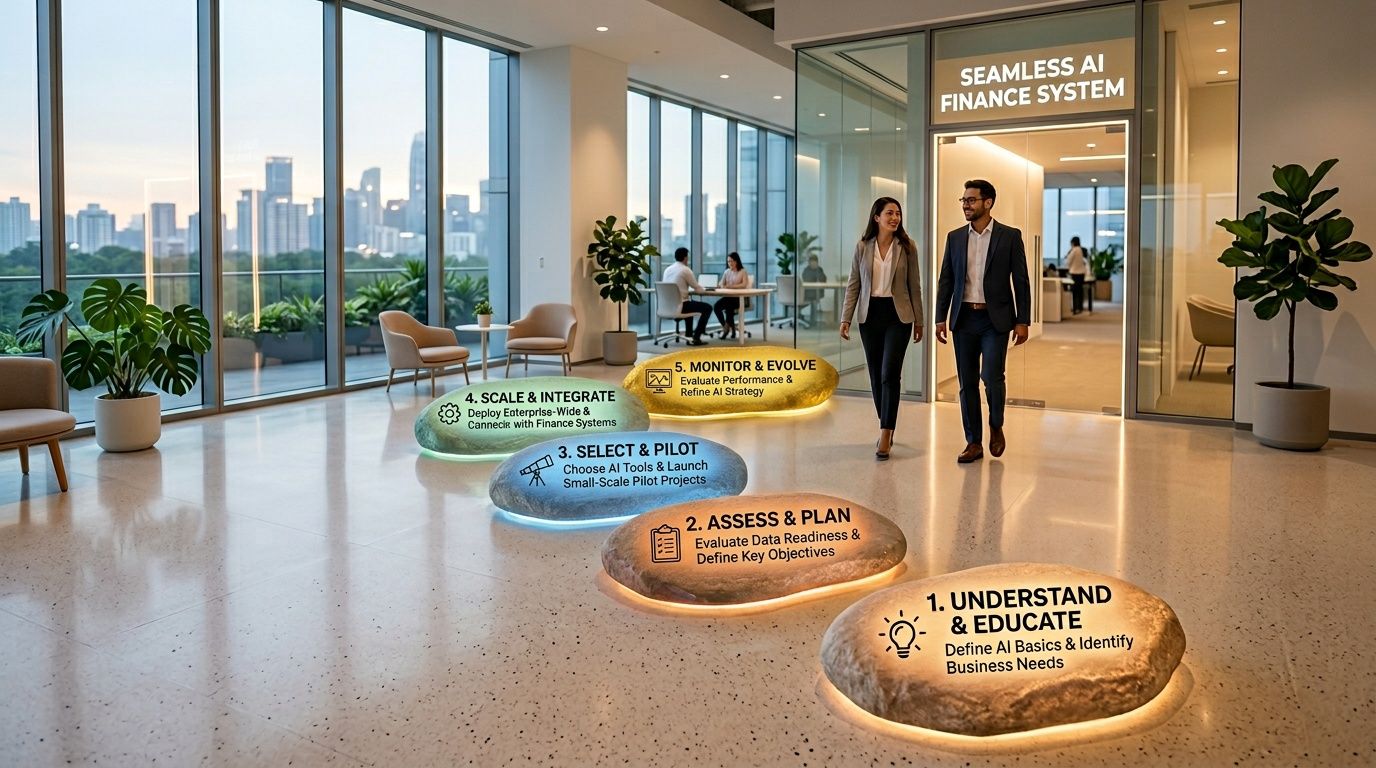
1. Start with data hygiene
Before the demo, take a look inside your organization. Check where financial data originates, who updates it, where it gets duplicated, and where it changes names as it moves through the process. Most future problems are already evident here.
Be sure to check the following:
2. Choose a business problem, not a technology
Many small and medium-sized businesses fail because they purchase a platform before defining their primary use case. Instead, start with a specific question. For example: Do we want to improve our cash flow forecasting? Do we want to better understand variances? Do we want to reduce the time spent on reconciliations?
This approach does two things. It reduces risk and makes the outcome measurable. A quick win is more convincing than an ambitious but vague strategy.
Practical tip: If your initial goal is to integrate your entire business system all at once, you’re probably starting too big.
3. Evaluate the platform using managerial criteria
The decision shouldn’t be based solely on the promise of “AI.” For an SME, what matters most are integration, usability, audit trails, clear roles, and the ability to scale without adding more tools. The right questions are more practical than marketing hype:
4. Launch a limited pilot and assemble the team
An effective pilot isn’t just a generic trial. It’s a test with a defined scope, key stakeholders, and success criteria. Choose a small team, clarify who approves what, and explain upfront that the goal isn’t to replace people, but to reduce repetitive work and improve the quality of decisions.
For a practical framework, it may be helpful to consult a 90-day roadmap for adopting artificial intelligence, especially if you want to break down your goals into weekly tasks.
5. Measure the value, then expand
ROI shouldn’t be viewed solely as a cost-cutting measure. In finance, reliability, decision-making speed, internal clarity, and a reduction in downstream corrections also matter. When the first use case works, don’t roll it out across the board right away. Expand it step by step. From cash flow to expenses. From expenses to variances. From variances to decision support for management.
Here is a summary of the roadmap:
| Phase | Guiding question | Expected outcome |
|---|---|---|
| Data cleansing | Is the data legible and consistent? | reliable foundation |
| Key objective | Which problem should I tackle first? | focus |
| Platform selection | Does the solution support governance and integrations? | actual fit |
| Pilot | Does the team use it with confidence? | proof of value |
| Staircase | Where can I replicate that success? | sustainable adoption |
At this point, the crux of the matter is clear. SMEs don’t need to accumulate software. They need to reduce complexity, data silos, and reliance on manual processes. This is where a unified platform changes the game.
ELECTE, an AI-powered data analytics platform for SMEs, tackles the problem at its root. Instead of leaving banking, invoicing, e-commerce, and other data streams in systems that don’t communicate well with one another, it connects them within a single environment, centralizes the information, and makes it easier to interpret. This approach helps both operationally and in terms of governance, as it creates a common foundation for oversight, visibility, and accountability.
The benefit isn’t just technical. It’s organizational. When reports, insights, and analyses become accessible in just a few steps, even non-technical teams can work with more readable data without having to build a custom project from scratch every time. In short, the path toward AI-driven financial reporting for SMEs by 2026 stops feeling like an unmanageable transformation and becomes a concrete evolution of how the company makes decisions.
Financial reporting in 2026 won’t reward those with the most dashboards. It will reward those with reliable data, clear roles, and the ability to turn financial signals into timely decisions. This is the real dividing line between superficial adoption and competitive advantage.
For Italian SMEs, the lesson is simple. AI should not be approached as the purchase of a standalone tool. It should be treated as a management discipline that combines data quality, governance, and a focus on the right use cases. By starting from this foundation, companies can make financial data more transparent, more consistent, and more conducive to growth.
There is another aspect that should not be overlooked. The market won’t wait for every company to feel ready. Companies that start now are building expertise, processes, and internal trust. The others risk discovering too late that the real cost wasn’t investing, but putting it off.
If you want to turn scattered data into clear, actionable insights, you can see how ELECTE helps SMEs centralize data sources, automate reporting, and make analysis accessible even without a dedicated technical team.

.svg)


.svg)
.svg)