

When you look at Google in 2026, the most common mistake is to think you’re watching the evolution of a search engine. In reality, you’re looking at something much deeper: the construction of a cognitive infrastructure that spans search, productivity, software development, and everyday interaction with digital services. For an Italian company, this distinction changes everything.
Context matters. Only 16.4% of Italian companies with at least 10 employees had integrated AI systems by 2025—nearly double the 8.2% recorded in 2024—according to this analysis of AI adoption among Italian SMEs. Actual adoption is growing, but it remains selective. This is precisely why Google’s strategy must be understood now, before it becomes the implicit standard upon which processes, data, and decisions are based.
The point isn't to review Gemini or comment on the latest announcement. The point is to understand the technological power structure that is taking shape. Google is trying to become the invisible layer on which AI operates for everyone. If you use Search, Workspace, Android, or tools connected to the Google ecosystem, this transformation is already affecting your business.
To say that Google is a search engine in 2026 is an outdated definition. More precisely, Google has become an AI company that also owns a search engine. This isn’t just a linguistic nuance. It’s a shift in focus that changes the way companies, users, and developers access information and software.
For years, Google has been organizing the web. Today, it is working to organize the intelligence that connects people, content, apps, and purchases. When AI is integrated into Search, Gmail, Docs, Workspace, and Android, it ceases to be a secondary feature. It becomes the system’s operating principle.
For Italian companies, the question isn’t whether or not to use Google. The question is to what extent their business model is already dependent on Google without them having formalized it. This is where Google AI becomes a strategic issue, not merely a matter of innovation.
Google isn't just adding AI features to its products. It's building the cognitive foundation that other products will eventually rely on.
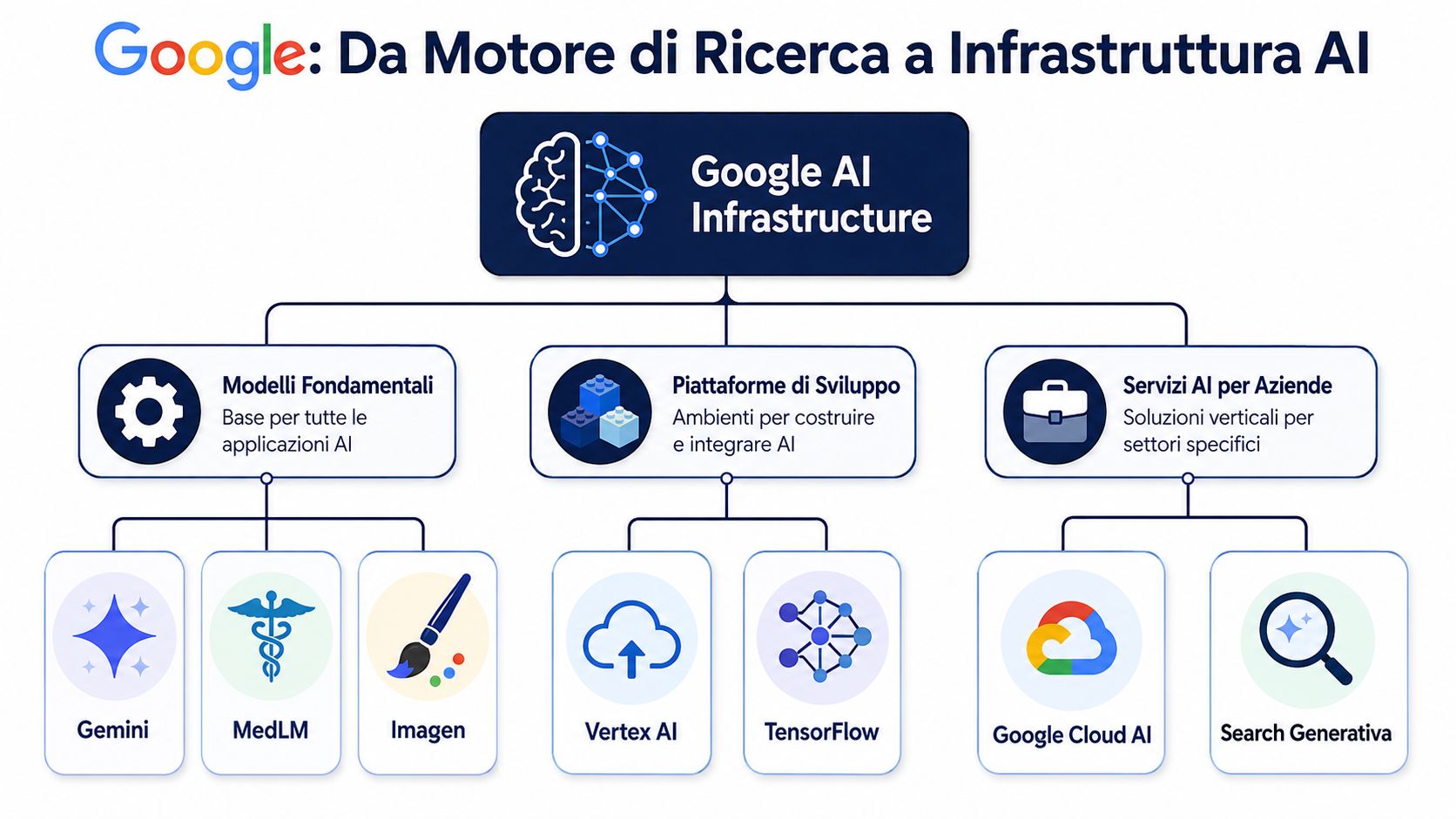
Twenty years ago, Google succeeded because it became the gateway to the web. In 2026, it is pursuing a more ambitious goal: to become the gateway to operational reasoning. This means it doesn’t just index content. It interprets intentions, breaks down problems, reconstructs answers, and, increasingly, prepares the next course of action.
This is the fundamental difference. A search engine organizes information. An AI infrastructure organizes decisions, workflows, and priorities. When the same entity controls the model, the distribution channels, and the everyday user interfaces, its role is no longer that of a product provider. It is that of an infrastructure.
The Google ecosystem exemplifies this very logic. Search identifies the need, Workspace manages the work, Android powers the device, and Cloud provides the application environment. AI doesn’t simply connect these pieces from the outside. It turns them into a single system.
Another useful context for understanding this trajectory is the debate on AI in cloud computing trends, because the competitive focus is shifting toward those who control models, distribution, and integration capabilities all at once.
For an SME, the risk isn’t that “Google becomes too innovative.” The risk is more subtle. If you’re already using Google services in various parts of your company, you may find yourself falling into a gradual cognitive dependency without a formal board decision.
This transformation has three practical effects:
Anyone who views Google as merely a provider of features underestimates the scope of its industrial design. Google doesn’t just want to be used. It wants to be the technical foundation upon which others operate.
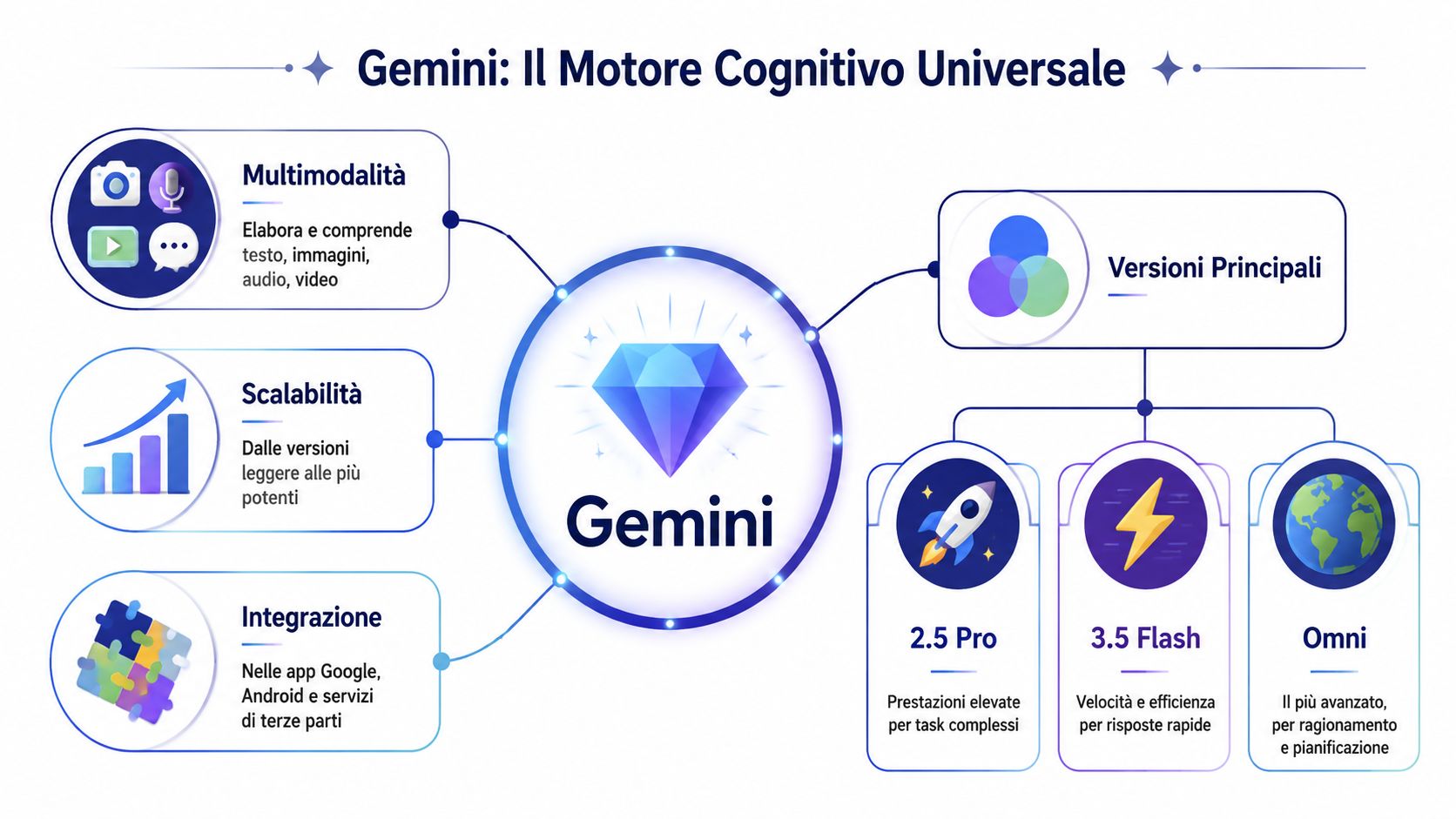
Gemini's strength lies not only in the quality of the model. It lies in its broad reach. In an AI market where many players compete on benchmarks, Google competes by covering all the key use cases that matter.
The most tangible evidence comes from day-to-day productivity. Google Workspace with Gemini integrates advanced AI agents that enable teams to perform autonomous planning and actions within apps such as Gmail and Docs. Additionally, NotebookLM supports audio summarization, analyzing files and discussions to understand complex information, as detailed in this overview of Google’s new AI features.
This integration changes the model's role. Gemini doesn't operate in isolation within a chat. It integrates into workflows, captures business content, generates summaries, prepares drafts, links sources, and supports day-to-day operations.
When a model is deployed everywhere, its competitive advantage no longer depends solely on how “well” it reasons. It depends on how many decisions it influences throughout the workday. And that’s where Google stands out.
Think of the model as a shared cognitive engine that can:
This is the point that many people overlook when talking about Google AI. You’re not just choosing a model. You’re choosing a system that aims to unify context, interface, and automation.
The battle is no longer between chatbots. It’s between ecosystems capable of making the model ubiquitous without forcing users to change their habits.
For a manager or entrepreneur, the right question isn’t “Is Gemini powerful?” The question is: Where does Gemini fit into my value chain, and how much of my business context is processed by that infrastructure?
There are at least three implications of technology procurement:
A common mistake among SMEs is to treat AI as if it were still a standalone software category. It is no longer that. In Google’s case, it is an operational layer that tends to expand horizontally.
For this reason, the evaluation should include a mini internal due diligence:
Google has an advantage that few can match. It can turn a model into a habit. And in software, habit is often just as important as performance.
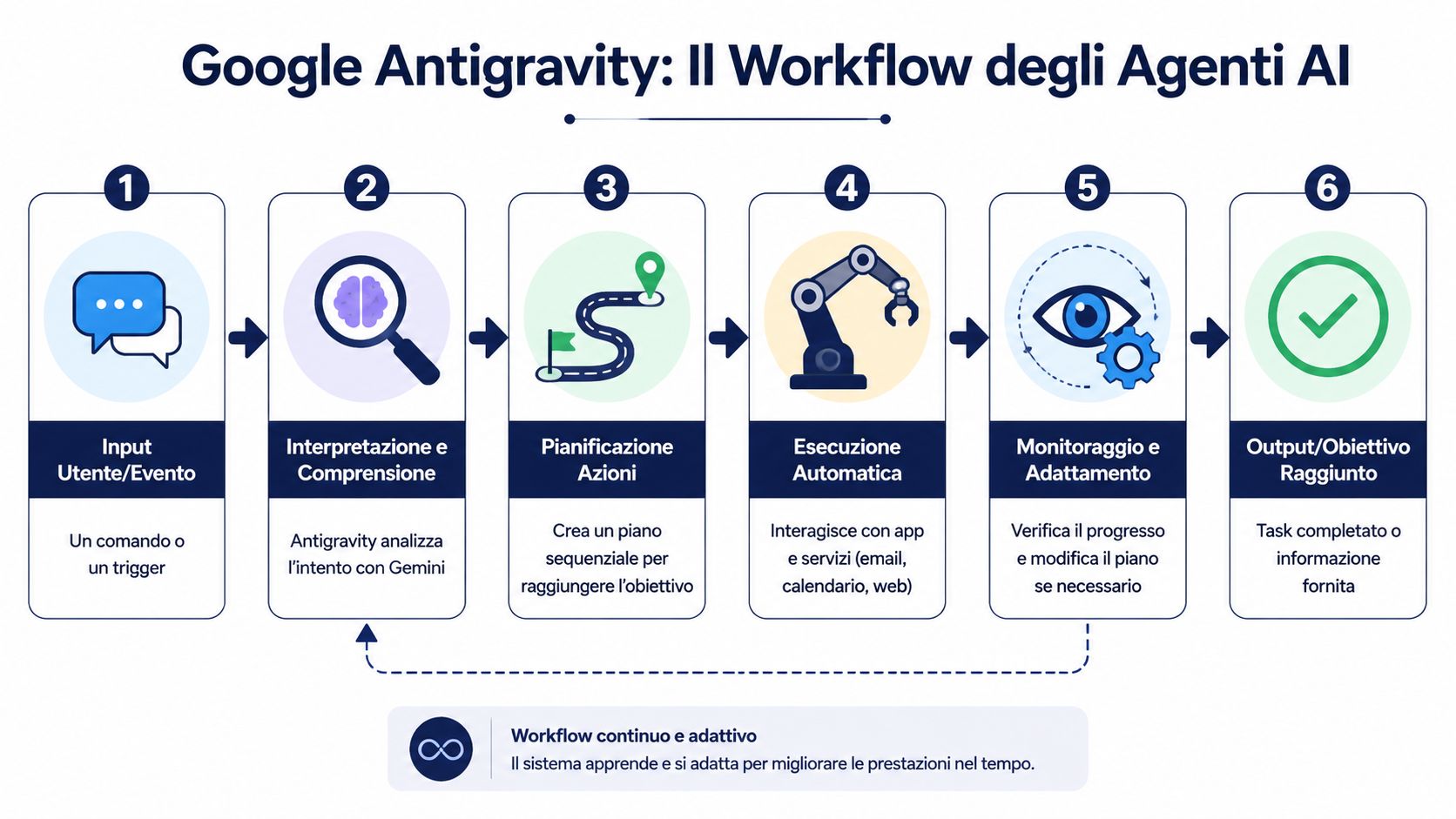
If Gemini is the engine, Antigravity is the platform's big bet. The strategic focus isn't on any single, spectacular capability of the agent. It's on standardizing the development of AI agents by third parties.
When Google promotes an "agent-first" approach, it seeks to change the way software is designed. No longer just screens to navigate and fields to fill out, but systems that interpret a goal, plan steps, and perform tasks with controlled autonomy.
This idea is consistent with what we already see in Search. Google AI Mode uses the “query fan-out” distribution technique to break down a query into hundreds of individual searches, generating a contextualized response that reduces search time and acts like a human advisor, as MIT Technology Review Italia explains in its in-depth article on Google AI Mode. Antigravity takes this logic beyond search—from analysis to execution.
To understand the impact, it helps to use a simple analogy. Android wasn't just a product. It was an environment that allowed others to build on it. Antigravity aims to do something similar for agents.
If a platform allows you to create agents with defined instructions, competencies, and operational capabilities, the value of the software shifts. The interface matters less. What matters more is access to data, the quality of processes, and the domain expertise built into the system.
Rule of thumb: When a vendor makes it easy to build agents, the competitive advantage of off-the-shelf software diminishes. Those who possess workflows, data, and vertical expertise are the ones who survive.
For an SME, this raises some very concrete questions:
A simple example will help. If today a sales team opens the CRM, email, spreadsheets, and calendar to prepare a proposal, tomorrow a sales rep can gather information, summarize the lead’s status, prepare materials, and suggest next steps. The team’s work doesn’t disappear. It’s just the point at which human value is applied that changes.
For those who want to understand how this transformation affects business processes, it’s also helpful to take a look at these ELECTE solutions ELECTE AI in the workplace, because the key issue isn’t the magic of the agent but its integration into real-world workflows.
It would be a mistake to think that the age of agents automatically favors those with more functions. That is not the case. It favors those who can combine four elements:
With Antigravity, Google is attempting to become the default platform for this new cycle. If it succeeds, many software categories will be evaluated not based on their interface but on how well they can be orchestrated by agents.

The most immediate change for Italian companies does not concern AI labs. It concerns traffic. Google’s AI Overviews were officially rolled out to the Italian market on March 26, 2026, following their launch in the United States in May 2024 and their rollout to over 100 countries in October 2024, as detailed in this in-depth article on the arrival of AI Overviews in Italy. They are designed primarily for long-tail informational queries and questions that begin with “what,” “how,” “when,” “where,” and “why.”
The strategic issue isn’t geographic reach. It’s the impact on traffic flow. With the arrival of AI Mode in Italy, over 90% of searches in this mode no longer generate clicks to external sources, according to Semrush data, as reported in this analysis of Google AI Mode and SEO. For those who rely on organic visibility, this isn’t just a minor detail. It’s a complete overhaul of the channel.
SEO, therefore, isn't dying. It's shifting focus. It's no longer enough to just rank on the first page. You have to become a source that AI considers worthy of being linked to in its summary.
The same pattern applies to e-commerce. If search becomes conversational and intent-driven, then shopping, too, ceases to be merely browsing a website.
For many e-commerce SMEs, the risk isn’t losing the website. It’s losing its central role. If agents become intermediaries in product discovery, comparison, and selection, the product catalog matters more than the homepage. What matters is the structure of the information, not just the design of the user experience.
This changes our operational priorities:
If search evolves from “access to data” to “a form of reasoning,” then e-commerce also evolves from “browsing experience” to “catalog searchability.”
There is also a second point that is often overlooked. According to this analysis of AI Overview and what it means for SEO, there is no such thing as “special SEO” for AI Mode. This forces companies to adopt a broader strategy, consisting of useful content, a clear structure, and a focus on an ecosystem that includes videos, social media, and reviews.
For an Italian SME, the message is simple: traffic can no longer be taken for granted. And visibility is no longer synonymous with traditional search rankings.
In 2026, technological competition no longer works the way it used to. On the surface, the major players compete over devices, operating systems, and services. But at a deeper level, some of them rely on the same cognitive layers to make their products credible.
This is where the most significant paradox of the current phase emerges. Even those who control a strong ecosystem may choose to rely on an external AI infrastructure to accelerate their growth. When this happens, the nature of the competitive relationship changes. The business rival also becomes a cognitive provider.
Apple and Samsung are the most obvious examples of this trend. Beyond the individual integrations announced in the market discourse, the analytical point is clear: when core intelligence is outsourced or shared, differentiation shifts toward distribution, hardware, user interface, and brand trust. The cognitive engine tends to become more concentrated.
Many managers view these partnerships as a sign of market maturity. This is partly true. But there is a second, more important level to consider. If even major players find it advantageous or necessary to operate within the same AI infrastructure, it means that the center of gravity is narrowing.
For those who buy technology, this has real-world implications.
A company may think it has chosen a product. In reality, it may have chosen a long-term dependency.
This does not mean avoiding Google on principle. That would be an ideological and unhelpful interpretation. It means recognizing that adopting Google’s AI is never merely a functional decision. It is a decision about control, choice, and resilience.
The right question isn't whether Google is trustworthy. The right question is how much of your business you can afford to entrust to an entity that controls access to information, productivity, mobile distribution, and AI models all at once.
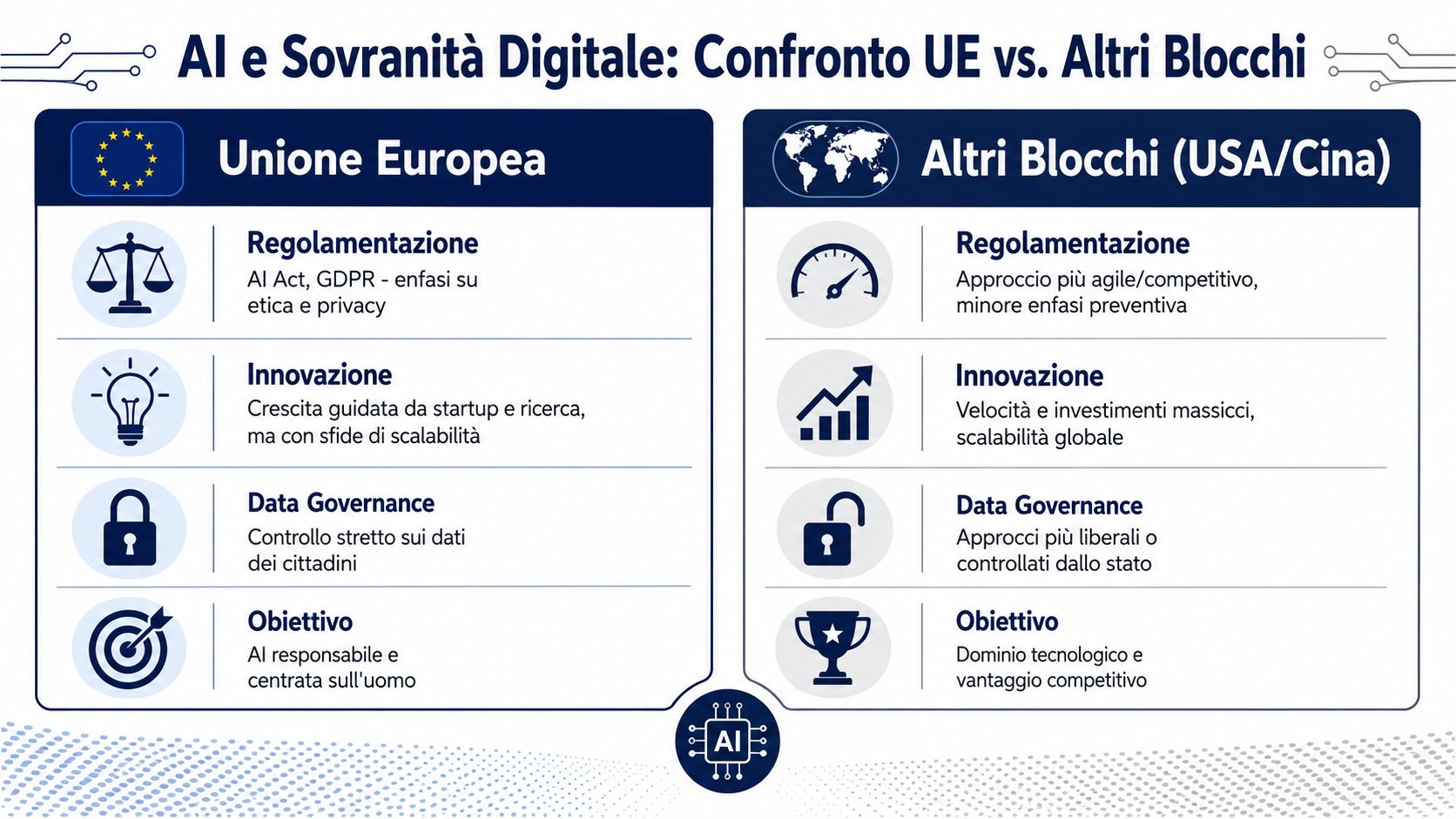
Europe has the right approach to privacy, rights, and AI governance. But the infrastructure challenge is a different matter. You can regulate the use of artificial intelligence without necessarily controlling the engines that power it.
This is the crux of the matter that many companies only realize when they begin to seriously integrate AI into their processes. If data, models, the cloud, and protocols are controlled by a handful of non-European players, digital sovereignty is not just a theoretical issue. It becomes a matter of operational architecture.
There is one important sign. In April 2025, the European Commission approved the Action Plan for AI on the continent, which calls for the creation of 16 artificial intelligence hubs in sixteen member states, as noted in this summary on the development of artificial intelligence in Europe. It is a significant industrial response, but it does not eliminate the distribution gap.
For an Italian company, digital sovereignty goes beyond mere formal compliance with the GDPR. It involves three operational questions:
These questions matter more today because adoption is accelerating. According to the I-Com TeamSystem study on AI in business, 78% of Italian companies with ten or more employees began using AI tools in at least one business function in 2024. This figure makes one thing clear: AI first enters as a widely used tool, then as a structural necessity.
That is why diversification is not a luxury. It is a risk management practice. The same logic applies when evaluating compliance and internal governance. A Guide to AI Compliance for Businesses is useful not only for avoiding regulatory errors, but also for linking legal considerations to architectural ones.
In Europe, the issue is not choosing between innovation and regulations. The issue is innovating without completely relinquishing control over the cognitive infrastructure.
For SMEs, this means avoiding two extremes. The first is an ideological rejection of large providers. The second is passive adoption, driven solely by convenience. The wise choice is a third option: using what adds value, while knowing which processes, data, and capabilities it is prudent to keep under closer control.
The most useful insight into Google’s AI in 2026 isn’t technical. It’s managerial. Google is building an AI infrastructure that spans search, productivity, agent-based development, and access to e-commerce. For many companies, dependence won’t come from a single major project. It will come from the gradual accumulation of convenient tools.
Here are the steps to take right now.
This article provides scenario analysis; it is not intended as legal, financial, or compliance advice. Decisions regarding data, contracts, and governance should be evaluated in consultation with your internal contacts and qualified advisors.
If you want to turn your data into actionable decisions without increasing your reliance on general-purpose platforms, discover ELECTE, an AI-powered data analytics platform for SMEs. ELECTE helps European businesses connect data sources, automate reports, identify anomalies, and generate useful insights with an approach focused on control, compliance, and ease of use. Ready to transform your data? Start your free trial →

.svg)


.svg)
.svg)






.webp)