
The adoption of AI is outpacing our ability to govern it. And this is where many SMEs are putting themselves at risk without realizing it. According to McKinsey & Company’s “State of AI” report, 55% of organizations have adopted artificial intelligence, but only 29% have a comprehensive governance plan (as reported by Dataversity). The gap is the real problem—not AI itself.
For an SME, this means using predictive analytics, decision automation, or intelligent reporting systems without clear rules regarding data, accountability, controls, and auditing. The risk isn’t just regulatory. It also affects reputation, the reliability of decisions, and the ability to scale without creating internal friction.
An AI governance framework for small businesses isn’t meant to slow down innovation. It’s meant to make it sustainable. When you define who approves a use case, how you monitor a model, and what data can be fed into the system, you stop winging it. You start building operational trust.
This guide translates governance into concrete actions for small and medium-sized businesses. No corporate jargon. No excessive bureaucracy. Just a practical approach that safeguards your business and improves the quality of your decisions.
According to IBM, the global average cost of a data breach reached $4.88 million in 2024. For an SME, an incident doesn’t have to be on that scale to cause real damage. All it takes is a model linked to incorrect data, an unverified automated decision, or the misuse of sensitive information to result in operational costs, customer friction, and project delays.
The key point is this: in small and medium-sized enterprises, AI is often introduced through tools already in use, such as analytics, forecasting, generative assistants, scoring, or process automation. Adoption therefore grows in a decentralized manner, while responsibilities, controls, and approval criteria remain implicit. This is where the risk increases—not because the technology is out of control, but because the business is using it without a commensurate decision-making framework.
Well-designed governance helps prevent costly mistakes and speeds up useful initiatives.
For a company with limited resources, this is a managerial priority rather than a legal one. If no one has defined who can approve a use case, what data is permitted, when human review is required, and how decisions are documented, each team will establish its own rules. The result isn’t speed. It’s operational variability. And variability—in areas such as pricing, credit, planning, or customer service—reduces the quality of decisions even before it creates a compliance issue.
AI governance is the system that allows you to experiment in a controlled manner; it is not an obstacle to innovation.
That is why SMEs do not need to copy the models of large companies. They need a tailored framework—light on processes but clear on responsibilities—that uses integrated platforms to track approvals, data, versions, and controls without adding manual bureaucracy. Those who establish these rules early on can decide more quickly which initiatives to scale up, which to halt, and which to revise. This transforms governance from a perceived cost into a real competitive advantage.
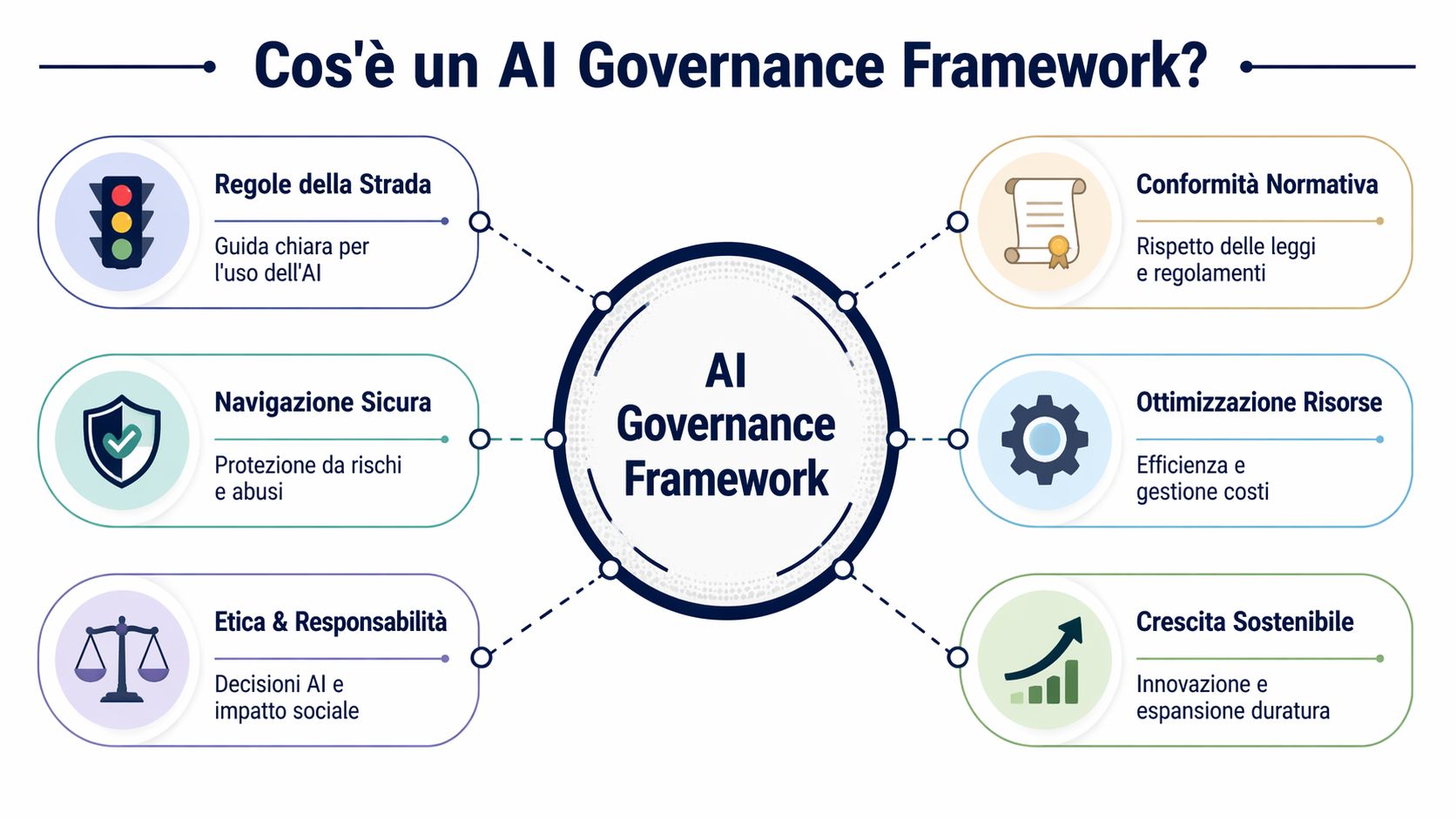
An AI governance framework is the set of policies, roles, controls, and procedures that defines how an organization approves, uses, monitors, and corrects artificial intelligence systems.
For an SME, this definition has very practical implications. It means determining who can initiate a new use case, what data is permitted, what checks are required before deployment, and when an automated decision must be reviewed by a human. Without these rules, AI is integrated into processes in a piecemeal fashion. Each team makes decisions independently. The benefits become difficult to measure, and errors take longer to correct.
In practice, the framework addresses six operational questions:
For SMEs, the point is not to build a formal structure similar to that of a large bank or a multinational corporation. The point is to implement a system that is proportionate to the risk and available resources. A streamlined framework, supported by integrated platforms that track approvals, versions, controls, and access, reduces manual work and makes governance sustainable even without a dedicated legal team.
Reducing governance to mere compliance often leads to an underestimation of its managerial impact. In reality, well-established governance improves the quality of operational decisions. It reduces the time wasted on recurring uncertainties, limits the misuse of data, and clarifies who bears ultimate responsibility for an AI-generated output.
For an SME, the benefits fall into four main categories.
| Area | Why it matters |
|---|---|
| Risk Management | Reduce data misuse, undocumented decisions, and initiatives that are disconnected from business priorities. |
| Customer trust | If you can explain how an AI process supports a decision, you’ll build credibility with customers, partners, and stakeholders. |
| Speed with discipline | Teams operate within clear boundaries, with fewer internal roadblocks and fewer exceptions handled on a case-by-case basis. |
| Regulatory preparation | A minimal structure today makes it easier to adapt to future requirements without having to redesign processes and responsibilities from scratch. |
This is already a practical reality, not just a theoretical concept. More and more small and medium-sized enterprises (SMEs) are adopting AI for tasks such as forecasting, pricing, inventory planning, customer service, risk assessment, and reporting. In all these cases, the issue isn’t just whether the model works. It also matters whether the company can demonstrate who approved it, what data was used to train it, what its limitations are, and how it is monitored over time.
For Italian companies, the regulatory landscape makes this approach even more valuable. This overview of how to interpret the European AI Act for businesses helps align internal policies with the emerging European requirements.
Practical rule: If an AI system affects prices, inventory, business priorities, risk, or compliance, it should be treated as a governed business process.
The less obvious benefit concerns investment selection. A well-designed framework does more than just mitigate problems; it also helps make better investment decisions. SMEs that establish approval criteria and monitoring metrics can more quickly distinguish between use cases that generate profit margins, efficiency, or service quality and those introduced due to internal pressure or market imitation. This makes governance a discipline of capital allocation, not just control.
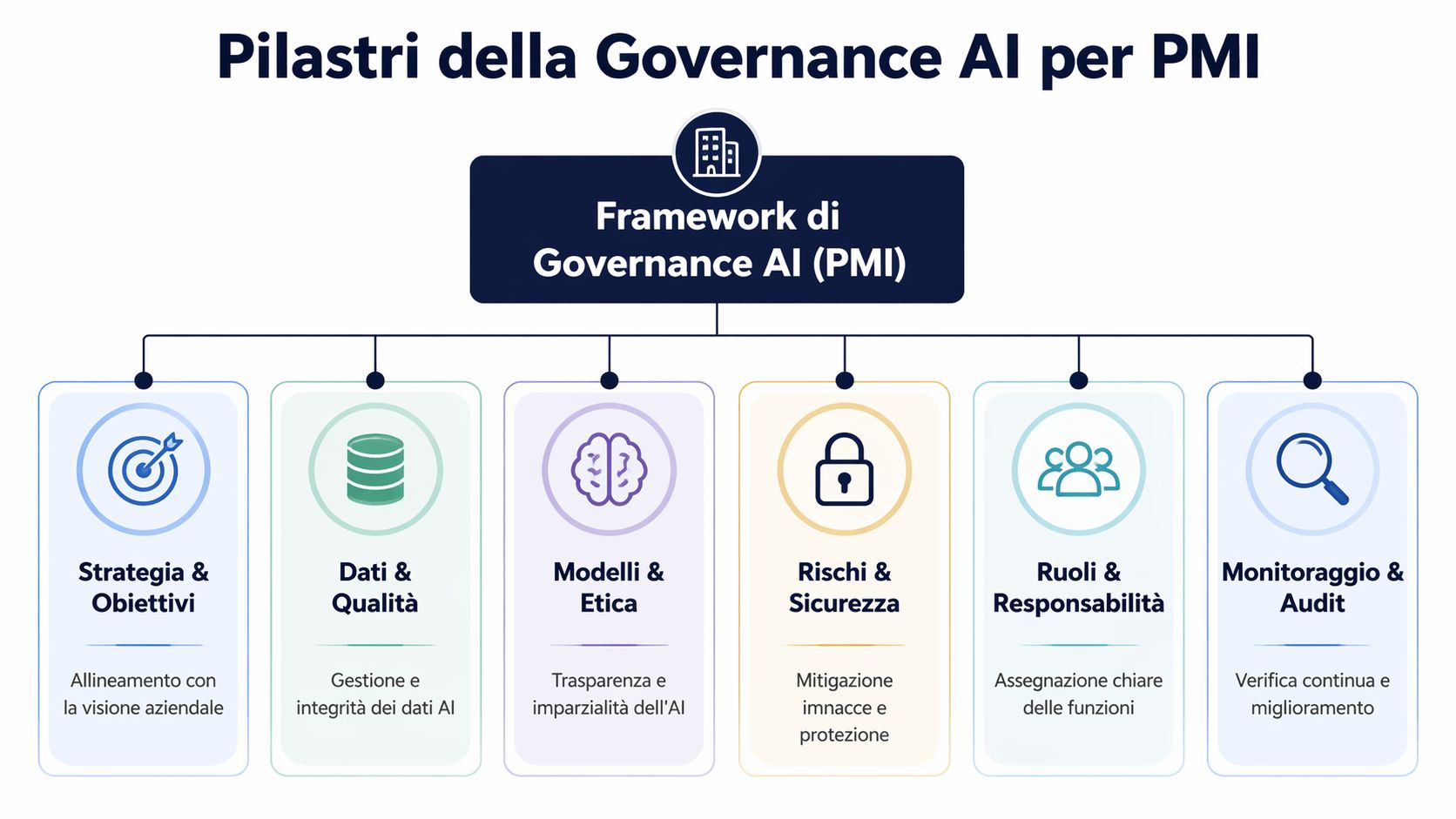
Effective governance for SMEs doesn’t come from a thick manual. It stems from a few clear pillars, applied consistently. If one is missing, the system struggles to hold up. If two are missing, governance remains merely theoretical.
IBM reports that 80% of business leaders view explainability, ethics, bias, and trust as the main barriers to the adoption of generative AI (summary in the IAPP article). This statistic clearly illustrates why these pillars are not merely theoretical. They are the conditions that make AI truly adoptable.
Every small business should start with a few non-negotiable principles. There’s no need for abstract formulas. What’s needed are actionable guidelines to guide day-to-day decisions.
A good starter kit might include:
These principles are only useful when they are incorporated into policies. For example, a policy may stipulate that every new AI use case must be described in terms of its purpose, the data used, the owner, and the risk level before it is released.
Many small and medium-sized businesses think they are too small to formalize roles. In reality, the opposite is true. When the team is small, confusion is more of a problem because the same people are handling different tasks.
A basic structure may include:
A basic RACI matrix clarifies who is responsible, who approves, who should be consulted, and who needs to be informed. It’s not just a formality. It’s the simplest way to avoid gray areas.
AI amplifies what it finds in the data. If the data is incomplete, sensitive, inconsistent, or poorly managed, the problem isn’t confined to the database. It influences decisions.
For this reason, governance must include at least three basic controls:
| Check | The question to ask |
|---|---|
| Visits | Who can view, edit, or export data and output? |
| Source of the data | Do we know where the data comes from and whether it is appropriate for the use case? |
| Traceability | Can we determine how an output was generated? |
If you can't trace the path of an output, you can't truly control it.
In the context of the GDPR, this approach helps reduce improvisation and the overuse of data. It does not replace legal advice, but it lays the operational groundwork to ensure that privacy and analytics do not operate on separate tracks.
Bias is not just an ethical issue. It is a business performance issue. A model that treats a geographic region, a customer segment, or a transaction category unfairly leads to poorer decisions.
For an SME, managing bias means asking simple questions before release:
Here, governance also improves managerial quality. It forces us to distinguish between useful automation and uncritical automation.
Not all models are easy to understand. But every small or medium-sized business must at least be able to explain three things: what the system does, what data it is based on, and how it is used in the decision-making process.
Explainability is what makes the system defensible to management, customers, auditors, or regulators. Without this capability, AI remains an organizational black box. And a black box is difficult to scale with confidence.
Here is a practical guideline:

The difference between intention and actual governance lies in implementation. For an SME, the best way to start is to create a short, clear, and repeatable process—not an endless project.
Best practices in governance call for the integration of technical controls into workflows, including a model inventory and automated pipelines to test for bias and robustness before deployment. This approach reduces risks by approximately 40–50% (according to an analysis by The Virtual Forge). The key message is simple: controls are effective when they are built into the workflow, not tucked away in a forgotten file.
Start by taking stock. List all systems that use AI or machine learning, even if they are external or embedded in a platform.
For each item, note:
This map reveals a reality that is often underestimated. Many companies believe they have one or two AI use cases. In reality, they have several, spread across departments and suppliers.
The initial policy doesn't have to be long. It needs to be practical. A well-designed page is worth more than a lengthy document that no one reads.
Be sure to include at least the following points:
| Element | Minimum content |
|---|---|
| Purpose | In what contexts is the use of AI permitted within the company? |
| Roles | Who proposes, who approves, who monitors |
| Data | Which categories require the most attention |
| Checks | What checks are required before issuance? |
| Escalation | When to involve management, IT, or the privacy team |
For those embarking on a broader initiative, a 90-day roadmap for AI adoption can help align governance, experimentation, and priorities within the same operational timeline.
In an SME, you don’t need a dedicated department. You need a designated person. This could be a data manager, an IT lead, an operations manager, or a manager with a broad perspective.
The role should include:
Practical implication: If everyone can approve the use of AI, in practice no one is really held accountable.
This is the key difference between symbolic governance and effective governance. Controls must be built into systems and processes, not managed solely through email or spreadsheets.
The most useful skills are:
For many teams, this phase is also a test of technological maturity. If the platform does not help document, monitor, and restrict access, governance becomes more costly.
A framework doesn't end with the go-live. Models change over time, just as data, seasonality, processes, and business expectations do.
Set up a periodic review with a few key questions:
A quarterly review is often more useful than infrequent, intensive checks. It keeps the framework dynamic and prevents it from becoming tied to its initial conditions.

SMEs understand the value of governance when they see it at work in their day-to-day processes. Not as an abstract principle, but as a practical way to correct decisions that would otherwise undermine results and control.
Effective governance is based on a multi-tiered structure that includes a supervisory committee, an ethics board for high-risk cases, and model owners responsible for each system. A lack of clear roles accounts for 60–70% of governance failures in small companies (Liminal guide). Even an SME can adapt this approach in a streamlined form.
A retailer uses an AI system to optimize reordering and stock distribution across stores. The model performs well on average, but over time it begins to underestimate demand in certain geographic areas. The affected stores experience more frequent stockouts, while others accumulate excess inventory.
Without governance, the problem remains hidden because the team looks only at the aggregate data. With governance, however, three corrective measures come into play:
Here’s the interesting point. Governance isn’t just about avoiding ethical biases. It’s also about preventing a mathematically efficient model from leading to commercially flawed decisions.
A financial services company implements a model to support risk assessments and control priorities. Operators begin receiving scores and alerts, but they don’t understand which variables actually influence the results. When management asks for explanations regarding certain cases, the team is unable to explain the decision-making logic.
Here, governance plays a different role than in the retail sector:
| Problem | Governance Response |
|---|---|
| Unexplained output | Minimum documentation on the model's logic, inputs, and limitations |
| Shared responsibility | Appointment of a system owner and a business approver |
| Overly automatic use | Human-in-the-loop for the most sensitive cases |
| Audit challenges | Logging and Revision Tracking |
A model that no one can explain may still seem effective. But in a company, it creates dependency, not control.
These examples point to a less obvious conclusion. The value of governance isn’t measured solely by its ability to mitigate risk. It’s measured by its ability to improve communication between technology, operations, and management. That’s when AI stops being a specialized function and becomes a core business capability.
Governance doesn't thrive in tools that force the team to handle everything manually. If an analytics platform doesn't provide visibility, traceability, and controls, every internal policy becomes more vulnerable.
When evaluating a platform, look beyond the dashboard and automation features. There are other questions you should be asking.
A governance-ready solution reduces administrative work and enhances operational discipline. Not because it replaces governance, but because it makes it actionable.
Many small and medium-sized businesses choose a platform primarily based on how quickly they can start using it. That’s understandable, but it’s not the whole picture. The real question is whether that tool helps the business grow without losing control.
To help you navigate this issue, it may be useful to compare the features of a business intelligence platform designed for more structured decision-making. The goal isn’t to make a hasty purchase, but to assess whether the vendor truly supports traceability, access controls, auditability, and clear outputs.
A platform suitable for a small business AI governance framework should excel at three things:
If any one of these three elements is missing, governance risks becoming a burden shifted onto manual processes. And when under pressure, manual processes are the first to break down.
Getting off to a good start is more important than starting out in a big way. Many small and medium-sized businesses stall because they view governance as a complex undertaking. In reality, you can start with a basic checklist and a brief policy—as long as you actually use them.
| Action | Status | Notes |
|---|---|---|
| Appoint an internal AI liaison | To-do list | They may be an IT lead, a data manager, or an operations manager |
| Create an inventory of the AI systems in use | To-do list | Also include AI features available on external platforms |
| Classify use cases by risk level | To-do list | Low, medium, or high, depending on the impact on the business and people |
| Define an initial policy for a page | To-do list | Purpose, roles, data, controls, escalation |
| Determine who approves new use cases | To-do list | Avoid implicit or informal approvals |
| Enable logging and output tracing | To-do list | Priority for systems that influence operational decisions |
| Schedule a periodic inspection | To-do list | It’s better to maintain a regular and sustainable pace |
| Identify cases that require human supervision | To-do list | Especially when it comes to risk, compliance, and sensitive decisions |
This checklist works if you treat it as a working tool—not just an attachment.
You can use this draft as an internal starting point.
Policy on Ethical Principles in AI
Our company uses artificial intelligence systems to support analysis, automation, and operational decision-making in accordance with the following principles.
Equity
We evaluate AI systems to reduce unjustified biases and inconsistent treatment across groups, regions, or customer segments.Transparency
We document the purpose, key data used, system owner, and known limitations of the use case.
Accountability Every AI system has an internal point of contact responsible for monitoring and escalation.Security and Privacy
Access to data and outputs is subject to defined permissions. The data used must be appropriate for the purpose and managed in accordance with applicable internal policies.Human supervision
Use cases with a significant impact on risk, compliance, or critical decisions require human review.
Continuous Monitoring We periodically review AI systems to assess their performance, consistency, and need for updates.
You can adapt the text to suit your industry, processes, and organizational structure. The key is to ensure that the policy is linked to specific roles, tools, and review points.
SMEs don’t need a cumbersome governance framework. They need one that works. A well-designed framework clarifies roles, protects data, improves explainability, and makes the AI use cases that really matter more reliable.
This is where the competitive advantage lies. Not simply in adopting AI, but in the ability to use it effectively while others proceed in a piecemeal fashion. Those who govern better make better decisions, scale more smoothly, and manage risk without stifling innovation.
If you want to build an effective AI governance framework for small businesses, start small—but start with a serious commitment. An inventory, minimum policies, a clear owner, technical controls, and regular reviews. That’s a solid foundation. And it’s often enough to change the way your company uses AI.
Want to see how an analytics platform can support governance, traceability, and decision-making without the complexity of a large enterprise? Discover ELECTE and see how you can bring more control and clarity to your AI processes.

.svg)


.svg)
.svg)