Are you using AI to streamline HR work, or are you delegating decisions to an algorithm that it should never make on its own? This is where the discussionabout AI in HR gets serious. In Italian SMEs, the issue isn’t whether artificial intelligence is useful. It is. The issue is understanding where it generates real value and where, on the other hand, it introduces opacity, bias, and regulatory risks.
As an entrepreneur, I’ve seen how tempting it is to automate the most tedious tasks. If you have hundreds of resumes to review, internal surveys to summarize, or employees who keep asking the same questions about vacation time and company policies, AI saves you time right away. But I’ve also seen the other side of the coin. A compatibility score generated by a model seems objective, and precisely for that reason, it can be more dangerous than an explicitly subjective human assessment.
The correct way to look at this isn't "AI yes" or "AI no." It's about finding the right balance between automation and human responsibility. For those looking for a very practical take on SMEs, I also recommend *AI in HR for SMEs*.
The right question isn't whether AI can help HR. The right question is whether it can truly select your next top talent without skewing the process.
In practice, AI is already being used today in resume screening, internal chatbots, survey analysis, onboarding, and document generation. It’s a particularly useful technology when the operational workload is high and speed delivers immediate value. But in human resources, every decision affects real people, real careers, and real rights. That’s why its adoption requires a different approach than when you bring in a “co-pilot” to write emails or summarize meetings.
Efficiency matters. When it comes to decisions about people, however, being quick isn't enough.
In the Italian market, this issue is even more sensitive. The GDPR and the European AI Act significantly limit the margin for error when an automated system influences hiring, performance evaluations, and personnel management. If you’re consideringAI for HR, here’s a simple rule: automate routine tasks, but keep decision-making in human hands.
AI in human resources isn't science fiction. It's already part of our daily work. Today, many companies use it to streamline repetitive tasks, speed up processes, and give the HR team more time for work that requires context and judgment.
According to Yomly data on AI adoption in HR functions, 44% of companies are already using it for recruiting. AI tools can reduce time-to-hire by about 50% and automate nearly 40% of repetitive tasks.
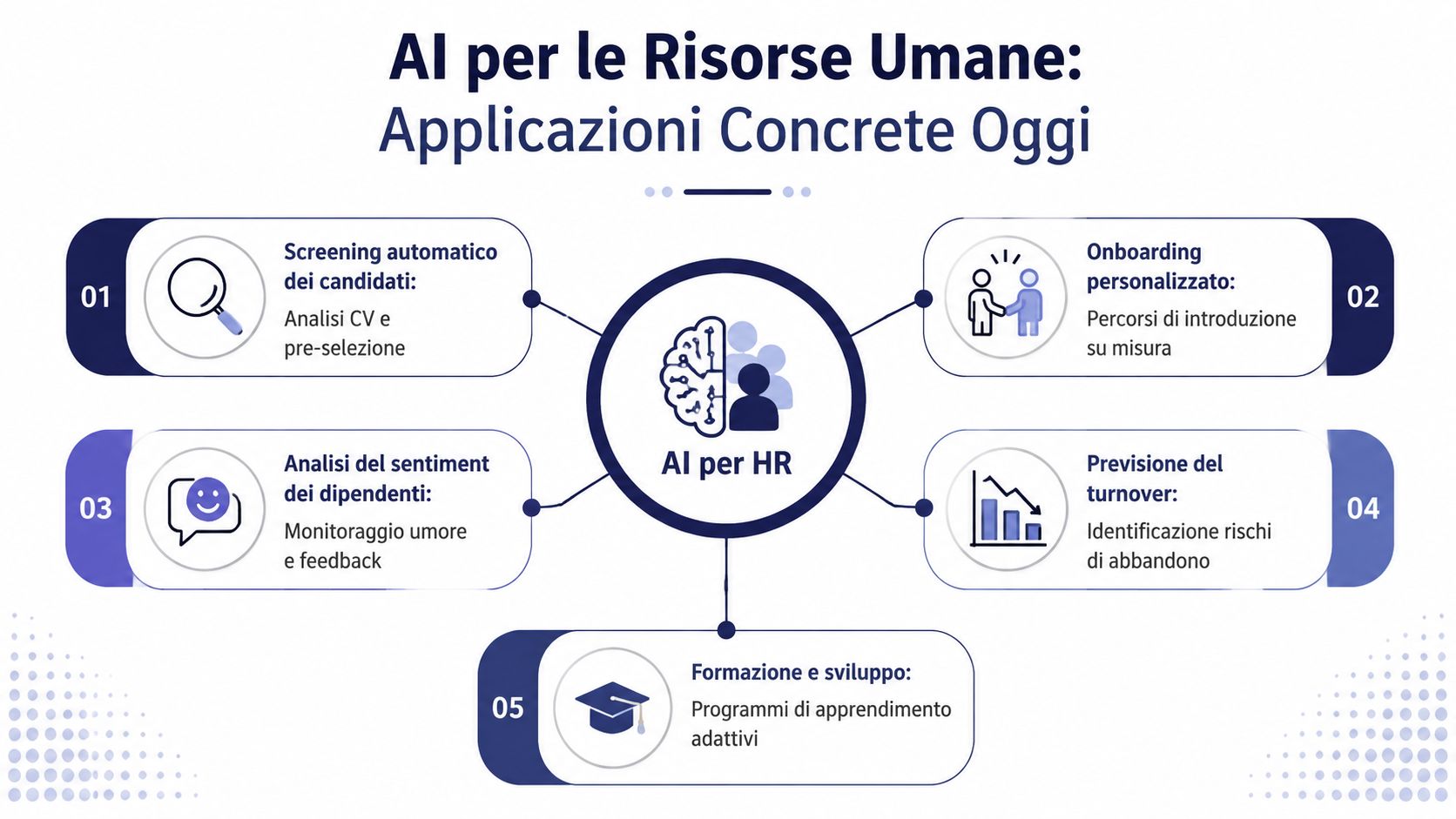
The most common use case is the initial screening of applications. An LLM reads resumes and job descriptions, compares skills, experience, and semantic cues, and then compiles a ranked shortlist.
In practice, it works well when the role is fairly standardized. I’m thinking of administrative positions, customer support, inside sales, and software development with a defined tech stack. If you describe the requirements clearly, the model greatly speeds up the first step.
It doesn't work as well when the factors in question are difficult to extract from a resume.
Rule of thumb: Use AI to narrow down 500 CVs to a more manageable list. Don't use it to decide on its own who deserves a final interview.
The second use case is less obvious, but often more useful. HR teams spend a large portion of their time on repetitive tasks. According to Tommaso Maria Ricci’s analysis of AI in human resources, HR teams devote between 40% and 60% of their time to tasks such as vacation requests, payroll, and company policies. HR chatbots can free up as much as 2–3 hours per day for more strategic activities.
The value here is immediate. An internal chatbot answers questions about remaining vacation days, documents, procedures, expense reports, policies, and administrative onboarding. The benefit isn’t just the time saved by the HR team. It’s also the quality of the employee experience—employees get a quick response instead of waiting for an email.
Where AI really shines is in the analysis of long, rambling texts. Internal surveys are a perfect example. Instead of manually reading through hundreds of open-ended responses, the model identifies recurring themes, sentiment, emerging issues, and patterns worth exploring further.
The most useful applications I see in small and medium-sized businesses are these:
Job descriptions and policies
The AI generates a coherent first draft, which the HR team then revises to ensure legal and cultural compliance.
's Customized Onboarding: It can tailor content, materials, and sequences based on role or department.
Skill mapping
Helps map existing skills and training gaps, especially when data is scattered across resumes, performance reviews, and managerial notes.
Climate Analysis: Transforms unstructured text into useful insights to help identify where action is needed.
There is also a growing distinction between generalist models and vertical models. On the vertical side, Wisq has built HRLM as a model specifically for HR. On the generalist side, GPT, Claude, and Gemini are already being used in many companies for operational HR tasks with well-designed prompts. The difference, however, lies not only in the quality of the output. It lies in governance.
The worst way to implement AI in HR is to think in absolutes. Zero automation leaves you with slow processes, an operational backlog, and decisions based on incomplete information. Total automation leads you to the opposite mistake: treating people and job applications as tickets to be sorted.
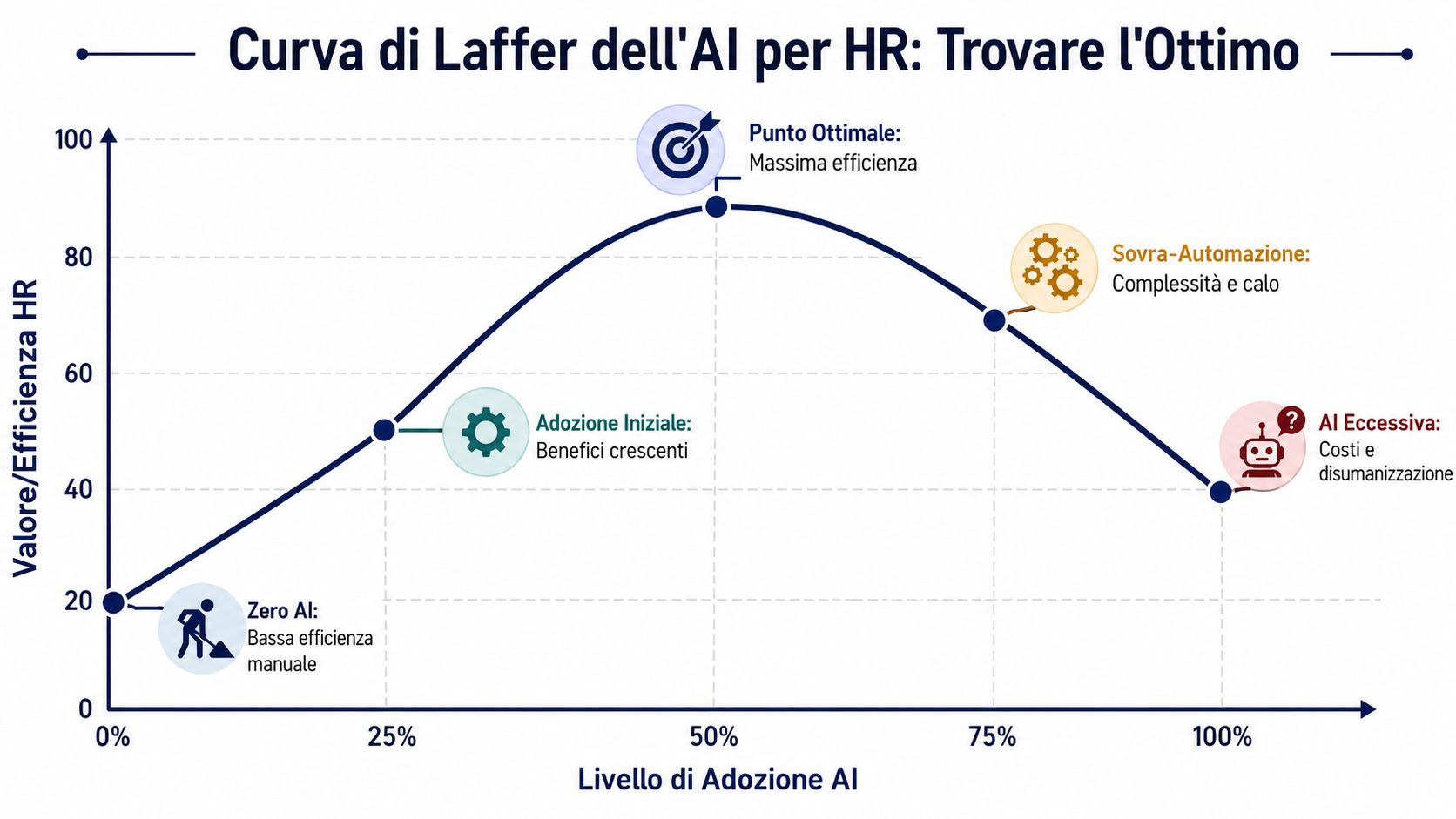
The Laffer curve metaphor works well here, too. At first, every instance of AI adoption generates efficiency. Automate internal FAQs, first drafts of documents, text analysis, and preliminary CV rankings. The value increases.
Then you reach a tipping point. If you keep entrusting the algorithm with increasingly sensitive tasks, its value begins to decline. Not because the model is useless, but because the risk increases faster than the benefit.
According to Workday’s overview of AI in HR, the main reasons for adoption are improved decision-making (41%), automation of repetitive processes (35%), and improved retention and employee experience (32%). These figures clearly explain why AI is so appealing to HR. But they don’t tell us where to draw the line. This is the point that’s often missing from the discussion.
The greatest value doesn't lie in replacing the HR team. It lies in helping them work more efficiently and quickly on the right tasks.
To find the optimal point, I use a simple distinction between mechanical tasks and decision-making tasks.
| Type of business | Recommended AI Level | Human supervision |
|---|---|---|
| FAQ: Employees, Vacation, Policies | High | Low, with periodic checks |
| Draft job descriptions | High | HR Review Required |
| Initial Resume Screening | Media | Human review is always present |
| Evaluation of Finalists | Low | High |
| Promotions, critical performance, individual exit risk | Very low | Fully Human Decision |
If you run an SME, the optimal approach is usually not technical. It’s organizational. You need to clearly decide where AI should make suggestions, where it should issue commands, where it should summarize, and where it should not make decisions.
Three questions can be very helpful:
The most dangerous aspectof AI for HR isn't the technology itself. It's its false aura of neutrality. When a recruiter evaluates a candidate, everyone knows that evaluation involves some degree of subjectivity. When a system assigns a score, many people stop asking questions.

This is the crux of the problem with algorithmic bias. If you train or configure a system using historical hiring data, the system tends to replicate the patterns that already existed in that data. If the company’s history has favored certain profiles and penalized others, the algorithm can do the same thing more quickly and in a less obvious way.
The Amazon case has become emblematic precisely for this reason. The company had to withdraw a resume-screening system that disadvantaged female candidates. This is not some isolated, curious incident. It is the predictable consequence of an approach that uses the past as a model of merit.
In Italy, the picture is far from reassuring. According to data published by ELECTE on this topic, only 12% of HR companies with AI systems have implemented systematic bias audits.
A better model does not solve the problem if the data, criteria, or organizational context remain skewed.
For those operating in Europe, this is not just an ethical issue. It is a legal issue. Article 22 of the GDPR grants candidates the right not to be subject to decisions based solely on automated processing when such decisions have significant effects on the individual. HR decisions fall squarely within this sensitive area.
In addition, the European AI Act classifies recruitment and personnel management as high-risk uses. This means much stricter requirements for documentation, transparency, oversight, and risk management compared to the general use of AI for individual productivity.
For an Italian company, the practical implications are clear:
Anyone who is seriously working on these issues should also look into companies' compliance with the AI Act.
The market is splitting into two very different categories. On one hand, there are general-purpose LLMs like GPT, Claude, and Gemini. On the other, specialized models designed specifically for human resources—such as Wisq’s HRLM—are emerging.
For an SME, a general-purpose model is often sufficient. If you need:
A good LLM with well-written prompts can work very well.
The advantage is practical. You can get started right away, spend less, and test quickly. For small HR teams or companies with relatively simple processes, this approach is often the most sensible way to begin.
There is, however, a limitation. General-purpose models are not designed with HR logic in mind, nor do they come with policies specific to your context, nor do they offer implicit guarantees of compliance simply because they are powerful.
If you handle higher volumes, more sensitive processes, or an organization with multiple levels of authorization, vertical models make sense. Not so much because they “understand everything better,” but because they are designed for a narrower scope.
They are usually the preferred choice when:
For an SME with 50 employees, the goal isn't to buy the most sophisticated system. It's to choose a system that the team knows how to use, monitor, and challenge when it makes a mistake.
The right question isn't which model is more advanced. It's which model best suits your operational risk. If the task is low-impact and high-volume, go with a generalist model. If the process involves sensitive decisions and requires structured oversight, the vertical model is worth considering.
The best implementations don't start with predictive recruiting. They start with everyday friction. That's where AI builds internal trust and shows whether the team is truly ready to manage it.
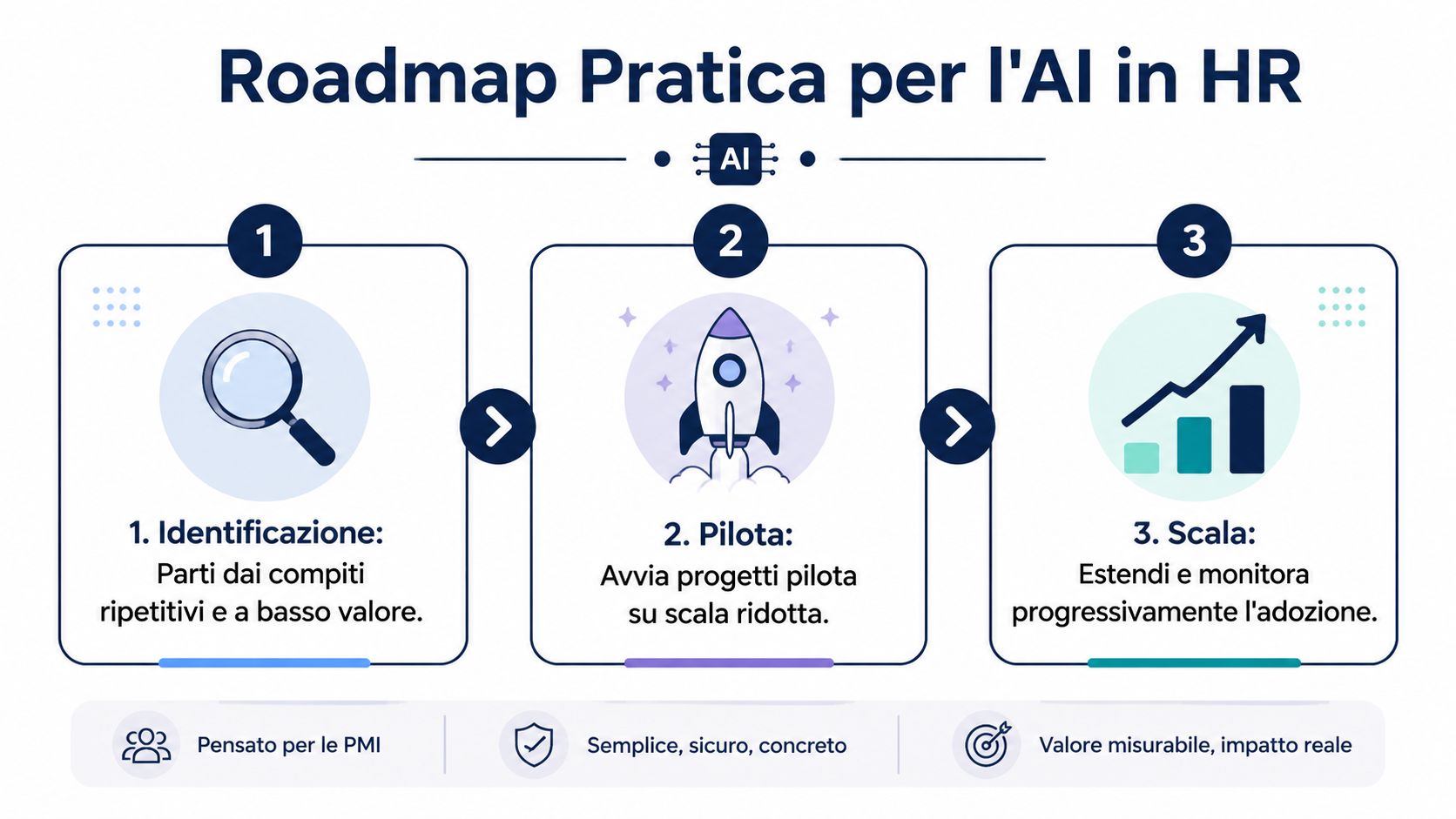
The first step is only trivial at first glance. You should start with high-volume, low-risk activities. If you start there, you’ll immediately see the benefit and limit your exposure.
Three sensible examples:
This approach has a positive effect. The HR team stops viewing AI as an abstract threat and begins to treat it as an operational tool.
The second step is more important than the first. You need to clearly document where the AI makes recommendations and where a human makes decisions.
Minimum governance in SMEs should include:
Decision-making boundary
AI can classify, summarize, and flag items. The manager or recruiter then approves, rejects, or investigates further.
Review Process Every high-impact output must be reviewed by a designated person.
Pre-release bias testing
If the system is used for recruitment or personnel evaluation, it must be tested using representative datasets and documented controls.
Internal Transparency
Employees and candidates must know when AI is used to support the process.
An SME that skips inspections isn't speeding things up. It's just pushing the risk further down the line.
The third step is to scale up gradually. A pilot project focused on a single HR process yields more insights than a broad rollout. First, validate the task; then, the team’s behavior; and finally, the regulatory scope.
For those who want to organize their work effectively, it’s helpful to follow a clear roadmap for AI integration rather than conducting scattered experiments.
To measure the success of AI in HR, it’s not enough to look at speed alone. We need to understand whether it improves the quality of decision-making without introducing risks, errors, or opaque processes.
In SMEs, the most useful criterion is simple: Is AI moving the HR team toward the right point on the Laffer curve, or is it automating tasks that still require human judgment too soon? If the time saved increases but so do disputes, reviews, or doubts about the fairness of the process, the gain is only apparent.
A concrete example is the analysis of internal satisfaction surveys. In many companies, HR manually reviews hundreds of open-ended responses and identifies the main themes—a process that takes a long time and varies somewhat from person to person. With a well-configured LLM, thematic clusters, recurring patterns, and anomalies emerge more quickly.
Here, the real benefit isn't just operational. The team stops wasting hours on summaries and can focus on priorities, follow-ups, and working with managers.
In this case, the useful metrics are few and specific: average analysis time, the consistency of the summaries compared to a random sample of human reviews, and the number of insights that lead to actual actions. If the AI produces quick but overly generic summaries, you’ve already gone past the optimal point.
The opposite scenario is more delicate. A chatbot that conducts the initial interview and assigns a preliminary score without human review may seem efficient, but for an Italian SME, it creates a serious methodological problem—even before we consider the technology.
There are three risks. You may reject qualified candidates based on unclear criteria. You may find it difficult to explain the decision transparently. You may expose yourself to GDPR compliance issues and, in high-impact cases, to the stricter obligations imposed by the AI Act for systems used in the workplace and for employment access.
As I’ve observed in the workplace, the right test is this: Is AI helping us make better decisions, or is it just speeding up a flawed decision? An analysis by ELECTE highlights this very point. Recruitment processes managed solely through automation tend to worsen the actual fit between a person and a role, while final human validation reduces the most costly errors.
Measuring effectively, therefore, means considering four indicators together: time saved, output quality, human correction rate, and compliance risk. If you measure only one of them, you’re usually misjudging the project.
AI for HR really works when it handles the routine tasks and leaves the most difficult task to humans: interpreting context, motivation, potential, and consequences. That’s the sweet spot. Not no AI, not total automation.
For an Italian SME, the priority is not to chase the latest and greatest innovation. It is to build a system that improves efficiency and quality without conflicting with the GDPR, the AI Act, and sound managerial judgment. If you apply this logic, AI becomes a useful multiplier. If you use it as a substitute for judgment, it becomes a risk.
If you want to turn operational data and organizational signals into clearer insights, ELECTE—an AI-powered data analytics platform for SMEs—helps you analyze complex information, automate reports, and make better decisions. To see how it works in practice, you can watch the platform in action and assess whether it fits your processes.

.svg)


.svg)
.svg)