
This is a common scenario. Marketing transfers data from one platform to another, sales updates the CRM at the end of the day, administration waits for the correct files, and the SME’s leadership makes decisions based on information that arrives late or is incomplete. The problem isn’t just the manual work. It’s the fact that each department functions well on its own, but poorly as a whole.
This is whereAI workflow orchestration for SMEs comes into play. Not as a technical fad, but as a practical way to integrate data, applications, and AI models into a single process. For many SMEs, this is the first real leap: moving from automating individual tasks to a system that coordinates activities, priorities, and decisions.
The time is right. SMEs account for approximately 37% of the global AI orchestration market share, and Fortune Business Insights projects that the market will reach $60.34 billion by 2034, according to its AI orchestration market forecast. This tells you one simple thing: it’s no longer just for big companies.
If you’re considering your first major AI automation project, you need less abstract enthusiasm and more practical clarity. You need to understand where to start, who should own the project, how to measure its success, and how to prevent it from becoming yet another experiment that goes nowhere.
Many small and medium-sized businesses have already automated certain processes. An email notification, a weekly report, or an update in the CRM. These are useful steps, but they often remain isolated initiatives. The result is a company with more tools, but not better coordination.
Operational intelligence emerges when these tools begin to work in sequence, guided by clear rules, shared data, and transparent decision-making processes. It’s not enough for a task to simply start on its own. It must begin at the right time, use the correct data, involve the right people, and produce an output that someone can use immediately.
For an Italian SME, this makes a real difference. When a sales rep identifies a high-potential customer, finance assesses the risk, marketing updates the nurturing strategy, and operations prepares the service—there’s no need for four disconnected steps. What’s needed is a single, coordinated workflow.
Automation executes. Orchestration coordinates.
As the company grows, the difference between the two becomes apparent every day. It shows in response times, data quality, the reduction in manual steps, and the ability to make decisions with less friction.
The orchestration of AI workflows is often confused with a simple chain of automations. In reality, it is a more structured process. It is the system that determines when a process begins, what data it uses, which models or agents it activates, the order in which it connects them, and how it handles exceptions, checks, and final outputs.
Think of an orchestra conductor. They don’t play every instrument, but they make sure each musician comes in at the right moment. The same is true in a business. A well-orchestrated system connects CRM, ERP, spreadsheets, APIs, business rules, and AI components in a sequence that has a clear objective.
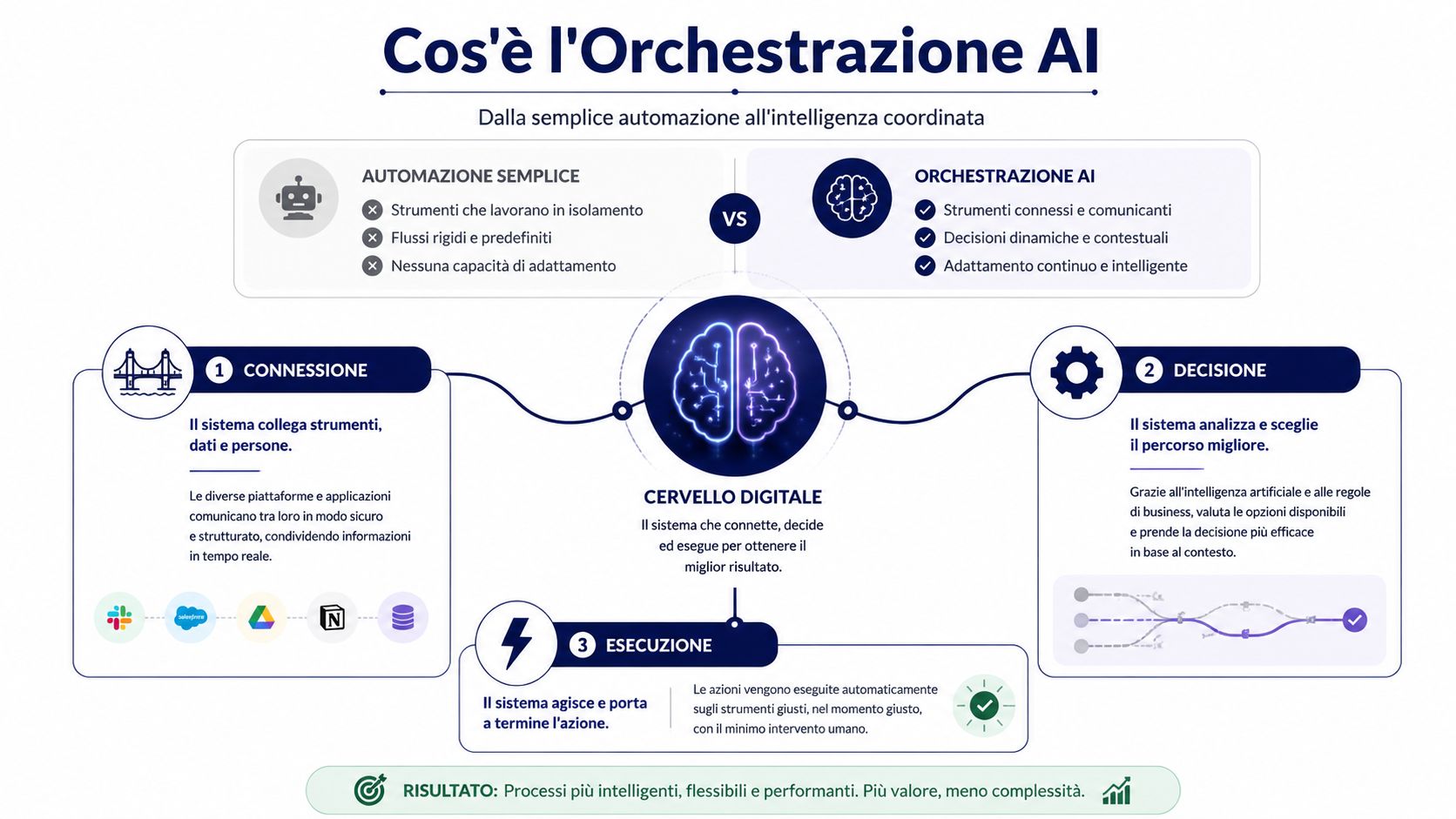
Automation takes a task and performs it in a repeatable manner. For example, it sends an email when a request comes in from the website. It’s useful, but it remains a one-time action.
Orchestration takes an entire process and manages it from start to finish. For example:
In this case, you don’t just have “an automation.” You have a coordinated decision-making process.
To simplify things, it is helpful to break the concept down into four parts.
One of the most common misconceptions concerns the role of AI. AI does not replace the entire workflow. It is used in specific steps where probabilistic judgment, rapid analysis, or decision support is needed. The rest of the process continues to rely on rules, checks, and integrations.
| Element | Practical question | Example in an SME |
|---|---|---|
| Trigger | What triggers the flow | New order or new customer request |
| Pipeline | What steps need to be taken | Validation, analysis, approval, submission |
| AI | Where intelligence is needed | Forecasting, scoring, classification |
| Output | What does the team get? | Alerts, tasks, reports, system updates |
Rule of thumb: if you can't explain the workflow on a page, it's too complex to get off to a good start.
That’s whyAI workflow orchestration for SMEs works best when it starts with simple yet high-impact processes. You don’t need to build a perfect machine. You need to build a machine that’s easy to understand, manageable, and useful.
The first objection I often hear is this: “It sounds interesting, but we’re an SME. We don’t have a dedicated team.” It’s a legitimate concern. That’s exactly why orchestration matters. It helps the people you already have perform better, without increasing manual work or redundant steps.
Companies that adopt AI-powered workflow automation report savings of 10–15 hours per employee per week, and 74% note significant improvements in overall operational efficiency, according to an analysis of SME productivity with AI workflows. For an SME, this doesn’t just mean “getting things done faster.” It means freeing up time for activities that help the business grow.

The most obvious benefit is the elimination of bottlenecks. When a process relies on manual exports, email checks, and scattered approvals, even a single delay can bring everything to a standstill. Orchestration brings order to the process.
The business benefits are particularly evident here:
For those assessing the impact on operations, the overview of AI solutions for SMEs on ELECTE provides a clear picture of the transition from manual reporting to more continuous decision-making processes.
For many small and medium-sized businesses, the real barrier isn’t interest. It’s the fear of having to build a complex infrastructure. This is where the cloud is a game-changer. Cloud platforms reduce the initial technical burden, speed up implementation, and make it easier to integrate existing data and applications.
In practice, the cloud lets you get started without having to build everything from scratch. This is one of the reasons why orchestration is no longer the exclusive domain of large organizations with extensive IT departments.
When a process is well-organized, the team doesn’t work harder. It works with less friction.
Beneath the surface, a complex system of coordination appears to be at work. For a manager, however, it’s not necessary to know every technical detail. What matters is understanding the logical flow: where the data comes in, what happens along the way, and how it leads to a useful outcome.
Well-designed architecture transforms scattered data sources into actionable insights. It doesn’t require you to hunt down files, check formulas, or juggle disconnected dashboards. Instead, it presents you with a process that has already done the heavy lifting of linking and preparing the data.
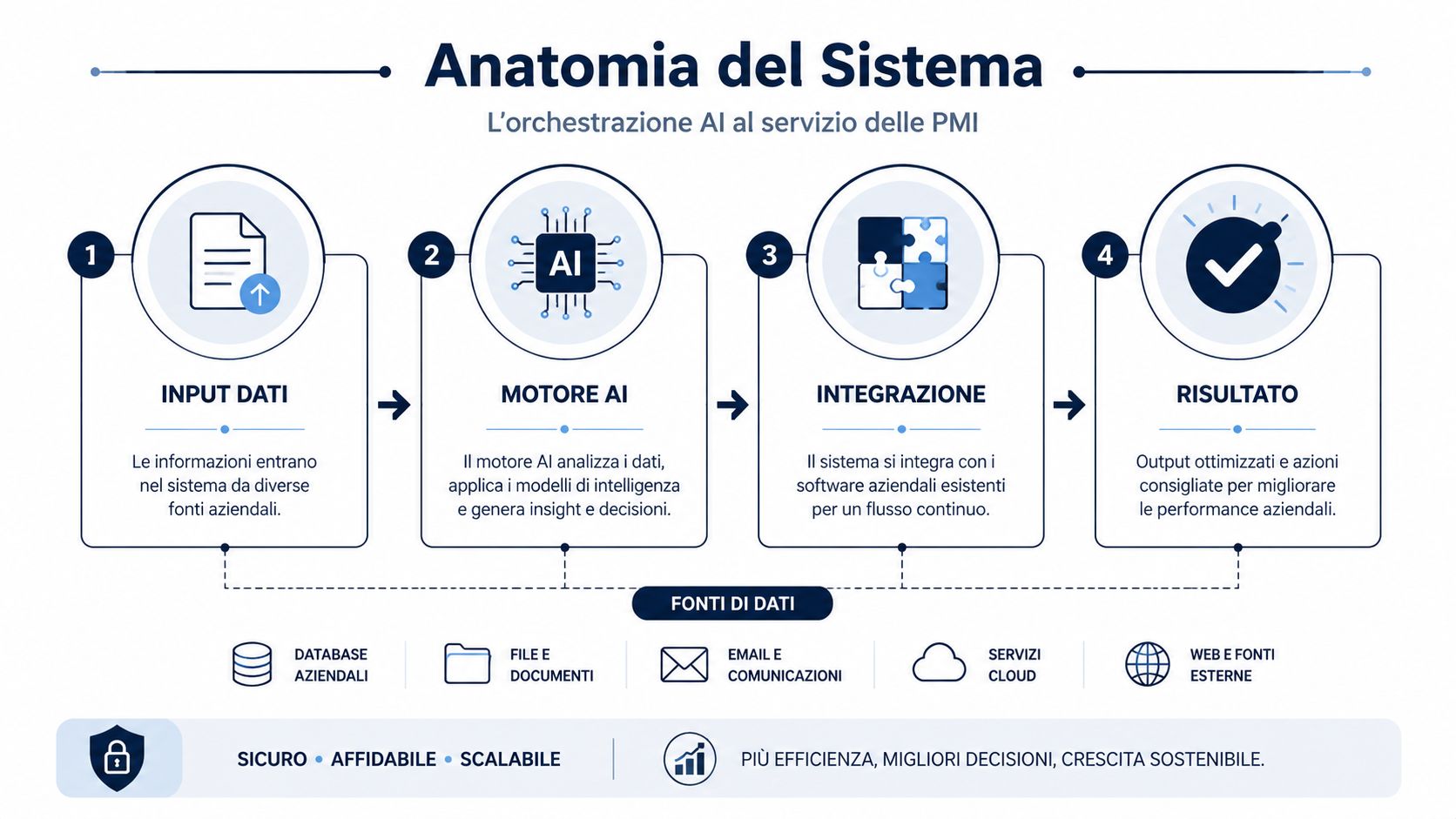
A typical system for SMEs follows a fairly straightforward path.
1. Data Input
Data is sourced from CRMs, ERPs, e-commerce platforms, databases, CSV files, spreadsheets, or vertical applications. Data quality is of the utmost importance here. If the input is fragmented, the workflow starts off on the wrong foot.
2. Pre-processing
This step cleans, normalizes, and standardizes the data. For example, it reconciles customer names written in different ways, removes duplicates, aligns dates, and fills in missing fields whenever possible.
3. AI Engine
This is where the right model is matched to the right task. Sales forecasting, ticket classification, anomaly detection, risk assessment, priority recommendations. It’s not just “any old AI.” It’s an engine tailored to a specific decision.
4. Integration Logic
The result must be fed back into the business workflow. A score can update the CRM, an alert can create a task, and a forecast can trigger a stock review.
5. Readable output
Reports, dashboards, notifications, approvals, or automated actions. Value is only realized when the result reaches someone clearly and at the right time.
Many SMEs get stuck because they approach architecture from the wrong angle. They see APIs, pipelines, models, and orchestrators, and assume they need a complex software project. In reality, management should focus on five key requirements:
The technical aspects should be handled behind the scenes. If you want to understand which connections really matter in a realistic project, ELECTE page on data and application integrations clearly illustrates the key point: an SME doesn’t need to add complexity, but rather to integrate it into a well-organized platform.
| Phase | What happens | Question from the manager |
|---|---|---|
| Input | The system collects data | Does the data come from reliable sources? |
| Preprocessing | Cleans and prepares | Is that information sufficient to make a decision? |
| AI | Analyze or predict | Does the model help in making a concrete decision? |
| Integration | Send the result to the systems | Does the team already receive the output where they work? |
| Output | Generate action or insights | Who should do what next? |
The surest way to fail is to treat orchestration as a “total” project. The surest way to get off to a good start is to choose a well-defined process with a clear problem and a visible impact. In SMEs, initial discipline matters more than ambition.
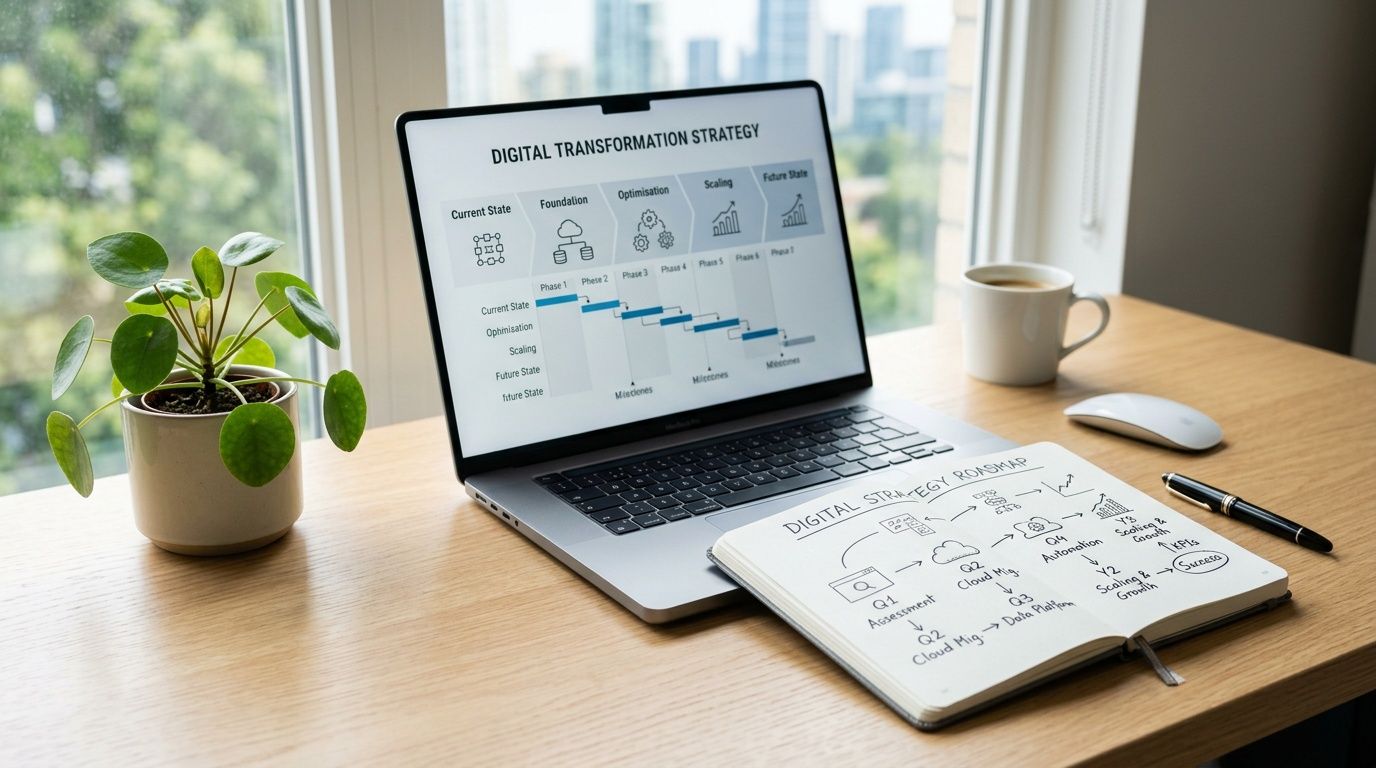
Don’t start with the department that “wants to do AI.” Start with the process where you’re currently losing time, accuracy, or decision-making speed.
A good first candidate usually has the following characteristics:
Common examples in SMEs: sales forecasting, lead management, operational reporting, anomaly monitoring, ticket prioritization, and inventory updates.
This is the point that many technical guides overlook. A workflow doesn’t work just because it “has been set up.” It works because someone is responsible for it.
It assigns three roles, even though in an SME these may be filled by just a few people:
If no one owns the workflow, it won't improve. It will simply continue until it stops being reliable.
To get organized, use a simple table like this one:
| Question | A decision to make |
|---|---|
| Which process should we choose? | A single pilot use case |
| What is our goal? | Clear business results |
| Who approves the workflow | A designated owner |
| Who monitors errors? | An operational contact person |
| When we review the results | A fixed rhythm |
After the pilot, the right approach is short and to the point. Implement, observe, and adjust. Don’t wait until you have the perfect model or the definitive taxonomy. SMEs achieve better results when they use an iterative approach, with frequent reviews and minor adjustments.
Use cases help turn theory into action. If you can visualize a workflow in your industry, it becomes much easier to understand priorities, responsibilities, and benefits.
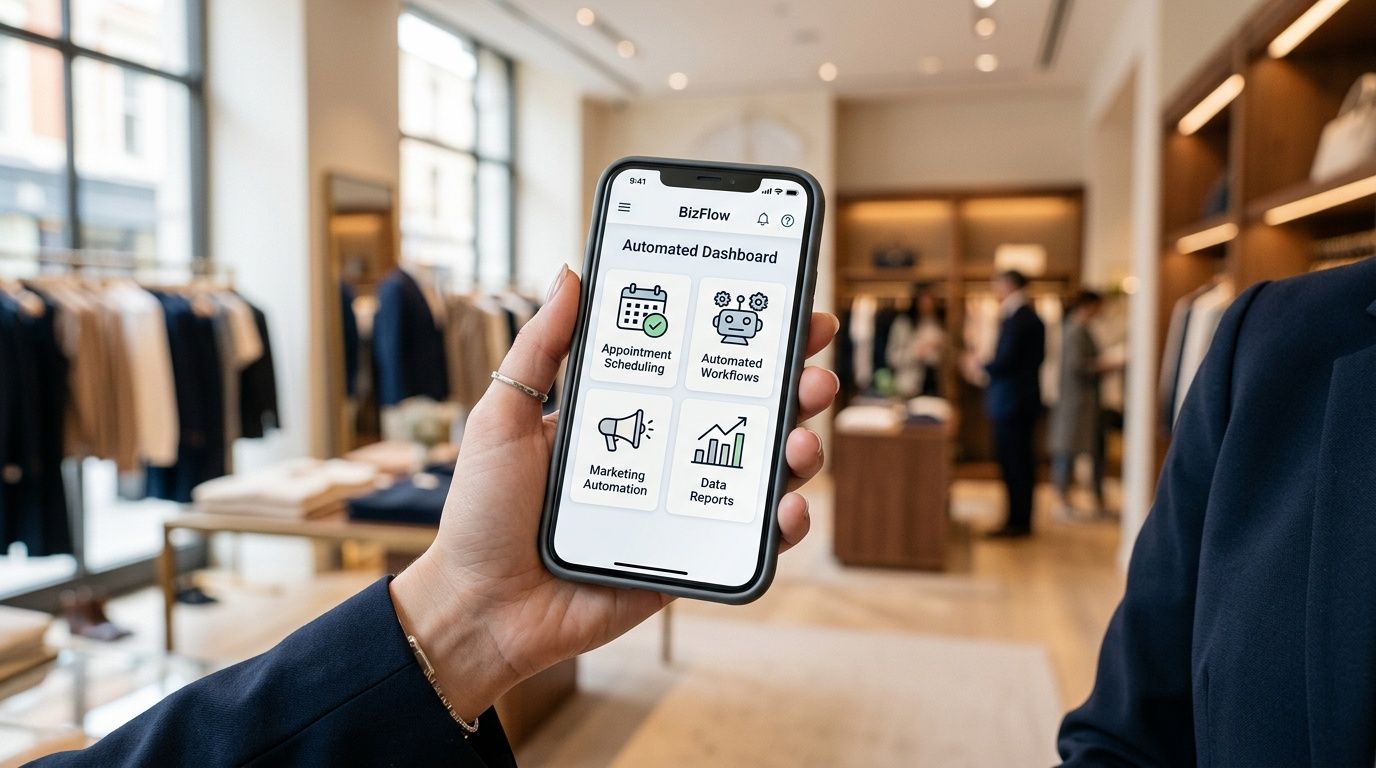
In retail, the problem is often twofold. On the one hand, there’s inventory. On the other, there are promotions and rapidly changing demand. Many small and medium-sized businesses respond with manual checks, periodic updates, and delayed decisions.
An orchestrated workflow can follow a simple logic:
The benefit here isn’t just “better forecasting.” It’s about integrating forecasts into day-to-day decision-making. In a case study of 250 SMEs in Lombardy, orchestrated sales forecasting workflows led to a 47% reduction in operational errors and an average ROI of 28% on operating costs within 90 days, as described in the case study on Lombardy SMEs and AI orchestration.
With ELECTE, this type of scenario is particularly useful when the team does not want to manage separate tools for analysis, forecasting, and reporting. Data is collected, prepared, and transformed into actionable insights without requiring management to keep track of the technical details of each step.
In finance for SMEs and specialized professionals, the challenge is different. The point isn’t just to speed things up. It’s to speed things up without losing control.
An orchestrated workflow for risk assessment can:
The practical benefit is that teams no longer have to chase down scattered documents and checks. They have a clear path, with well-defined steps and consistent outputs.
In finance, effective automation doesn't eliminate human oversight. It focuses it where it really matters.
Retail and financial services share a common characteristic. They involve recurring processes, sensitive decisions, and numerous interdependencies between data and people. This makes them excellent candidates forAI workflow orchestration for SMEs.
When the workflow is well-designed, AI doesn’t replace teams. It reduces the amount of preparatory work, helps prioritize tasks, and streamlines the process of turning data into action.
An SME doesn’t need a dashboard full of technical metrics. It needs just a few key metrics that help determine whether the project is improving the business. The right question isn’t “Is the workflow running?” The right question is “Is it saving time, reducing errors, speeding up decisions, or improving margins?”
Measurement works best if you divide the KPIs into three groups.
Operational Efficiency Here, you’ll see tasks being eliminated or streamlined. Time saved on manual steps, reduced handoff times, faster report generation, and a shorter decision-making cycle.
Economic Impact
In this category, include avoided operating costs, the value of decisions made more quickly, and reductions in waste or redundant activities. If the workflow helps sales teams prioritize more effectively or helps retail teams manage inventory better, the impact should be reflected in the income statement or in process costs.
: Quality and Reliability This includes fewer errors, more consistent data, less rework, higher compliance standards, and reduced reliance on individual memory.
A good management dashboard is concise. It doesn’t show everything. It shows what’s needed to support a decision.
Here's how you can organize it:
A useful KPI should drive action. If it doesn't guide a decision, it's just noise.
The most practical rule is this: measure the process first, then the technology. A management team doesn’t buy an orchestration tool just to have a sleek pipeline. It adopts it to better manage the work.
The adoption of AI in SMEs doesn't usually stall because of the technology. It stalls because of trust, accountability, and control. If the team worries that no one can explain how a workflow works or who should manage it when something changes, the project slows down.
Every AI workflow involves at least three sensitive issues: personal data, company policies, and human oversight. That’s why it’s helpful to establish some basic best practices right from the start:
Minimal governance shouldn't be burdensome. It should be clear.
This is one of the most underestimated risks. A critical challenge for SMEs is the “no one owns the model” issue: AI workflows that become ineffective because there is no clear organizational accountability for their management, monitoring, and continuous learning, as highlighted in the analysis of the organizational problem of ownership in AI workflows.
The issue isn't just technical. It's organizational. If no one decides when to update the workflow, who checks for errors, who collects feedback, and who evaluates the results, the system remains active but ceases to be useful.
To avoid this, every workflow should include at least the following rules:
| Topic | Question requiring clarification |
|---|---|
| Ownership | Who is responsible for the business results? |
| Monitoring | Who monitors exceptions and anomalies |
| Revision | When the workflow is reviewed |
| Documentation | Where logic and responsibility are written |
| Escalation | What happens if the workflow fails? |
Compliance doesn’t start with the regulator. It starts when everyone in the company knows who makes decisions, who oversees them, and who takes action.
The central idea is simple. Orchestration is not a standalone IT project. It is a more mature way of organizing decisions, data, and responsibilities.
SMEs don’t need to chase every new AI trend. They need to make better use of what they already have: data, people, tools, and processes. Orchestration is the step that transforms scattered automations into a smarter operating system.
When the workflow is clear, the results are more useful to the business. Teams spend less time on repetitive tasks, managers have a better view of what’s happening, and decisions are made more quickly and consistently.
This is the true value ofAI workflow orchestration for SMEs. No more complexity. More coordination.
If you want to get off to a good start, don’t think about the biggest project possible. Choose the right process, assign ownership, define the KPIs, and build the first workflow that your team will actually use.
If you want to turn scattered data into clearer operational decisions, check out how ELECTE can support your first AI orchestration project with analytics, forecasting, and automated reporting designed for SMEs.

.svg)


.svg)
.svg)