

You already have the data. The problem is that it’s scattered across your CRM, Excel spreadsheets, business management system, marketing campaigns, and operational reports. Every week, someone on the team tries to piece it all together, but the results often come too late—or show up as a dashboard full of numbers that don’t explain what to do next.
For many Italian SMEs, this is the reality. The data exists, but it doesn’t translate into decisions. Meanwhile, the pressure is mounting. There’s a need for more reliable forecasts, less manual work, and faster identification of useful signals—from customers at risk of churning to products that are losing momentum.
Data analysis using artificial intelligence is becoming the most concrete solution to this operational bottleneck. Not because it replaces managerial judgment, but because it makes it easier to identify patterns, estimate future scenarios, and synthesize insights in a timely manner. It is no coincidence that Istat is investing in artificial intelligence as a strategic lever to innovate statistical processes, leading to greater efficiency and quality. This is a clear signal. In Italy, the adoption of AI in data management is no longer just an experiment.
In this guide, you'll find a practical roadmap designed for business leaders and team managers who want to understand how to use AI as a true virtual analyst. No abstract theory here—just concrete steps, simple examples, and useful guidelines to get you off to a good start.
On Monday morning, Marco opens the business management software, then an Excel file, then the advertising platform. He’s looking for a simple answer: where are we making money, and where are we losing ground? The data is there, but it’s scattered. It takes time to piece it all together. Often, by the time the problem becomes clear, the week is already underway, and the decision comes too late.
SMEs don't suffer from a lack of data, but because the data remains siloed, requires manual steps, and rarely serves as an immediate guide for decision-making. The result is a reactive approach. They look at what happened yesterday, while management needs to understand what deserves attention today.
Data analysis using artificial intelligence changes the pace of work. It doesn’t just show numbers. It connects scattered signals, recognizes recurring patterns, and brings to light exceptions that can impact sales, margins, or operations. For an SME, the real benefit isn’t receiving more reports. It’s reducing the time between a signal, its interpretation, and taking action.
For many Italian companies, the issue isn't about building an in-house data science department. The point is to make an existing function smarter: analyzing data to make better decisions.
This applies directly to areas such as:
In practice, AI analytics provides small and medium-sized businesses with capabilities that previously required time, specialized expertise, or many hours of manual analysis.
AI does not replace managerial judgment. It makes it faster, more informed, and less prone to blind spots.
Many entrepreneurs associate AI with complex tools, lengthy projects, and technical jargon. For an SME, it makes sense to adopt a more down-to-earth approach: a virtual analyst who works alongside the team.
It functions like a collaborator that collects data from multiple sources, organizes it, flags anomalous variations, and prepares an initial analysis for validation. A framework of this type—similar to that of an AI agent used as a virtual analyst—makes the analysis more accessible even to non-technical teams. There’s no need to start with abstract algorithms. Instead, start with operational questions: Which customers are slowing down? Which campaigns are wasting budget? Which signals foreshadow a margin problem?
Overcoming this mindset is the decisive step: we must shift from the idea of “complicated software” to that of “enhanced business functionality.” When this happens, data ceases to be an archive to be consulted after the fact and becomes a daily tool for making better decisions, more quickly, and with a clearer operational return.
The most common mistake is to confuse AI with a fancier dashboard. That's not the case. The real difference lies between simply looking at data and querying it as if you had a tireless analyst working alongside you.
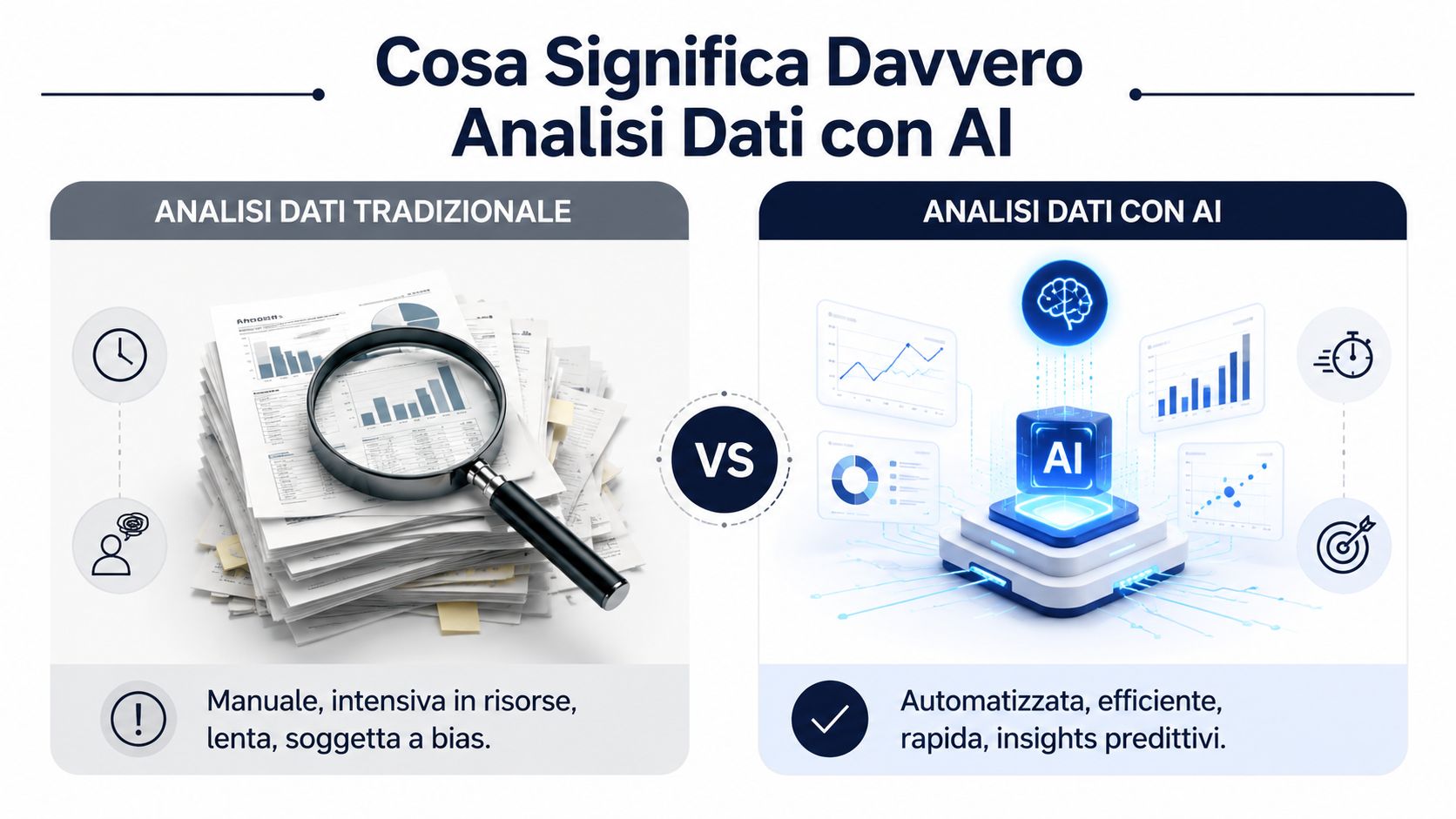
Traditional business intelligence mainly tells you what happened. For example: “Sales dropped in a certain area last month” or “The cost per acquisition went up.” It’s useful, but it remains descriptive.
Data analysis using artificial intelligence takes it to the next level. It also tries to answer questions such as:
It is the transition from a still image to a dynamic interpretation.
Think of a very skilled human analyst. First, they gather data from various sources. Then they clean it up, eliminate errors, look for correlations, compare time periods, identify exceptions, provide commentary, and finally propose a hypothesis. AI does something similar for many repetitive tasks, but with a speed and consistency that a small team would struggle to maintain on its own.
The difference isn't just about automation. It lies in the ability to:
| Approach | What does it produce? |
|---|---|
| Manual reading | Reports, filters, spot checks |
| AI Analysis | Patterns, predictive signals, narrative summaries, alerts |
Rule of thumb: If your team spends more time preparing data than discussing its meaning, AI can already make a difference.
This is where many readers get confused, and that's normal. There are different roles involved in working with data.
Predictive AI is primarily used to estimate probabilities based on future data. It is the most useful tool for forecasting sales, conversion rates, churn, or demand.Generative AI, on the other hand, is often used to write comments, explanations, and narrative summaries based on analytical results. These are two complementary capabilities.
For a manager, this distinction is easy to remember:
When these two components work together, the data becomes more accessible even to non-technical teams. You don’t need to know SQL or build models from scratch to gain useful insights. All you need is a clear business question and a system capable of transforming data into actionable insights.
The technologies behind AI-powered data analysis seem complex as long as you describe them in abstract terms. In practice, you can think of them as business functions. Each one solves a different kind of problem.
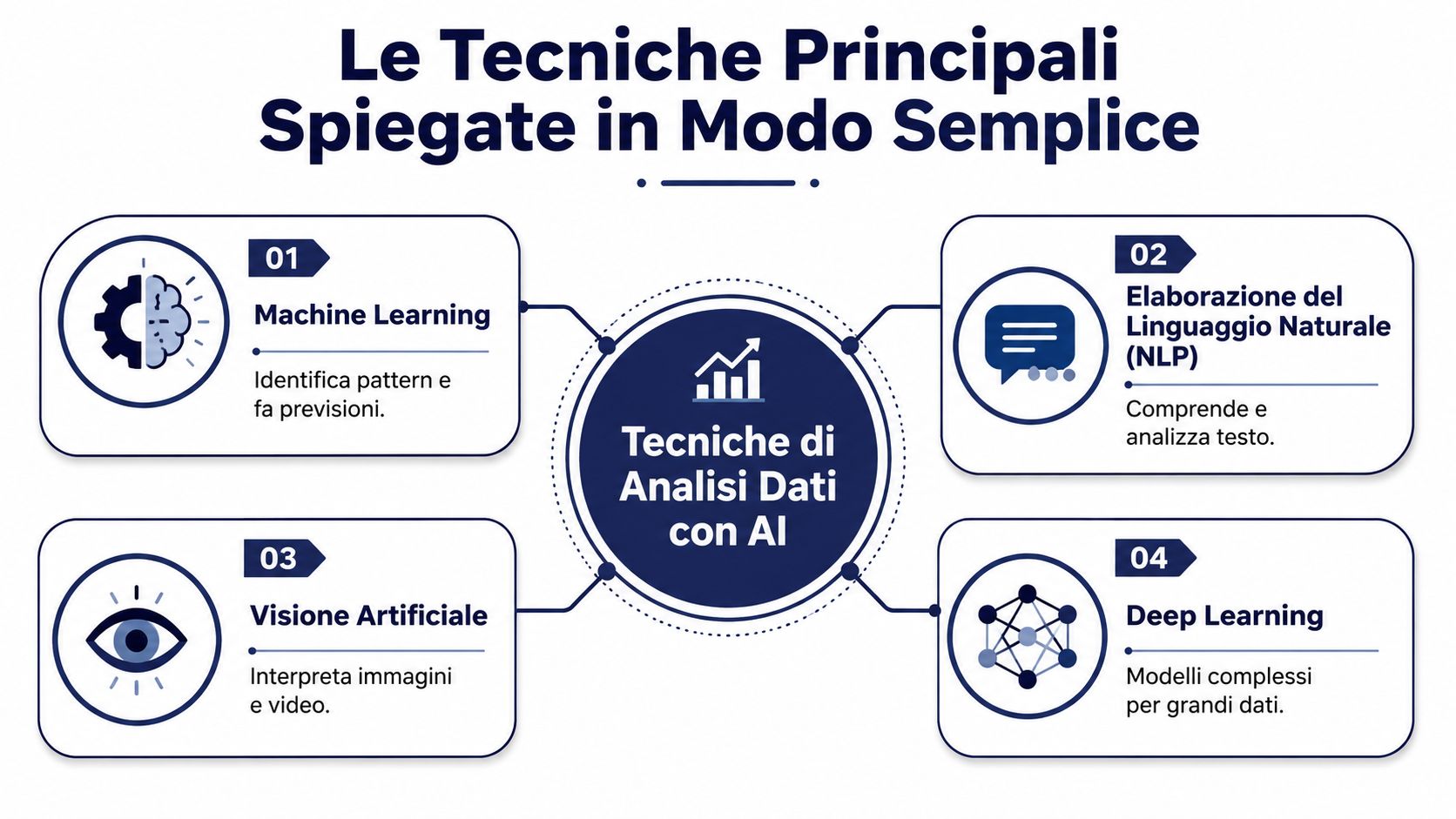
Machine learning is a process that learns from historical data. It does not “understand” in the same way a person does, but it recognizes recurring patterns and relationships.
Here’s a simple example. A retailer wants to understand which customers tend to make repeat purchases after a promotion. A machine learning model analyzes purchase history, frequency, seasonality, product categories, and response to offers. This reveals similar customer groups and useful insights for more targeted campaigns.
If you want to learn more about the logic behind the most commonly used models, the ELECTE Guide to Machine Learning provides a useful overview that helps connect technical concepts with practical applications.
Forecasting is the most intuitive use of AI analytics. It uses historical data to estimate future scenarios. It’s not a crystal ball. It’s a system that measures probabilities and trends.
For an SME, this may mean:
Alongside forecasting is anomaly detection. Here, AI acts as an alert system. It looks for unusual behavior that warrants investigation, such as a sudden spike in returns, unexpected marketing spending, or a suspicious transaction.
If a manager has to spot an anomaly only by manually reviewing a report at the end of the month, the problem isn't the data. It's the process.
Many companies think of data as nothing more than rows and columns. But a significant portion of the information exists elsewhere: emails, reviews, support tickets, sales reports, documents, customer chats, and consultant notes.
This is where techniques such as NLP and language models come into play. The goal is to transform text and conversations into actionable insights. For example:
This area is still greatly underutilized. Sixty-eight percent of Italian companies in the retail and finance sectors do not take advantage of AI’s ability to analyze unstructured data such as text and conversations. This is a real missed opportunity, because the most valuable strategic insights often lie not in traditional KPIs, but in the language of customers, suppliers, and internal processes.
When evaluating a platform or project, ask yourself which of these features you really need:
You don't need to implement everything at once. For many small and medium-sized businesses, starting with a single high-impact initiative is the smartest choice.
Theory is only interesting to a certain extent. An entrepreneur or manager wants to understand where the benefit lies. The answer is simple: AI analytics is valuable when it shortens the time between data and decision.
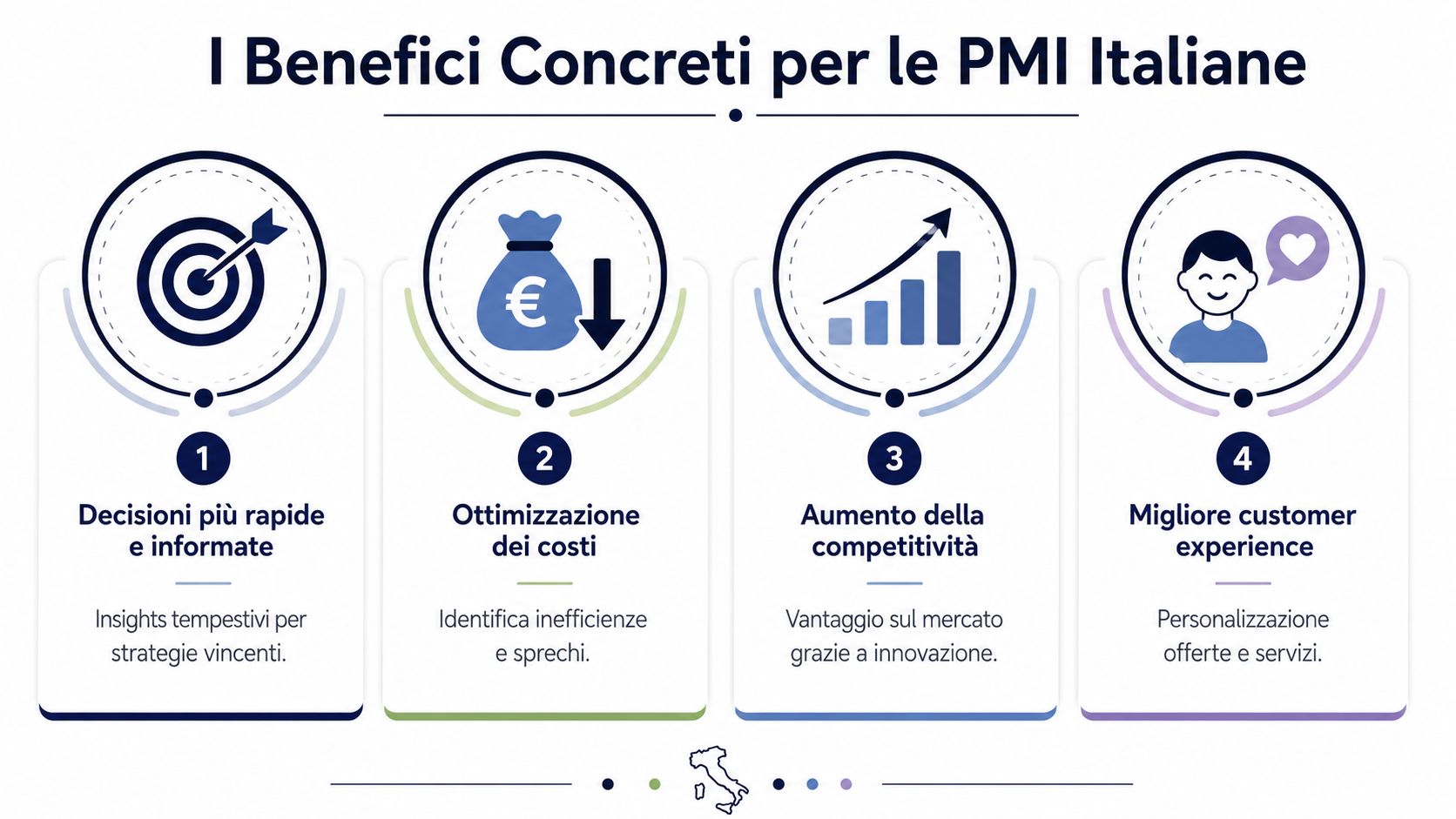
The most immediate benefit is efficiency. According to Myndo, by 2026, the use of mature AI tools for data analysis will reduce analysis time by 50–70%, freeing companies from their reliance on dedicated data analysts and allowing them to focus on higher-value activities such as predictive modeling.
For an SME, this means less time spent on:
And more time for activities that truly impact the business. For example, redefining a promotion, adjusting a sales forecast, reviewing the product assortment, or identifying at-risk customers.
The point isn't to “do more analysis.” The point is to make decisions sooner and better.
A retail manager can use these insights to optimize inventory and promotions. A finance team can spot risk signals or budget deviations more quickly. A marketing manager can shift the focus from retrospective reporting to segmentation and response forecasting.
AI becomes strategic when it reduces friction in the decision-making process, not when it adds technical complexity.
There is also an organizational benefit that is often underestimated. When insights are presented in a clearer, more concise format, they can be discussed in meetings by people in different roles. Sales, finance, and operations can all start from the same framework, rather than each bringing their own file.
This does not automatically guarantee results, and no platform should promise that. However, it creates a much more favorable environment: fewer isolated interpretations, greater operational alignment, and faster action.
Many people think that data analysis using artificial intelligence requires a lengthy, technical project involving complex integrations. In reality, the workflow can be very straightforward if you look at it from a decision-maker’s perspective.
The first step is to connect the data sources already in use at the company. These typically include CRM systems, spreadsheets, ERP systems, e-commerce platforms, advertising systems, or internal databases. The goal isn’t to create a perfect database. It’s to build a foundation that’s organized enough to support reliable queries.
Then comes the part that most often takes up hours of human labor: preparation, cleaning, and labeling. This is where AI agents prove to be truly useful. Cloud-based AI agents automate repetitive tasks such as data cleaning and labeling, enabling business users to analyze large volumes of information and predict outcomes using natural language, while reducing operating costs.
This changes the pace of work. Instead of waiting for someone to manually clean up the dataset, the team can focus on business questions:
To help you better navigate this step, you may also find a practical guide to analysis for small and medium-sized businesses useful.
The most useful model for understanding them is this one. The agent isn't just a chatbot that responds. It's an operational entity that analyzes data, performs repetitive tasks, flags relevant events, and provides insights ready for action.
A platform like ELECTE—an AI-powered data analytics platform for SMEs—fits right in here. It connects data sources, automates pre-processing, generates insights, and supports reporting and forecasting without requiring a dedicated technical team.
A typical workflow looks like this:
Connecting data sources
The data comes from systems already in use. There’s no need to start from scratch.
Automated Preparation: The agent helps standardize, clean, and organize the information.
Analysis and Forecasting The system identifies patterns, estimates future scenarios, and highlights anomalies.
Natural-language querying
Managers and teams can ask questions without having to use technical queries or procedures.
Operational Action The insight is turned into a decision: adjust the budget, review inventory, and take action on at-risk customers.
A good flow of AI analytics does not replace human judgment. It makes it faster and more informed.
This approach is particularly effective when the team wants to reduce friction, not add another layer of technical complexity. If the platform requires specialized expertise for every change, the benefit is lost for many SMEs.
Enthusiasm for AI can lead to a simple mistake: thinking that all you need to do is activate a platform to gain reliable insights. It doesn't work that way. Projects succeed when data, process, and governance are taken seriously.
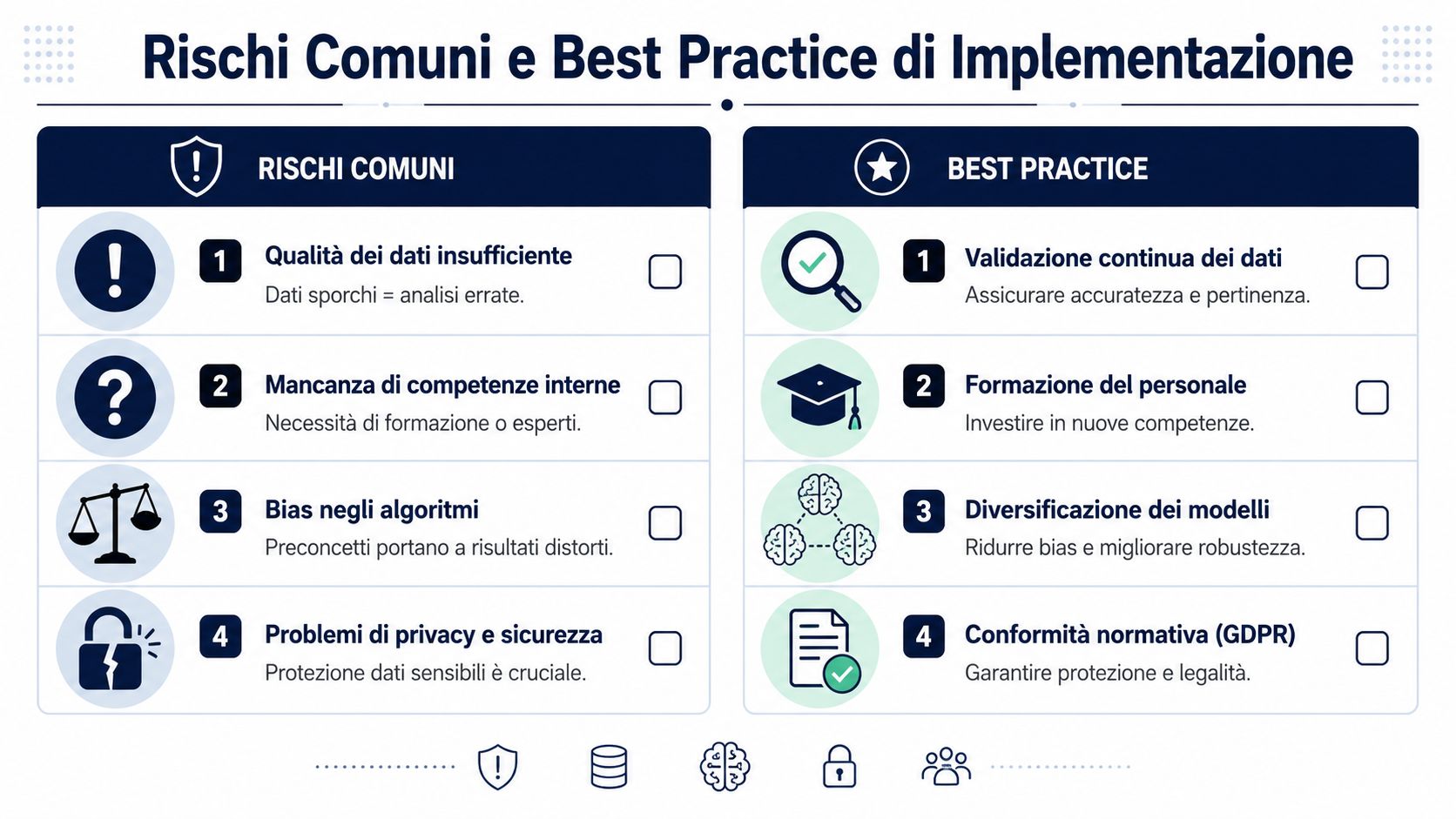
The main risk is also the most obvious one. The effectiveness of artificial intelligence in data analysis depends critically on the quality of the data provided, because poor-quality input directly compromises the accuracy of the predictions and insights generated.
To put it simply: if the CRM is incomplete, if product codes are inconsistent, or if half of the marketing tracking data is missing, even the most sophisticated model will produce unreliable results.
Other recurring problems include:
AI systems speed up work. They do not eliminate the need for oversight, context, and accountability.
People who implement things well usually follow just a few rules, but they really stick to them.
| Best Practices | Why it matters |
|---|---|
| Start with a use case | A specific question yields more useful results than a general project |
| Clean up critical data | We don't need total perfection; we need reliability when it comes to the key factors. |
| Define who makes the decisions | Every insight must have a business owner |
| Compliance Check | Privacy, access, and governance aren't just tacked on at the end |
For teams operating in regulated environments or seeking a better understanding of the European framework, it is helpful to review the AI Act’s requirements and risk classification.
Here is an example of a practical sequence:
This approach reduces the risk of investing energy in a vague promise. And it increases the likelihood that AI will actually become part of everyday processes.
If you've made it this far, you already have a head start. You're no longer viewing AI as an abstract technology, but as a concrete way to speed up reading, forecasting, and decision-making.
To get off to a good start, keep this essential checklist handy:
Data analysis using artificial intelligence works best when it starts not with the technology, but with a well-chosen business question. That’s where the concept of a virtual analyst stops being a metaphor and becomes an operational advantage.
If you want to see how a virtual analyst can transform scattered data into clear, actionable insights, you can find out how ELECTE works. It’s an easy way to assess whether an AI analytics workflow is right for your team, without adding unnecessary complexity.

.svg)


.svg)
.svg)






.webp)