
Is your warehouse still relying on spreadsheets and manual checks? Do you face the risk every day of not being able to find a product requested by a customer, or of having capital tied up in inventory that nobody wants? If the answer is yes, you’re not just wasting time—you’re leaving money on the table.A warehouse management app isn’t just software—it’s a strategic partner that transforms your logistics center from an operational cost into a growth engine. It replaces manual methods, centralizes operations, and gives you full control over inventory, orders, and profitability.
In a market where customers expect immediate delivery and the competition is just a click away, relying on outdated methods is a risk you can no longer afford to take. Managing your inventory manually—using endless Excel spreadsheets or, worse yet, “by heart”—is a recipe for disaster.
This traditional approach is the main cause of costly human errors—incorrect counts, wrong shipments—that damage your reputation and your profits. Not having a real-time view of your inventory leaves you vulnerable to two scenarios, both of which are harmful:
Implementinga warehouse management app means transforming what is currently a cost center into a true driver of growth. It’s not just software—it’s a partner that streamlines workflows, frees up resources, and prepares your small business for the challenges of the future.
The market is moving quickly. Forecasts indicate that by 2026, the logistics sector in Italy will exceed 320 billion euros, driven precisely by innovation in warehouse management. Companies that have already digitized their processes have managed to reduce excess inventory by 20–30%. This change is no longer an option but a necessity to remain competitive. If you want to learn more about how process innovation is the real driver of growth, you can read our article on business process management.
To understand the value of a warehouse management app, you shouldn’t view it as just a list of technical features. The right features are true drivers of change that transform your daily operations, delivering measurable efficiency and a level of control that was previously unimaginable.
Imagine having a GPS for every single item in your inventory. That’s real-time inventory tracking. It’s no longer a matter of “thinking” you have an item, but of knowing for certain where it is, how many units are available, and when it’s time to reorder. A difference that puts an end to the two nightmares of every logistics manager: stockouts, which halt sales, andoverstock, which ties up valuable capital.
The map below clearly illustrates the shift from the chaos of manual management—often reliant on error-prone spreadsheets—to the practical solutions offered by a dedicated app.
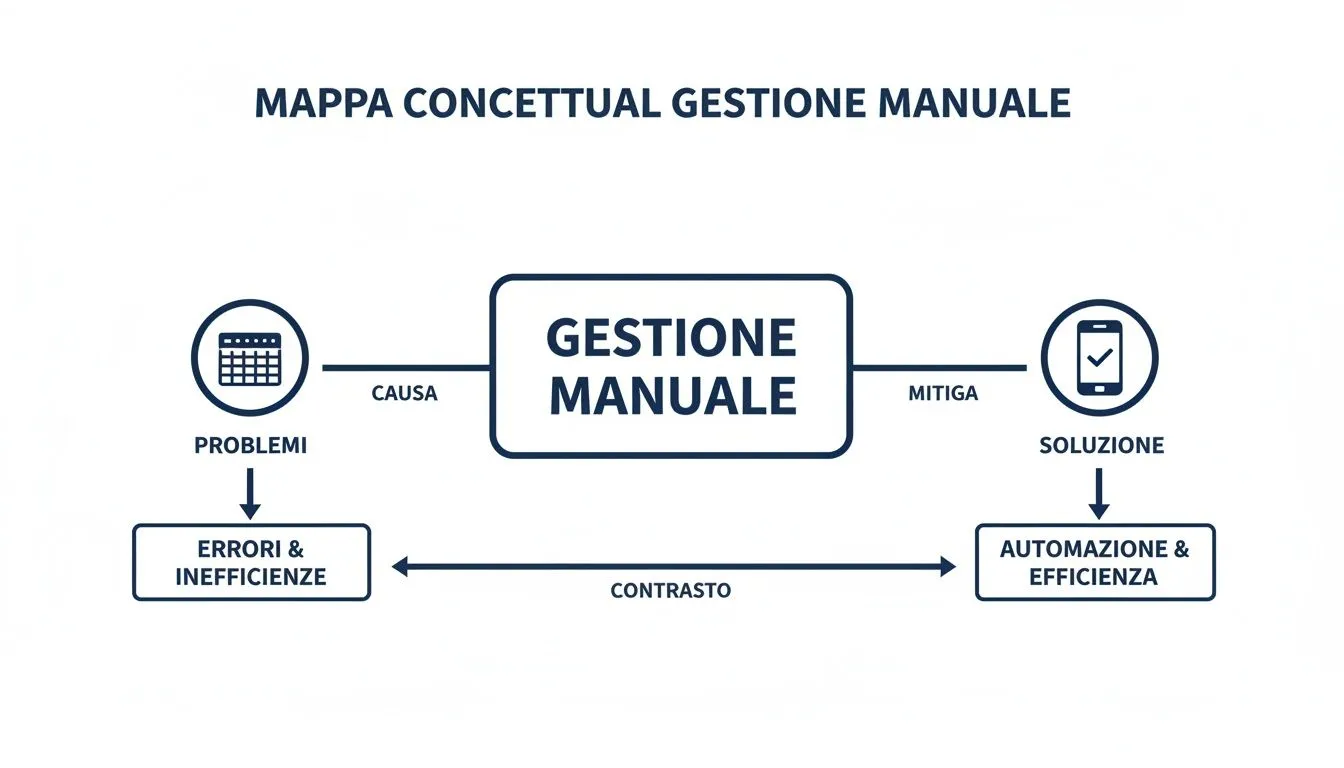
As you can see, the app is more than just software: it centralizes data, automates processes, and gives you complete visibility into everything, addressing at the root the inefficiencies and human errors typical of traditional systems.
Let’s see how these features have a tangible impact on your day-to-day operations:
To give you a clearer picture, this table summarizes the key features, the direct benefits for an SME, and the key performance indicators (KPIs) that allow you to measure their impact.
A warehouse management app shouldn’t operate in isolation. Its true power shines through when it connects with the other systems you already use. Integrating it with your e-commerce platform, for example, allows you to automatically update product availability online. No more disappointed customers who bought items that were actually already out of stock.
An integrated system creates a seamless business ecosystem where information flows smoothly between the warehouse, sales, and administration, eliminating the disconnects that are the main cause of delays and misunderstandings.
Similarly, integrating the app with ERP (Enterprise Resource Planning) software ensures that inventory data is always in sync with accounting and billing. This creates a unified workflow, where every department works based on the same up-to-date information.
Adopting new technology is never just a matter of style. For an SME, every investment must have a single goal: to improve business results.A warehouse management app does exactly that, turning operational efficiency into tangible financial benefits that you’ll see reflected in your income statement.
The first and most immediate impact is on cost reduction. Managing inventory with surgical precision means eliminating waste, preventing products from spoiling on the shelves, and making the most of every cubic inch of available space. In short, you cut unnecessary expenses and free up resources to reinvest in growth.

But cutting costs is only half the story. Having complete visibility into your inventory allows you to do something even more important: boost sales. When you know exactly what you have on hand, you can ensure that your most popular products are always in stock and ready to ship.
This prevents stockouts, which aren’t just lost sales. They result in disappointed customers who will likely turn to a competitor next time. Being able to fulfill orders quickly and accurately directly translates into greater customer satisfaction.
A satisfied customer isn’t just someone who comes back to buy again. They’re the best advertisement your company could have. Today, accuracy and speed are key to building a solid reputation.
This operational efficiency sets off a virtuous cycle that fuels growth. For SMEs, adoptinga warehouse management app can unlock potential similar to that seen in the startup world, as demonstrated by the success of companies that secure significant investments—such as the $5 million raised by Brum—a clear sign of confidence in their business model.
Finally, there is the most strategic benefit: the shift to a data-driven decision-making model. A warehouse app isn’t just an operational tool; it’s a goldmine of information.
This data is the fuel for making smart decisions—no longer based on instinct, but on concrete evidence. Analyzing these metrics, much like you would witha financial statement analysis, allows you to optimize your purchasing and plan effective promotions, building a lasting competitive advantage.
Choosinga warehouse management app is a strategic investment that will shape your operations for years to come. There is only one "perfect" solution: the one that fits the unique needs of your small business, both today and tomorrow.
To avoid making mistakes, start with an honest assessment. Imagine your company three to five years from now. Will the solution you’re considering be able to handle twice as many orders? And a much larger product catalog? Scalability isn’t a luxury—it’s the guarantee that your investment will keep pace with your growth, without forcing you to start all over again in a few years.
Choosing a scalable app that is already AI-ready is no longer an option, but a strategic necessity. The efficiency you achieve today must become the foundation for tomorrow’s competitiveness.
This is no coincidence. A recent study on the future of logistics estimates that by 2026,80% of Italian logistics companies will adopt solutions integrated with Artificial Intelligence and the Internet of Things (IoT), reducing order fulfillment times by up to 40%. You can learn more about how logistics is evolving toward 2026 and understand why preparing now makes all the difference.
In addition to scalability, there are practical factors that determine the success of adoption. A complex and unintuitive interface is the quickest way to squander the app’s benefits. If your team perceives it as an obstacle, they will instinctively revert to old methods, and the investment will have been wasted.Usability is just as important as functionality.
Also analyze the pricing model:
There is no single "best" model. The choice depends on your cash flow and financial planning.
Finally, don’t overlook two crucial factors: integration capabilities and the quality of customer support. Your inventory management app must integrate seamlessly with the systems you already use, from your e-commerce site to your accounting software. Request specific demos to see how these integrations work.
Similarly, responsive customer support available in Italian is essential. When something goes wrong during a surge in orders, you can’t afford to wait days for a response. A reliable partner ensures peace of mind and business continuity.
Having an excellent inventory management app is the first, essential step. But that’s just the beginning. The real leap forward—the one that creates a genuine competitive advantage—happens when the data you collect stops being a rearview mirror of the past and becomes a telescope focused on the future.
This is where artificial intelligence comes into play. Data analytics platforms like ELECTE connect to your app’s data, transforming raw numbers into strategic insights. Instead of just seeing what happened, you begin to understand why it happened and, most importantly, what’s going to happen next.

With ELECTE, our AI-powered data analytics platform, you can go beyond basic inventory management and start optimizing it predictively.
Our goal is to make predictive analytics accessible to all small and medium-sized businesses, without the need for a team of data scientists. We transform raw data into smart decisions with a single click, democratizing access to insights that were once reserved only for large corporations.
This analytical capability is crucial in a competitive market. In a market like Italy’s, where warehouse growth is projected to reach 3.2% by 2025, companies are struggling with tight operating margins, often hovering around 2%. Turning collected data into accurate forecasts is no longer a luxury but a necessity to protect your profitability. You can read the full analysis of the Italian logistics market to learn more about these trends.
Connecting your inventory management app to a platform like ELECTE means giving your business a strategic advantage. If you’d like to learn more about the different types of software available, read our guide to the best inventory management programs.
We’ve seen why manual methods hinder growth and howa warehouse management app can transform your logistics. Here are the key points to remember:
Logistics is no longer just an operational cost to be borne. Today, when managed with the right tools, it becomes a powerful strategic advantage, capable of improving your margins and customer satisfaction. The future of warehouse management is smart and predictive. It’s no longer just about knowing where a package is, but about anticipating market needs and making decisions based on hard data, not gut feelings.
Connecting the operational data collected by your app to an AI-powered analytics platform like ELECTE is the final step in this evolution. It serves as the bridge linking day-to-day efficiency to a long-term strategic vision. This isn’t some distant future—it’s a real, achievable opportunity for your small or medium-sized business as well.
Are you ready to turn your warehouse data into smarter decisions?
Discover how ELECTE help you make better logistics decisions

.svg)


.svg)
.svg)