
A math teacher places a protractor on the desk and says almost nothing. On the other side of town, a sales team opens a dashboard and is asked just one question: “What do you notice?” In both cases, learning begins when someone stops handing out answers and instead creates the conditions for finding them.
Discovery-based learning matters more today than ever before because we live in environments where simply knowing a concept is not enough. We need to be able to formulate hypotheses, interpret signals, and distinguish useful clues from background noise. In schools, this means training students to be less reliant on lectures. In the workplace, it means building teams that don’t wait for the final report, but learn to analyze data and draw meaningful insights from it.
Many guides stop at the classroom. The interesting point, however, is that this pedagogical model also speaks directly to the modern workplace. An analyst, a retail manager, a marketing manager, and a teacher all face the same challenge: transforming scattered information into actionable insights. If you want to understand how discovery learning works, when it’s best to use it, where it can lead to confusion, and how data can amplify its effects, you’ll find a comprehensive and practical guide here.
It’s convenient to be given a ready-made treasure map. Learning to navigate by the stars takes longer, but it completely changes the kind of skills you acquire.
This is howdiscovery learning works. Instead of immediately providing the rule, the trainer or teacher creates a situation in which the learner observes, tries things out, compares, makes mistakes, rethinks, and gradually builds the concept. It’s not a lack of guidance. It’s a different kind of guidance.
A common misunderstanding arises here. Many people think that discovery learning means “letting things happen” and waiting for everything to emerge on its own. That is not the case.
The facilitator prepares the activity, selects the materials, decides which questions to ask, and determines when to intervene. The difference from a traditional lecture is that it does not immediately focus on providing a complete explanation. Instead, it focuses on exploration.
In the more traditional model, the process often follows this sequence:
In discovery learning, the sequence is reversed:
The result isn't just a correct answer. It's a mind that's better trained to come up with answers.
Jerome Bruner brought this approach to prominence because he shifted the focus from “how much content I convey” to “how a person constructs meaning.” It is a profound shift.
From this perspective, learning does not mean accumulating facts. It means organizing experience, recognizing patterns, and establishing connections. This makes discovery-based learning particularly powerful in complex contexts, where problems rarely have a ready-made solution.
Key idea: The goal isn’t to have students guess the answer. It’s to develop cognitive autonomy.
In today’s workplace, people are often faced with incomplete information. A drop in sales, a change in inventory levels, unusual customer behavior, or a shifting forecast. In these situations, we need the same skills we develop in the classroom through discovery-based learning: interpreting data, generating plausible explanations, and making informed decisions.
That is why the pedagogical model is not limited to schools. It is useful wherever problem-solving, critical thinking, and decision-making are needed.
A class exploring a geometric concept and a team analyzing a business trend have more in common than meets the eye. In both cases, someone has to make the shift from “I was told” to “I understand because I figured it out myself.”
Bruner does not describe learning as a single mental act. He views it as a progressive process. To fully understand discovery learning, it is helpful to start with the three ways in which people represent what they learn.
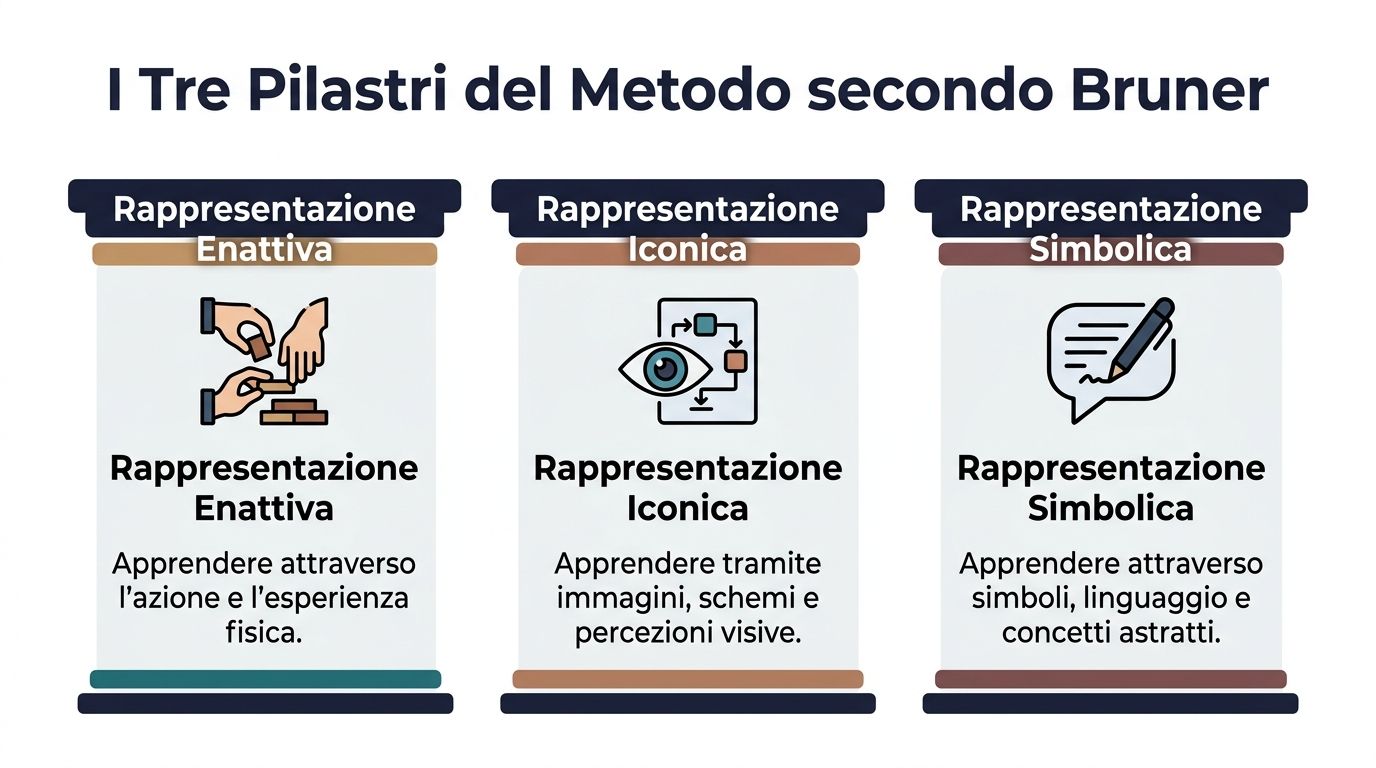
The first approach is the most practical. You learn by doing.
A child understands balance by riding a bike even before they can explain it. A student grasps the difference between materials by handling them in the lab. A new hire learns a procedure by observing and repeating the steps on the job.
Here, knowledge is gained through action. The body is not just a detail; it is part of the cognitive process.
Typical examples of enactive representation
If you skip this step too soon, many people end up memorizing words without having built up any experience.
After the action comes the imagery, the mental maps, and the visual models. A person doesn’t necessarily have to relive the experience every time. They can recall it through a mental representation.
A diagram of the water cycle, a concept map, a line graph, or a heat map all fall into this category. It’s also essential in the workplace. A raw table is often confusing. A clear visualization helps reveal relationships that were previously hidden.
Here’s the crux of the matter. The image must not replace experience too soon. It must organize what experience has made perceptible.
For example, in geometry, you can first have students look for angles around the school and then use photographs or diagrams to classify them. In a business setting, you can first have employees explore the data and then summarize their findings in a comparative chart.
Best practice: When someone says, “Now I see it,” you’ve entered the iconic stage.
The final level involves language, symbols, formulas, definitions, and abstract categories. This is the stage at which learning becomes more transferable.
The student doesn’t just see a triangle. He or she knows how to define it. He or she doesn’t just notice a pattern. He or she knows how to express it using precise language or a formula. Similarly, in a company, a team doesn’t just observe an anomaly in a graph. It translates it into a formalized hypothesis, an operational rule, or a decision-making criterion.
A common mistake is to teach only at the symbolic level. We start with the definition, then provide examples, and finally, if there is time left, move on to practice. With Bruner, the approach can be different.
This sequence often works better:
| Phase | Guiding question | Example |
|---|---|---|
| Inactive | What happens if I try? | I handle objects, explore data, and run tests |
| Iconic | What do I see? | I use images, diagrams, and charts |
| Symbolic | How would I describe it? | I formulate rules, categories, and technical terminology |
A well-designed approach doesn’t rely on a single pillar. It combines them. Action brings the issue to life. The image makes it understandable. The symbol makes it stable and reusable.
This applies to schools, technical training, and even the onboarding of non-specialist teams. First, let them experience the problem firsthand; then, make it visible; finally, give it a name.
Discovery learning appeals to many educators because it makes lessons more interactive. But its main strength isn’t just engagement—it’s the depth of understanding it fosters.
According to the research presented in this in-depth analysis of discovery learning, direct discovery has a more positive effect on information retention six weeks after instruction compared to traditional direct instruction. This is an important finding because it shifts the discussion from “Did you enjoy the lesson?” to “What sticks over time?”
When a person arrives at a concept through observation and inference, they tend to form stronger connections. This yields clear benefits.
In the workplace, this makes a big difference. A team that discovers a relationship between variables on its own tends to remember it better and apply it with greater confidence than those who simply receive a pre-interpreted report.
There is, however, a crucial difference between guided discovery and discovery left to its own devices. If the context is unclear, there is a real risk of learning incorrectly.
Some common challenges:
Discovery learning is effective when the problem is well-chosen and the materials are appropriate for the participants’ level. It is less effective when inexperienced people are expected to deduce complex concepts without any support.
Rule of thumb: If no one knows where to start, it’s not a lack of motivation. It’s a lack of scaffolding.
That is why the facilitator’s role is crucial. They should not take the hard work out of the research process, but they must prevent chaos. A well-posed question is worth more than a long explanation. A good constraint can also be helpful. For example: “Look only at these three variables,” “Compare these two cases,” “Try to describe the pattern in simple terms.”
The opposite mistake would be to turn it into a dogma. Not all content requires in-depth exploration. Some basic points can be presented directly, especially when the goal is to provide initial reassurance, a minimal vocabulary, or quick clarifications.
In practice, the best approach is often a combination of methods. It alternates between periods of exploration, formalization, and consolidation. The strength of discovery learning does not lie in rejecting explanation. It lies in giving explanation its proper place—that is, after the experience has raised a genuine question.
The theory becomes clear when you see it in action. A good academic example demonstrates how the method corrects deeply ingrained misconceptions. A good business example shows that discovery is not a creative game, but a rigorous approach to decision-making.
In an elementary school, the teacher doesn’t start by defining an angle. Instead, the teacher asks the students to look for angles in the classroom, in the hallway, in the windows, in scissors, and in open books. The teacher encourages them to take pictures of them, point them out with their fingers, or recreate them using their bodies or sticks.

Only then does the confusion begin. Some children call any point a corner. Others confuse a side with an angle. Still others think that a longer angle is automatically larger.
A study of 500 students in Palermo found that 68% had misconceptions about the concept of angles before engaging in discovery-based learning activities, and that this figure dropped to 22% after participating in hands-on activities, as reported in the University of Palermo’s research.
This data is useful because it highlights a point that is often overlooked. The discovery does more than just “get people involved.” It helps bring to light hidden errors that a straightforward explanation might leave unaddressed.
He doesn't immediately say who's right. He asks questions.
This way, students don’t receive feedback from an outside source. They reconstruct the concept from within their own experience.
Educational application: Initial mistakes should not be hidden. They should be brought to light and discussed.
Now consider a small or medium-sized retail business. Sales in a particular geographic area are slowing down. The manager might receive a static report with a pre-determined conclusion. That would be quick, but limited.
Adopting a discovery-based approach, the team starts with a practical question: Why did sales decline in that region during the quarter? At this point, they examine historical data, promotions, inventory levels, product categories, delivery times, sales channels, and local market indicators.
A marketing team may notice that the decline is not uniform. Some categories are holding steady, while others are plummeting. They may then observe that the decline coincides with an aggressive promotional campaign by a competitor. Finally, they may realize that the impact was most severe in areas where the product lineup was already weak.
The difference is subtle but crucial. The team doesn’t just get an answer. It learns a way of thinking about data.
Those working in analytics and decision-making encounter similar dynamics in many business contexts. To connect these principles to real-world applications of AI that are already integrated into day-to-day operations, it can be helpful to explore some practical examples of artificial intelligence in business.
When a group discovers a pattern on its own, it usually changes three things:
This is the most valuable bridge between education and business. In both cases, the value does not lie in having the correct answer right away. It lies in the ability to arrive at it based on evidence.
Many failures aren’t due to the method itself, but to how it’s implemented. If you want to use discovery learning in the classroom, in a training program, or within a corporate team, you need clear direction.
A good activity doesn't start with a section of the curriculum. It starts with a question.
It’s best to avoid closed-ended questions, where there is only one obvious answer. Questions that require observation and the ability to make connections work better.
Effective examples
The question should be accessible, but not trivial. It should prompt inquiry, not merely the recall of facts.
People don't perform well in chaotic situations. They need carefully selected materials, clean data, clear tools, and a well-defined task.
In the classroom, these might include objects, images, experiments, or short texts. In a business setting, they might include dashboards, filters, time series, segmentations, or comparative reports. If the material is too scattered, it breaks the audience’s concentration.
A similar approach applies in experimental and decision-making contexts as well. Those who work with tests, hypotheses, and variables may find a more practical framework for experimental design useful, especially when they want to transform exploration into a more structured learning process.

This is the hardest part. The facilitator must resist the temptation to explain things too soon.
It can be helpful to use Socratic questions such as:
The facilitator sets the pace. If the group gets stuck, they narrow the scope. If the group moves too quickly, they ask for further clarification.
Practical tip: Don’t give the answer as soon as there’s a pause. Often, a pause is the moment when thoughts are being organized.
If a person discovers something but is unable to express it, that learning remains fragile. Exploration must be followed by a phase of articulation.
Here you can request:
This phase transforms intuition into knowledge that can be shared.
A discovery is truly valuable when it transcends the specific case. Once you’ve grasped a concept, try applying it in a new context.
For example:
| Initial context | Successful transfer |
|---|---|
| Recognizing Angles in the Classroom | Classifying corners in complex images |
| Analyzing a decline in sales | Investigate an anomaly in margins or inventory |
| Understanding a procedure | Improving a similar procedure |
Without this step, learning remains isolated. With it, it becomes a skill.
A good implementation doesn’t just produce people who can solve the problem of the day. It produces people who begin to see patterns, similarities, and hidden levers in other contexts as well.
For years, discovery-based learning had a clear limitation. It was difficult to scale. It worked well in small groups. In complex settings, with large amounts of data and diverse teams, it became more challenging to provide everyone with useful clues, appropriate paces, and personalized pathways.
This is where AI and analytics come into play.
Technology does not replace independent research. It makes it feasible in environments that are far richer in information. Instead of leaving people to grapple alone with incomprehensible documents, well-designed digital tools reduce friction, organize information, and highlight relationships worth exploring.
This is particularly relevant when groups have different skill levels. In schools, the problem is very evident. A Unipa study covering the 2023–2025 period indicated that pure discovery learning fails in 40% of cases for students with SLDs, while the success rate risesto 85% when supported by adaptive AI tools, as reported in the document dedicated to corner activities.
This principle also applies to the workplace. In a corporate team, not everyone interprets data in the same way. Some people spot patterns quickly. Others need visualizations, prompts, and guided comparisons.

A static report says, “Here’s what happened.” A well-designed analytical environment encourages you to ask, “Why did it happen?” and “What changes if I look at another variable?”
This is the true link between classical pedagogy and modern business. Discovery becomes an organized process of analysis.
In practice, AI and data help teams to:
In large organizations, there are often specialists who interpret data for others. In SMEs, however, many decisions are made by people who know the business well but do not have a background as data scientists.
In these cases, the challenge isn’t having more data. It’s making that data accessible to those who need to take action. The democratization of technology is moving precisely in this direction. Exploring the topic of AI democratization and access to advanced tools for the entire team helps us understand why discovery is no longer the exclusive domain of specialists.
The key point is this: AI is useful when it expands our ability to ask questions and interpret clues. Not when it claims to replace human judgment.
When a company operates this way, it doesn’t just train people to “read dashboards.” It builds teams that observe, formulate hypotheses, discuss evidence, and learn from their own analyses.
It is the very essence of discovery-based learning, translated into organizational terms. Not a school method forced onto the business world, but a shared skill: learning to discover what matters before making a decision.
There are a few principles that can help you stay on track when applying discovery learning in the classroom or at work.
A good discovery stems from genuine intellectual curiosity. If the question is artificial, the exploration becomes artificial as well.
Clear materials, readable data, and well-chosen constraints are more effective than providing a comprehensive explanation too early.
The best questions don't just test knowledge. They challenge the way we think.
A helpful question: “What evidence leads you to this conclusion?”
This approach works in a teaching discussion, a project review, and an analysis meeting.
In discovery-based learning, a mistake isn’t a blunder to be erased. It’s a clue to be deciphered.
Discovering isn't enough. We need to build on it.
By the end of the learning process, learners must be able to clearly articulate what they have understood, how they arrived at that understanding, and where they can apply it. Without this step, the experience remains interesting but unfocused.
Discovery learning remains one of the most fruitful pedagogical approaches because it does more than simply convey content. It fosters a way of thinking. Observe, connect, verify, name, apply.
This makes it valuable both in school and at work. In the classroom, it helps students move beyond rote memorization. In the workplace, it helps teams avoid relying solely on canned responses. In both cases, the most important outcome is the same: greater intellectual autonomy.
Today, data and AI make this approach even more applicable in professional settings. When exploration is well-guided, people don’t just see more information. They learn to ask better questions and make more informed decisions.
In the knowledge economy, the advantage does not lie solely with those who possess data or information. It lies with those who know how to uncover the meaning behind that data.
If you want to apply this approach to your own work environment, try ELECTE, the AI-powered data analytics platform designed to help teams explore data, generate clear insights, and turn analysis into smarter decisions.

.svg)


.svg)
.svg)




.jpg)