
If you listen to certain pitches, it seems as though blockchain and artificial intelligence are the automatic solution to any business problem. That’s not the case. In most instances, combining the two technologies produces more slides than value. Yet it would be a mistake to dismiss them as nothing more than a fad.
The real issue isn’t “revolutionary convergence.” The issue is more practical: how do you make an AI system verifiable when its output influences operational, financial, or compliance decisions? If a model generates a risk alert, a forecast report, or a recommendation that enters a formal process, sooner or later someone will ask a simple question: Where did that result come from? Who produced it? When? With what inputs? And using which version of the model?
This is where blockchain can make sense. Not as some kind of technological magic, but as a digital notary that records events, versions, and proofs of integrity in a shared ledger that is difficult to alter. It isn’t always necessary. Often, it isn’t even the best choice. But in some contexts, it lives up to the hype.
The paradox is simple. AI can interpret, classify, predict, and automate, but it often requires trust. Blockchain stores, timestamps, and makes data verifiable, but on its own, it doesn’t “understand” anything. One is a digital brain. The other is an immutable ledger.
When you combine them effectively, each compensates for the other’s limitations. AI generates decision-making value. Blockchain provides integrity, traceability, and documentary evidence. In business terms: you’re not buying two trendy technologies; you’re trying to solve an operational trust issue.
For an entrepreneur or manager, the useful question isn’t “Is this combination the future?” The right question is a different one: Are there multiple parties in my process who need to be able to independently verify data, decisions, and steps? If the answer is no, a well-designed centralized architecture is often sufficient. If the answer is yes, then the combination of blockchain and artificial intelligence deserves consideration.
There’s a real reason why there’s so much talk about blockchain and artificial intelligence—at least on a conceptual level. AI makes decisions or produces outputs that impact business. Blockchain creates a tamper-resistant audit trail. Together, they can make it easier to verify information that today is often confined to a supplier’s internal logs.
Think of a scoring process, a predictive report, or an engine that generates risk alerts. If a client, auditor, or regulator wants to understand how that result was reached, evidence is needed. Statements like “trust the system” aren’t enough.
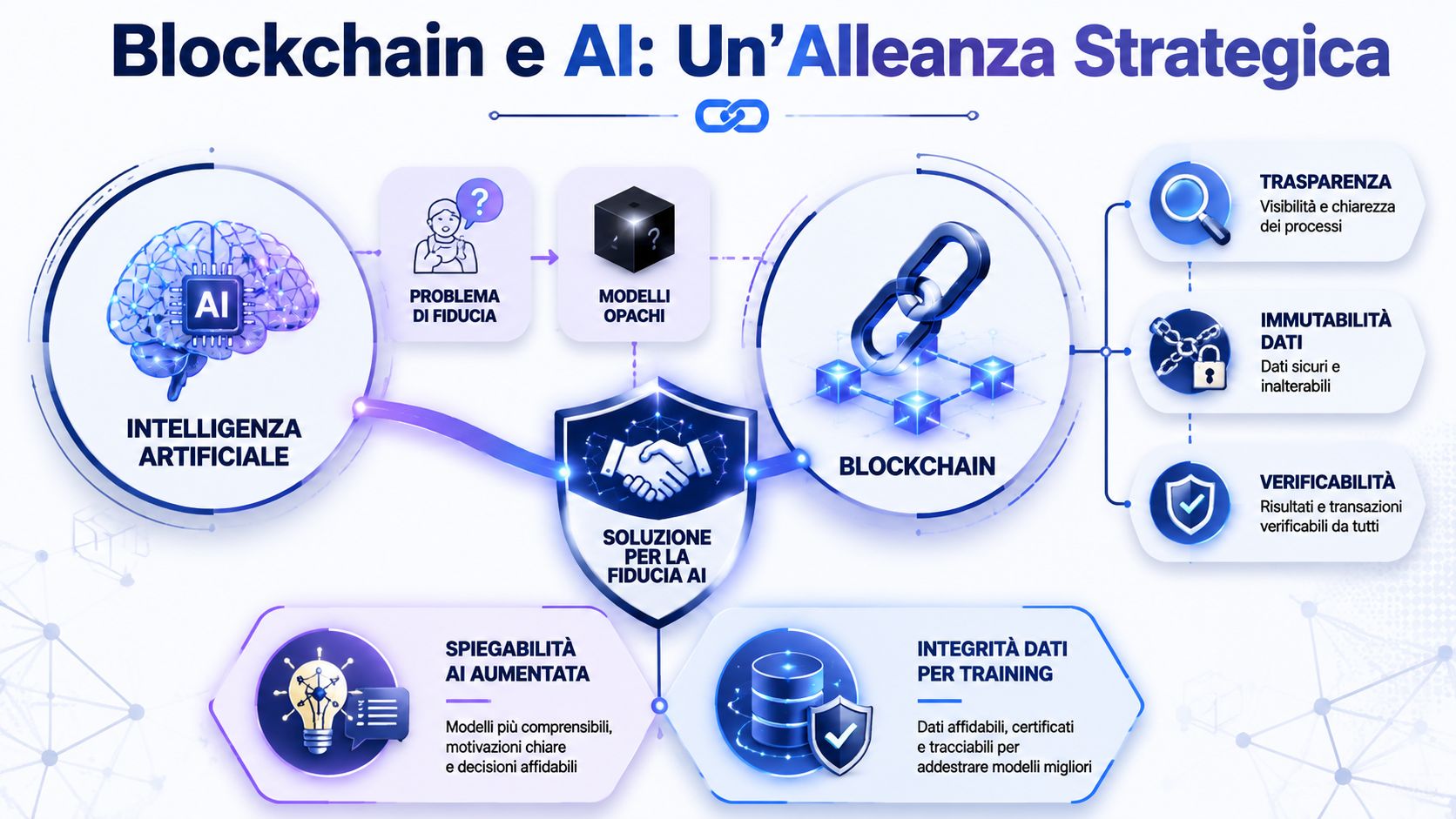
In this scenario, blockchain does not replace the model. It records what really matters:
Rule of thumb: If the value depends on the ability to prove “what happened” to third parties, blockchain can be useful. If the goal is simply to make the process work, a good database is often sufficient.
This is where the regulatory framework comes into play. According to Gartner, by 2027, 30% of high-risk AI systems will require traceability mechanisms based on technologies such as blockchain to meet audit and regulatory compliance requirements, particularly with the entry into force of the European AI Act (Gartner forecast).
This finding does not mean that every company must launch a blockchain project. It signifies something more modest and more important: the verifiability of AI outputs is moving beyond the realm of “nice to have” and into that of compliance.
A short story will make the point clearer. A financial operator uses a model to generate alerts on anomalous transactions. The model works well, but the problem arises afterward: the compliance team must reconstruct the reason for the alert, the source of the data, the model version, and the exact time of the analysis. If all these details exist only in the provider’s logs, the client must simply trust them. If, on the other hand, some evidence of integrity is recorded in a system that can be verified by multiple parties, the situation changes.
That's where the combination comes into play. The AI interprets. The blockchain verifies.
Most companies don't need blockchain in their AI systems. It's best to say that right away. The sooner we clear up this confusion, the easier it will be to evaluate the serious cases.
I use a simple criterion. If you remove the blockchain, does the system still work just as well? If so, the blockchain is probably unnecessary. If not, you need to explain precisely what problem it solves that a traditional database does not.
The right questions are these:
Are there more independent players?
If a single company controls the data, the application, and the process, decentralization rarely adds value.
Do we need a shared, verifiable test?
Not an internal record. A test that multiple parties can verify.
Is there a real risk of disputes, audits, or manipulation?
If so, immutability may make sense.
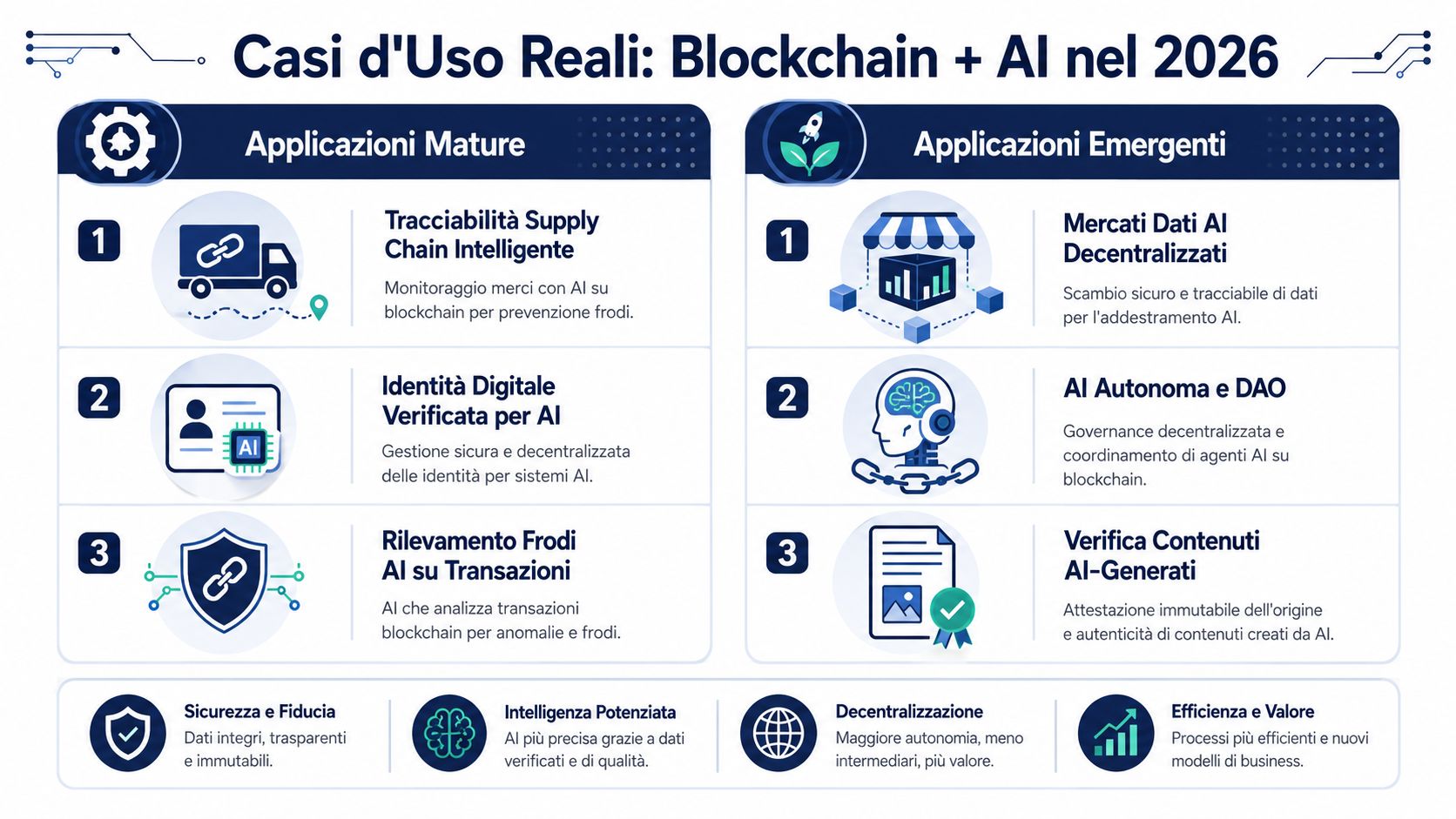
This is the scenario that most closely reflects the day-to-day operations of many SMEs. AI forecasts demand, estimates delays, optimizes routes, and supports replenishment. Blockchain, on the other hand, records key stages in the supply chain, certifications, origin, and status changes.
It works when different stakeholders are involved, each with their own systems and interests. Producers, transporters, distributors, and retailers do not always share the same database or the same level of mutual trust. A shared ledger therefore makes clear business sense.
What Works in Production:
Which is more delicate:
For those interested in seeing business applications of AI that have a tangible impact, it's also worth checking out these ROI demonstrations featuring AI.
Here, the division of labor is clear-cut. Machine learning models analyze transaction graphs, wallet clusters, behavioral patterns, and risk signals. The blockchain provides the native ledger of transactions to be investigated.
This is a real-world example, not because it “uses blockchain,” but because the data to be analyzed is already on-chain. The AI extracts patterns from a transparent yet complex environment. The audit trail exists by the very nature of the system.
In the world of cryptocurrency, the blockchain is not just an architectural addition. It is the very foundation on which the problem exists.
The idea is promising: distributed GPU nodes run open-weight models, while the blockchain certifies that a given output was produced by the specified model with a specific configuration. The theoretical value is high, especially in terms of reducing dependence on a single provider.
Today, however, it remains a mixed bag. It’s promising from an infrastructure standpoint, but less mature from an enterprise perspective. The nodes must be reliable, the correctness proofs must be robust, and the costs and time required for verification must not undermine the operational advantage.
This is one of the most interesting areas of development, especially in healthcare and finance. The combination of blockchain, cryptographic proofs such as zero-knowledge proofs, and AI models can enable the analysis of sensitive data without exposing the raw data.
The potential is great, but the technical complexity remains high. It works best in limited, well-designed scenarios with strict data governance.
The question to start with is brutal but useful: Are you solving a trust issue between different parties, or are you just making a system that could have remained simple more expensive?
If your data resides in a centralized database controlled by your company or your provider, blockchain isn't your top priority. Your top priorities are security, access control, robust logging, encryption, backups, role segregation, and governance.
If the model runs on a single cloud provider and no one needs to independently verify the process, decentralization doesn't add much value. Instead, it adds latency, design costs, opportunities for error, and integration burdens.
Many “blockchain + AI” proposals fall short here. They confuse three different concepts:
| Situation | Most likely solution |
|---|---|
| A single owner of the data and the system | A Well-Managed Centralized Architecture |
| More actors with limited trust | Verifiable Shared Ledger |
| Just a need for automation | AI, Workflow, and Traditional Logging |
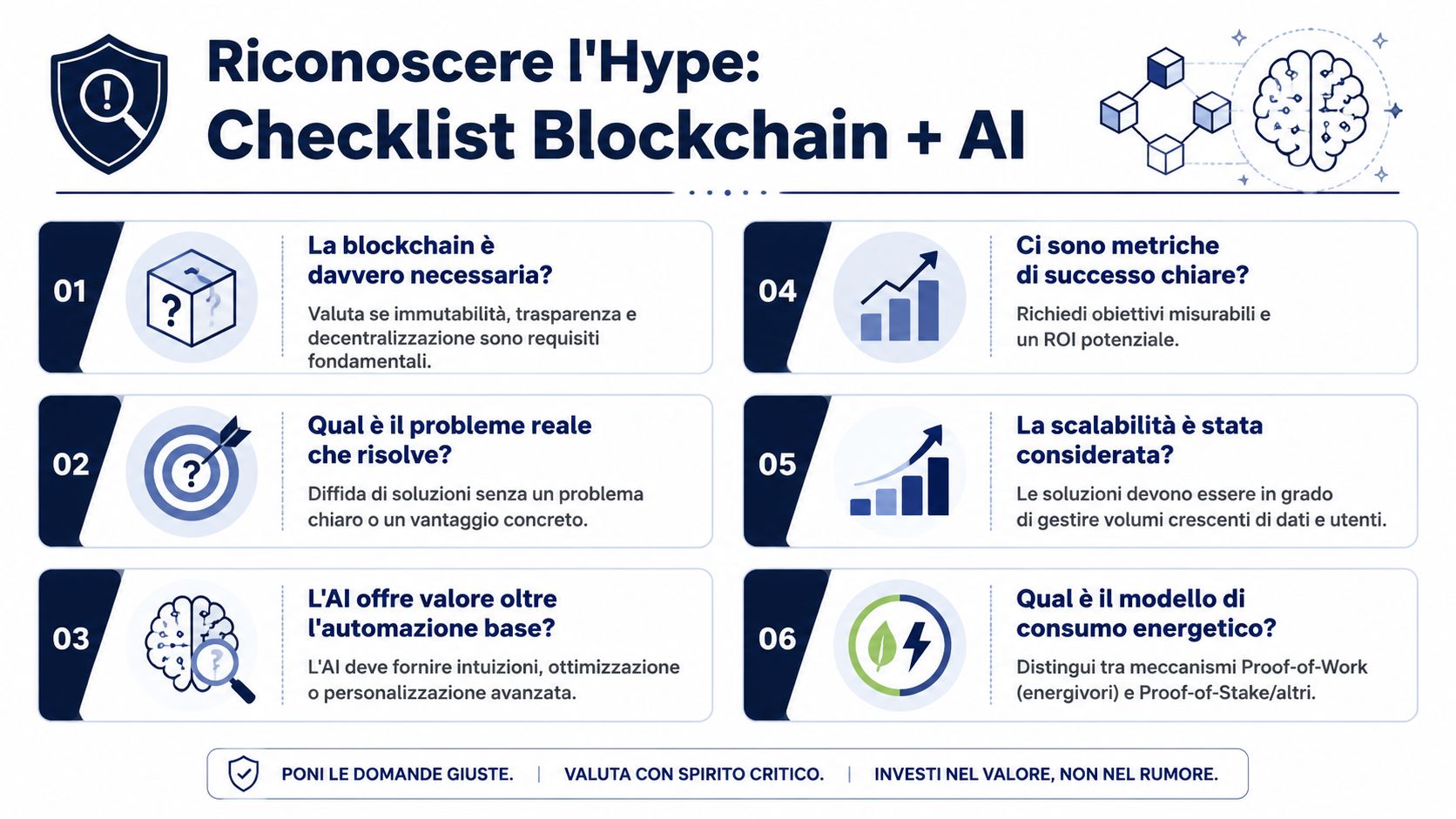
We don't need slogans. We need tough questions.
If the salesperson can't explain why a traditional database isn't enough, they aren't proposing an architecture. They're selling a story.
This is where real-world factors come into play. Regulations, energy consumption, and privacy aren't just legal details to be left until the last minute. They are the constraints that distinguish prototypes from viable solutions.
The energy issue must be addressed without oversimplification. Saying “blockchain” does not automatically mean absolute inefficiency. Saying “AI” does not automatically mean intelligent progress. Both technologies can have significant energy costs, and lumping them together indiscriminately is a bad idea.
The first major distinction is between Proof-of-Work and more efficient mechanisms such as Proof-of-Stake. On this point, one fact is very clear: Ethereum’s transition to the Proof-of-Stake consensus mechanism has reduced the network’s energy consumption by more than 99.95%, as documented by Ethereum.org in its explanation of energy consumption.
This does not mean that every use of blockchain is sustainable by definition. However, it dispels a common misconception: energy impact depends on the chosen architecture. If someone proposes “blockchain + AI for sustainability” based on a Proof-of-Work blockchain, you should call them out on the inconsistency.

The second issue is more nuanced. The blockchain thrives on immutability. The GDPR includes principles of data minimization, accountability, and, in certain cases, erasure. The tension is structural.
That is why serious implementations avoid putting raw personal data on-chain. The most sensible approach is to keep sensitive data off-chain and use the blockchain to record evidence, hashes, consents, process statuses, or verifiable references. There’s no magic here either. It’s all about legal and technical design.
For those working in Europe, it’s worth exploring the topic of data sovereignty and compliance from an operational perspective—for example, in this in-depth article on navigating European AI data compliance.
Immutability is useful for auditing. It becomes a problem when someone uses it as an excuse to ignore data protection.
The third point is the most strategic. Europe is shifting the debate from “what can be done” to “what can be demonstrated.” This is changing the AI supplier market.
For an SME, the message isn’t “build a blockchain.” It’s more practical: start figuring out how your suppliers document models, data, versions, automated decisions, and audit logs. In regulated industries, these questions will cease to be technical and become contractual.
This is not legal or compliance advice. It is an operational analysis of the market. Those purchasing AI systems in Europe will increasingly need to evaluate verifiability, not just perceived accuracy.
For most SMEs, the conclusion is reassuring: you don’t need to implement blockchain and artificial intelligence tomorrow. Instead, you need to understand where this combination might indirectly play a role in the services you’ll use.

You can safely ignore this—at least for today:
If you're a traditional SME, the most common risk isn't falling behind on blockchain. It's investing your attention in a complex solution that doesn't solve anything.
This is where things get real. If you use analytics, automation, scoring, or predictive systems, ask yourself these questions:
For many companies, the issue will arise in the context of the supply chain, compliance, or risk management. For others, it will arise in the context of software procurement. In any case, it helps to consider the problem alongside the most common barriers to adoption, including AI adoption costs, data, and regulations.
Whether you work in the food, pharmaceutical, manufacturing, or retail industries, pay particular attention to cases where predictive AI and traceability intersect. This is the area where substance is closer to everyday reality than the hype.
The combination of blockchain and artificial intelligence is not a magic wand. It is a specific solution to a specific problem: trust in automated processes when proof, audits, and verifiability are required.
Outside this scope, it’s often just marketing. Within this scope, it can be useful infrastructure. The point isn’t to take sides. The point is to ask the right question: What problem does it solve that a standard, well-managed database doesn’t?
There are just a few practical steps to keep in mind:
Understanding these criteria today will help you avoid two opposing mistakes: ignoring a trend that will have real-world effects, or buying into complexity simply because it sounds innovative.
If you want to build a solid foundation before jumping on the bandwagon, start with tools that turn data into verifiable and useful decisions. ELECTE, an AI-powered data analytics platform for SMEs, helps teams move from scattered data to clear insights, automated reports, and actionable analytics—without the complexity of enterprise-level systems. ILLUMINATE THE FUTURE WITH AI. Ready to transform your data? Start your free trial →

.svg)


.svg)
.svg)



.webp)