
You’re likely facing a very real situation. Your team hears about AI every day, vendors promise efficiency, competitors are starting to make moves, and in the meantime, you have to make a decision that’s not just about technology. It’s about budgets, priorities, internal expertise, and speed of execution.
For an SME, the question in 2026 is no longer whether to use artificial intelligence. The real question is how to adopt it without creating a project that is costly, slow, and difficult to manage. This is where the dilemma arises: should we develop a solution in-house or purchase a ready-to-use platform?
The choice may seem technical, but it is actually strategic. One approach can offer you more control, while the other offers greater speed. One promises differentiation, while the other reduces complexity and risk. The key is to understand which option delivers real value in your specific context, not in the abstract.
This guide is designed for just that. You’ll find a clear comparison between building and buying, an introductory table to help you get your bearings right away, a decision-making framework based on hidden costs, time-to-value, and data quality, and a more nuanced take on the topic: for many SMEs, buying isn’t a compromise. It’s the smartest way to learn, achieve results, and then decide where to actually build.
It’s Monday morning. You have a meeting with Operations, Finance, and Sales. Everyone wants something from AI. The retail manager is asking for more reliable demand forecasts. The CFO wants faster reporting. The operations team is looking to reduce manual work. Meanwhile, IT reminds you that building a solution in-house takes time, organized data, and people who are already stretched thin.
This is the reality for many SMEs in 2026. AI is no longer a lab experiment, nor is it a side project to be put off until the end of the year. It is a decision that affects execution, profit margins, and the ability to react faster than the market.
The problem is that the “build vs. buy” dilemma is often oversimplified. “Build” is portrayed as synonymous with control, and “buy” as synonymous with simplicity. In reality, the real difference lies elsewhere: how long it takes you to achieve a useful result, how much risk you’re taking on, and how much complexity you’re introducing into your organization.
Key point: The right choice isn’t necessarily the most sophisticated one. It’s the one that creates measurable value with the least organizational friction.
That’s why you need a leadership approach, not just a tech enthusiast’s perspective. You need to evaluate the path that protects your cash flow, accelerates learning, and leaves room for growth.
In 2026, waiting is already a decision. And it’s often the most costly one.
According to Founded’s *The SME Guide to AI in 2026*, 35% of UK SMEs were already using AI in 2025, up from 25% the previous year. The same study indicates that 24% of British companies plan to adopt it by the end of 2026. The report also states that AI adoption can increase productivity by 13%.

The most important finding, however, isn’t just a number. It’s cultural. According to that same study, for SMEs, AI is shifting from something to explore to something to master. This changes the dynamics of the “build vs. buy” decision for AI in SMEs by 2026. You’re not just choosing software. You’re choosing the speed at which your company enters a new operational phase.
Many SME leaders still believe that AI is a priority only for companies with in-house data science teams. That is no longer the case. The pressure stems from very common issues:
This is the key point that many people overlook. AI in SMEs isn’t growing because it’s “trendy.” It’s growing because it helps manage real-world tasks: automated reports, data preparation, operational summaries, forecasts, and risk management.
When a company needs to do more with fewer people, the real benchmark isn’t technical sophistication. It’s the time it takes to turn raw data into useful decisions.
Staying put has three practical consequences.
First, manual processes remain unchanged. The team continues to copy data between spreadsheets, systems, and presentations.
Second, your organization misses out on learning. While others are testing, making mistakes, and improving, you remain in a passive observation phase.
Third, the market adapts to new standards. If your competitors start responding more quickly to sales signals, forecasting demand more accurately, or monitoring risks more effectively, the gap doesn’t stem from an algorithm. It stems from the quality of execution.
Most mistakes stem from a flawed premise: treating "build vs. buy" as an IT decision.
In fact, it’s a decision that affects:
| Factor | If you take a wrong turn |
|---|---|
| Capital | commit your budget too early or in a way that lacks flexibility |
| Timing | delay the first positive result |
| People | overworked, unprepared teams |
| Governance | a wide range of tools and responsibilities |
| ROI | It's too late to tell whether AI is actually creating value |
For an SME, the key isn't to adopt every possible AI solution. It's about adopting the ones that truly improve work, without turning the initiative into an unmanageable program.
Many comparisons on this topic are misleading because they rely on overly narrow definitions. “Build” doesn’t simply mean developing a model. “Buy” doesn’t just mean purchasing a subscription.
The real choice is about who will shoulder the burden of complexity.
If you choose to build, you’re not just buying freedom. You’re taking on technical and operational responsibilities throughout the entire process.
In practice, a build may include:
It’s like building a custom-designed facility. You have more design freedom, but you have to handle the land, utilities, permits, and maintenance. What you see is just a fraction of the work involved.
When making a purchase, choose a platform or a suite of services that are already designed for common use cases. You’re not giving up on your strategy. You’re simply avoiding building components from scratch that don’t really set you apart.
In practice, "buy" often means:
For an SME, this makes a big difference. The team can focus on processes, KPIs, data quality, and internal adoption, rather than spending energy on architecture and MLOps.
Rule of thumb: If your competitive advantage doesn’t stem from the model itself, you probably don’t need to build the model from scratch.
The choice is never entirely black and white. Between building and buying, there are hybrid solutions that many small and medium-sized businesses adopt without even calling them that.
Three common examples:
Buy with light customization
Purchase a platform and configure it for workflows, roles, dashboards, and internal data sources.
Buy with API extensions
Use a product that’s ready for common features and add custom components where needed.
Build on purchased components
You don’t start from scratch. Combine APIs, business models, and proprietary logic into a more specialized system.
SMEs often choose to build their own solutions because they fear that buying off-the-shelf software would lead to excessive standardization. But the real question isn’t “How customizable is it?” It’s “Where do you want to invest your effort?”
If your challenge is automating reporting, forecasting, data preparation, or alerting, the real key to success almost never lies in the model itself. It lies in the operational rules, integrations, and understanding the business context.
On the other hand, if your model or pipeline is a direct part of your competitive advantage, then building it yourself may make sense. But only if you already have a clear understanding of the use case, sufficiently reliable data, and the internal capacity to manage it over time.
Before getting into the details, it’s worth getting an overview.
| Criterion | Build | Buy |
|---|---|---|
| Initial cost | Taller and less predictable | Spread out over a longer period of time |
| Time-to-value | Slower | Faster |
| Required skills | High and continuous | Read more on the inside |
| Maintenance | To be paid by the in-house team | Managed largely by the supplier |
| Customization | Top-of-the-line, but expensive | Suitable for standard and customizable use cases |
| Operational scalability | It depends on the architecture you've created | It depends on the maturity of the chosen platform |
| Main risk | Delays, complexity, technical debt | Lock-in and adaptation limits |
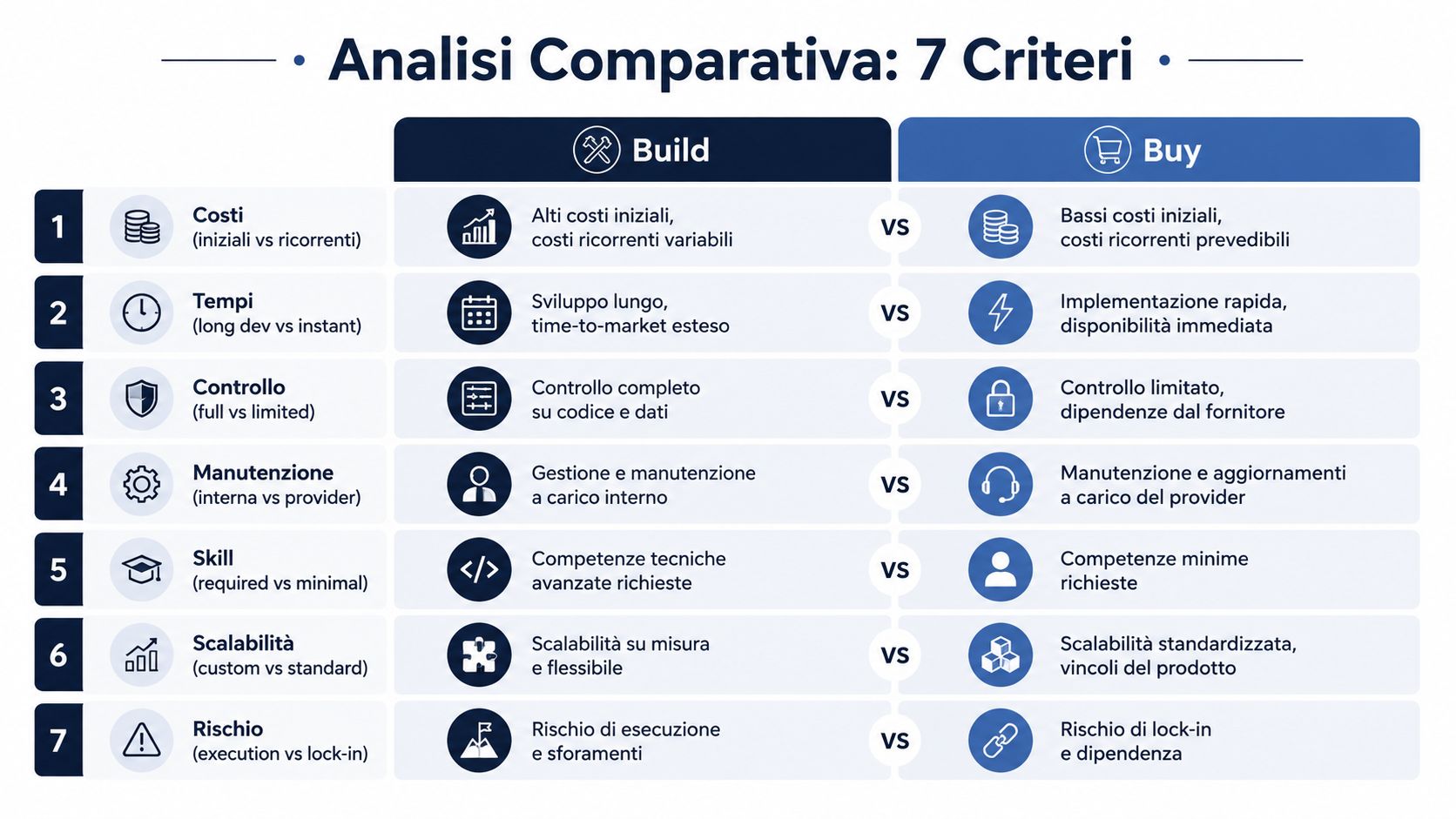
Industry sources report that a "buy" approach often allows for deployment within a few weeks, whereas a "build" approach typically takes 3–6 months. The same analysis cites a Gartner forecast that by 2026, over 80% of enterprise software will include embedded AI—a strong indication that many horizontal use cases are being purchased rather than built (technical analysis of "build vs. buy" AI in 2026).
The first mistake is to focus solely on the upfront cost. The real comparison isn’t CAPEX versus subscription fees. It’s the time and effort required to achieve a result that the business recognizes as valuable.
With custom development, the upfront cost is just the beginning. You need to factor in technical work, coordination, testing, integrations, maintenance, and updates. If the project slows down, costs continue to rise even without delivering operational value.
With a buy model, the cost is often more transparent because the provider handles a significant portion of the infrastructure, training from scratch, and model maintenance. This shifts the focus from technical ownership to business outcomes.
For many Italian SMEs, this is a critical factor. If the main constraint is liquidity or the need to deliver results quickly, the predictability of a subscription or usage-based model is more manageable than an open-ended development program.
The problem isn't spending too little. It's spending too late relative to when the business needs the results.
To gain a deeper understanding of this approach, it is helpful to read the analysis of the hidden costs of implementing artificial intelligence in SaaS solutions.
Building this requires an organization capable of sustaining the AI over the long term. A good developer or a brilliant external consultant isn’t enough. You need clear roles, processes, and ownership.
Useful questions are very specific:
If these answers aren’t already clear enough today, the development process risks creating an internal dependency on a few key individuals. For an SME, this vulnerability is often more dangerous than vendor lock-in.
With a buy approach, basic technical maintenance is largely outsourced. This doesn’t eliminate internal work, but it does change it. Your team needs to focus on use cases, priorities, data quality, and adoption—not on resolving every infrastructure issue.
This is where the conversation gets interesting. Many people choose builds to “gain control.” But control only makes sense if you can actually exercise it.
Having complete architectural freedom is useful when the model, decision-making logic, or pipeline represents a direct competitive advantage. If you’re building unique, non-replicable capabilities, this may be the right approach.
If, on the other hand, the use case is horizontal—such as internal search, document summarization, operational support, or customer triage—the key differentiator rarely lies in the AI engine. It lies in the quality of the data, integration with business systems, and governance policies. In these scenarios, purchasing and configuring a solution is often the more rational approach.
Here is a practical summary of the risks:
| Area | Risk in the build | Risk in the buy |
|---|---|---|
| Execution | delayed or incomplete project | vendor lock-in |
| Evolution | growing technical and maintenance debt | limitations on extensive customizations |
| People | expertise concentrated in just a few people | less direct control over the stack and roadmap |
| Business | Deferred ROI | risk of choosing an unsuitable platform |
If your company hasn’t yet reached a high level of AI maturity, the biggest risk isn’t having less control. It’s choosing a level of complexity that you can’t manage.
This is why the “build vs. buy” debate regarding AI for SMEs in 2026 should be viewed through a managerial lens. The right approach is not necessarily the most theoretically sound one; rather, it is the one that best aligns resources, timelines, and the value that can be achieved.
The best decisions don’t come from abstract discussions. They come when you link the operational model to the use cases that are actually impacting the bottom line or the team’s time right now.
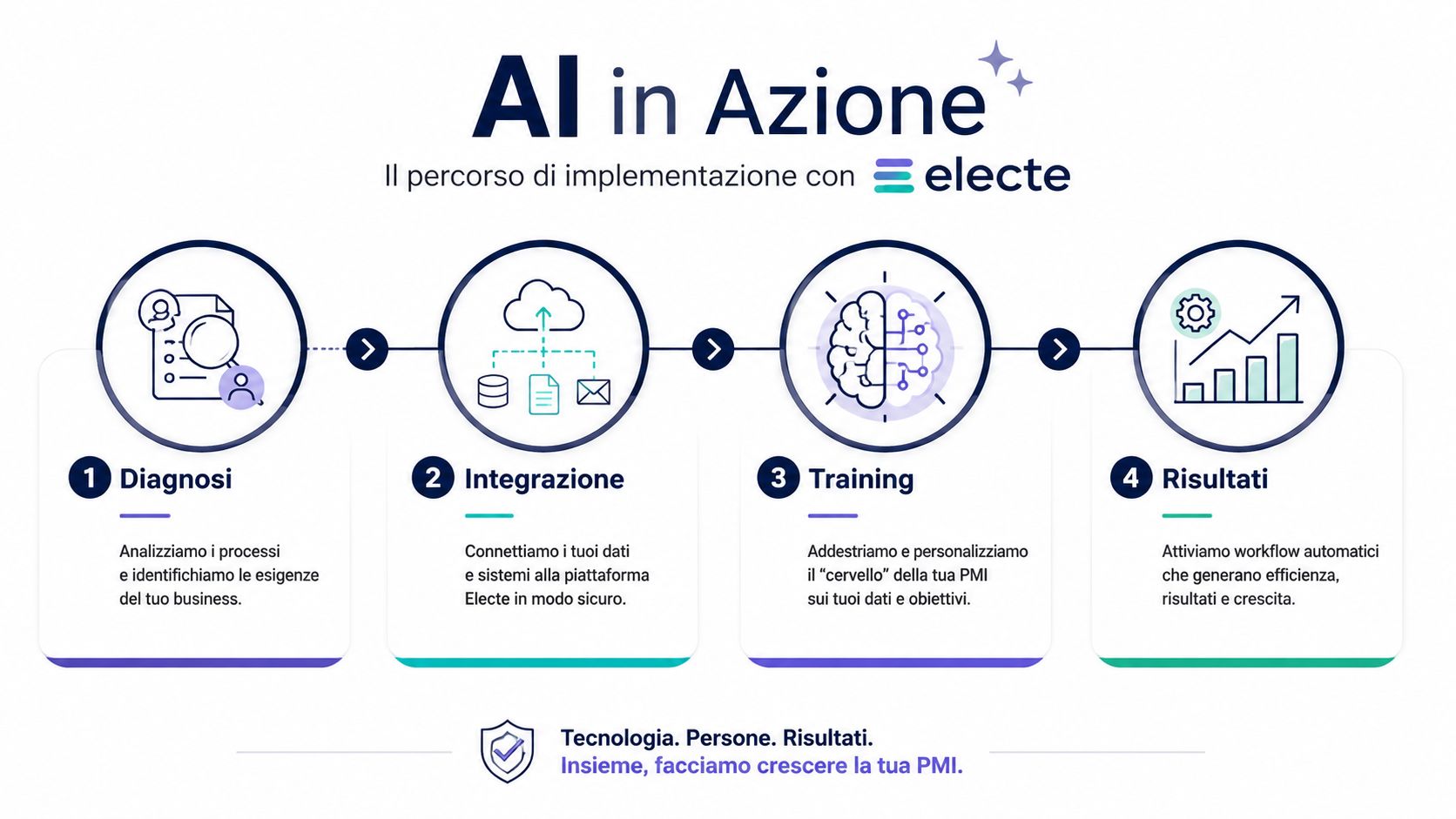
Industry analyses suggest that data quality matters more than model selection and indicate that platforms with automatic pre-processing reduce the risk of AI project failure in SMEs, where unstructured or siloed data is often the critical issue (read more about the central role of data quality in the "build vs. buy" AI debate).
Imagine a retailer whose data is scattered across e-commerce platforms, business management systems, promotional campaigns, and sales team spreadsheets. The challenge isn’t creating the most sophisticated model. The challenge is arriving at a usable forecast before the season changes.
In this scenario, a ready-made platform is often the most practical choice for four reasons:
When it comes to tasks such as inventory optimization, sales forecasting, promotion tracking, and alerts for operational anomalies, building a system from scratch rarely yields benefits that justify the effort. More often than not, it causes delays.
In the finance sector or in control functions, the point isn’t just to automate. It’s to do so in a way that’s manageable.
When you need to work on risk monitoring, periodic analysis, forecasting, or recurring reporting, AI projects often fail not because of the model, but because the data is incomplete, in inconsistent formats, or follows different logic from department to department.
This is where practical logic comes into play. If your team has to spend weeks first making the data readable, the AI initiative is already off to a slow start. A platform that integrates, normalizes, and supports ready-to-use analytical workflows reduces that initial friction.
This category also includes ELECTE, an AI-powered data analytics platform for SMEs, designed to connect multiple data sources, pre-process information, and generate automated insights, forecasts, and reports without requiring a dedicated technical team. In a procurement context, this type of approach is particularly valuable when the goal is to transform fragmented data into actionable insights more quickly.
The real question isn't whether your company has enough data. It's whether it can make that data usable quickly enough to improve decision-making.
To see how these scenarios translate into practical applications, you can check out the case studies on AI implementations in the retail and finance sectors.
A platform tends to succeed when the following conditions are met:
On the other hand, when the algorithm, pipeline, or decision-making logic is part of your core competitive advantage, then it makes sense to consider a more proprietary development approach. But that’s a later stage for many SMEs, not the starting point.
More mature SMEs don’t view “build” and “buy” as two opposing approaches. They see them as stages of the same journey.

According to Helium42’s analysis of the “build vs. buy” AI model in 2026, the hybrid model is set to emerge as the dominant strategy by 2026. The same source cites MIT research indicating that mid-market companies in the UK that purchase AI solutions from specialized vendors have a 67% success rate, compared to 33% for those that build in-house. Furthermore, organizations that take a phased approach achieve a measurable ROI 60% faster.
This approach accurately describes the smartest path forward for many small and medium-sized businesses.
You buy to learn. Not to become dependent.
You buy to clarify use cases. Not to lock in your strategy.
You buy to see where AI truly adds value, and only then decide what’s worth building in-house.
This approach offers three concrete benefits.
First, it shortens the organizational learning curve. The team quickly understands what works, what data is needed, and which processes are truly suitable for automation or predictive support.
Second, avoid jumping the gun on the wrong customizations. Many companies realize too late that they were trying to build something that a preconfigured platform could have already handled adequately.
Third, it improves the quality of future build decisions. When it comes time to build, you do so with clearer priorities, better data, and more robust operational metrics.
Being the first to buy doesn’t mean giving up your competitive edge. It means avoiding building in the dark.
The build comes into play once you've reached a certain level of experience and can confidently answer a few questions:
If the answer is yes, the hybrid model allows you to build only what truly warrants an in-house investment. Everything else is purchased, integrated, or configured.
This is the point that many leaders don’t immediately grasp. AI maturity isn’t demonstrated by building everything in-house. It’s demonstrated by knowing what not to build.
The decision between building and buying AI for SMEs in 2026 becomes much clearer when you frame the comparison in terms of practical questions.
Use this table as your first internal filter. If most of your answers fall into the “Buy” column, the most sensible approach is to start with a platform. If “Build” prevails, you likely have a more unique use case and more mature resources.
| Key Question | Rating: 'Buy' | Vote for 'Build' |
|---|---|---|
| Do you need results quickly? | High | Bass |
| Is the use case common and repeatable? | High | Bass |
| Is your data fragmented or unstructured? | High | Bass |
| Do you have in-house AI expertise that is reliable and readily available? | Bass | High |
| Is the model part of your direct competitive advantage? | Bass | High |
| Do you want to reduce maintenance and technical complexity? | High | Bass |
| Have you already validated the ROI for this use case? | Medium | High |
Three final questions help bring things full circle:
To view this assessment from an executive perspective, the AI investment guide for executives and value propositions may also be helpful.
The choice between building and buying isn’t a matter of ideological preference. It comes down to a more practical question: which path will lead your small or medium-sized business most quickly to a profitable, manageable, and sustainable outcome?
Building makes sense when your use case is truly unique and you’re prepared to handle the complexity, maintenance, and technical responsibility over time. Buying makes sense when you want to accelerate your impact, reduce internal friction, and keep your team focused on the business—not on infrastructure.
For many SMEs, the most sensible choice in 2026 isn’t simply “build or buy.” It’s to start by buying, learn quickly, validate the value, and build only where it’s truly needed. This approach protects budgets, improves time-to-value, and reduces the risk of investing too early in the wrong direction.
If you’re making a decision right now, don’t go for the solution that looks the most ambitious on paper. Look for the one that makes your company better able to make good decisions, more often, with less friction.
If you want to see firsthand how a buy approach can streamline reporting, forecasting, and data analysis in your company, check out how ELECTE works.

.svg)


.svg)
.svg)