
Are you spending too much time on repetitive tasks that are holding your business back? Do you feel like your best resources are tied up in day-to-day operations instead of focusing on innovation and growth? If the answer is yes, it’s time to consider business process outsourcing (BPO), a key strategic tool for scaling your business.
Imagine being able to entrust non-strategic processes to a team of specialists, freeing up your team’s energy to focus on what makes you unique. This guide will show you how BPO isn’t just about cost reduction, but a way to access top-tier expertise and technology, improving efficiency and accelerating growth. You’ll discover how to choose the right partner, which processes to outsource, and how to measure the success of your investment, transforming a cost center into a driver of strategic insights.
Business process outsourcing (BPO) is a strategic decision in which you entrust one or more of your operational processes to a specialized external partner. Don’t view it simply as a cost-cutting measure, but rather as immediate access to expertise and technology that would require massive internal investments.
The basic idea is simple: outsource everything that isn’t central to your business—that is, the activities that aren’t at the heart of what you offer—so you can focus on what truly sets you apart in the market.
It’s as if a Michelin-starred restaurant decided to entrust its accounting and cleaning to experienced partners, so it could devote itself entirely to creating memorable dishes and enhancing the customer experience.
The figures confirm that this is not just a passing trend, but a solid growth strategy. The Italian business process outsourcing market reached $8.75 billion in 2024, with projections for significant growth. This boom demonstrates how SMEs, in particular, are embracing BPO to remain agile and competitive.
Delegating doesn’t mean losing control; it means gaining efficiency. For an SME, the benefits translate into tangible and immediate competitive advantages.
Here are the main benefits for your business:
Adopting a business process outsourcing strategy is not a sign of weakness, but a strategic move that demonstrates a deep understanding of where your company’s true value lies.
Deciding what to outsource goes hand in hand with effective business process management. To understand how to map and optimize workflows, our guide to business process management can help you identify the best areas for outsourcing, maximizing your return on investment.
Once you’ve decided to pursue business process outsourcing, the first big question is: where? The answer isn’t simply a matter of geography. It’s a strategic decision that affects costs, communication, work quality, and even compliance with complex regulations.
There are three main options on the table: onshore, nearshore, and offshore.
Understanding the nuances of each model is essential to making the right choice. There is no single “best” solution; the choice depends on the nature of the process you want to outsource, your budget, and your corporate culture.
The onshore model means choosing a partner that operates within your country’s borders, in Italy. The huge advantage? No language or cultural barriers. Communication is seamless, and there is a thorough understanding of the local market.
The strengths are clear:
Onshore outsourcing is the ideal choice for processes that involve sensitive data or require in-depth knowledge of the Italian context, such as tax accounting or the management of complex complaints. Although it is the most expensive option, the level of control and security it offers is unmatched.
With nearshore BPO, on the other hand, the focus is on countries that are geographically and culturally close, such as those in Eastern Europe or North Africa. It is a smart compromise, a way to reduce costs without sacrificing too much of the proximity and control typical of onshore operations.
A nearshore partner can reduce operating costs by up to 40% compared to an Italian provider, while maintaining time zones that allow for seamless daily collaboration.
The beauty of nearshore outsourcing lies precisely in this balance: competitive rates, good cultural compatibility, and time zones that overlap for most of the workday. It’s a fantastic solution for services like multilingual technical support in Europe or for software development teams.
The diagram below helps you visualize the reasoning behind deciding whether and what to outsource.
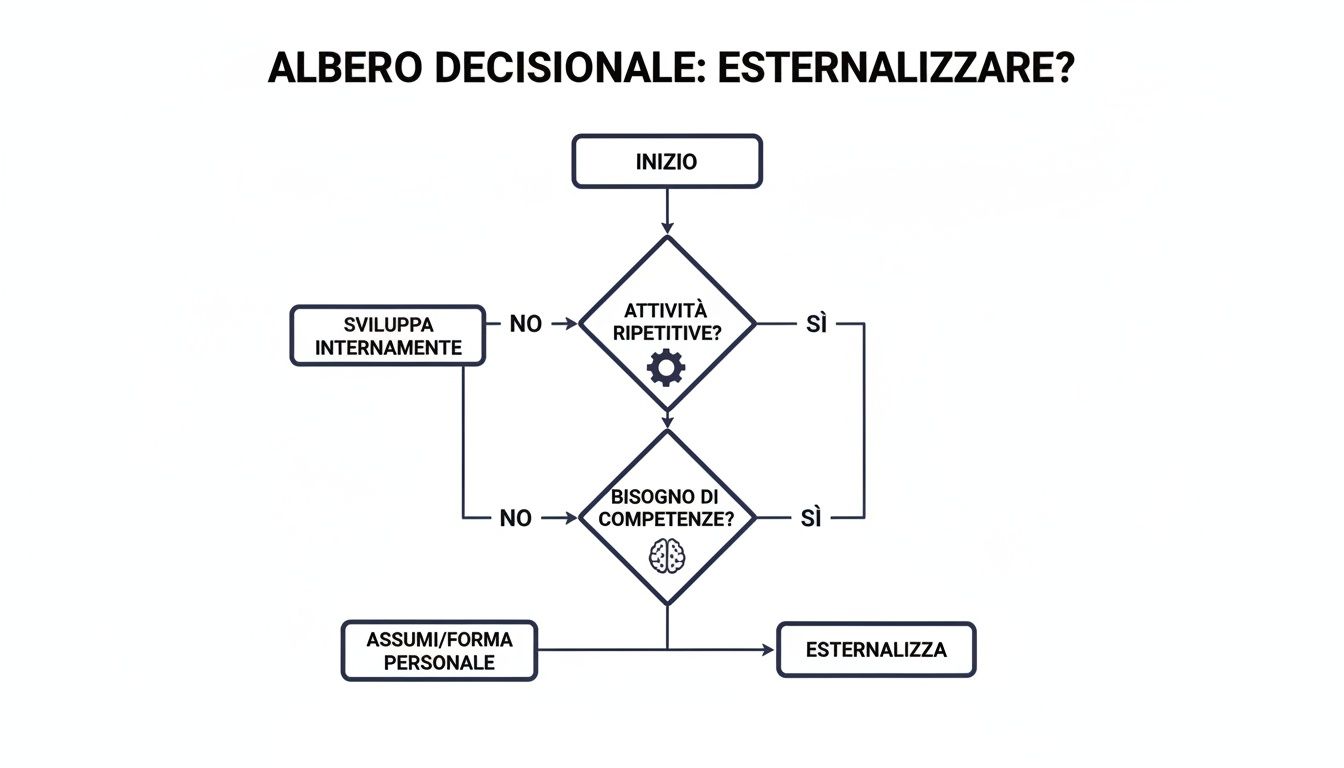
As the diagram shows, delegating a task makes sense when it is repetitive and does not require strategic skills that need to remain within your company. At that point, BPO becomes a viable option to consider.
Finally, the offshore model: outsourcing processes to suppliers in distant countries, such as India, the Philippines, or Latin America. Here, there is a single, powerful main attraction: a drastic reduction in labor costs.
This option is ideal for standardized, high-volume tasks that do not require continuous real-time interaction. Consider:
But be careful. Offshoring comes with significant challenges: cultural differences, language barriers, and dealing with opposite time zones can complicate matters. For this model to work, you need strong governance and rock-solid communication processes. Otherwise, there’s a risk that the pursuit of maximum savings will result in a decline in quality.
Deciding which parts of your business to entrust to an external partner is a delicate decision. The good news is that Business Process Outsourcing offers tremendous flexibility: you can start with a single task or delegate an entire business function. The concept is simple: you outsource operational activities to free up your team, allowing them to focus on what truly generates strategic value.
Instead of planning a complete overhaul, the best approach is almost always a gradual one. Start with the most standardized processes—the ones least tied to your true competitive advantage. This way, you minimize risks and test the waters with your BPO provider.

Virtually every department has processes that a specialized vendor could manage more efficiently. Let’s take a look at the most common opportunities, which serve as the ideal starting point for most small and medium-sized businesses.
These are the main areas:
Practical example: A manufacturing company that outsources its accounts payable not only reduces errors and payment delays, but also frees up its financial analysts. Instead of chasing down invoices, they can finally devote their time to analyzing profit margins and supporting strategic planning.
To make this concept even clearer, here is a list of activities that are ideally suited for BPO, broken down by function.
Finance and Accounting:
Human Resources:
Customer support and back office:
IT and development:
Identifying the right processes is the first, crucial step toward a successful BPO. To understand how to analyze and document your workflows, our guide to business process mapping is an essential tool for ensuring your company is fully prepared. Choosing the right activity to start with can determine the success of the entire strategy.
Choosing a business process outsourcing provider is one of those decisions that can shape the future of your company. A strategic partner can become the engine of your growth, free up resources, and give you the competitive edge you’re looking for. On the other hand, the wrong choice can turn into a bottomless pit of hidden costs, declining quality, and frustration for your team.
The real challenge isn’t finding the lowest quote. It’s identifying a partner who shares your vision, fits in with your company culture, and is ready to grow alongside you. To achieve this, you need an evaluation process that goes beyond glossy brochures.
Even before you start your search, you need to have a very clear idea of what your goal is. Without a goal, how will you know if you’re succeeding? Ask yourself: What is the real reason I’m considering outsourcing?
These numbers aren’t just wishful thinking; they’re the cornerstones on which you’ll build your Service Level Agreement (SLA) and the compass that will guide your decision.
A BPO partner isn’t just a supplier. It’s an extension of your team working outside your office. Cultural compatibility is no longer just a “nice-to-have”—it’s a fundamental requirement for a successful partnership.
Having clear objectives allows you to ask the right questions—the ones that truly put candidates to the test.
With your KPIs in hand, it’s time to start your search. Don’t stop at the first page of search results. Take advantage of professional platforms, reach out to your network for referrals, and, above all, look for case studies specific to your industry.
During the evaluation, there are three areas you absolutely cannot overlook:
The case studies on the website are important, but direct references are worth their weight in gold. Ask to speak with two or three of their current clients—ideally companies that are similar in size and complexity to yours.
When you call them, get straight to the point with specific questions:
These conversations will give you a much more realistic picture of what day-to-day collaboration will be like.
Finally, to avoid getting overwhelmed by all the information, use a checklist to compare the finalists. A table will help you objectively weigh the pros and cons.
A table for comparing and evaluating potential BPO partners based on key decision-making criteria.
Evaluation CriteriaSupplier ASupplier BSupplier CRating andScoreIndustry ExperienceHighAverageLowSupplierA has 3 case studies in retail.Service Cost (annual)€50,000€45,000€60,000B is the most affordable, but has less experience.Cultural FitExcellentGoodFairSupplierA’s team seems more aligned with our values.Security and GDPR PoliciesISO27001CompliantCompliantSupplier A offers the most documented guarantees.Quality of Client ReferencesExcellentGoodNotprovidedSupplier A’s clients are very satisfied.
This comparative analysis is the final tool needed to turn what seemed like a gamble into a strategic and informed decision.
By following this process, you’re not just choosing a business process outsourcing provider—you’re selecting a strategic partner who will help you grow in a smarter and more sustainable way.
Once you’ve signed the contract with your business process outsourcing partner, the real work begins: ensuring that the partnership delivers tangible value and managing the risks that will inevitably arise. Delegating a process, in fact, doesn’t mean losing control. It means managing it more effectively.
The key to a successful partnership lies in setting clear and measurable expectations from day one.
A Service Level Agreement (SLA) is much more than a legal document; it is the strategic roadmap for your partnership. An effective SLA leaves no room for interpretation. It must clearly define performance standards, the responsibilities of both parties, and penalties for non-compliance.
Within the SLA, Key Performance Indicators (KPIs) serve as the compass that guides day-to-day operations. These must be specific, measurable, and aligned with your business objectives.
Here are some practical examples of KPIs for various outsourced processes:
Monitoring these KPIs isn’t just about tracking for the sake of it. It’s a way to turn operational data into strategic discussions with your partner, focused on continuous improvement.
BPO is not without risks. The best approach is to anticipate them and turn them into a proactive governance plan. The main risks are almost always the same: data security, a potential decline in quality, and a loss of strategic control.
Fortunately, there are proven strategies for mitigating them.
Data Security: Information security is a top priority. Ensure that your partner holds key certifications such as ISO 27001 and is fully compliant with the GDPR. Schedule regular security audits, conducted by independent third parties, to verify that policies are being implemented in practice.
If you’d like to learn more about how to protect your sensitive information, you can read our insights on AI security and data protection, whose principles apply equally well to BPO.
Quality and Control: How can you prevent service quality from deteriorating over time?
By implementing these controls, business process outsourcing ceases to be an unknown quantity and becomes a manageable and predictable asset—a true driver of your growth.
Many people view business process outsourcing solely as a way to cut costs. That view is outdated. When the efficiency of BPO is combined with the power of artificial intelligence, the result is not just cost savings, but a real competitive advantage.
Don’t think of AI as a replacement for your BPO partner. Instead, think of it as a strategic co-pilot—a tool that turns outsourced operations into a goldmine of valuable insights.

While your BPO team handles the operational tasks, an AI-powered analytics platform like ELECTE works in the background analyzing the data generated by those same activities. This creates a virtuous cycle: the BPO ensures flawless execution, and the AI extracts strategic value from that efficiency, giving you the foundation to make better decisions.
The integration of AI shifts the focus of BPO from a purely operational approach to a strategic one. Your external partners no longer simply enter data or respond to customers; they become the frontline for gathering information that, when properly analyzed, can shape the future of your business.
Here are some real-world scenarios where the combination of BPO and AI makes a difference:
Traditionally, business process outsourcing has been viewed as a way to cut costs. Artificial intelligence completely changes this perspective. Your investment in BPO is no longer just an expense, but an investment in making your business smarter.
AI doesn't replace your BPO partner—it gives them superpowers. It transforms the raw data they handle every day into forecasts, warning signs, and growth opportunities that would otherwise remain hidden.
This approach gives you a level of control and visibility that was previously unthinkable. With an AI-powered analytics dashboard, you have a real-time overview of the situation. You can monitor critical KPIs, compare performance against goals, and, most importantly, understand the reasons behind the numbers.
In practice, this approach allows you to:
In short, integrating an analytics platform like ELECTE into your business process outsourcing strategy means equipping your company with an intelligent nervous system. The BPO partner manages the body, while AI acts as the brain, analyzing, predicting, and guiding action. This is how modern BPO becomes a driver of scalable and sustainable growth.
When it comes to business process outsourcing, especially for small and medium-sized businesses, the same questions always come up. Let’s clarify things with practical answers based on real-world experience.
This is a common but mistaken belief. In fact, BPO is a powerful tool, especially for small and medium-sized businesses. While large corporations use it to optimize large-scale operations, you can leverage it to bridge a critical gap: gaining access to expertise and technologies that would otherwise be out of reach.
It’s a driver of democratic growth. It puts you in a position to compete with much more established companies, allowing you to scale up quickly without having to make prohibitive initial investments in staff and infrastructure.
The biggest fear is always the same: losing control over processes and the resulting decline in quality. It’s a real risk, but it’s also a risk that can be fully managed if you take a proactive approach.
To counteract this, the strategy is based on three pillars:
The key to a successful BPO is not eliminating risks, but managing them. Strong governance turns uncertainty into strategic control.
There is no one-size-fits-all answer. The time it takes to implement a business process outsourcing strategy depends on what you want to outsource.
For simple, routine tasks, such as data entry or payroll processing, it takes just a few weeks. The handover is quick.
For more complex processes, such as a full-scale accounting system or software development, the process can take several months. In these cases, the time invested early on in planning and close collaboration with your partner is the best way to speed things up. It ensures that the transition is smooth rather than disruptive.
Ready to boost your business with data-driven decisions? Find out how ELECTE can transform your BPO strategy into a powerhouse of insights. Start your free trial →

.svg)


.svg)
.svg)