
The most common piece of advice when comparing next-generation voice assistants is also the least useful: comparing which one “responds better.” This is the logic of a consumer test, not a strategic decision. If you look at the market through the eyes of an entrepreneur, an innovation manager, or a compliance team, the right question isn’t which voice sounds smarter, but which system best orchestrates models, data, devices, and actions.
In Italy, the groundwork has already been laid for this shift in perspective. Home adoption of voice assistants rosefrom 11% of households in 2018 to 15% in 2019, according to *Biblioteche Oggi Trends* on voice assistants and smart speakers. We are therefore not talking about a technological novelty, but rather an interface that has already become part of everyday life.
The point today is a different one. The major players are converging on the same foundational building blocks of AI. When the “engine” starts to look alike, the differences shift to architecture, the ecosystem, actual agentic capabilities, and data governance. That is where the future will be decided.
For years, we’ve evaluated voice assistants the way we evaluate a game show. Does it understand the question? Does it respond quickly? Does it make few mistakes? Today, that framework is too narrow. A next-generation assistant doesn’t just compete on the answer itself, but on its ability to connect services, maintain context, perform actions, and operate within an ecosystem.
From my perspective, the real mistake is assuming that the underlying language model is still the primary differentiator. It clearly is no longer the case. As more companies rely on external models or shared infrastructure, conversational quality tends to converge. At that point, the competitive advantage lies not in the “brain” itself, but in how that brain is integrated.
The market isn't just rewarding those who speak best. It's rewarding those who best coordinate devices, services, context, and data.
For an Italian professional, this changes everything. The comparison of next-generation voice assistants should not be viewed as a gadget ranking, but rather as a choice between platforms with very different business models, technological dependencies, and operational implications.
The public debate continues to treat Siri, Alexa, Google Assistant, and emerging solutions as if each possessed a radically distinct form of intelligence. This perspective is becoming increasingly less useful. The industry is moving toward the commoditization of output: more powerful models, often accessible through shared infrastructure or partnerships, are narrowing the perceived gap in basic conversation.

An Italian benchmark is particularly revealing because it distinguishes between two metrics that many people confuse. In Worldline Italia’s test of 800 identical questions, Google Assistant achieved 100% question comprehension and 87.9% correct answers, Siri achieved 99.6% and 74.6%, Alexa achieved 99% and 72.5%, and Cortana 99.4% and 63.4%, as shown by Worldline Italia’s comparative benchmark.
These numbers tell us one thing for certain: understanding almost everything doesn’t mean being able to answer everything correctly. And above all, it doesn’t mean knowing how to act appropriately. The benchmark also highlights differences by task category: Siri outperformed Google on voice commands, while Google dominated in general knowledge questions and informational tasks. So there is no “absolute champion” that exists in a vacuum, detached from the context of use.
If multiple assistants reach similar levels of basic understanding, the platform is no longer the main factor in the decision. At that point, I consider four factors:
Rule of thumb: If two assistants seem similar in their responses, see what happens when they have to put words into action.
For this reason, a comparison of next-generation voice assistants shouldn’t start with a “who knows more” test, but with a different question: who truly controls the entire chain—from voice to model to integration to result?
When the engine tends to converge, the architecture becomes the real battleground. That is where it is decided how an assistant will evolve, how specialized it will become, and how reliable it will be when it has to handle complex actions—not just simple, isolated requests.
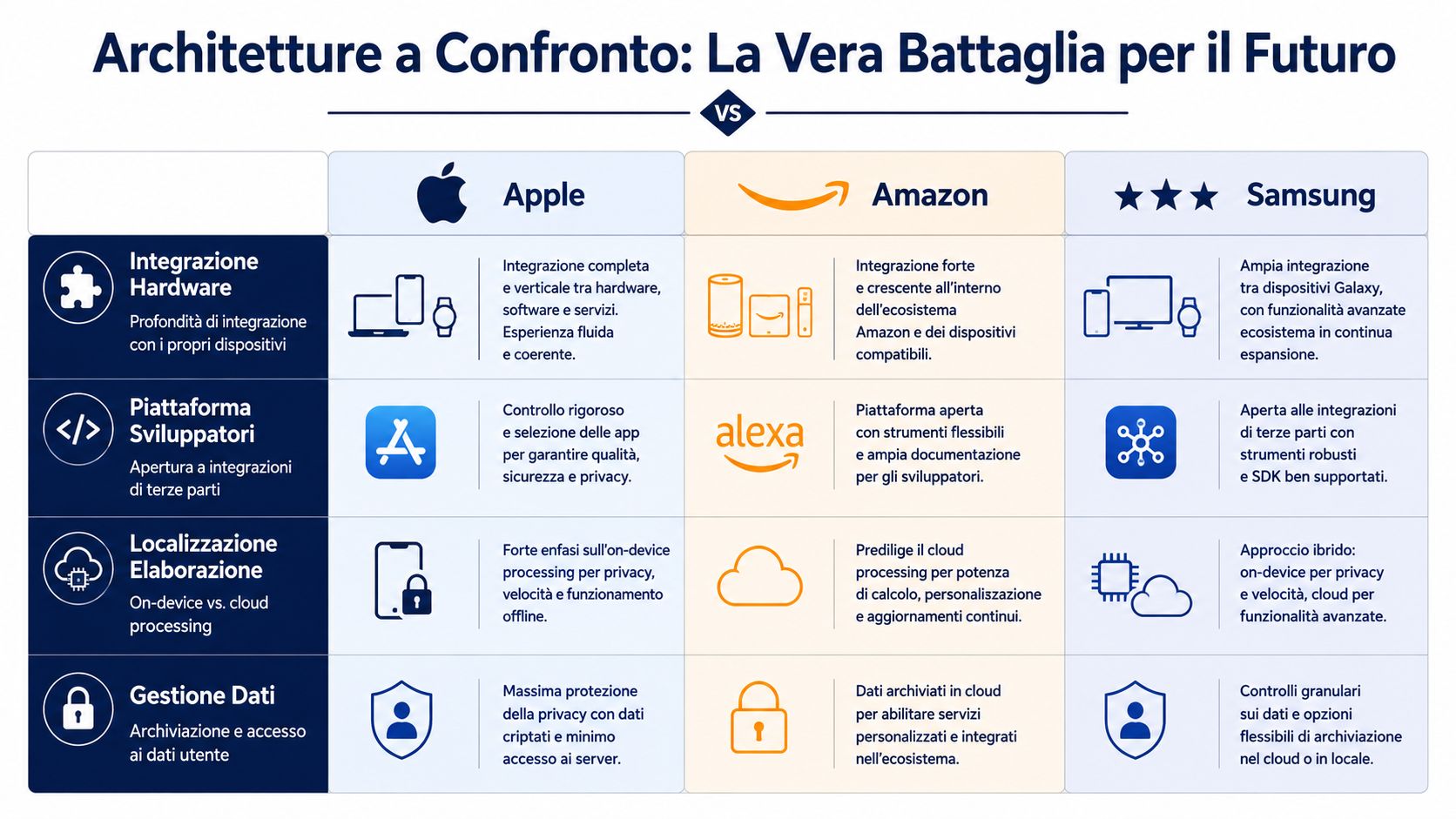
Large companies are taking different approaches, and this difference matters more than any single demo.
ApproachLogicStrengthMainRiskMonolithicAunifiedexperiencethat attempts to hide complexityConsistency perceived by the userLess flexibility if the system needsto specializeMulti-agentMultiplecomponents with distinct roles orchestrated togetherSpecialization by taskGreatercoordination complexityDeep reconstructionRethinkingthe assistant at the stack and interface levelsPotential qualitative leap in the medium termSlow transition dependent on actual integration
Amazon tends to prioritize a more unified experience. Samsung has demonstrated an approach more focused on orchestrating multiple components. Apple, on the other hand, is noted primarily for its ability to credibly rebuild Siri after a long delay perceived by the market. There’s no need to turn these trajectories into slogans. It’s enough to understand that architecture is a strategic choice, not a technical detail.
A feature can be copied. An architecture cannot—or at least not quickly. If a competitor launches a new summary, booking, or auto-dial feature, others can replicate it. But the way an assistant distributes tasks among speech recognition, memory, scheduling, external apps, and permission management determines the system’s quality over time.
For those working in the company, the key question is this: Is the assistant designed to perform a reliable sequence of actions, or to impress during a demo?
It’s one thing to ask, “Reserve a table for me.” It’s quite another to have a system manage a sequence of steps involving constraints, authorizations, sensitive data, and verification of the result.
This also highlights the limitations of consumer-oriented AI. Many assistants promise to “do things for you,” but in practice, they perform best in highly standardized areas: music, timers, quick information, smart home controls, messages, and calendars. As soon as the task involves exceptions, policies, corporate data, or operational responsibilities, their capabilities become more limited.
That’s why, when I assess the future of a platform, I don’t just look at what it can do today. I look to see if its architecture is capable of handling:
When comparing the latest generation of voice assistants, the real battle isn’t about which ones sound more natural. It’s about which ones have more convincing models.
The term “agent-like” is used too loosely. These days, all it takes is for an assistant to complete a guided task to be labeled an agent. I disagree. A system is truly agent-like when it can interpret a goal, break it down into steps, interact with different tools, verify the outcome, and handle exceptions without losing sight of the context.
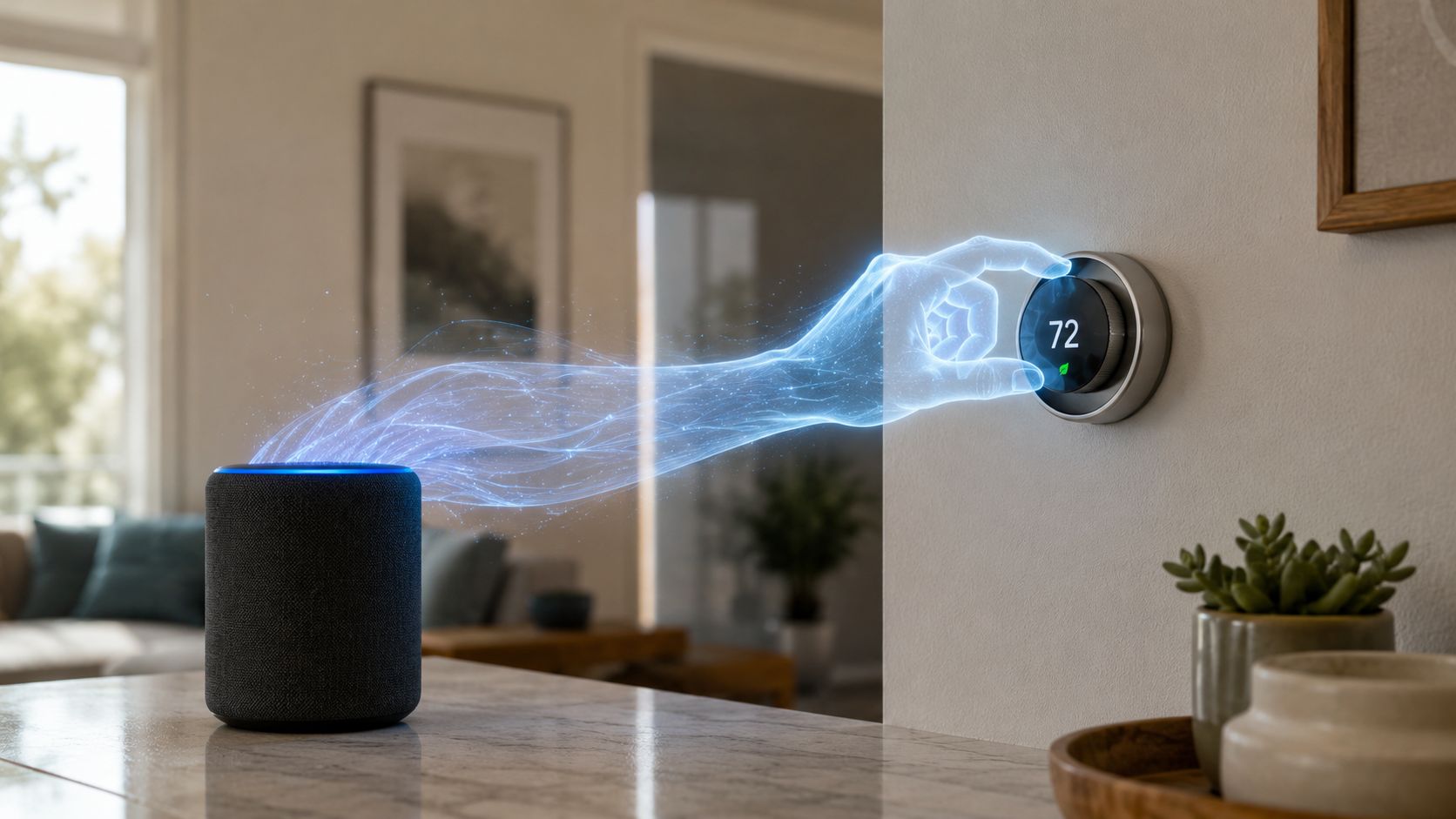
In the consumer sector, many “actions” are actually well-designed shortcuts. Turning on the lights, starting a playlist, setting a reminder, sending a message. They’re useful, and often very well designed. But they’re actions that take place in relatively closed environments, with little room for ambiguity.
In day-to-day work, the bar is raised immediately. A true professional must be able to connect data, applications, internal policies, and responsibilities. If a manager requests an analysis of a drop in sales, the system shouldn’t just summarize a dashboard. It should cross-reference sources, flag anomalies, distinguish between assumptions and facts, and produce actionable insights.
This is where the difference between a consumer assistant and ELECTE’s AI Agents for business processes becomes clear. It is not a difference in abstract “general intelligence.” It is a difference in design: objectives, data, tools, controls, and auditability.
The real bottleneck in an assistant’s capabilities isn’t just the model itself. It’s the network of integrations that the assistant can activate in the local context. Historical data on the Italian market illustrates this well: a cited survey indicated 2,920 Alexa skills in Italy, compared to 65,901 in the United States and 34,771 in the United Kingdom, as reported in True Numbers’ analysis of home voice assistants.
This gap is no small matter. It means that Italian users, even when using a powerful assistant, operate within a more limited ecosystem of third-party features compared to English-speaking markets. And if the ecosystem is more limited, so too is the ability to “take action.”
Three practical implications:
An assistant who “gets things done” at home isn’t automatically ready to “get things done” at work.
That’s why, when comparing next-generation voice assistants, I always distinguish between three levels: conversation, guided execution, and reliable automation. Marketing tends to lump them all together. Anyone making a serious investment should carefully distinguish between them.
If basic intelligence becomes standardized, the competitive advantage shifts from the model itself to the network of connections. This is where many public debates miss the point. They treat the assistant as a finished product, when in reality its value depends on what it can enable around it.
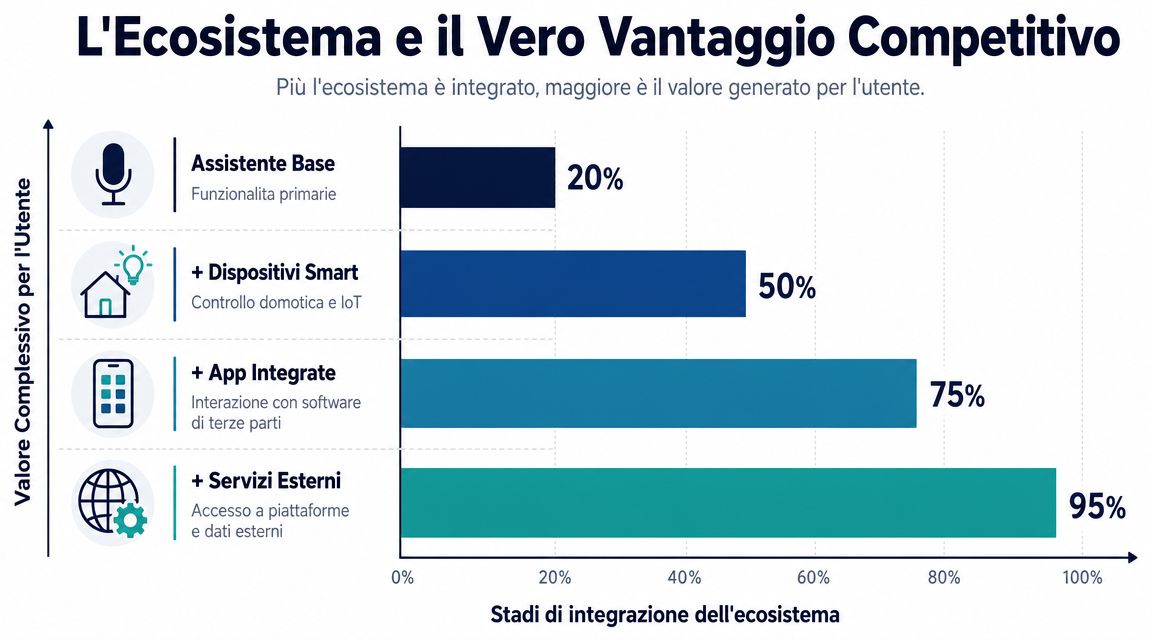
In the Italian market, a strong brand isn’t enough. An assistant may look excellent on paper, but if the local ecosystem lacks depth, its practical value in everyday use is limited. This applies to smart homes, apps, local services, payments, and vertical integrations.
According to GMI Insights’ report on the voice user interface(VUI) market, the market was valued at $16.5 billion, with North America accounting for over 30% of the global market in 2023. For Italy, the same industry landscape helps reveal a concrete trend: the main assistants available are Siri, Google Assistant, and Alexa, but the practical choice often revolves around the ecosystem, multi-device compatibility, and home automation integration.
For a professional team, the ecosystem is more than just a list of compatible tools. It’s a complete ecosystem:
A rich ecosystem reduces friction. A fragmented ecosystem creates dependencies, exceptions, and blind spots.
The more interchangeable the models become, the more the ecosystem becomes the product.
This is why a comparison of next-generation voice assistants should be viewed as an evaluation of the platform. You’re not just choosing a voice. You’re choosing an ecosystem of integrations, technology partners, and operational capabilities. And for a business, this ecosystem often matters more than the brilliance of a single response.
The most overlooked topic in reviews of voice assistants is also the most important one for a business audience. Almost all reviews focus on features, accuracy, voice quality, and smart home capabilities. Very few actually delve into data governance.
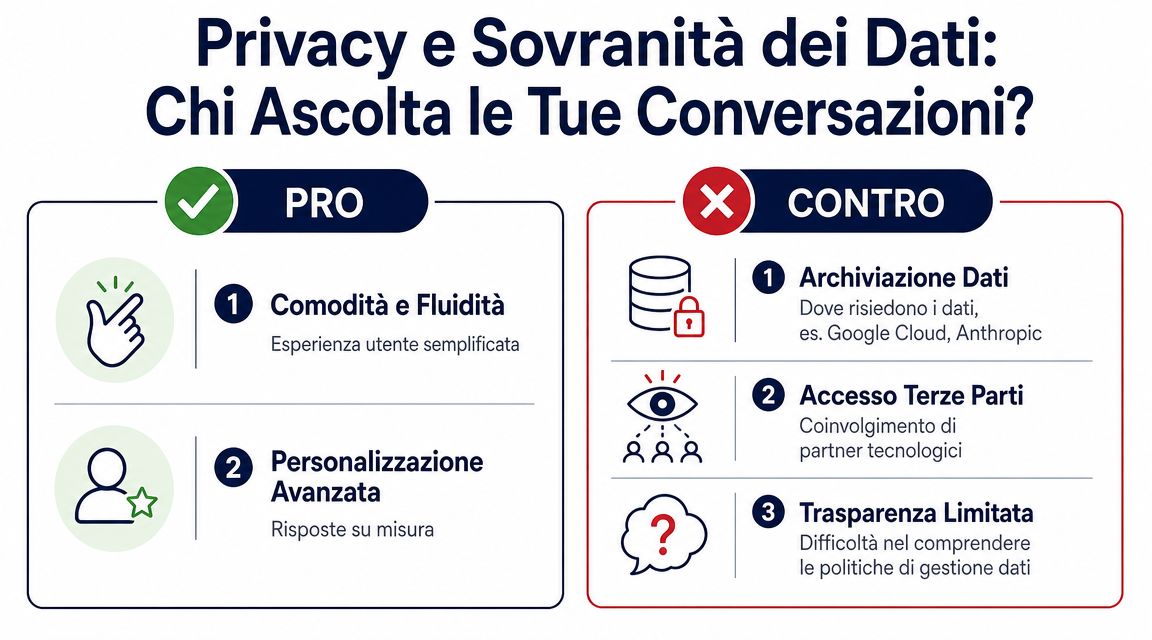
An Italian source puts it plainly: most analyses of voice assistants in Italy overlook privacy, compliance, and data sovereignty, creating an information gap for companies. This is the key point highlighted by Hello Uniweb in its analysis of voice assistants.
To a consumer, this omission may seem minor. To an SME, a finance team, or a compliance officer, it is anything but. If a voice request traverses cloud infrastructure, third-party services, and external application chains, the question is not just “Is the response correct?”, but also:
To explore this topic from a broader perspective, it is also worth reading ELECTE’s analysis on listening, data, and information risk in AI systems.
This video helps put the topic into perspective from a more accessible angle:
When a voice assistant is introduced into a professional setting, I suggest evaluating it as you would any technology that involves data and processes—not as a mere gadget.
A basic checklist should include:
CriterionQuestion toAskData ResidencyDo you knowwhich jurisdiction requests and outputs pass through?Third Parties InvolvedDo you havevisibility into the technology partners that process or host the data?Administrative ControlCan youmanage policies, accounts, permissions, and deactivations centrally?AuditabilityAre therelogs, action traceability, and audit capabilities?Risk mitigationCan yourestrict the transmission of sensitive data or separate personal and business contexts?
The bottom line: In business, it’s not the nicest assistant who wins. It’s the one who reduces friction without increasing operational risk.
This changes the very nature of the comparison between next-generation voice assistants. If you’re a European professional, the quality of the conversation is just one of the criteria. The other factor—often the more important one—is actual control over the data. And on this front, the market is even less transparent than marketing communications would have you believe.
The voice assistant market is entering a new phase. The key question is no longer which platform looks the most impressive in a demo, but which one is best at orchestrating models, integrations, context, and governance. That’s where the real advantage lies.
What sets it apart isn’t just the quality of the conversation. It’s the architecture underpinning the experience, the depth of the ecosystem that enables actions, the maturity of the agent’s capabilities, and the level of control over data. For a business user, these four factors matter far more than a witty reply or a command executed in a matter of seconds.
Those looking ahead should think in terms of orchestration. It is the same logic that is redefining not only consumer assistants but the entire new generation of operational AI systems. A useful read on this topic is ELECTE’s analysis of AI orchestration and the role of integrations in real-world workflows.
If you want to turn data, signals, and workflows into concrete operational decisions, try ELECTE, an AI-powered data analytics platform for SMEs. It’s the most straightforward way to see how a business-oriented AI agent differs from a consumer-focused assistant: less conversation for its own sake, and more analysis, automation, and real support for decision-making.

.svg)


.svg)
.svg)