
The most common piece of advice about AI agents today is also the most misleading: all it takes is for a piece of software to “use an LLM,” and suddenly it becomes an agent. It doesn’t work that way. By 2026, nearly every product with a chat feature, a prompt box, or an automation function will market itself as an “AI Agent,” but calling everything an “agent” renders the term meaningless.
For a company, this isn't just a semantic detail. It's an operational and investment issue. If you buy a chatbot expecting it to be an autonomous analyst, you'll be disappointed. If you buy a real agent and manage it as if it were just a conversational assistant, you won't get any value out of it and you'll increase your risk.
Anyone who actually works with autonomous data systems sees the difference right away. A chatbot responds when you ask it a question. An agent keeps working even when you’re not watching. It monitors, compares, decides on the next step, uses tools, produces output, and corrects itself. It’s the difference between a switchboard operator and an analyst who delivers the report that really matters first thing in the morning.
This guide is designed to clear things up. If you want to understand what AI agents are, here you’ll find a rigorous definition, a practical map of the spectrum of agency, a 5-question test to evaluate any product, and an honest assessment of the real risks.
In today’s market, “AI Agent” has become a catch-all term. People slap it on chatbots with short memories, workflows that involve an LLM, plugins that call an API, and even enhanced search interfaces. The result is simple: the term no longer helps you understand what you’re buying.

The confusion stems from a misguided habit. We judge technology based on superficial features—such as the presence of a chat function, natural language processing, or a more seamless user experience. But agency isn’t measured by the interface; it’s measured by the system’s operational behavior.
A chatbot waits for input. An agent pursues a goal.
This distinction is particularly important in the business world. A finance, operations, or retail team doesn’t buy “AI” in the abstract. It buys operational capabilities. It wants to know whether the system can monitor data, detect anomalies, query multiple sources, generate insights, and continue to do so without having to be prompted every time.
When vocabulary breaks down, expectations and decision-making processes break down as well. I see three recurring mistakes:
The question isn't "Does it use an advanced model?" The question is: Does it act autonomously toward a goal, in a real-world environment, using real tools, and adjusting its course as it goes?
If the answer is vague, you're probably looking at marketing.
The most useful definition isn’t the broadest one. It’s the one that helps you rule out what an AI agent isn’t.The European Union’s AI Office, as reported by PwC Italy, defines AI agents as “systems based on generalist models (GPAI)” used for tasks that require multiple decisions and interaction with complex digital environments, such as browsers or operating systems, clearly distinguishing them from traditional reactive generative models.
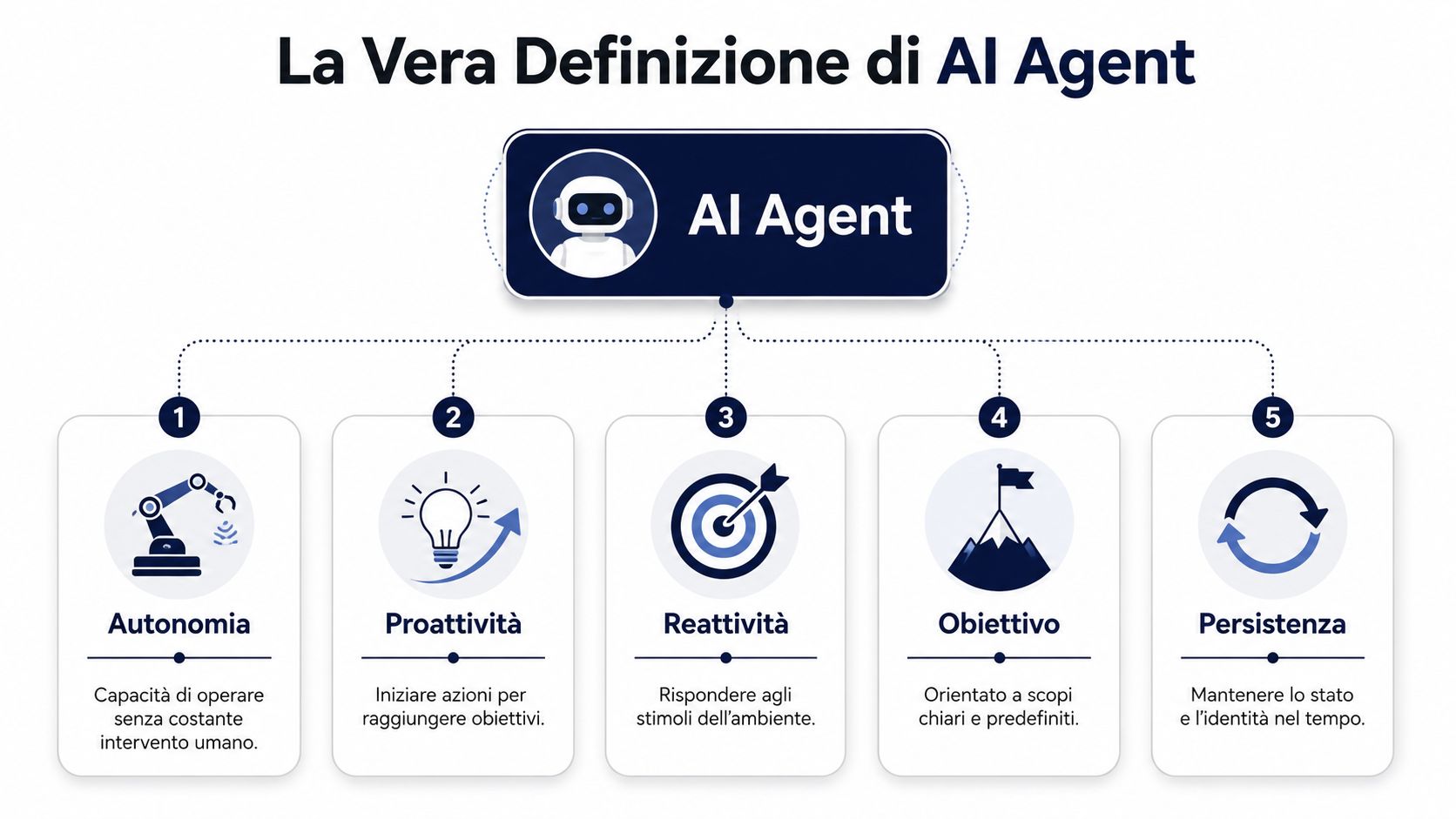
In practical terms, an AI agent is a system that is given a goal and pursues it autonomously. It plans its steps, takes actions, observes the results, and adjusts its course without requiring human instructions at every step.
This is the technical and operational difference that matters to buyers. Not the tone of the chat. Not the number of available prompts. Not the fact that it “seems smart.”
Rule of thumb: If you have to tell them every single step, you're not using an agent. You're micromanaging an assistant.
An agent operates without step-by-step instructions. You assign it a goal, not a detailed list of clicks or commands. For example, “Check the sales data and report any significant anomalies” is a goal. “Open the file, filter by region, compare it to yesterday’s data, then write a summary” is a human procedure disguised as automation.
An agent maintains state and context over time. It remembers what it was doing, what exceptions it encountered, which sources it has already checked, and what logic it followed. A stateless chatbot, on the other hand, often starts from scratch or from a limited memory.
An agent breaks down complex objectives into subtasks. If the agent needs to produce a useful report, it may decide to collect data, validate its quality, identify outliers, compare trends, and then summarize the findings. Planning is what distinguishes a mere executor from a system capable of working.
An agent uses external tools. It calls APIs, queries databases, executes code, navigates browsers, and writes to operating systems or enterprise platforms. Without these tools, in most cases you end up with a model that sounds good but does little.
An agent evaluates its own output and makes corrections. If data is inconsistent, if a query fails, or if an action produces an incomplete result, the agent must be able to try again, change its strategy, or request an escalation.
The simplest metaphor is still this one. A chatbot is an assistant who answers the phone. An agent is an analyst who works even when the office is closed and places the numbers you need to see on your desk in the morning.
Here is a practical summary:
SystemWhat it doesWhen it operatesLevel of initiativeChatbotAnswers questionsWhen you ask itLowTraditional automationFollows predefined rulesWhen a trigger is activatedMedium, but rigidAI agentPursues goals adaptivelyEven without continuous inputHigh
If one of the five criteria is missing, it isn't automatically useless. It can be an excellent assistant, a good orchestrator, or a valuable automation tool. But calling it an "agent" just creates confusion.
The market isn't divided into two distinct blocks. It's not just chatbots on one side and autonomous agents on the other. There's a spectrum of agency, and that's the only serious way to understand the products you encounter.
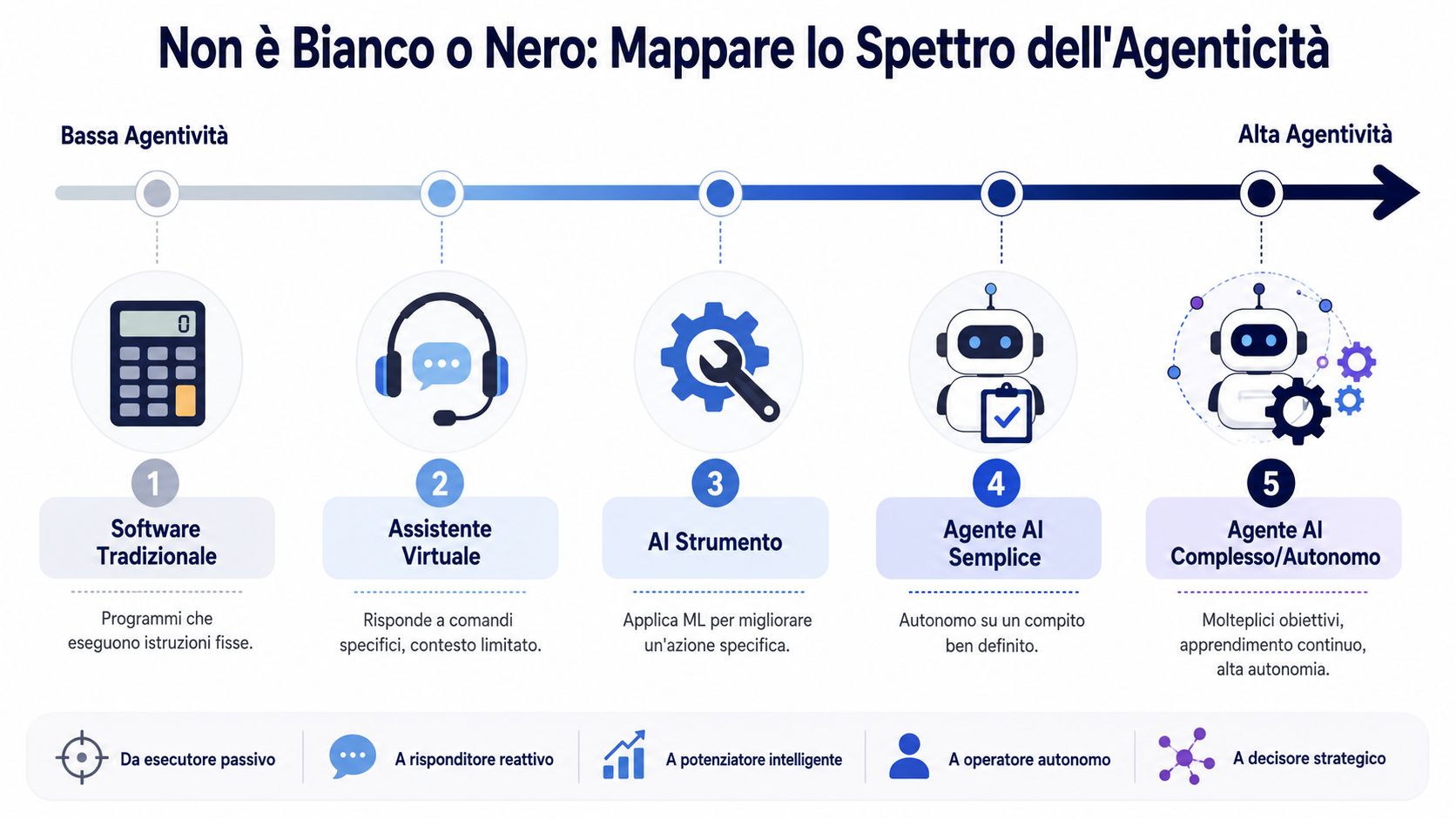
At the lower end of the spectrum is the pure chatbot. It answers a question, has no real operational persistence, and does not interact with the outside world. It is useful for support, FAQs, draft generation, and conversational retrieval.
One step up, you’ll findthe assistant with tools. Here, the system can do a little more when you ask it to. It can search for information, fill out a form, retrieve data, perhaps book an activity, or coordinate a single task. In 2026, many consumer and workplace products fall into this category.
Then there’sintelligent automation. A workflow built in Zapier, Make, or similar tools that uses an LLM to classify, route, or generate text isn’t necessarily an agent. It’s often a more flexible form of automation than traditional ones. It’s useful, but still heavily reliant on triggers, rules, and predefined paths.
The next level isthe supervised agent. Here, the system plans, uses tools, and progresses through multi-step tasks, but requests human confirmation before critical steps. In a business setting, this is often the best configuration when the cost of error is high.
At the very top isthe autonomous agent. It is given a goal, works in a real-world environment, uses the necessary tools, monitors the results, and carries out the mission without you having to direct it.
SAP’s classification of AI agents provides a useful framework: agents can be reactive, proactive, hybrid, utility-based, learning-based, and collaborative, and goal-based agents select the most efficient path to achieve the desired outcome. This classification is important because it explains something that marketing tends to hide: not all agents make decisions in the same way, and two products with the same label can have very different capabilities.
If a vendor only shows you a chat demo, they haven't shown you the agent capabilities yet. They've just shown you the interface.
To help you get your bearings, here’s a quick overview of the 2026 market most frequently mentioned in professional discussions:
The correct way to look at it isn't "does it work or doesn't it?" It's: where does it fall on the spectrum, and is that level consistent with the work you want to delegate?
When you're in a demo, conducting due diligence, or in the process of making a purchase, avoid abstract questions. Ask for verifiable information. A true AI agent is recognized by its behavior, not by its promises.
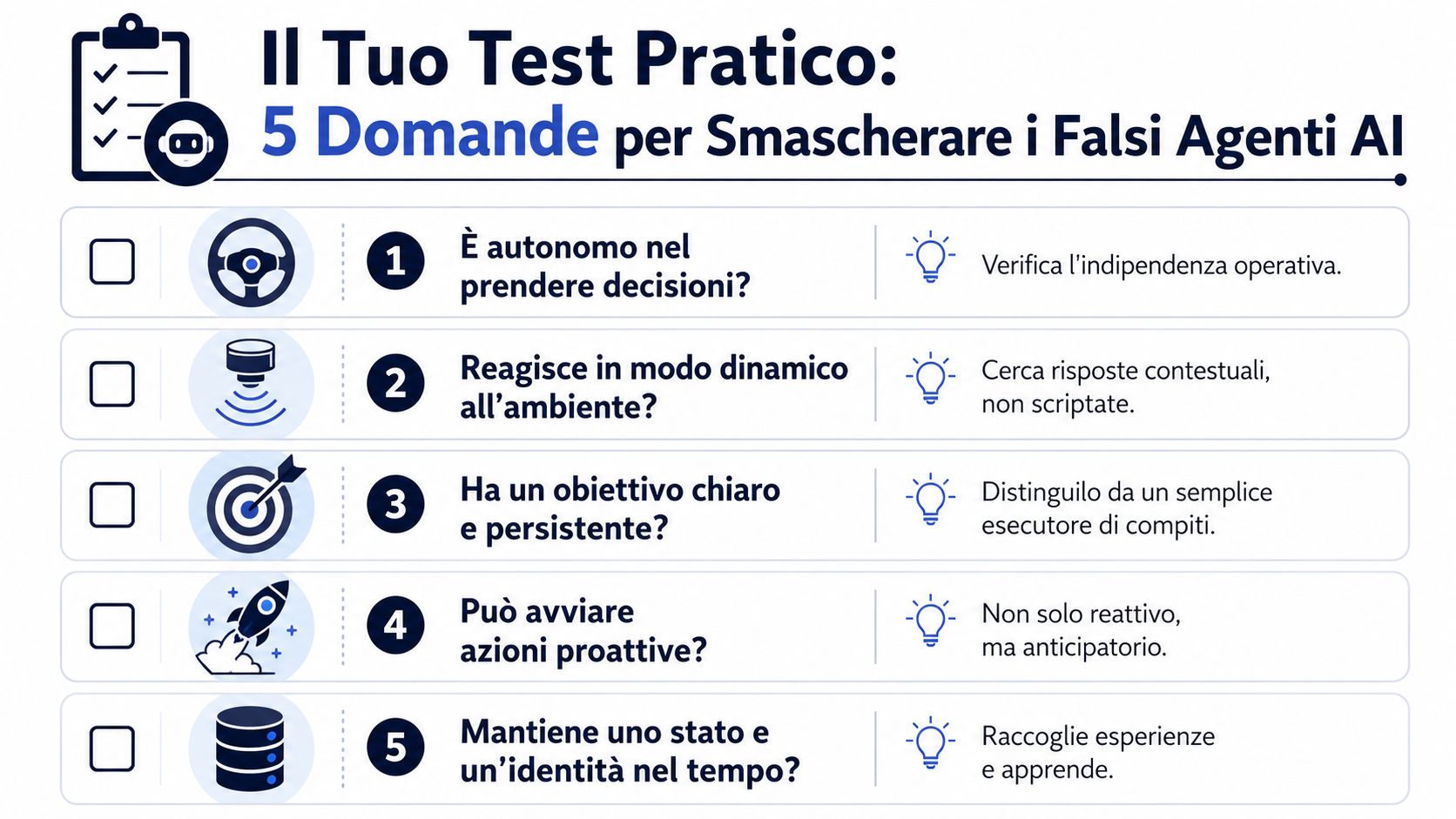
The rule is simple:
Don't ask, “Is it agent-based?” Ask to see a complete task—from the objective to the result—without human intervention.
A good supplier won't take offense at these questions. In fact, they should be happy to discuss the details. Those who usually avoid technical discussions are the ones who know they're selling a lower-quality product under a stronger brand name.
This distinction isn't just theoretical. It changes the type of value you're buying, the budget it makes sense to allocate, the type of team you bring in, and the return you can reasonably expect.
A chatbot tends to improve response times and access to information. Automation reduces manual work on repetitive tasks. A human agent can influence monitoring, execution, and operational decision-making.
This also changes the way you evaluate the use case:
According to Google Cloud’s report on AI agents, up to 40% of IT companies in Europe have not yet implemented agents to automate complex analytical workflows—a sign that the market remains underserved and that many companies have not yet fully grasped the concept of the “autonomous analyst.”
The most common mistake isn't buying a subpar product. It's buying the wrong product based on the expectations you have in mind.
If you buy a chatbot expecting it to detect anomalies in the data, coordinate sources, generate reports, and take the initiative, you’ll say that “AI doesn’t live up to its promises.” In reality, you’ve purchased the wrong type of solution. If, on the other hand, you buy an agent and use it only to answer occasional questions, you’re paying for capabilities you aren’t taking advantage of.
For decision-makers, the key point is this: ROI isn’t just measured by the costs avoided. It’s measured by the nature of the work you delegate. To learn more about the difference between automation and agency as applied to processes, it’s worth reading this in-depth article on agent-based AI 2026.
Autonomy is useful as long as it remains controlled. When an agent can execute code, write to systems, send communications, or modify data, every potential error takes on operational significance. This is the point that many vendors downplay because it complicates the narrative.
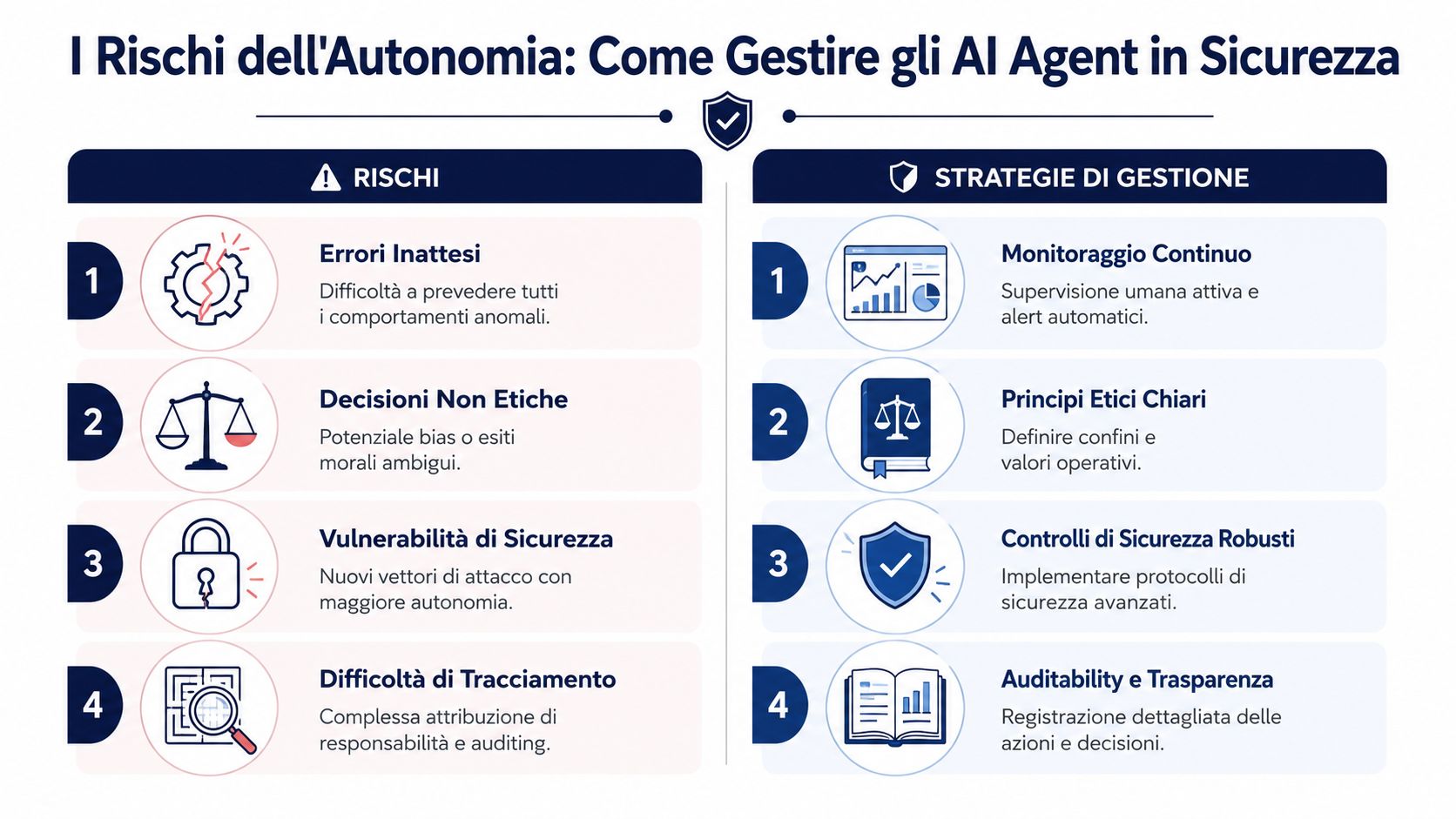
The main risks are not theoretical. They are very real:
A lane without a guardrail isn't "more advanced." It's just more dangerous.
To use an enterprise agent effectively, clear guidelines are needed. Generic policies or an internal disclaimer are not enough.
A solid foundation includes:
If you work in regulated environments or with sensitive data, the Spark guide on the AI Act provides a solid foundation in both regulations and best practices. It helps clarify obligations, responsibilities, and the level of attention required when autonomous systems move beyond the lab and into business processes.
For a report focused on enterprise controls, you can also check out this AI Agent Security Outlook 2026.
If you want a concise summary, here it is. What are AI agents? They aren’t just chatbots with a more modern name. They are systems that pursue goals autonomously, maintain context, plan, use tools, and correct themselves along the way.
The best way to evaluate them is not to rely on the category specified by the vendor. Instead, place them on the agency spectrum and then apply the 5-question test. That two-step filter eliminates much of the market noise.
If you're interested in autonomous data analysis, the point isn't to have a fancier chat feature. The point is to have a system that actually works like a digital analyst. To see what that means in practice, you can explore " Uncovering Patterns with AI Agents."
ELECTE, an AI-powered data analytics platform for SMEs, is built precisely on this distinction: not a chatbot that waits for questions, but an agent that monitors data, identifies anomalies, and generates actionable insights. If you want to understand how to apply this approach to your business without the complexity of an enterprise-level solution, visit ELECTE and discover how to turn data into clearer decisions.

.svg)


.svg)
.svg)