
You’ve just wrapped up a promising call, sent a quote, or picked up an interesting lead at a trade show. Then, silence. This is where many small and medium-sized businesses fall short: the initial contact has been made, but there’s no system in place to turn it into a relationship, a decision, and a result.
If you’re wondering what “follow-up” means, the answer isn’t simply “sending a reminder.” In day-to-day work, a follow-up is the bridge between initial interest and the next concrete step. If that bridge is fragile, the lead loses interest, the project slows down, the best candidate accepts an offer elsewhere, and the team loses its focus.
In business, this is even more important because many processes stall right after the first interaction. Not because of a lack of opportunities, but because of a lack of structure. A well-planned follow-up increases clarity, speeds up decision-making, and reduces operational inefficiencies. An improvised follow-up, on the other hand, comes across as pressure or, worse yet, indecision.
Here you'll find a practical take on the concept, with applications in sales, project management, and internal organization. The point isn't to write more messages. The point is to follow up in the right way, at the right time, and with content that truly helps the recipient take action.
The most delicate moment in a negotiation, a project, or a hiring process isn’t always the beginning. Often, it’s what comes right after. You’ve captured their attention, sparked their interest, and started a conversation. But if you don’t follow through, you’re letting the other party decide the timing, priorities, and direction.
In practice, follow-up serves to bridge this gap. It brings order to intentions and turns them into progress. In sales, it means guiding the prospect toward a decision. In projects, it means confirming responsibilities, deadlines, and next steps. In people management, it means maintaining the quality of the relationship even when there isn’t an immediate response.
Good follow-up doesn't chase after people. It reduces decision-making friction.
Those who handle this aspect well gain two clear advantages. On the one hand, it improves efficiency by reducing downtime and ambiguity. On the other hand, it increases the likelihood of conversion, because each message has a specific purpose and a simple call to action.
To truly understand what “follow-up” means, you have to stop thinking of it as a mere formality. It’s an operational skill. And in small and medium-sized enterprises, it often makes the difference between a full but unproductive pipeline and processes that actually move forward.
If you really want to understand what “follow-up” means, it’s best to start with the language and then move on to its practical application.The Accademia della Crusca notes that, in general Italian usage, “follow-up” is largely equivalent to “seguito.” But it also adds a crucial point: in specialized fields such as medicine and business, the English term has taken on a more precise technical meaning, related to monitoring, continuation, and control over time.
This clears up a common misunderstanding. In business terminology, “follow-up” doesn’t simply mean “I’m writing again because you didn’t reply.” It means continuing an interaction with a specific goal in mind. It’s a planned action, not an impromptu reaction.
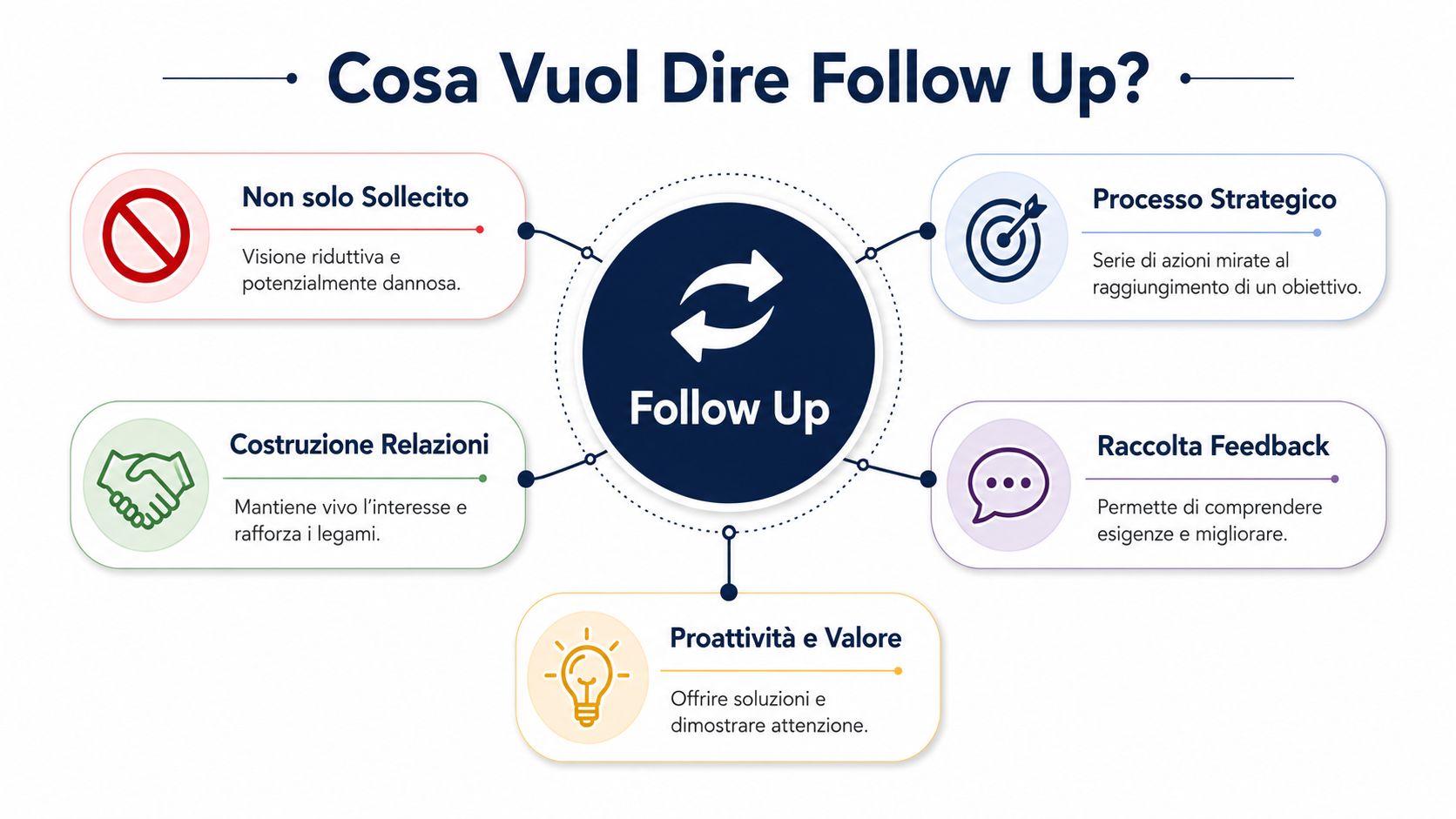
The most useful distinction is this:
| Approach | Logic | Effect on the recipient |
|---|---|---|
| Reminder | He is asking for a response | It might seem like pressure |
| Strategic Follow-Up | It adds context, value, or a next step | Makes the decision easier |
A reminder might say: “Did you get a chance to see my email?”
A well-crafted follow-up might say: “After our meeting, I summarized the two key issues that came up, and I’d like to schedule a 15-minute call to see if this solution aligns with your priorities.”
The first message shifts the mental load onto the recipient. The second reduces it.
Rule of thumb: If your follow-up doesn't add anything, you're just asking for attention. If it adds clarity, you're creating value.
In sales, this changes how your role is perceived. You don’t come across as pushy. You appear organized, reliable, and capable of guiding the process. The same logic applies to any business role where you need to move a conversation forward, check on a status, or secure a decision.
When companies truly understand what follow-up means, they stop treating it as a minor task. They incorporate it into their processes, CRM systems, project workflows, and team routines. That’s when follow-up becomes a driver of conversion rather than just a chase.
In the real world, there is no single type of follow-up. The objective, tone, timing, and content all vary. Treating every follow-up the same way is one of the most costly mistakes.
One statistic illustrates the problem well. In the Italian business context, only 18% of SMEs structure targeted follow-ups with an integrated value proposition, and communications featuring a clear call to action and specific benefits can increase the response rate by up to 45%, according to Unid Formazione. In other words: many companies still write just to “make themselves heard,” while few write to move a decision forward.
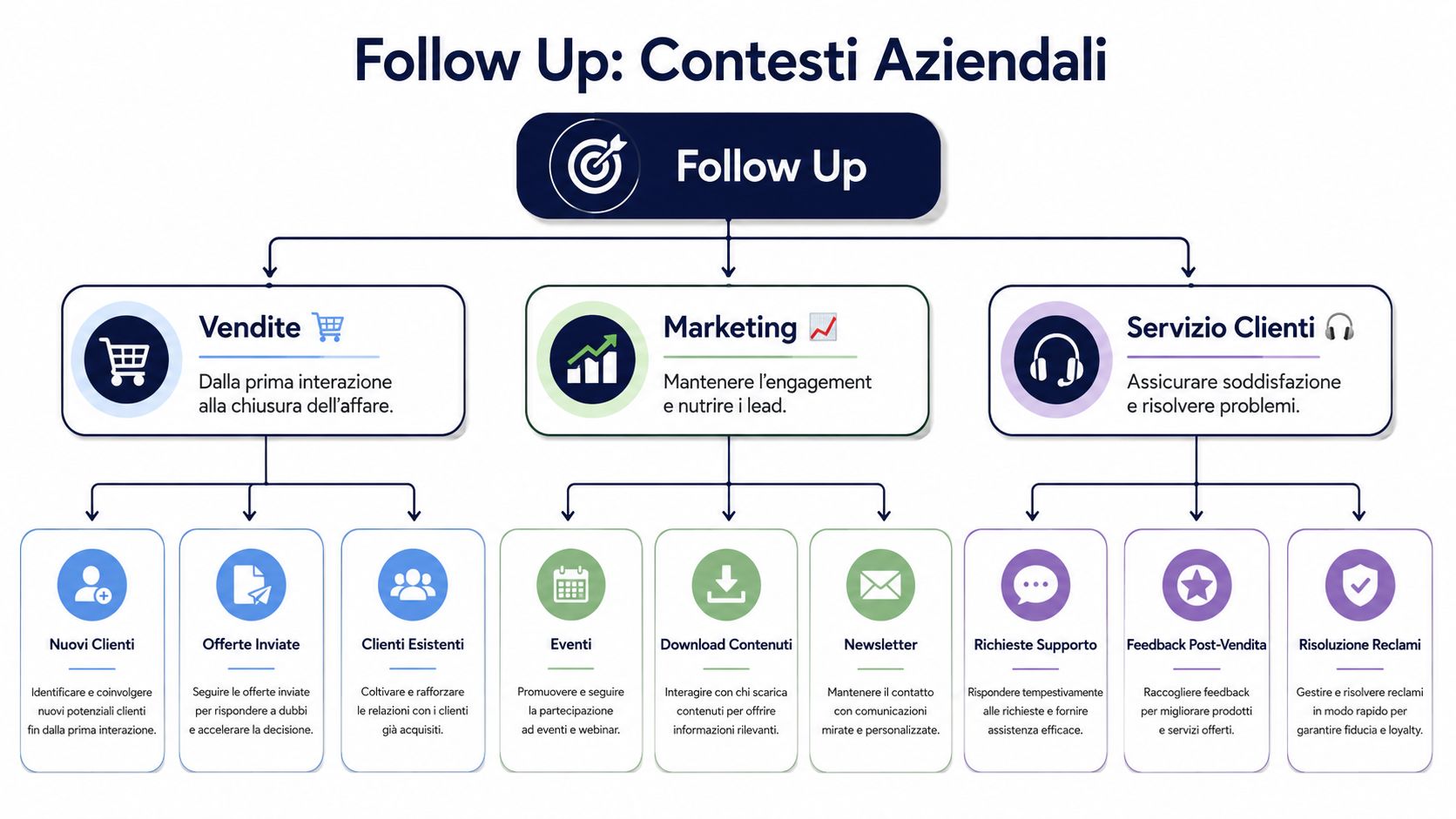
In sales, follow-up is used to move a prospect from interest to action. The point isn't to remind them that you exist. The point is to reduce the doubts that are preventing them from signing.
Useful examples:
If you want to align this work with demand generation, a data-driven marketing plan helps connect content, scoring, and sales priorities.
In project management, follow-up isn't about "keeping tabs on people." It's about safeguarding the workflow. When it's missing, three things happen: responsibilities become blurred, deadlines get pushed back, and problems surface too late.
Effective follow-up, in this context, takes a different form:
The quality of follow-up in a project can be gauged by a simple question: Who is responsible for what, by when, and according to what criteria for completion? If the message doesn't answer this, it isn't coordinating anything.
In projects, the best follow-up is the one that prevents delays—not the one that documents them after they’ve already happened.
In recruitment, follow-up builds a company’s reputation. A candidate also evaluates a company based on how it follows up. Uncertain timelines, generic messages, and a lack of updates convey a lack of organization.
The most successful companies use follow-ups to:
The same applies to internal management. After a one-on-one, formal feedback, or performance review, follow-up is essential to ensure that everything doesn’t fizzle out into mere good intentions. Without follow-up, the discussion remains just a conversation. With follow-up, it becomes operational improvement.
A follow-up email works when it makes the next step easy. Not when it sounds vaguely polite. The recipient needs to understand three things within a few seconds: why you're writing, what value it offers them, and what they should do next.
In digital marketing, there is a clear best practice: sending a follow-up email within 2–3 days of the previous interaction helps maximize conversion. Furthermore, emails that provide added value and include a clear call to action (CTA) are more likely to reignite the sales conversation, as ActiveCampaign explains in its in-depth guide on follow-up emails.
The subject line doesn't have to be creative. It has to be useful. If the recipient has to guess what you're talking about, you've already lost clarity.
Items such as the following work best:
The opening line must be grounded in reality. One line is enough, as long as it's specific.
Examples:
The main body of the email should serve a useful purpose. Don't just fill space. This is where many companies go wrong—they simply repeat the request without adding anything.
The right content depends on the context. It can be:
Then comes the CTA. Just one—clear and easy to follow.
| Weak CTA | Effective CTA |
|---|---|
| Let me know | If that works for you, we can talk on Thursday at 11 a.m. or Friday at 3 p.m. |
| I'm here if you need me | If you'd like, I can put together an updated version of the proposal based on the budget we agreed on. |
| I look forward to hearing from you | Can you let me know by Friday which of the two options you prefer? |
If the CTA requires too much effort, the recipient will put it off. If it requires a simple choice, they'll respond more readily.
To automate your initial responses without compromising quality, you may find it helpful to read these tips for a smart autoresponder.
After a sales call
Good morning, [Name],
. I’d like to follow up on what came up during our discussion yesterday. It seems to me that there are two priorities: reducing manual steps and gaining greater visibility into the status of opportunities. I’d like to offer you a demo focused on these two aspects. If that works for you, I can schedule it for Wednesday morning or Thursday afternoon.
After sending a quote
Good morning, [Name],
. I'm writing to you regarding the proposal we sent. To make it easier for you to evaluate, I'd like to highlight the point that has the greatest operational impact: the reduction of repetitive tasks during the management phase. If you'd like, I can send you a comparison between the basic option and the one best suited to your current workload. Would that be helpful?
After an event or trade show
Good morning, [Name],
. It was a pleasure to speak with you during the event. You mentioned the need to improve the handoff between marketing and sales. I’m sending you a summary of possible initial steps, and I’m available for a brief discussion if you’d like to review priorities and timelines.
Three criteria bring us full circle:
Mistakes in follow-up rarely seem serious at the time you make them. A generic email seems harmless. An extra message seems like a safe bet. A vague call to action sounds polite. In reality, every mistake creates friction and erodes trust.
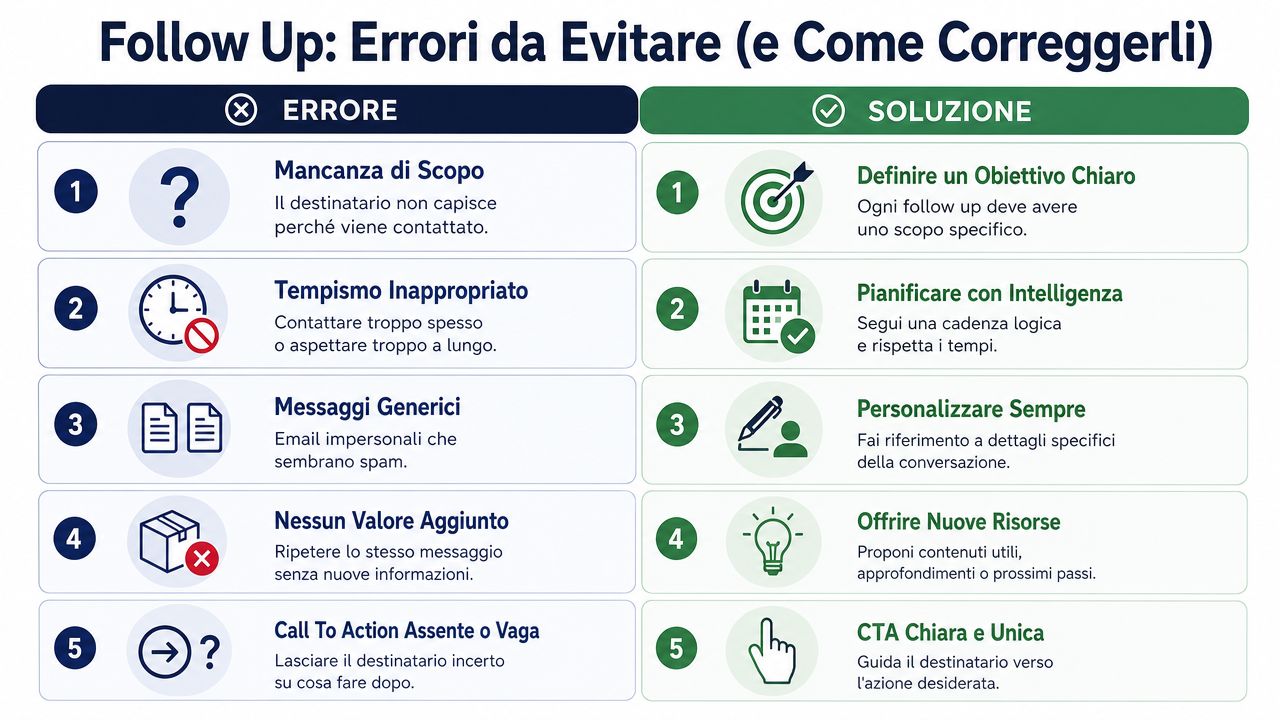
Lack of Purpose
Writing “I’ll contact you for a follow-up” doesn’t say anything. The recipient doesn’t understand the reason for the message, so they don’t perceive any urgency or value.
Solution: Always define the purpose of the contact. A decision to be made, clarification to be provided, material to be shared, or a call to be scheduled.
Poor Timing
If you write too soon, you risk coming across as anxious. If you wait too long, the momentum has faded. In either case, you lose impact.
Solution: Establish a rhythm that aligns with the decision-making cycle. After an event, timing is crucial. After a complex proposal, you need realistic lead times.
Generic messages
Emails that are indistinguishable from one another come across as automated in the worst sense of the word. The reader gets the impression that you aren’t following up on their specific case—you’re just going through the motions.
Solution: Include a specific reference to the conversation, a need, or a constraint that was mentioned.
Impersonal follow-up doesn't scale. It simply results in a proliferation of messages that no one feels are meant for them.
Lack of new value
Repeating “I’m waiting” doesn’t help the decision-making process. If you don’t bring anything new to the table, you’re asking for attention without earning a response.
Solution: Add a summary, a useful question, an alternative option, a practical clarification, or relevant content.
Missing or vague CTA
“Let me know” is a convenient phrase for the writer, but not for the reader. It leaves too much room for interpretation.
Solution: Specify a single, precise action. Confirm a time slot, choose between two options, or approve the next step.
A quick check before sending helps a lot:
If any of these responses is weak, the follow-up should be rewritten.
The limitation of manual follow-up isn't just time. It's inconsistency. Some leads are followed up on too late, others too often, and still others with the wrong message. As the pipeline grows, the error isn't just occasional—it becomes systemic.
In Italy, only 7.2% of SMEs use AI for predictive analytics, while 91% consider it a moderate priority, according to this analysis of AI adoption among SMEs. This disparity is a telling sign of the current situation: many companies recognize the value, but few have already translated that value into operational processes.

There are recurring signs:
Here, data makes all the difference. Not to replace human judgment, but to help us make better decisions. If you know which interactions most often lead to a response, which timing avoids losing the lead, and which content results in higher-quality conversations, follow-up stops being a hit-or-miss process.
Useful automation isn't about "sending more emails." It's about better coordinating the steps.
For example:
An AI-driven workflow orchestration approach for small and medium-sized businesses helps with exactly this. It links events, data, and actions into a single, coherent process, so follow-up doesn't depend solely on an individual's memory or energy.
Smart automation works when it standardizes the process and leaves the quality of the relationship up to people.
For an SME, this is a tangible way to boost efficiency. Fewer missed steps, greater continuity, and clearer priorities. And above all, it provides an operational advantage over those who continue to treat follow-up as a secondary task.
If you want to remember a truly useful definition of what “follow-up” means, here it is: intentionally following up on a relationship, a decision, or an activity to move it forward.
Key Takeaways
Those who master follow-up manage their time more effectively, minimize distractions, and improve the quality of important conversations. In other words, it boosts both efficiency and conversion rates. It’s a skill that’s easy to understand but powerful when organized well.
If you want to take this approach to the next level, ELECTE—an AI-powered data analytics platform for SMEs—helps you turn operational data into clear insights, automate repetitive analyses, and identify the right moments to take action. It’s a practical way to make follow-ups less haphazard and more intelligent. Ready to transform your data? Start your free trial →

.svg)


.svg)
.svg)