
If you're investing a large portion of your budget in acquiring new customers, there's a strategic question worth considering: How much are the customers you've already acquired over time actually worth? The answer lies in customer lifetime value, often abbreviated as CLV.
This issue matters because, according to the Harvard Business Review, acquiring a new customer can cost 5 to 25 times more than retaining an existing one. For an SME, this changes the way you view marketing, sales, customer service, and profit margins. You’re not just looking for orders. You’re building relationships that can generate repeat revenue, higher-value purchases, and smarter business decisions.
Think of a regular customer at a coffee shop. Their value isn’t just this morning’s cappuccino. It’s the sum of all their future breakfasts, their regular visits, their trust, and even the likelihood that they’ll recommend the place to others. That’s what CLV is, in simple terms.
This guide puts the concept into practice. You’ll learn how to interpret customer lifetime value without unnecessary technical jargon, how to calculate it incrementally, which metrics influence it, and how to increase it through concrete actions. You’ll also see why AI-powered platforms today make this analysis accessible even to small and medium-sized businesses without a team of data scientists.
Many entrepreneurs measure success by looking at the number of new customers acquired this month. That’s understandable. New customers are visible, easy to count, and give an immediate sense of growth. But the real point isn’t just how many customers come on board. It’s how much value they generate over time.
That’s exactly what customer lifetime value is for. Simply put, it’s an estimate of the total economic value a customer can bring to your business over the course of the entire business relationship. It doesn’t focus on a single purchase. It measures the trajectory.
Whether you run a retail store, an e-commerce business, a professional practice, or a service-based business, CLV helps you stop thinking in terms of isolated transactions. You’ll start to see the customer as a relationship worth nurturing. A customer who buys only a little but returns often can be worth more than one who places a large order and then disappears.
The best customer isn't usually the next person you need to convince. It's the one who has already decided to trust you.
This is where the shift in mindset begins. When CLV is factored into decision-making, marketing ceases to be merely a cost center and becomes a return-oriented investment. Promotions are evaluated differently. Customer service becomes a driver of profit. And small and medium-sized businesses begin to interpret their data with much greater clarity.
Customer lifetime value is often defined in overly technical terms. In reality, the concept is intuitive. It means understanding how much a customer is worth—not just today, but over the entire duration of their relationship with your company.
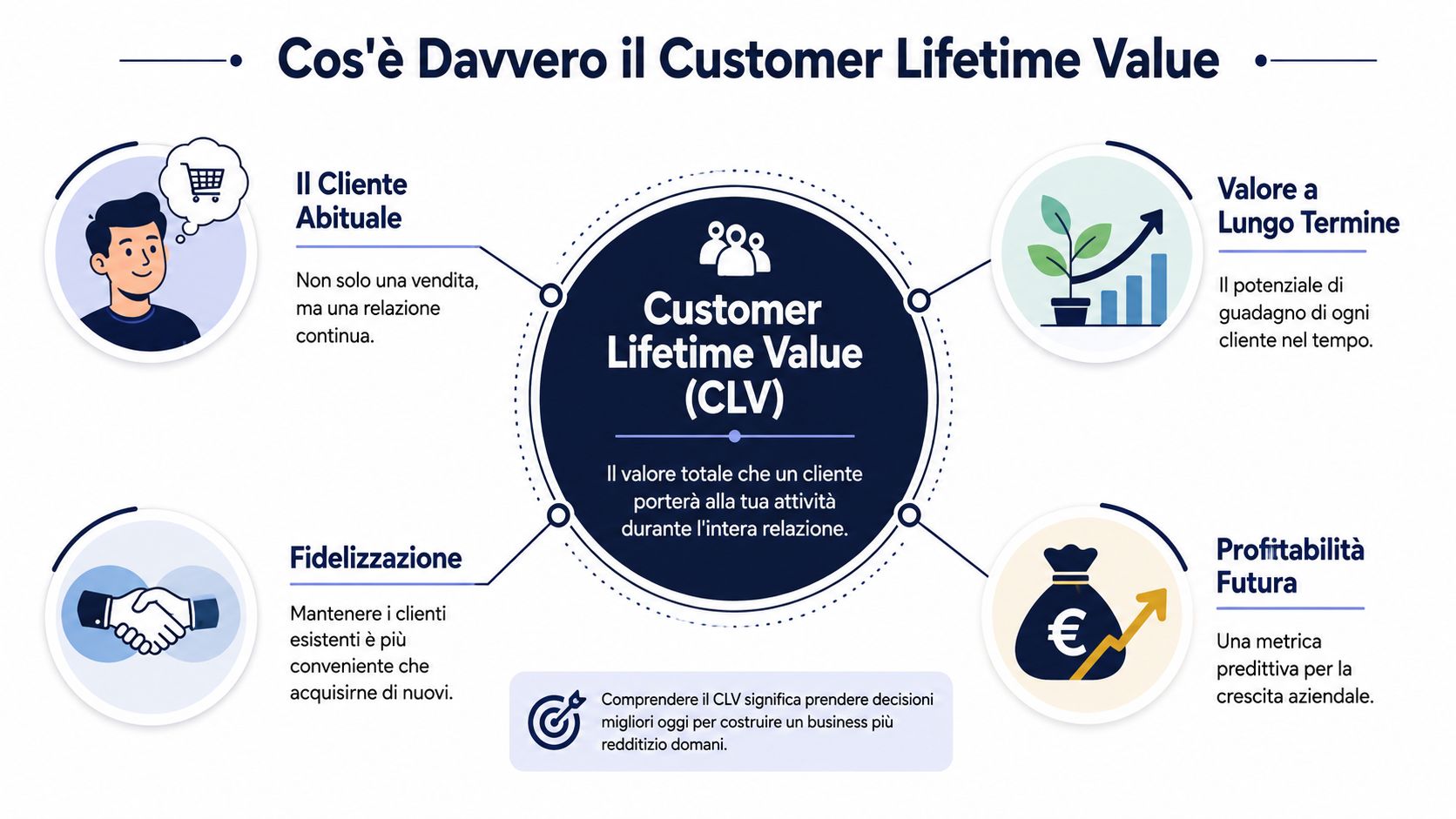
Take the example of a neighborhood café. One customer walks in on Monday, orders a coffee, and leaves. Another comes in three times a week, occasionally orders a brioche, brings a coworker, and keeps coming back for months. Which of the two is more valuable?
The answer is obvious when you look at it this way. Yet many companies set up campaigns, discounts, and budgets as if every customer were equally valuable. CLV corrects this mistake. It forces you to look at the cumulative value of the relationship.
In the case of a bar, the value of a regular customer depends on a few simple factors:
When you consider all these factors together, the customer is no longer just “a receipt.” They become a relational asset.
CLV may seem like a metric for marketers, but it actually affects the entire company. It helps business leaders make more informed decisions in four very concrete areas.
| Area | Practical question | Why CLV Helps |
|---|---|---|
| Marketing | How much can you spend to acquire a customer? | It gives you a more reasonable budget |
| Sales | Which segments deserve the most attention? | Highlight the customers with the greatest potential |
| Product or Offer | What drives buybacks? | Show which experiences increase loyalty |
| Customer Service | Where is the best place to invest in support? | Link retention to future profit |
There is also one point that often causes confusion. CLV isn't just a "historical" number. It can be a forward-looking estimate. This means it's not just for understanding what has happened. It's also for deciding what to do next.
Rule of thumb: If your team measures only monthly revenue, it sees only the present. If it also measures customer lifetime value, it begins to see the business it is building.
To start, you can use a very simple version of CLV based on average order value, purchase frequency, and relationship duration. Then, as more data becomes available, you can add margin and predictive logic. The important thing isn't to start with a perfect model. It's to begin thinking in terms of value over time.
The best way to understand customer lifetime value is to start with a simple formula and then make it more realistic. You don’t need to be a quantitative analyst. You need to understand the factors behind the number.
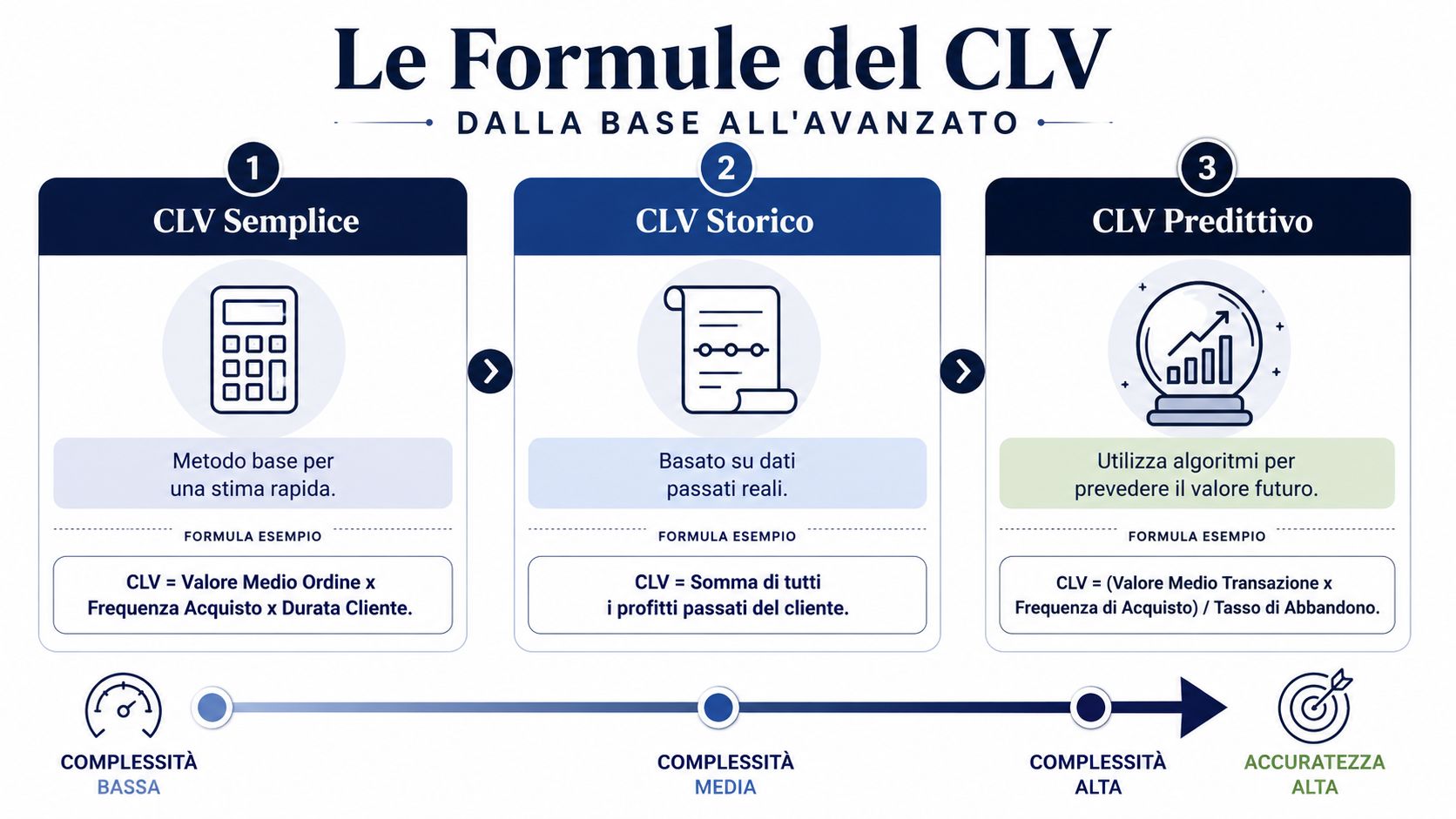
The basic formula is as follows:
CLV = average order value × purchase frequency × relationship duration
It works well as a general guideline. If you sell online, the average order value is the average receipt amount. Frequency is how many times a customer makes a purchase over a certain period. Retention is how long a customer remains active.
This formula is useful because it forces you to break down the problem. If the CLV is low, the reason is never “vague.” It usually comes down to one of these three things:
For a quick estimate, you can also use specialized tools such as the customer lifetime value calculator, especially if you want a working basis without having to build a complex file from scratch.
This simple formula has a major limitation. It looks at revenue, not profit. For this reason, it’s a good idea to factor in the margin as soon as you can.
Two customers may have the same cumulative revenue but represent very different values to the company. One buys high-margin products. The other buys only discounted items, requires frequent support, or generates returns. In that case, CLV based on revenue may be an overestimate.
A more sophisticated approach, therefore, considers profit per order or per customer. This brings CLV closer to actual ROI. It also helps you avoid a common pitfall: increasing sales at the expense of value.
| Calculation Level | What does it take into account? | When to use it |
|---|---|---|
| Simple CLV | Average revenue, frequency, duration | Initial phase or quick check |
| Historical CLV with margin | Actual profits generated over time | When you have cleaner financial data |
| Predictive CLV | Probability of Future Purchases and Retention | When you want to allocate budgets and set priorities |
When you adopt a predictive approach, CLV ceases to be a simple total and becomes a forecast. This is where concepts such as churn, retention, and discount rates come into play.
Put simply, the discount rate serves as a reminder that a euro earned today is not worth the same as a euro you might earn in the future. You don’t need to do complex financial math to understand this. You just need to realize that time matters.
Churn, on the other hand, measures customer attrition. If churn rises, the average relationship duration shortens and CLV tends to decline. If retention improves, CLV increases. That’s why it’s helpful to think of these metrics as an ecosystem.
A healthy business doesn't look at CLV in isolation. It looks at how acquisition, margin, frequency, and churn work together.
This approach is very useful for ROI. If a campaign brings in customers who buy right away but churn quickly, the apparent results may look good in the short term. Customer lifetime value, on the other hand, reveals whether you’re building sustainable growth or just temporary volume.
CLV doesn't stand alone. If you look at it in isolation, you risk making biased decisions. The most useful metrics are those that help you understand where customer value comes from and where it can break down.
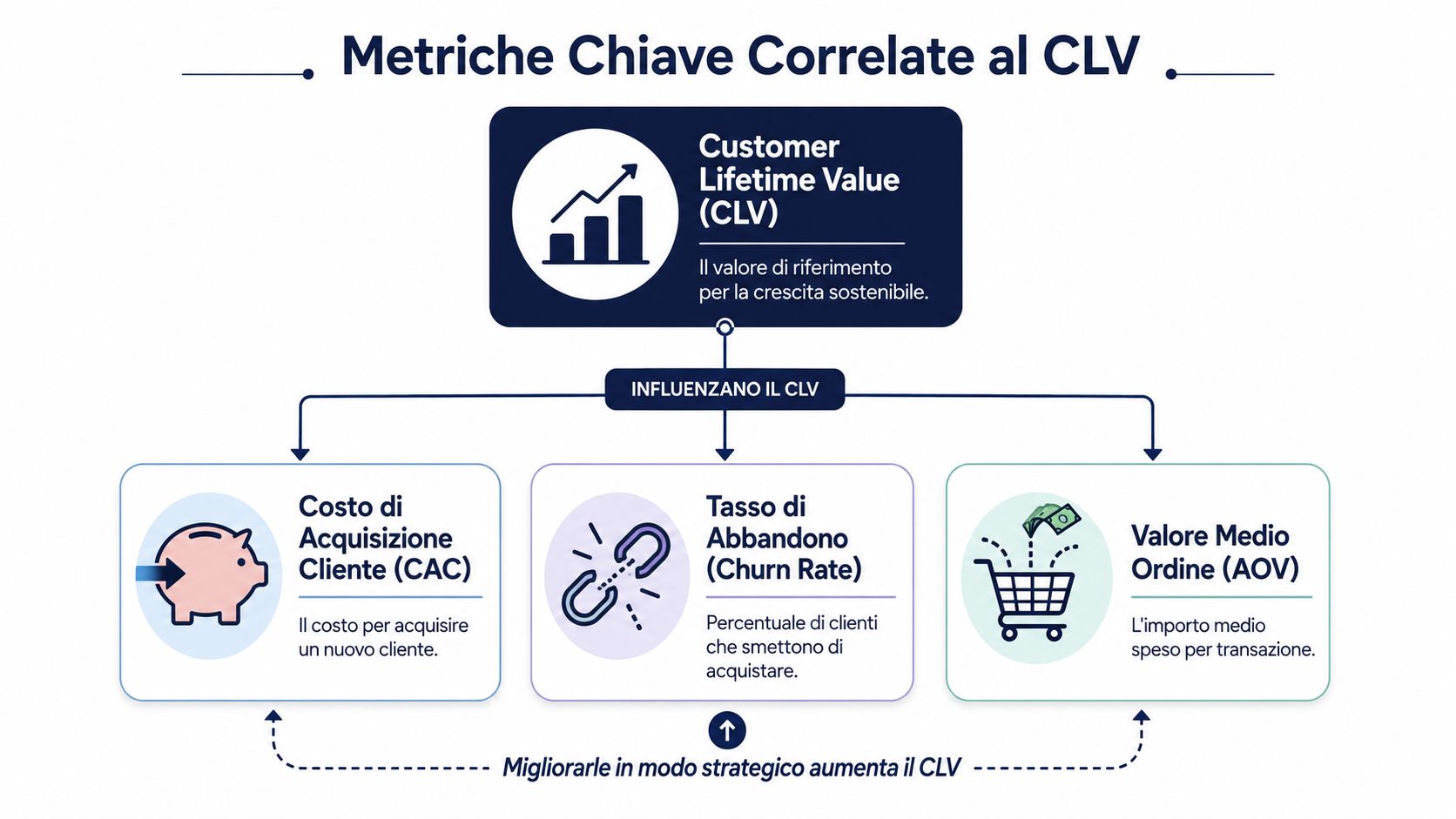
The first is CAC, or customer acquisition cost. You don’t need a figure that’s exact down to the cent to understand the principle. If you spend too much to acquire customers who then buy very little or only once, CLV is unlikely to sustain the business. The ratio of CLV to CAC then becomes a measure of sustainability.
The second is the churn rate. It’s the rate at which customers leave the relationship. A high churn rate shortens the customer’s lifetime and reduces future value. That’s why churn isn’t just about support or customer service. It’s about margins, cash flow, and business priorities.
The third is average order value, often referred to as AOV. If you can increase it without compromising the customer experience or resorting to destructive discounts, CLV can grow in a healthy way.
Another useful indicator comes from customer feedback. Listening tools such as AI-driven NPS insights can help you connect feedback, churn risk, and experience quality.
Not all companies need to start with a sophisticated predictive model right away. It’s best to choose the method based on the maturity of the data.
| Approach | Complexity | Accuracy | Recommended Use |
|---|---|---|---|
| Simple average | Low | Limited | Initial Guidance |
| Cohort analysis | Media | Good | To analyze group behavior over time |
| Predictive Models | Higher | More durable | For advanced segmentation and budget allocation |
Cohort analysis is often a great tool. Instead of viewing all customers as an indistinct group, you can segment them by acquisition period, channel, or initial behavior. This allows you to see whether certain groups stay longer, spend more, or churn early.
If all customers seem “average,” you’re almost always looking at an average that hides crucial differences.
Predictive models take it a step further. They estimate a customer’s future value by combining purchases, the time between orders, product categories, interactions, and risk signals. This is where AI comes in handy, as it allows us to identify patterns that remain invisible to the naked eye or on a simple spreadsheet.
Measuring customer lifetime value is useful. Increasing it really makes a difference to the income statement. For an SME, this means focusing on specific customer behaviors: buying more effectively, buying more often, and staying with the company longer.
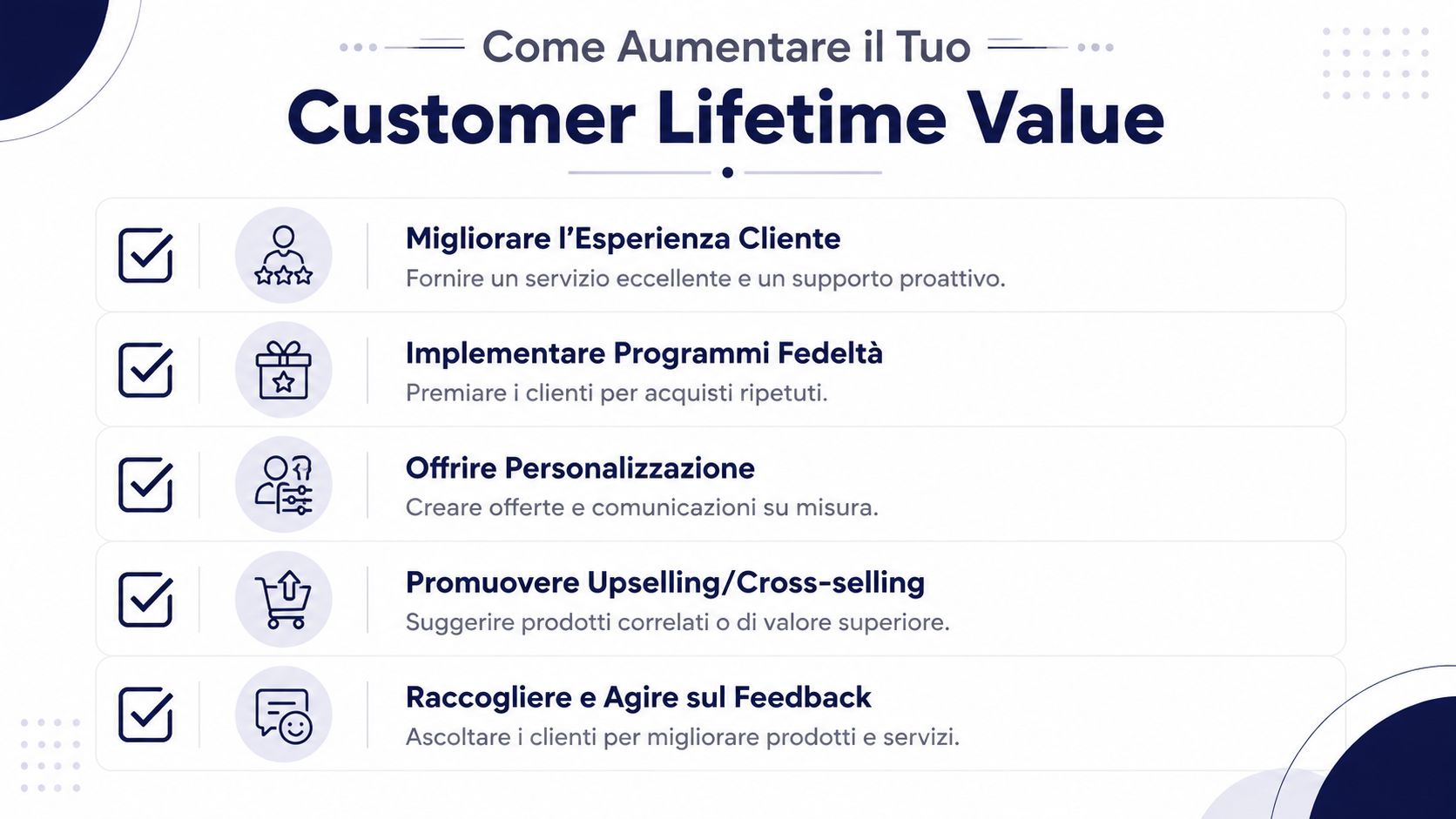
The first mistake to avoid is treating everyone the same. Not all customers have the same needs, the same timeframes, or the same potential. Effective segmentation doesn't require abstract models. It can start with very practical factors: purchase frequency, preferred category, average order value, and most recent order.
Here’s a simple example. A cosmetics e-commerce site can distinguish between regular customers who repurchase everyday products and customers who only buy during seasonal promotions. The former deserve personalized reminders and early access to new product lines. The latter can receive bundles that increase their cart total without getting them used to permanent discounts.
It works because personalization reduces friction. Customers can find what they need more easily and perceive greater relevance.
The key here isn't "selling more to everyone." It's about increasing value without eroding trust.
Optimize your pricing with discipline. Constant discounts may increase orders in the short term, but they often lower the quality of CLV. It’s better to use targeted promotions, smart thresholds, bundles, and offers tied to actual customer behavior.
Use upselling and cross-selling strategically. If a customer buys a coffee machine, it makes sense to suggest compatible capsules or a higher-end model with useful features. If you suggest random items, you’re just adding noise, not value.
Turn customer service into customer retention. Prompt, clear, and knowledgeable support reduces the risk that a customer will leave after experiencing a problem. For those who want to learn more about processes, roles, and best practices, these resources on customer success for small and medium-sized businesses offer useful and very practical insights.
Build loyalty programs that reward the right behaviors. A good program doesn't just hand out perks. It guides customers toward actions that strengthen the relationship, such as repeat purchases, referrals, upgrades, or recurring purchases.
Gather feedback and take action. If customers stop buying, the warning signs often appeared earlier in the form of a complaint, a support ticket, a review, or a sudden lack of communication.
A loyalty program works when it builds a habit, not when it simply gives out rewards.
A quick example might help. An online accessories boutique may notice that customers who buy a purse are more likely to return if, shortly afterward, they receive a recommendation for a matching wallet or product care tips. There’s no need to push. It’s about presenting the right recommendation at the right time.
CLV really comes into its own when it guides everyday decisions. Three stories help illustrate how decision-making changes.
An e-commerce site selling home goods was investing in retargeting in a fairly uniform way. Anyone who visited the site saw similar ads. The result was a lot of noise and little focus.
When the team began analyzing customers from a customer lifetime value perspective, it noticed a clear qualitative difference between those who made a one-time purchase during a promotion and those who returned to buy complementary products. From there, it changed its approach. It reduced sales pressure on cold prospects and focused its messages, emails, and offers on segments most likely to make repeat purchases.
The point wasn't to sell to more people. It was to sell better to the right people.
A clothing boutique had loyal customers, but treated them almost the same as everyone else. New collections were launched in the same way for the entire customer base.
The CLV analysis prompted the business owner to identify customers who made purchases more consistently and had a stronger affinity for the brand. Instead of offering blanket discounts, she gave this group early access to new products, more personalized in-store advice, and more carefully crafted communications. The relationship grew stronger because the benefits were aligned with the customers’ behavior.
Not all customers ask for a discount. Many ask for attention, convenience, and recognition.
At a financial consulting firm, the challenge wasn't the first contract. It was maintaining continuity and trust over time. Some clients remained loyal and open to other services. Others disappeared after a promising start.
The team began to evaluate customer value not only based on immediate revenue, but also on the quality of the relationship: frequency of contact, timeliness of responses, foreseeable future needs, and signs of dissatisfaction. This led to a more proactive service. Customers at risk of churning received more timely follow-ups. Those with greater affinity received more relevant offers.
In the financial sector, a note of caution is in order. Business decisions must always comply with regulatory requirements, ensure the appropriateness of the offering, respect privacy, and adhere to internal compliance rules. CLV can support operational priorities. It does not replace professional judgment or regulatory obligations.
Many small and medium-sized businesses start working on customer lifetime value using spreadsheets. It’s a natural first step. But problems soon arise: data is scattered, criteria change, formulas multiply, and every analysis requires manual effort.
A file may be sufficient for an initial estimate. Then its operational limitations become apparent.
Here, the cost isn't just technical. It's a decision-making issue. If the CLV arrives late or is incomplete, marketing, sales, and customer service teams are working with an incomplete view of the ROI.
A modern analytics platform connects data sources, cleans the data, unifies master data, and makes customer behavior clear. That's the starting point. The real value comes later.
With an AI-powered approach, you can:
| Requirement | Manual Approach | AI-powered approach |
|---|---|---|
| Merge Customer Data | Copy and paste, manual matching | Automatic Integration and Normalization |
| Estimating CLV | Static formula | Historical Analysis and Predictive Analysis |
| Identifying High-Potential Segments | Manual Filters | Pattern Discovery and Dynamic Segmentation |
| Addressing Churn | Retrospective Analysis | Early Warning Signs and Operational Priorities |
For an SME, this changes the way it interacts with data. There’s no longer any need to wait for an analyst to find the time to prepare a report. Management can identify trends, segments, and risks much more quickly, even without advanced data science skills.
Another advantage is continuity. CLV isn’t just a quarterly exercise. It becomes a dynamic metric that can guide promotions, retention campaigns, business priorities, and customer support. Anyone who wants to understand how these technologies are becoming accessible even to non-technical teams can explore AI solutions for business analytics.
When the analysis becomes ongoing, CLV stops being just a report and starts driving day-to-day actions.
Essentially, the difference is this: The manual method often tells you what has already happened. An AI-powered platform helps you identify where to take action now, before customer value is lost.
Customer lifetime value is much more than just a formula. It’s a strategic lens. It helps you understand which customers are shaping the future of your business, which initiatives generate real value, and where you’re confusing volume with growth.
For an SME, the benefit is tangible. If you measure CLV consistently, you’ll improve the way you invest in customer acquisition, service, pricing, and retention. If you use it effectively, you’ll stop chasing every opportunity in the same way and start protecting what makes your business stronger.
This logic also applies outside the realm of marketing. Those who focus on long-term relationships often make better decisions regarding brand positioning, brand experience, and brand identity. From this perspective, it may be worthwhile to read a broader perspective on building a purpose-driven design brand, which can help us reflect on how consistency and vision influence value over time.
Your best customer might already be in your database. The right question isn't how many new customers you can pursue tomorrow. It's how much value you can unlock from those who have already chosen to trust you.
If you want to turn scattered data into clear insights on customer lifetime value, ELECTE—an AI-powered data analytics platform for SMEs—helps you connect data sources, automate analysis, and identify growth opportunities with a single click. ILLUMINATE THE FUTURE WITH AI. Discover how ELECTE works and build a stronger foundation for your decision-making.

.svg)


.svg)
.svg)