
A sales director sees margins falling, but reports come in late and don’t provide much insight. A finance manager notices anomalies in cash flows, but the team spends more time chasing down spreadsheets than making decisions.
This is where domain-specific AI models for SMEs really make a difference. Not because they “do more AI,” but because they tackle real-world problems using the language, constraints, and data specific to your industry. For an SME, this distinction matters more than technical complexity.
This is a pressing issue today. In the United Kingdom, the number of active AI companies has grown by 600% over the past decade, and according to a Gartner projection, by 2027, 50% of enterprise AI models will be domain-specific, compared to1% in 2023, driven by greater accuracy and fewer hallucinations than generic models (data cited here). In short, the market is shifting from curiosity to utility.
For an SME executive, the right question isn’t “Should we use AI?” It’s a different one: Which AI helps us make better decisions without adding complexity? The answer, more and more often, is specialized AI. Here’s a clear guide to understanding what it is, where it creates value, how to prepare, and how to get started with a realistic roadmap.
A general-purpose AI model offers versatility across many domains. A domain-specific model, on the other hand, is trained or adapted to perform well in a specific area, using the data, rules, and language of that context.
For an SME executive, the difference is immediately apparent in the type of result that needs to be achieved. If the goal is to write an email, summarize a document, or produce a first draft, a generic template may suffice. However, if you need to correctly interpret an unusual order, estimate future demand, assess a customer risk, or analyze sales data using industry-specific logic, you need a template that understands that specific field.
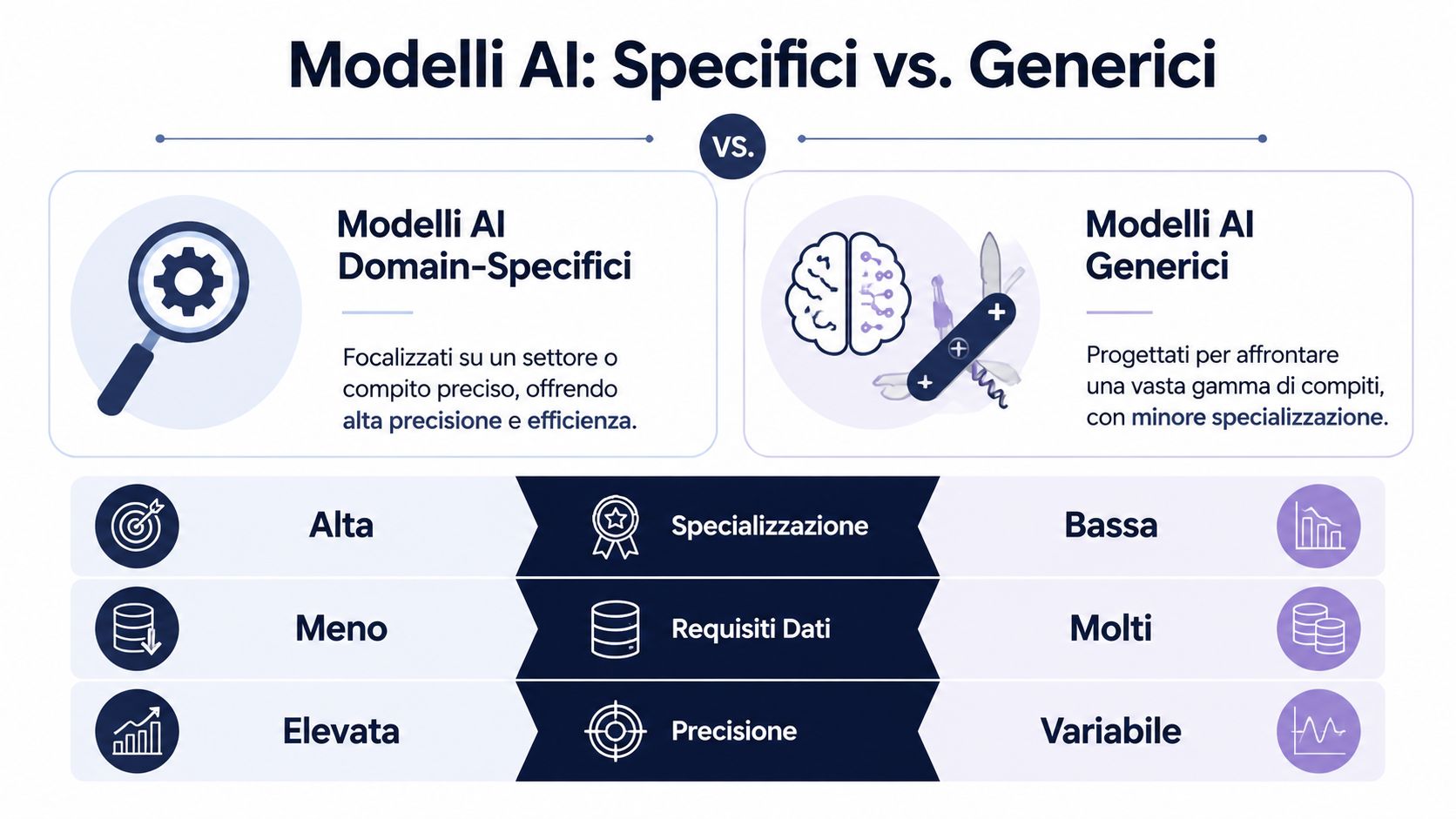
This is where confusion often arises. Many business owners hear about AI and think of it as a tool that’s “good at everything.” In business practice, however, the real value comes when the system truly understands the operational context. A specialized model can distinguish between terms that sound similar but have different meanings in your industry, recognize recurring exceptions, and perform better on processes that directly impact an SME’s margins, timelines, and service quality.
In other words, it doesn’t matter how impressive AI may seem in general. What matters is how useful it is when it comes to helping a person make good decisions quickly and with imperfect data.
A good AI result doesn’t come from an “intelligent” response. It comes from a response that is useful in your operational context.
The advantage lies in its focus. A domain-specific model doesn’t try to know everything. It operates within a clearly defined scope, using industry-specific data, internal documents, operational rules, and recurring scenarios. It’s the same difference between a new employee and someone who already knows the company’s customers, products, codes, exceptions, and priorities.
For an SME, this makes a big difference, because it reduces the time spent “translating” business processes for the machine. If the model already understands business terminology, inventory logic, risk thresholds, or production constraints, teams get more consistent and user-friendly answers. It’s also one of the reasons why so many companies are shifting their focus from general-purpose AI to systems built for specific tasks, as we explain in our in-depth look at how specialized AI models are revolutionizing business in 2025.
This approach is particularly useful in non-technical SMEs. It doesn’t require starting with complex theory. Instead, it starts with a simple question: which business decision do we want to improve first? From there, we build a concrete roadmap with realistic priorities, readily available data, and a manageable scope. It is precisely this transition from confusion to clarity where ELECTE management’s work.
There is also another point that is often overlooked. A specialized model isn’t just for making predictions or classifications. It serves to reflect the way the company operates and competes. For example, a manufacturing company that prioritizes quality, traceability, and sustainable “Made in Italy” practices needs a system that treats these requirements as integral to the business, not as secondary details.
Here is a helpful summary to distinguish between the two approaches:
| Appearance | Generic template | Domain-specific model |
|---|---|---|
| Objective | Wide-ranging versatility | Targeted tasks and processes |
| Language | General | Sector-specific and operational |
| Accuracy | Variable | Higher in specific use cases |
| Adoption in SMEs | Useful for cross-curricular activities | Better suited for critical processes |
| Value | General Support | Practical decision-making |
In Italy, SMEs account for 99% of active businesses, but only 12% have adopted advanced AI. At the same time, 65% of manufacturing SMEs report a lack of customized AI tools, while platforms that use domain-specific models can reduce operating costs by 25–30% in retail and finance (data cited here). This tells us two things. First: adoption is still limited. Second: where AI is well-suited to the context, the value becomes tangible.
For a manager, the primary benefit isn’t “driving innovation.” It’s reducing operational friction. A specialized model helps identify signals that are currently lost amid ERP systems, CRM systems, accounting, orders, Excel spreadsheets, and fragmented reports.

When the model truly understands the domain, some very practical things happen:
Rule of thumb: if a model doesn't improve a recurring decision, it isn't creating business value.
Many Italian SMEs believe that AI is only useful for companies with in-house data scientists, large budgets, and complex infrastructure. That view is now outdated. The advantage of specialized models is precisely this: they can be much more closely aligned with the day-to-day operations of an average business.
Take advanced manufacturing or premium retail, for example. In these sectors, even small differences in forecast accuracy, the timing of promotions, or cost analysis can impact profit margins. The same applies to companies investing in more responsible supply chains and sustainable “Made in Italy” practices, where operational visibility, waste control, and more disciplined planning are essential.
A specialized AI model does not replace management. It makes management more effective. It helps identify where to take action, what the priorities are, and what the risks entail. And for an SME, this can mean moving beyond reactive measures and starting to better manage margins, inventory, cash flow, and compliance.
Three commercial advantages stand out clearly:
Greater precision in recurring decisions
The model speaks the language of your industry and recognizes patterns that a general-purpose system tends to treat too broadly.
Useful automation, not just for show
Reports, analyses, and alerts are generated faster without requiring the team to build the process from scratch every time.
Access to capabilities previously reserved for large companies
Even an SME can utilize more sophisticated forecasting, risk analysis, and operational monitoring without having to set up an in-house AI department.
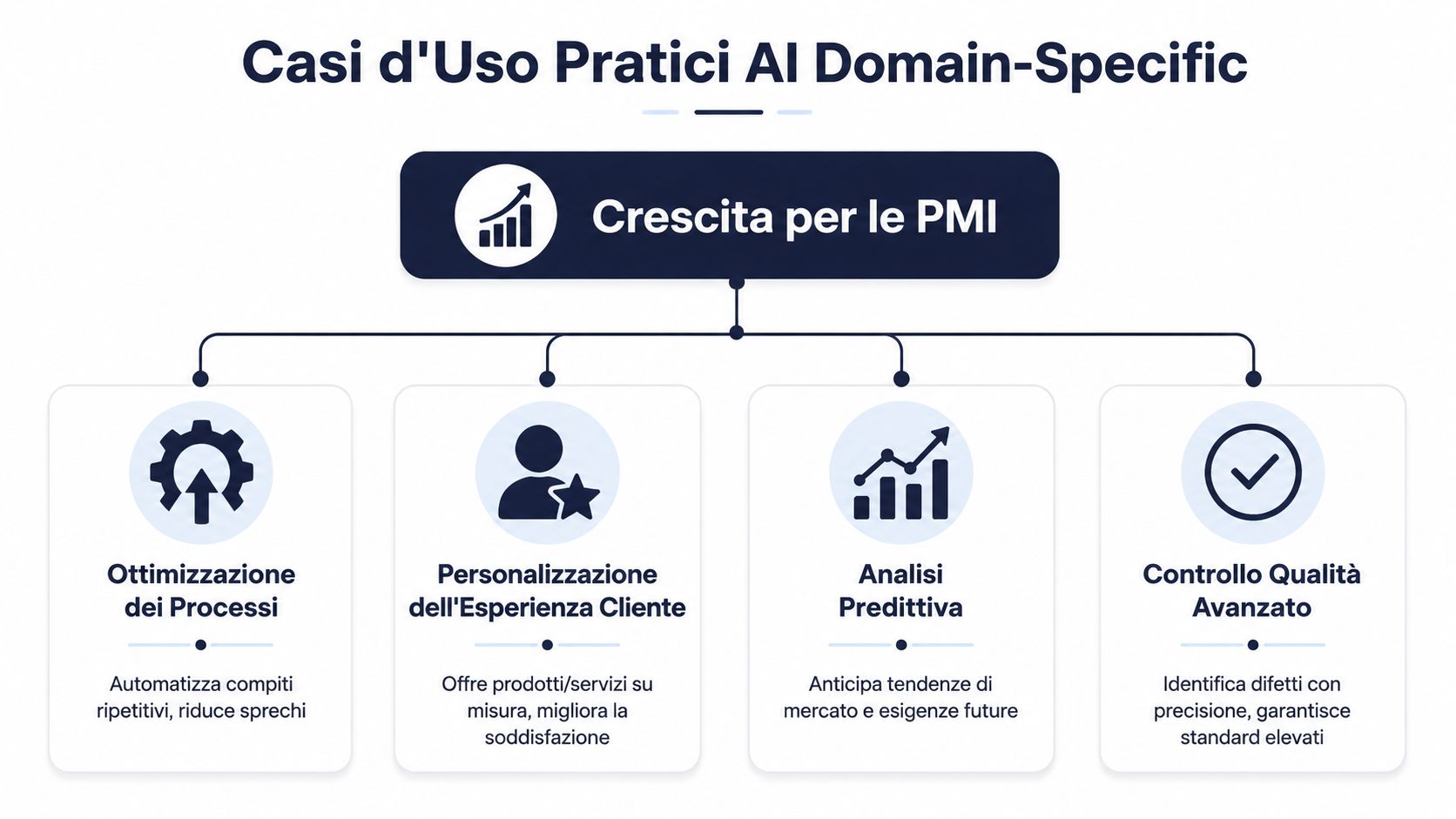
The best use cases don’t start with technology. They start with a recurring operational pain point that comes up every week. When the same question keeps coming up, it’s worth considering whether a specialized model can handle it better than a manual process.
This approach is already evident in the Italian market. Sixty-two percent of IT companies with revenues between €2 million and €50 million have customized AI models using proprietary data for analytics, achieving an average accuracy of 92% in tasks such as sales forecasting and risk assessment, compared to 78% for generic models. In the same context, fine-tuning reduces computational requirements by up to 70–80% and minimizes hallucinations by 40% (data reported here).
Consider an SME that operates in the financial services sector or manages complex trade receivables. Every week, the team reviews exposures, delinquencies, documentation, unusual transactions, and data consistency. The challenge isn’t just “finding the data.” It’s understanding which indicators warrant immediate attention.
A domain-specific model in the field of finance can help:
A generic model tends to be too abstract. It can identify risks, but it doesn’t always distinguish between an operational anomaly and a simple administrative exception. A specialized model, on the other hand, works better if it has been tailored to your workflows, categories, and decision thresholds.
In finance, useful AI isn’t the kind that writes better. It’s the kind that helps the team focus on the cases that matter.
To see how this approach is applied in real-world business scenarios, it may be helpful to review ELECTE’s case studies.
Another interesting lesson comes from the creative and design sectors. Even those working in design are beginning to use more context-aware AI to transform ideas, data, and constraints into faster processes. The AI guide for interior designers clearly demonstrates how adoption becomes effective when the tool is closely aligned with real-world work, not just theory.
In retail, demand changes rapidly. Promotional schedules, seasonality, channel mix, stockouts, and local customer behavior all complicate matters. A specialized model can help the team interpret these factors in a practical way.
A small or medium-sized retail business often faces three challenges at once:
| Problem | Impact on business | Contribution from a specialized model |
|---|---|---|
| Excess inventory | Stagnant capital and eroded margins | Highlight overexposed areas |
| Out of stock | Lost sales and frustrated customers | Reports a risk of burnout |
| Promotions that lack focus | Discounts that don't improve the bottom line | Supports more consistent planning |
The value here doesn’t lie in a “prettier” dashboard. It lies in the fact that the purchasing manager, the sales representative, and the store manager can all work from a shared foundation. The system helps identify which items are causing delays, where a promotion risks cannibalizing margins, and where restocking is needed before the problem escalates.
The more closely the model aligns with the business domain, the more actionable the insights become. For example, a retailer with a large product catalog and strong seasonality doesn’t need a generic tool. It needs an engine that consistently links inventory, sell-through, promotions, and sales history.
For those who prefer a visual format, this video offers a helpful overview of the evolution of AI in business.
Forecasting is where many small and medium-sized businesses come to understand the true value of specialized AI. Forecasting isn’t about predicting the future. It’s about making better decisions today regarding purchases, budgets, staffing, promotions, and business priorities.
Consider a medium-sized B2B company with long sales cycles and a concentrated customer base. A generic model can help describe the context. A specialized model, on the other hand, can interpret signals such as order recurrence, customer seasonality, historical delays, product mix, and channel performance.
The practical benefits are evident in three areas:
Sales Planning Management gains a more reliable view of scenarios and variances.
Alignment Across Departments
: Sales, Operations, and Finance Stop Defending Different Numbers.
Faster response
When the model signals a change in trajectory, the team can correct it sooner.
Many companies don’t need “more data.” They need a better understanding of the data they already have. Domain-specific AI models for SMEs are designed to do just that. They transform scattered data into actionable insights that are more closely aligned with day-to-day decision-making.
The most common objection is simple: “It sounds useful, but it’ll be too complicated for us.” In reality, the initial requirements are much more manageable than many executives imagine. You don’t need to start with a perfect architecture. You just need to start in an organized way.
In Italian IT regions, domain-specific AI models—often ranging from 1 to 7 billion parameters—reduce operational costs by 50–60% compared to generic LLMs and achieve 95% accuracy on specialized tasks, outperforming general-purpose models by 22 %. The key factor, however, is not the size of the model. It is high-quality data verified by industry experts (data reported here).
For an SME, the starting point isn’t to collect everything. It’s to identify the data that truly impacts the decision you want to improve. If you want to forecast sales, what matters is order history, the promotional calendar, stock availability, and certain business variables. If you want to manage risk, you need data sources that align with your control processes.
A realistic checklist to get started:
Key point: An SME doesn’t succeed by having the largest dataset. It succeeds by having the most useful and best-managed dataset.
Governance doesn’t mean slowing things down. It means deciding in advance who can view what, which outputs require verification, and how to handle sensitive data. This approach is particularly important in finance, HR, sales, and any process with regulatory implications.
There are few, concrete questions:
What data goes into the model?
It’s best to start with sources that are well-known and already used in decision-making processes.
Who validates the outputs?
We need a process manager, not an endless committee.
When should AI make suggestions, and when should it stop?
High-impact activities require human oversight.
How do we handle privacy and compliance?
The platform we choose must help the team comply with European regulations.
To help navigate these issues, ELECTE’s guide tothe European AI Act is a useful resource for translating the legislation into clear, actionable guidance.
SME executives often find themselves at the same crossroads: the data is there, the processes are in place, but decisions keep coming too late or with too much uncertainty. At that point, the most common mistake is to treat AI as a technology project. For an SME, it works better to treat it as a process focused on priorities, simple choices, and measurable results.
The right roadmap resembles a well-crafted business plan more than an IT initiative. It starts with a concrete problem, is tested in a controlled environment, and then only the elements that generate value are scaled up. It’s the transition from confusion to clarity. And it’s also how ELECTE accelerate the process, helping non-technical teams turn scattered data into faster, more actionable decisions.
1. Start with a decision that affects the income statement
The initial question isn’t “How do we use AI?”, but “Which decisions today are costing us time, profit margins, or accuracy?”
For example:
A good starting point has three characteristics: it occurs frequently, has a financial impact, and is based on data already available within the company. In practice, it makes sense to start with an operational issue that management can immediately identify, rather than with an abstract idea of innovation.
2. Check if you have enough data to get started
Many small and medium-sized businesses get stuck at this point. They think they need to have everything in order first: perfect databases, standardized records, and a flawless history. In most cases, this level of preparation isn’t necessary.
We need a platform that’s reliable enough to run a serious pilot program.
Check the following four points:
It’s like setting up a new production line. You don’t need to rebuild the entire plant. You need to determine whether the key components are available and whether the workflow can withstand an initial test.
3. Choose a tool that reduces complexity, not one that shifts it onto the team
For a non-technical SME, the key factor isn’t the sophistication of the model itself. What matters most is having a platform that connects data sources, reduces manual work, and provides insights that managers can understand. In this context, ELECTE, an AI-powered data analytics platform for SMEs, is an option worth considering if the goal is to obtain predictive analytics, automated reports, and actionable insights for business teams.
The criteria to consider are concrete:
| Criterion | Why it matters |
|---|---|
| Data integration | Reduces manual tasks and scattered files |
| Clarity of outputs | Helps managers determine what action to take |
| Forecasting and Risk Support | Adds value to high-impact decisions |
| Governance and the European Context | Helps manage privacy, access, and compliance with less friction |
The rule of thumb is simple: if using the platform requires translating everything into technical jargon, the project will slow down. If, on the other hand, the tool makes patterns, anomalies, and predictions easy to understand, adoption becomes much more realistic.
4. Launch a small but serious pilot project
Your first project doesn't have to prove everything. It just has to prove something useful.
For example:
A well-structured pilot has a streamlined format:
Clear goal
: Improving a recurring decision
's core team: a business liaison, a data expert, and a decision-maker
Defined duration
: The time needed to compare the before and after, without immediately expanding the scope
If the pilot involves too many departments, too many exceptions, and too many objectives all at once, you’re not testing the AI. You’re complicating the project before you even know if it creates value.
5. Expand only what has already proven useful
After seeing initial results, many companies try to implement AI everywhere. An SME achieves better results with a more disciplined approach. First, it verifies that the initial use case has actually improved the process.
The right questions are these:
If the answer is yes, then it makes sense to scale up. First, by applying the approach to similar processes. Then, to related functions. It’s growth in blocks, not through announcements.
This is the logic that makes specialized AI a practical game-changer for an SME. Not because it introduces more technology, but because it helps management make better decisions with less wasted effort. ELECTE value ELECTE precisely in this aspect: it bridges the gap between data, understanding, and action.
Not necessarily. The point isn’t the price in the abstract, but the cost-benefit ratio for each specific use case. If the model helps reduce manual work, improve forecasts, or detect operational anomalies sooner, the project can still make sense even with a limited scope.
In most initial cases, no. What’s needed much more is the involvement of people who are familiar with the process, the available data, and the decisions that need to be improved. Domain expertise matters more than technical sophistication in the early stages.
Waiting for perfection is one of the most common ways to never get started. It’s better to start with a useful, limited, and reasonably consistent dataset. Then you can improve as you go, especially if the use case is clear.
It depends on the business. For cross-functional tasks and general productivity, it may be sufficient. For sensitive operational decisions, regulated processes, or forecasts with financial implications, the benefits of a specialized model tend to be much more tangible.
Choose a recurring issue that’s causing friction today. Then see if you have the basic data needed to address it in a more structured way. That’s where nearly every successful AI project in an SME begins.
Give the pilot a business owner, a specific goal, and clear guidelines for use. If no one is responsible for its implementation, even the best model will remain nothing more than a demo.
If you want to turn scattered data into clearer insights for forecasting, risk management, and reporting, you can explore ELECTE and assess whether its approach is suitable for your operational context.

.svg)


.svg)
.svg)