
The data generated within your SaaS platform is like a car’s dashboard. If the driver can see speed, fuel level, and warning lights while driving, they can make better decisions without having to stop and consult a separate manual. Many SaaS products do the opposite: they collect valuable data, then force users and internal teams to step out of their workflow to interpret it elsewhere.
This is a product issue, not just a reporting issue. Theembedded analytics market is projected to grow from $67.24 billion in 2025 to $200.19 billion by 2033, with a CAGR of 14.65%, and 81% of analytics users now rely on embedded solutions for faster and more consistent decisions, according to this market analysis on embedded analytics. The strategic signal is clear: analytics is ceasing to be a separate cost center and is becoming a native product feature.
For a European CEO, this changes the business case. An embedded analytics SaaS product isn’t just about “displaying dashboards.” It’s about making the software more indispensable, more defensible, and more monetizable. And, in the European context, it must do so with governance, data isolation, and compliance already built into multi-tenant environments.
In many SaaS companies, customer data is everywhere, but insights are nowhere to be found. Application events, operational metrics, business signals, and usage patterns already exist. The problem is that they remain scattered across databases, exports, and reports requested from the technical team.
A CEO sees the signs in other ways: slow onboarding, repetitive support requests, customers who don’t fully appreciate the product’s value, and upsell opportunities that are hard to justify. When analysis happens outside the product, value comes too late and costs more.
This is wherethe SaaS embedded analytics product comes into play. The idea is simple: to bring reports, dashboards, and insights right to where the user works and makes decisions. Not as an add-on, but as part of the core experience.
The data in your SaaS platform isn’t just an operational byproduct. It can become a driver of revenue, customer retention, and differentiation.
For business leaders in Europe, this issue is even more critical. Simply integrating charts isn’t enough. You need to build trust, ensure data isolation, implement access controls, and maintain compliance—so that analytics becomes a robust product feature, not a sleek but fragile experiment.
Embedded analytics integrates dashboards, reports, and exploration capabilities directly into an existing application. Users don’t have to open another tool, export CSV files, or wait for a manual report. They see the data in the context of the action.
Think about e-commerce software. If the promotions manager can view sales, inventory, margins, and promotional anomalies on the same screen where they manage the catalog, the data becomes actionable. If, on the other hand, they have to log out of the system, open a separate BI platform, and re-establish the context, the data becomes a hindrance.
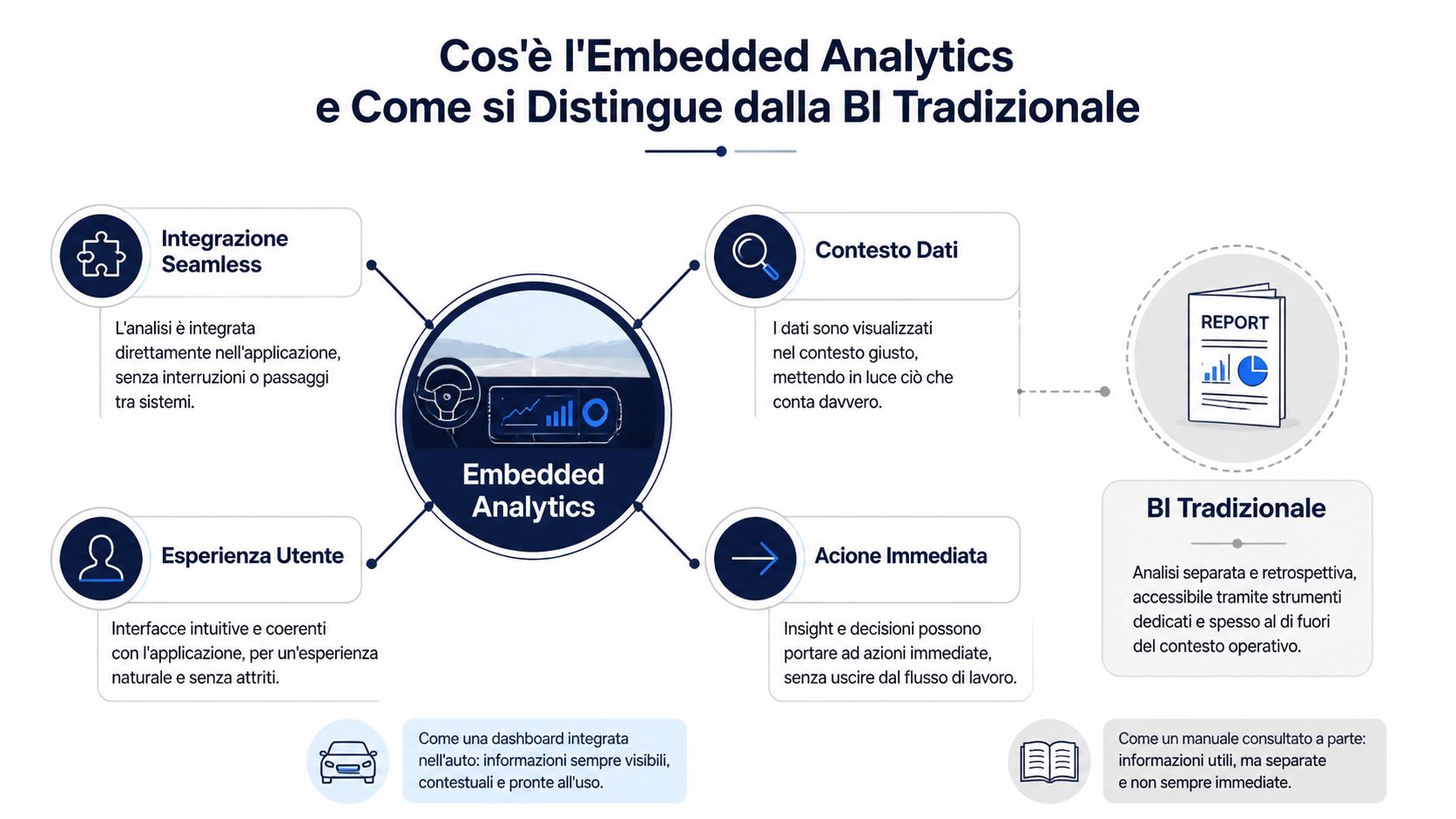
The difference isn't just superficial. It's fundamental. When analytics are built in, the software stops being merely a data-logging system and becomes a decision-making system.
Traditional BI remains useful for cross-functional analysis, centralized governance, and internal reporting. However, in a SaaS product aimed at customers or operational teams, it has a structural limitation: it separates the moment of observation from the moment of action.
This results in at least four hidden costs:
| Approach | What happens | Impact on business |
|---|---|---|
| Traditional BI | User changes environment | More friction, less adoption |
| Traditional BI | Exported or reconstructed data | More manual labor |
| Embedded analytics | Insights at the point of use | Faster decisions |
| Embedded analytics | An experience consistent with the product | Greater perception of value |
For SaaS providers, embedded analytics increases product stickiness. If customers use your software not only to execute processes but also to figure out what to do next, the switching cost goes up. They’re no longer just buying workflows. They’re buying insights.
For the end customer, the benefit is just as tangible:
Rule of thumb: if a user has to stop using your product just to figure out how to use it, your analytics aren’t creating a competitive advantage.
A well-designed SaaS embedded analytics product does the opposite. It shortens the gap between event, insight, and decision. And it is precisely this shorter gap that, over time, translates into customer retention, monetization, and differentiation.

For a SaaS CEO, the point isn’t to add more reports. The point is to shift analytics from an internal cost center to a product feature that protects margins, boosts retention, and opens up new revenue streams.
For years, many software companies have treated analytics as a back-office function. Internal teams created dashboards for support, customer success, or management. That model works as long as the customer buys the software solely to execute a process. For a European SME, however, the perceived value changes when the product also helps with decision-making, without forcing users and managers to leave the application, reconstruct the data, and validate it manually.
This is where the business case gets more interesting.
A management system that tracks orders is useful. A management system that identifies which customers are slowing down, which promotions are eroding margins, and which locations are deviating from forecasts is much harder to replace. The difference is similar to that between a dashboard that displays speed and an onboard system that warns of impending failure. In the first case, you’re simply measuring. In the second, you’re reducing risk and improving response times.
According to the vendor, embedded analytics improves three key metrics that really matter on the bottom line.
For European SMEs, this shift carries additional weight. In sectors with slower sales cycles and tighter IT budgets, success doesn’t depend solely on offering more features. It depends on demonstrating a measurable return on investment in a short timeframe. A well-integrated analytics module supports the sales process by highlighting the software’s business value during everyday use—not just in a demo.
From the customer’s perspective, the benefit isn’t about “more data.” It’s about reducing the time between an operational event and a managerial decision.
This gap is more pronounced in SMEs than in large companies. Teams are smaller, roles often overlap, and the person who monitors business or financial KPIs is the same one who must take action. If the information resides outside the SaaS platform, decisions are made later. If, on the other hand, the operational context and analytical insights coexist within the same interface, the customer reduces manual work, misinterpretations, and reliance on specialists.
The benefit is practical, not aesthetic:
That is why embedded analytics also affects your end customers’ retention. Software that reveals the root causes of problems is perceived as more useful than software that merely records processes.
In the European market, the strategic value of embedded analytics also depends on the ability to manage security, data segregation, and compliance. For customers in regulated industries, or those closely tied to the financial and insurance ecosystems, simply presenting insights is not enough. It must be demonstrated that insights are distributed with adequate controls, consistent permissions, and traceability. Regulations such as DORA have drawn management’s attention to digital operational risk. Consequently, a well-designed analytics function can accelerate sales. A poorly designed one can halt them.
The decisions that truly impact ROI are therefore very concrete:
Tenant Isolation In multi-tenant environments, data separation protects future revenue as well as security. A data breach doesn’t just require technical remediation. It leads to customer churn, commercial friction, and delays in enterprise negotiations.
Granular access controls
Row-Level Security allows you to show each user only what they are authorized to see, based on client, location, department, or role. This reduces risk and makes it possible to monetize customized views without increasing the number of dashboards or maintenance costs.
's native product experience: If analytics appears as a separate component, adoption rates drop. If it appears as an integral part of the workflow, customers use it more often and better appreciate its value.
Self-service with governance
Users must be able to filter, compare, and explore data. However, metrics must remain consistent. Without governance, self-service leads to conflicting interpretations of the same data and erodes trust in the product.
For the board, the conclusion is simple. Embedded analytics is not a secondary feature. It is a strategic positioning decision. It transforms SaaS from a system that performs operations into one that drives decisions. And it is through that transformation that a cost center can become a driver of revenue, customer retention, and competitive advantage.
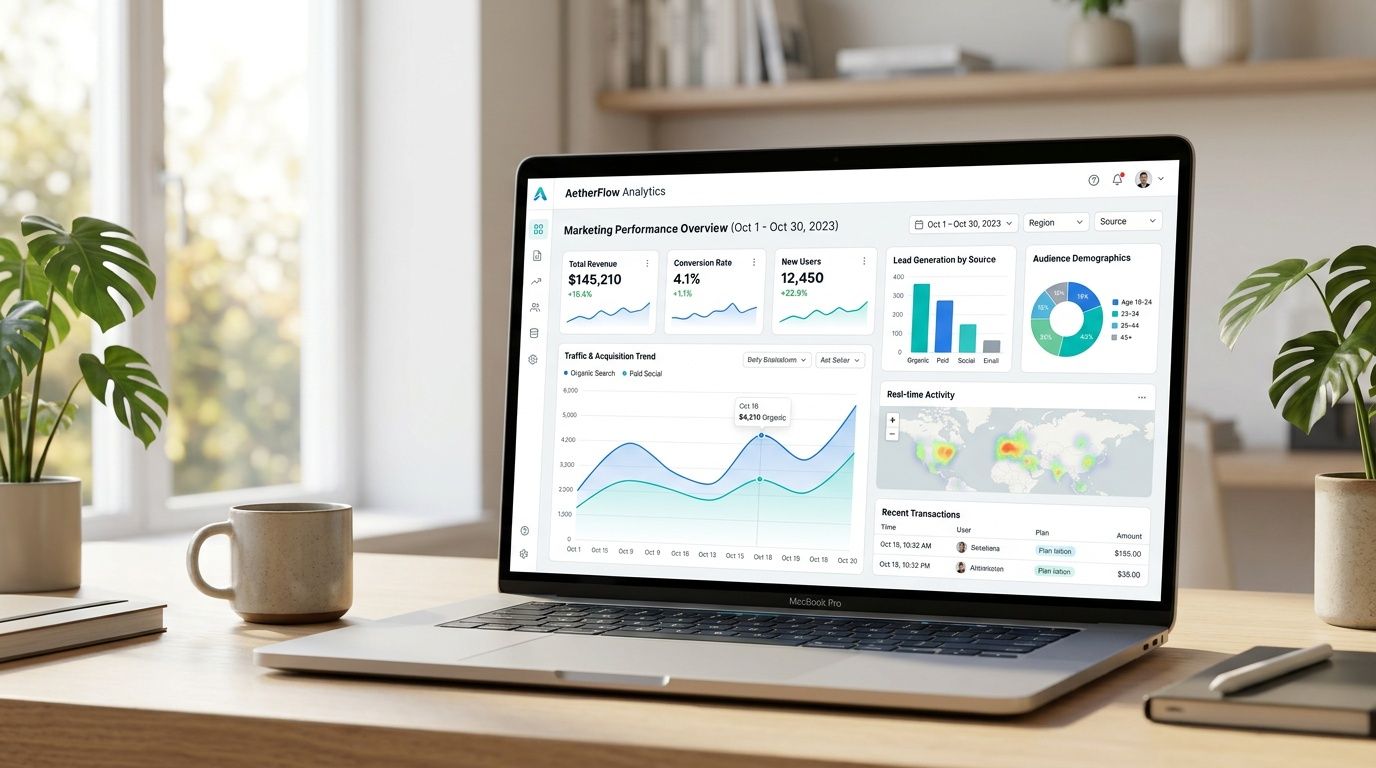
A good platform is one that stands up to the real-world demands of users, not just a demo. To evaluate it, you should approach it as you would an operations manager: don’t just ask what it does; ask how it reduces workload, risk, and reliance on the technical team.
At 9 a.m., the retail manager opens the management system and sees, all in one interface, how promotions are performing, which items are running low, and any deviations from the forecast. He doesn’t need to export data. He doesn’t open Excel. He takes action.
For him, three skills are important:
In the afternoon, a financial analyst checks for risk indicators and unusual deviations directly within the software they use to monitor processes and portfolios. Here, the focus shifts. Usability remains important, but security and governance become non-negotiable.
In multi-tenant architectures, row-level security is critical. Modern platforms enable a SaaS team to complete integration in about four weeks, resulting in a 30–40% increase in customer retention thanks to self-service features that reduce data-related support tickets, according to this article on embedded AI analytics for SaaS.
These figures warrant a closer look. The speed of integration matters, but it isn’t the main point. The point is that well-designed security doesn’t hinder the business case. It enables it.
To understand which features are truly relevant in an operational setting, it’s also worth reviewing ELECTE’s feature overview, which serves as a useful reference for assessing what a modern platform should make accessible even to non-technical users.
When evaluating a solution, I would start with this short list:
| Area | What to check | Why it matters |
|---|---|---|
| Integration | Mature APIs and SDKs | Reduces custom work |
| Multi-tenancy | Native tenant isolation | Avoid architectural rework |
| RLS | Filters by user, role, or client | Data Protection and Compliance |
| Self-service | Reports and filters that can be managed by the business | Reduces reliance on the data team |
| Semantic layer | Consistent and managed metrics | Avoid conflicting versions of the truth |
| Branding | Reliable white-label solution | Improve adoption and perception of quality |
Practical tip: The right platform isn’t the one with the most views. It’s the one that saves you from having to use a second platform, a second team, and a second interpretation of the same data.
For this reason, the essential features are not technical bells and whistles. They are the building blocks that determine whether embedded analytics will remain a promise or become a measurable advantage.

Industry adoption says a lot about where competitive advantage is created. In 2022, the IT and Telecommunications sector was the leading user of embedded analytics, accounting for 27.4% of the total market, according to these industry statistics on embedded analytics. This figure matters because it illustrates a typical pattern: IT leads the way, followed by decision-intensive sectors, particularly finance and regulated industries.
In digital retail, embedded analytics is most useful when it links business metrics to immediate action. An e-commerce manager doesn’t need a standalone report at the end of the week. They need to understand, while the campaign is running, whether a promotion is driving sales, eroding margins, or depleting inventory too quickly.
The most robust use cases are those in which the data changes a behavior within the same session:
In finance, value takes on new forms. Here, embedded analytics isn’t just about tracking trends—it’s about taking disciplined action. Risk, compliance, and operations teams can monitor anomalies directly within the software they already use, rather than relying solely on periodic reports or requests to the data team.
An advisor can show a client their portfolio performance in an interactive way. An AML team can identify suspicious patterns right where they handle cases. An operations manager can track SLA trends, exposures, or unexpected changes without having to switch between different environments.
In regulated industries, insights are only valuable if they come with the right level of access, traceability, and context.
If you were to create an internal scorecard, this is how I would weigh the criteria qualitatively:
: Close to a Decision How close is the insight to the moment when the user can take action?
Reducing Manual Work
How many steps today rely on exports, spreadsheets, or internal tickets?
's Business Value: Does analytics help sell a premium tier, justify pricing, or reduce churn?
Regulatory Implications
Does the use case require fine-grained control over access, segregation, and auditability?
TCO Sustainability: Does the chosen model require ongoing maintenance, or does it remain manageable over time?
This framework is useful because it shifts the conversation. It’s not about asking, “Where can we display a dashboard?” It’s about asking, “Where does embedded insight actually change unit economics, service quality, or operational risk?”
For a CEO, choosing an embedded analytics SaaS product isn’t a design decision. It’s an economic architecture decision. If the chosen platform can’t handle growth, compliance requirements, and complex access models, analytics remains a cost center disguised as a feature. If, on the other hand, it can handle these constraints from the start, it becomes a part of the product that drives upsells, retention, and price defense.
In the European context, this factor carries greater weight. The GDPR, auditability requirements, and frameworks like DORA are shifting the criteria for selection. It is no longer enough to ask whether the dashboard is user-friendly or whether the time-to-market is short. It is essential to determine whether the solution can be integrated into a SaaS product used by SME customers who require access control, business continuity, and traceability—without increasing the workload on the technical team.
There are only a few useful questions, but they have a direct impact on ROI:
Is the integration API-first, or does it require fragile customizations?
A platform designed to be embedded within the product reduces development time, minimizes technical debt, and makes it easier to extend functionality to new modules or new customer segments.
Does it natively support multi-tenancy, roles, and row-level security?
This aspect matters far more than the user interface. If permissions and data segregation are handled upfront, the team avoids having to build custom controls that are difficult to maintain and risky in regulated industries.
Is the user experience designed for operational users or analysts?
If a sales representative, operations manager, or finance manager doesn’t understand what to do within the first few minutes, adoption rates drop. And a feature that isn’t used generates neither retention nor additional revenue.
Is the total cost of ownership visible before signing?
The license fee is just one part of it. Setup, maintenance, governance, support, monitoring, and the cost of future changes also matter.
Does the platform integrate well with the existing stack?
To verify this, it’s best to conduct a thorough analysis of the available integration models and connectors, rather than relying solely on the marketing documentation.
A rule of thumb can help you avoid costly mistakes. If a critical capability—such as granular permissions or an audit trail—depends on custom code written by your team, you’re getting less product than it seems.
For many European SaaS SMEs, making the wrong choice doesn’t create an immediate problem. It creates cumulative friction. Every new enterprise customer requires a different set of permissions. Every compliance review requires manual checks. Every customization request shifts work to the product team or the data team.
The outcome is predictable: margins under pressure, a delayed roadmap, and longer sales cycles.
That’s why it’s important to evaluate the platform as you would a core product component, not as an afterthought. A good embedded analytics stack reduces the marginal cost of serving more demanding customers. An unsuitable stack does the opposite. It increases the cost of every new client and makes growth less profitable.
AI should be evaluated with the same rigor. The point isn’t to add a feature that looks impressive in a demo. The point is to determine whether the system helps users make better decisions more quickly within their existing workflow.
For an SME, this makes a big difference. A small team doesn’t have dedicated analysts for every department. If AI can translate operational questions into actionable insights, flag anomalies, and maintain proper access controls, analytics begins to deliver operational and business value.
When making a selection, I would look for these indicators:
| Question | What does it reveal? |
|---|---|
| Does it support natural language queries that are useful in real-world contexts? | Reduces reliance on technical staff |
| Does it generate actionable insights, or does it just show KPIs? | Indicates the maturity level of the analytics engine |
| Do you link forecasts and alerts to operational decisions? | Measure the economic value of the function |
| Does it also apply governance and permissions to AI functions? | Determines suitability for regulated environments and compliance-sensitive customers |
The ultimate question for a CEO is simple. Will this feature make the product more marketable, harder to replace, and less expensive to support over time? If the answer isn’t clear during the evaluation phase, the risk isn’t just technical. It’s a direct risk to revenue, customer retention, and the quality of growth.
Static dashboards are useful. But they aren’t enough when the business demands speed. AI is transforming the nature of embedded analytics because it enables the system to identify patterns, suggest insights, and anticipate scenarios without waiting for a user to ask the perfect question.
The real leap here is from data as a repository to data as an operational assistant. Users don’t just look at metrics; they query the system using natural language, receive context-aware insights, and use forecasts to take action before a problem becomes apparent to everyone.
According to this in-depth analysis of embedded analytics for SaaS, integrating predictive analytics into an embedded analytics SaaS product increases feature adoption by 3x in the first two months. The same analysis notes that natural language queries and conversational analytics eliminate the learning curve and can provide forecasts with over 85% accuracy in areas such as sales forecasting.
In a large corporation, this data can be distributed among multiple specialized teams. For an SME, however, this luxury is often not available. The sales director, the finance manager, and the operations manager need to quickly grasp, in just a few steps, what is happening and what needs to be done.
This is exactly where embedded AI comes in:
While traditional analytics tells you where you’ve been, embedded AI helps you choose your next move.
That is why the value is not merely technical. It is managerial. A smaller organization can operate with the discipline of a larger one, without taking on the same level of complexity.
ELECTE, an AI-powered data analytics platform for SMEs, makes sense in this context because it puts into practice the requirements discussed so far: accessible integration, understandable insights, analytical automation, and a focus on business use cases where decision-making time is truly critical.
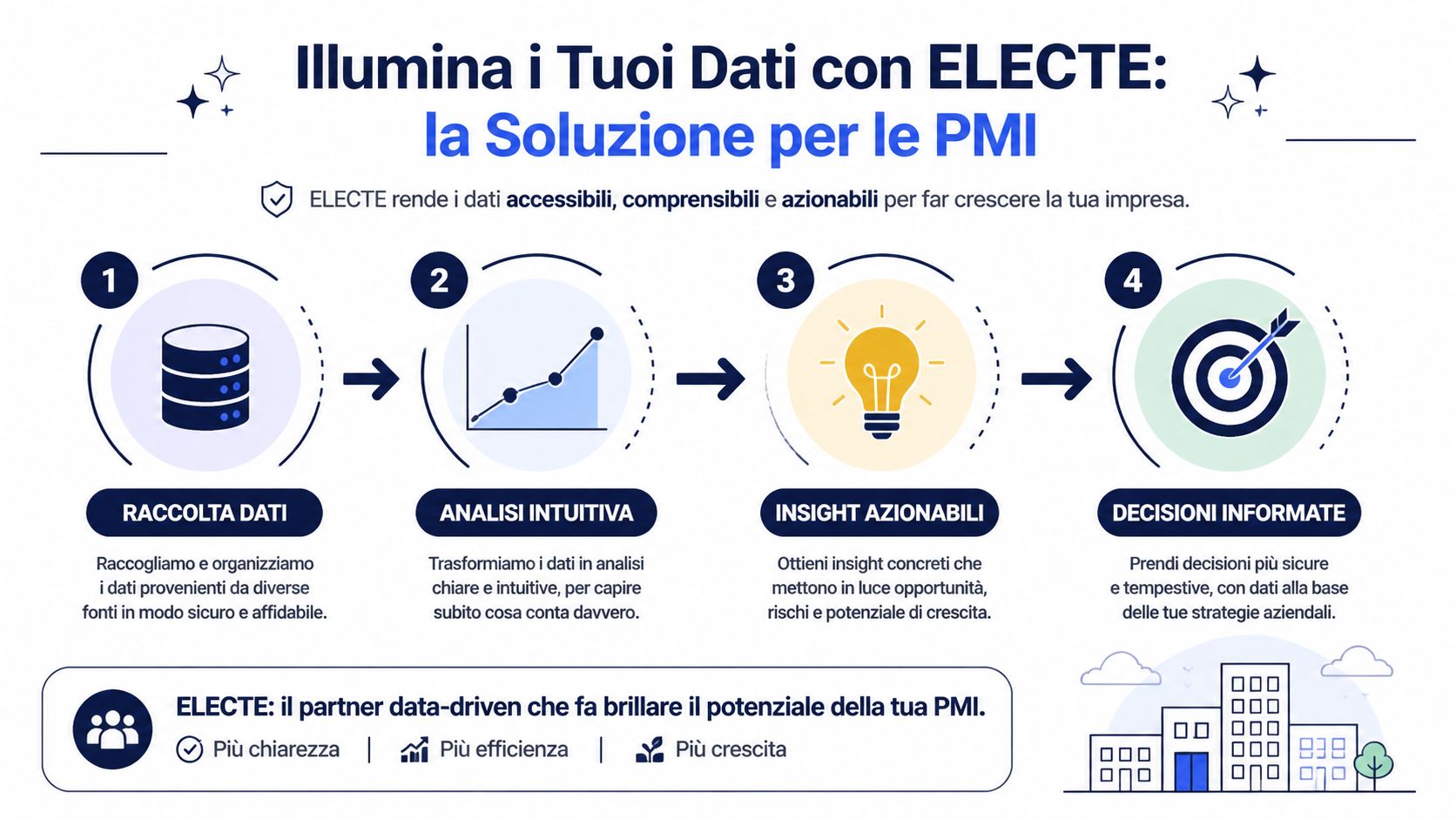
For SMEs, the point isn’t to have “more data.” The point is to have a platform that reduces repetitive work and makes insights accessible even to those who aren’t professional analysts.
ELECTE fits well into this framework because it combines the key features that a mature SaaS embedded analytics product should offer:
The strategic difference is this: bringing enterprise-level capabilities to a more accessible format. You don’t need a large team to derive value if the platform lowers the technical barrier.
If you're considering implementing embedded analytics, these are the most sensible steps to take:
Choose a high-impact use case—
, retail, sales forecasting, risk monitoring, or executive reporting. Start with the area where a better decision delivers tangible value.
Map the data you already have
Don’t start by asking, “What data are we missing?” Instead, ask, “What data do we already have but aren’t using in the decision-making process?”
Define the minimum governance requirements
Permissions, segregation, roles, auditability. Without this step, the analysis moves faster than trust.
Test the experience with real business users
If sales or finance managers don’t see the value within a few minutes, the technology isn’t working for you yet.
Looking for a phased rollout?
A good project starts small, demonstrates adoption, and then scales up.
If I had to boil it all down to a basic plan of action, this is how I would start.
The key message remains this: analytics delivers the greatest value when it stops being confined to a corner of the system and becomes an integral part of the product. At that point, data doesn’t just describe the business—it drives it.
Embedded analytics is no longer just a nice-to-have feature. It’s a strategic choice. When analytics is built into the product, SaaS moves beyond simply executing processes and begins to drive customer decisions.
For a CEO, the business case is compelling because it combines three outcomes that rarely go hand in hand: greater perceived value for the customer, stronger competitive positioning, and more opportunities to monetize premium features. In the European context, this advantage is amplified when security, multi-tenancy, and compliance are built into the architecture from the start, rather than added as an afterthought.
Those who act now will create a product that is more useful and harder to replace. Those who delay risk leaving their data trapped—and with it, part of their competitive advantage.
If you want to turn your data into a tangible product feature, discover how ELECTE can help you integrate insights, forecasting, and AI automation into your company’s decision-making processes. Ready to transform your data? Start your free trial.

.svg)


.svg)
.svg)