
Have you ever wondered how it’s possible that your company posts a healthy profit at the end of the year, yet your bank account is always empty? You’re not alone. It’s a common situation that baffles many business owners and managers.
This guide will show you how a sample cash flow statement can reveal the full story that simple profit figures fail to tell. You’ll learn how to turn a list of numbers into a strategic roadmap, enabling you to make smarter decisions and steer your small business toward solid, sustainable growth.
Too many business owners focus exclusively on the income statement. Sure, seeing a positive number under "net income" is a huge relief, but it’s a terribly incomplete picture. Profit, in fact, is a purely accounting concept that often doesn’t reflect the cash you actually have on hand.

The real key to an SME’s survival and growth—the factor that distinguishes those who are just getting by from those who are firmly in control—is understanding where the money goes. And the cash flow statement is the tool that does exactly that: it tracks every single euro that comes in and goes out, showing you your company’s true ability to generate cash.
Learning to read it isn’t just a simple accounting exercise, but a strategic skill that every entrepreneur should master. It allows you to:
Consider that an analysis by the National Association of Accountants of the 2023 financial statements of nearly 600,000 Italian corporations revealed a striking picture: although85% of companies reported a profit, real GDP growth came in at a modest 0.6%. This disconnect between reported profits and actual economic performance tells us one thing clearly: without a close eye on cash flow, financial stability is nothing but an illusion.
In this guide, we’ll start with the basics, walk through a practical example together, and see how modern platforms like ELECTE—an AI-powered data analytics platform for SMEs—can make everything easier. The goal? To help you see this document not as a chore, but as your greatest ally.
For an even more comprehensive overview, you can delve deeper intothe analysis of financial ratios in our dedicated article.
While the income statement tells you whether your company has “done well” (i.e., whether it has made a profit), the cash flow statement is its electrocardiogram. It shows you exactly how its heart is beating: its cash flow.
This document, which has been mandatory for corporations since 2016, is not merely a formality. It is a dynamic snapshot of your company’s financial health, showing where the money comes from and, above all, where it goes.
That’s the key difference. Net income includes purely accounting items such as depreciation and amortization, which reduce profit on paper but do not represent an actual cash outflow. The cash flow statement, on the other hand, focuses exclusively on actual cash flows, giving you a clear, unfiltered view of your company’s ability to generate cash.
To fully understand the story behind the numbers, the cash flow statement breaks down cash flows into three main categories. Each one answers a specific question about the management of your business.
Keeping an eye on these three areas will help you determine whether your company is generating cash on its own, investing wisely for the future, or, on the contrary, relying too heavily on external loans and financing to stay in business.
There are two approaches to creating this document. The direct method is very intuitive, almost like a bank statement: it lists all income (payments received from customers) and expenses (payments to suppliers, salaries). It seems simple, but in practice it is quite complex to prepare.
For this reason, the vast majority of Italian SMEs use the indirect method. This approach is more practical: it starts with operating income and “adjusts” it by eliminating all costs and revenues that did not have a monetary impact and by including changes in accounts receivable, accounts payable, and inventory. It is less straightforward to interpret, but much easier to prepare using the data already in your financial statements.
In our practical example of a cash flow statement, we will use the latter.
Moving from theory to concrete figures is the best way to truly understand how this document works. Let’s take a look at an example of a simplified yet comprehensive cash flow statement for a fictional SME, “Alfa S.r.l.,” which manufactures mechanical components.
You'll see that this exercise will turn a simple table of numbers into a clear picture of your company's health and strategic decisions.
It all starts with a figure you already know: the profit (or loss) shown on the bottom line of the income statement. For our company, Alfa S.r.l., let’s assume an operating profit of €50,000.
This figure tells you that the company has been profitable, of course, but it reveals nothing about its liquidity. To get the full picture, we need to “adjust” this figure using the indirect method. The first step is to reconcile net income with cash flow from operating activities.
This is the most important section—the one that reveals whether your core business generates or burns cash. Starting with profit, we need to make some crucial adjustments.
When you add it all up, you get the operating cash flow: 50,000 + 20,000 + 15,000 - 10,000 - 5,000 = €70,000. This is an excellent result: it shows that Alfa S.r.l.’s core business has generated solid cash flow.
Now let’s see how the company has decided to use its cash to grow. This section records the purchase or sale of long-term assets—the real bets on the future.
A negative cash flow from investing activities, as in this case, is by no means a cause for alarm. On the contrary, it often indicates that your company is aiming to expand and grow stronger.
The investment in the new machinery required more cash than was generated by operating activities. How did Alfa S.r.l. cover this shortfall? The answer is in this section.
The total cash flow from this activity is therefore: +80,000 – 10,000 = +70,000 €. The company has wisely used debt to finance its investments.
This infographic summarizes the process we have just analyzed, illustrating how operating, investing, and financing cash flows combine to determine the final change in cash.
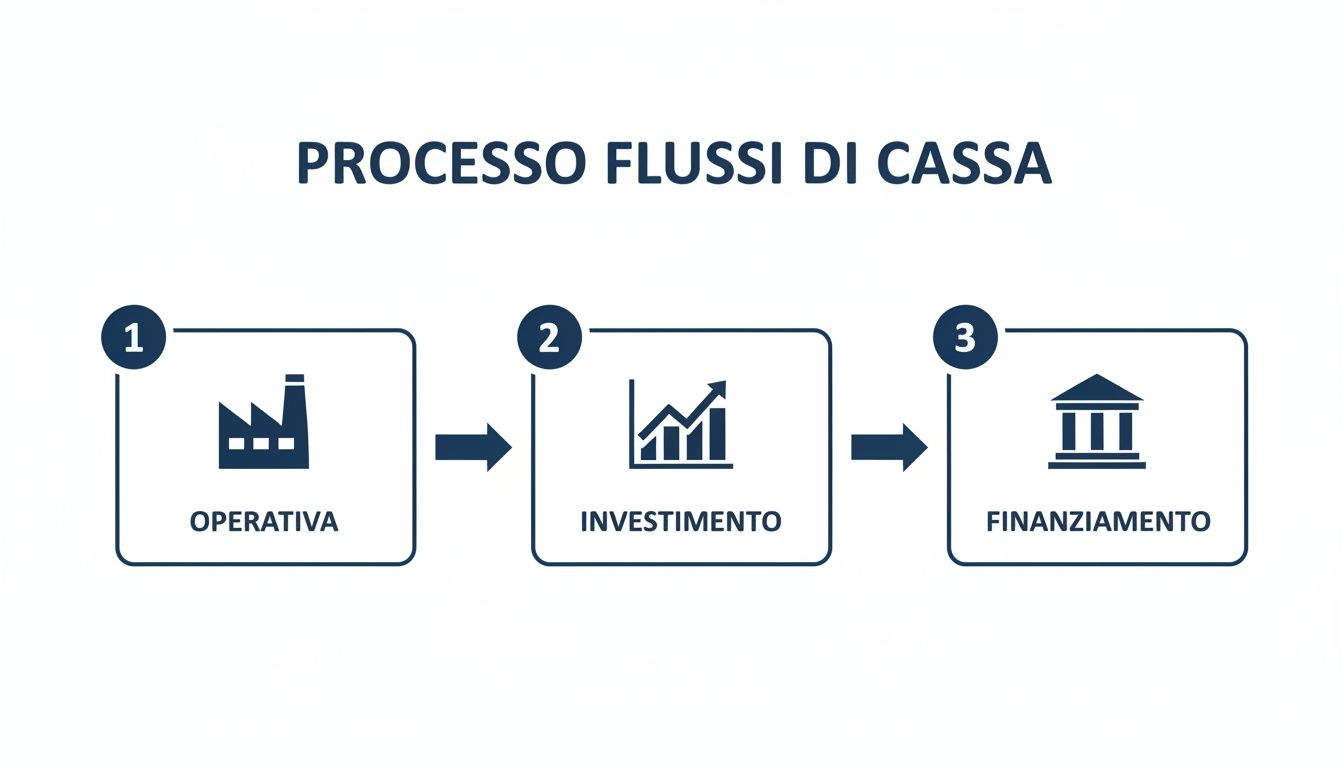
The chart clearly shows how the cash generated by the operational "engine" was allocated to future initiatives (investments) and supported by external "fuel" (financing).
It’s time to take stock and assess the overall impact on your company’s cash flow over the past year.
When you add up the three cash flows, you get the total change in cash: 70,000 – 100,000 + 70,000 = +40,000 €.
This means that, at the end of the year, Alfa S.r.l.'s cash balance has increased by €40,000. If, at the beginning of the year, it had, say, €20,000 in its account, it will have €60,000 at the end of the year .
Here is a summary in table format of our sample cash flow statement, which organizes everything.
.tbl-scroll{contain:inline-size;overflow-x:auto;-webkit-overflow-scrolling:touch}.tbl-scroll table{min-width:600px;width:100%;border-collapse:collapse;margin-bottom:20px}.tbl-scroll th{border:1px solid #ddd;padding:8px;text-align:left;background-color:#f2f2f2;white-space:nowrap}.tbl-scroll td{border:1px solid #ddd;padding:8px;text-align:left}Esempio di rendiconto finanziario con metodo indiretto (Valori in €)Voce del rendicontoImporto (€)A) Flusso di cassa da attività operativa+70.000Utile d'esercizio+50.000Rettifica per ammortamenti+20.000Variazione crediti v/clienti+15.000Variazione debiti v/fornitori-10.000Variazione rimanenze-5.000B) Flusso di cassa da attività di investimento-100.000Acquisto immobilizzazioni materiali-100.000C) Flusso di cassa da attività di finanziamento+70.000Accensione nuovi finanziamenti+80.000Rimborso quota capitale finanziamenti-10.000Variazione liquidità netta (A+B+C)+40.000Liquidità iniziale+20.000Liquidità finale+60.000
This example of a cash flow statement tells a clear and positive story: Alfa S.r.l. is a healthy company whose core business generates cash. It had the courage to invest in the future, financing this growth in a balanced way through a new loan. The end result is an increase in liquidity, which puts the company in a strong position to face future challenges.
To manage data like this efficiently, you might be interested in our in-depth guide on how to create a sample Excel table for data analysis.
Now that you’ve seen how to read a cash flow statement, it’s time to roll up your sleeves. Preparing this document may seem like a task for experts, but with the right guidance, it’s something any diligent entrepreneur can master.
The goal is to turn the dry numbers in your financial statements into a clear picture of your company’s cash flow.
To get started, you only need two essential documents, which you most likely already have on hand:
Having these two reports on hand is the first, essential step in tracing the path your cash flow has taken over the past year.
Once you have the data, the process for preparing the income statement using the indirect method follows a specific procedure. Follow these steps:
This guide takes you from theory to practice, turning numbers into vital insights for your business.
When filling out the form, it’s easy to make a mistake. Here are a few tips to help you avoid them:
Remember: the goal isn’t accounting perfection, but rather to obtain a clear and reliable snapshot of your company’s financial health. A well-prepared cash flow statement is a management tool first and foremost, rather than merely a legal requirement.
This approach is crucial, especially in the current context. According to ISTAT data, Italian companies demonstrated remarkable resilience in 2023, with an 8.5% increase in average EBITDA. Understanding how this margin translates (or does not translate) into cash flow is the real key to navigating complex economic scenarios . You can learn more by reading the full report on corporate income statements.
To classify items correctly, it is essential to start with a well-organized accounting structure. For this reason, we recommend reading our guide on how to set up an effective chart of accounts for your business.
Creating a sample cash flow statement by hand is a crucial step in understanding the logic behind cash flows, but the real competitive edge comes from consistent and proactive analysis. When done manually, this process is slow, repetitive, and, worse still, prone to errors that can be costly.
This is where technology comes in. Instead of spending hours poring over spreadsheets, you can rely on an AI-powered data analytics platform that turns this accounting chore into a powerful strategic advantage.
Platforms like ELECTE were created precisely for this reason: to automate analysis and free up your time for the decisions that really matter.
Imagine being able to connect your accounting systems (invoicing, business management software, online banking) to a platform that does the heavy lifting for you. Artificial intelligence doesn’t just collect data—it interprets it. ELECTE, for example, is capable of:
This dashboard is a perfect example of how complex cash flow data can be transformed into clear, actionable visualizations.

At a glance, you can see the trend in operating cash flow, compare it to previous periods, and analyze the AI-generated forecasts.
Automation isn't just about "getting things done faster." It's about gaining a deeper, ongoing understanding of your company's financial health—shifting from retrospective analysis to predictive management. Instead of looking in the rearview mirror, you start driving while looking at the road ahead.
Adopting an AI platform for financial statement analysis offers tangible benefits, especially for small and medium-sized enterprises. The Italian business sector, which saw a 0.96% increase in the number of registered businesses in 2025, is built on a foundation that is often fragile. In this context, efficiency is not a luxury, but a necessity.
You can explore the dynamics of the Italian business landscape to better understand the importance of monitoring market trends.
Automating your analysis with a platform like ELECTE allows ELECTE to:
Ultimately, it transforms your sample cash flow statement from a static document into a dynamic dashboard that helps you confidently steer your company’s growth.
You’ve reached the end of this journey. You now have the tools to view your business with fresh eyes, capable of seeing beyond the bottom line. The financial statement isn’t just a document to file away—it’s the dashboard that guides you every day toward healthy, sustainable growth.
True power doesn’t lie in preparing a financial report once a year, but in integrating it into your daily decision-making process. It’s the compass that tells you whether you’re heading in the right direction to create real value—not just on paper.
Here are the key points you should never forget:
Are you ready to turn your data into strategic decisions? Find out how ELECTE automate this process and give you a clear overview of your cash flow in just a few clicks.
It’s normal to still have some doubts. In fact, it’s a good sign: it means you’re starting to think critically about how to apply these concepts to your own situation. Here are the answers to the most common questions.
The difference lies in the starting point and the level of detail.
It depends on what stage your company is at.
Think of your cash flow statement as a CT scan of your business. Keep an eye out for these three warning signs.
A consistently negative operating cash flow is the most serious warning sign. It’s as if your car’s engine, instead of producing energy, is consuming it just to run. It means that the heart of your business is burning through money instead of generating it.
Here’s a quick checklist:
Are you ready to turn your financial data into strategic decisions? With ELECTE, you can automate the creation and analysis of your cash flow statement, gaining clear, predictive insights in just a few clicks.

.svg)


.svg)
.svg)