
The most telling aspect of FinOps for AI is not technical. It is managerial. When nearly all organizations begin treating AI spending as a category to be managed, it means that AI has ceased to be a side project and has become part of the company’s operational engine. According to the FinOps Foundation, 98% of organizations now manage AI spending, up from 63% the previous year and 31% two years prior, while the stated goal is forecasting accuracy exceeding 90% for shared AI services, thereby reducing bill shocks (FinOps principles for estimating AI costs).
For an Italian SME, this changes the very meaning of “cost control.” It’s no longer enough to know how much you’re spending on the cloud at the end of the month. You need to understand which team, which model, which query, which report, and which architectural choice is consuming budget and generating value.
This is where FinOps AI analytics cost management comes into play. Not as a discipline reserved for large enterprises, but as a practical tool for those who want to use analytics and AI without sacrificing visibility, margins, or planning capabilities. If AI is the new engine, FinOps is the dashboard that prevents you from driving while staring only at your fuel receipt.
AI costs rarely skyrocket dramatically. More often than not, they build up quietly. An extra API call, a model left running, a duplicate pipeline, a dashboard that refreshes too often. The problem is that many companies only notice this when the bill arrives—not when the costs first start to accumulate.
That’s why this issue isn’t just about IT. It concerns CFOs, COOs, department heads, and managers who must decide whether an investment in analytics is creating real value or just hidden complexity. In short, AI has made the cloud less like a flat fee and more like a meter.
That is exactly what FinOps is for. It translates technical usage into financial accountability. It allows you to shift from reactive management—based on surprises and justifications—to intentional management—based on visibility, priorities, and measurable decisions. Those who want to better understand where the less obvious costs lie can also start with this analysis of the hidden costs of implementing artificial intelligence.
The real challenge isn’t simply spending less overall. It’s about spending more effectively, moving faster than competitors, and gaining greater clarity on the return on investment for every AI initiative.
FinOps is often described as a method for reducing cloud spending. That’s too narrow a definition. In reality, it’s a cultural practice that brings finance, operations, data teams, and leadership together around the same table, so that technology spending is viewed as a business decision rather than a technical byproduct.
In the context of AI, this distinction becomes crucial. According to the FinOps Foundation’s report, *The State of AI FinOps 2025*, by 2025, 63% of organizations will actively manage AI spending—more than double the 31% from the previous year (analysis of the report published by Portkey). When a practice doubles in such a short time, you’re not looking at a trend. You’re looking at a shift in discipline.
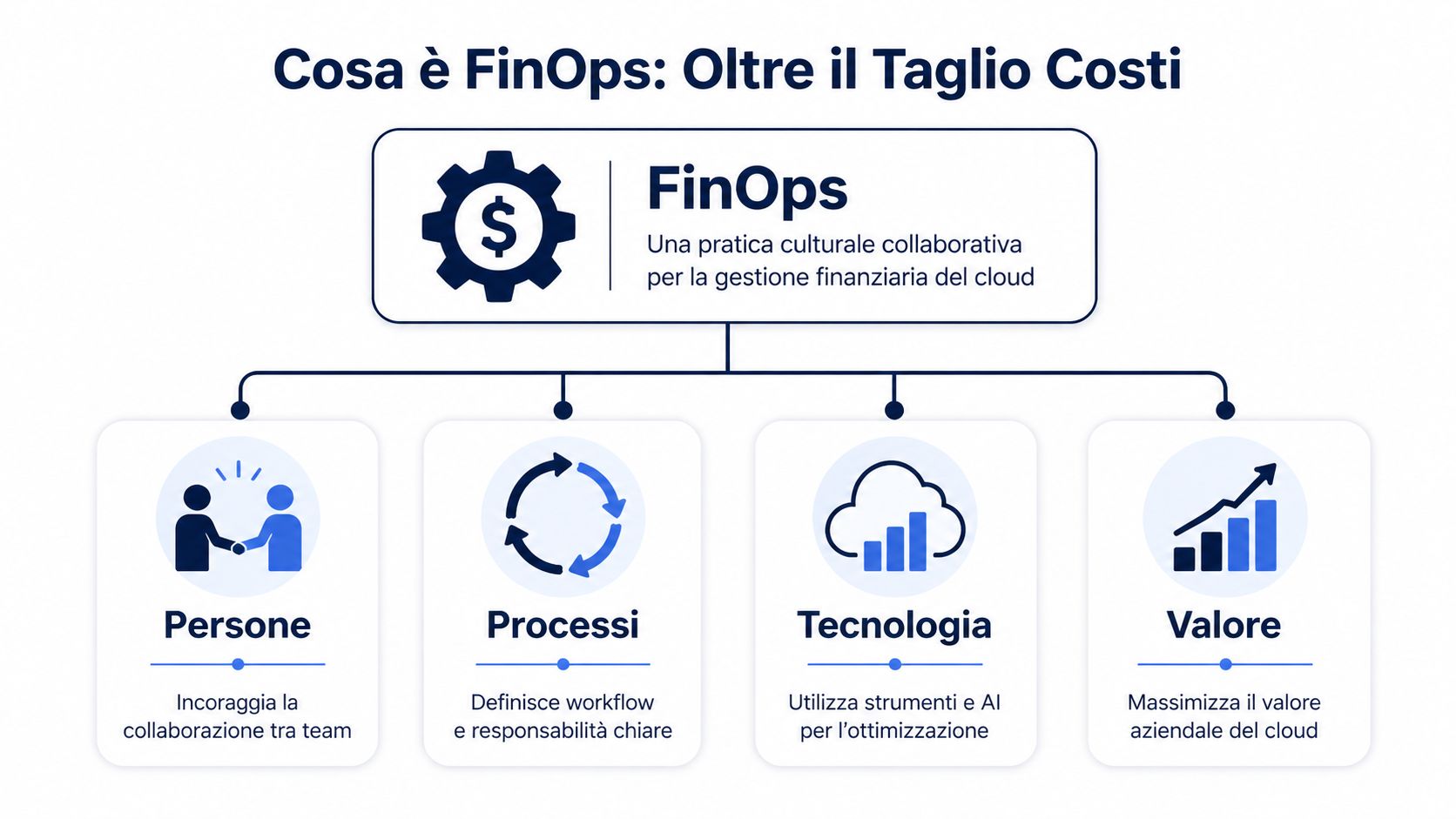
Think of a household budget with multiple bills, multiple subscriptions, and multiple people making purchases. If you only look at the total at the end of the month, you’re already behind. But if you know who’s spending what, for what purpose, and with what priority, you can make choices without putting everything on hold.
The same principle applies in a business setting. FinOps works when it combines four elements:
Mature FinOps doesn't tell teams to innovate less. It forces them to better explain why they're spending money.
AI workloads do not behave like traditional applications. They may depend on token-based consumption, GPU usage, intermittent experiments, variable inferences, and rapidly changing environments. This makes the traditional annual budget—based on relatively stable costs—vulnerable.
For a business leader, the key issue is a different one: AI shifts the focus from “purchased capacity” to actual usage. You’re not just paying for infrastructure. You’re paying for operational practices, the quality of prompts, query frequency, the models used, and the governance of experiments.
Three implications are particularly significant:
Cloud spending becomes granular
It’s not enough to know the total cloud cost. You need to track prompts, inferences, API calls, test environments, and production environments.
Responsibility is shared
The cost is no longer “IT’s” responsibility. It belongs to the teams that use models, data, and automation to generate business outcomes.
Optimization is not a linear process
Cutting costs in the wrong place can worsen performance, latency, or decision-making quality. FinOps is designed precisely to avoid indiscriminate cuts.
That’s why FinOps AI analytics for cost management is more like a navigation system than a budget cutter. Those who treat it as mere cost-cutting end up stifling innovation. Those who use it effectively can decide more precisely where to accelerate.
For an Italian SME, a few percentage points of uncontrolled AI spending can have a greater impact than a poorly executed marketing campaign. The reason is simple: the cost base is tighter, teams are less specialized, and every euro spent on poorly monitored experiments reduces the ability to invest where returns are faster.
In this context, the benefit of FinOps is managerial rather than technical. It takes AI costs out of the hands of specialists and makes them understandable to those who set budgets, operational priorities, and risk levels. An administrative manager, a sales director, or a COO doesn’t need to interpret log files. They need to see which use cases are consuming resources, which are producing results, and which need to be corrected.

The maturity of the AI market is also changing the expectations of non-technical teams. Organizations that adopt models, automation, and analytics no longer treat these costs as inherently unpredictable. They expect more accurate estimates, clear control thresholds, and defined accountability.
For an SME, this shifts the conversation from “how much does the cloud cost” to “which decision results in which cost.” It’s a significant difference. The first figure is for reporting purposes. The second is used to guide the company.
The most tangible benefits become apparent very quickly:
For non-technical teams, the value is also psychological. A cost that can be explained is approved more readily than one that can only be justified afterward.
Large companies can tolerate inefficiencies for a few quarters. An Italian SME, however, often cannot. Here, FinOps functions like the dashboard of a delivery van. You don’t need to know every detail about the engine. You need to see fuel levels, fuel consumption, and warning signs immediately, because a breakdown has a much greater impact on a fleet of three vehicles than on one of three hundred.
In SMEs, therefore, the real competitive advantage isn’t the size of the AI budget. It’s the speed with which the company links implementation, results, and adjustments. Those who can do this are able to test more initiatives without turning every trial into a financial risk.
This point is also significant from a regulatory perspective. In sectors such as finance, insurance, or regulated services, regulations governing costs and digital suppliers support more orderly governance, which is also beneficial in relation to operational and resilience requirements such as those outlined in DORA. It is not enough simply to use modern tools; it is necessary to be able to demonstrate who is using them, for which processes, and what their economic impact is.
Many FinOps guides are aimed at large enterprises with structured procurement processes, cloud centers of excellence, and platform teams. For many Italian SMEs, the starting point is different. They typically have a finance person, an IT contact, a few line managers, and growing pressure to do more with less.
This is precisely why FinOps applied to AI analytics is accessible. It does not require a complex structure. It requires operational visibility, a minimum set of shared rules, and integrated data from various sources. A useful foundation can also be established by linking cloud invoices, usage logs, cost centers, and management systems via connectors to corporate and cloud data sources.
The result is not just cost control. It is a new organizational capability. The SME stops reacting to AI costs and begins to choose more precisely where to invest, where to standardize, and where to stop before a low-value experiment becomes a fixed cost.
If FinOps is the method, data architecture is its nervous system. Without a solid information foundation, cost control remains a matter of opinion. You may have good intentions, but you won’t have true decision-making capability.
In FinOps AI analytics cost management, the key is not simply to collect more data. It is to collect the right data, at the right frequency, and in a format that makes it comparable across different systems.
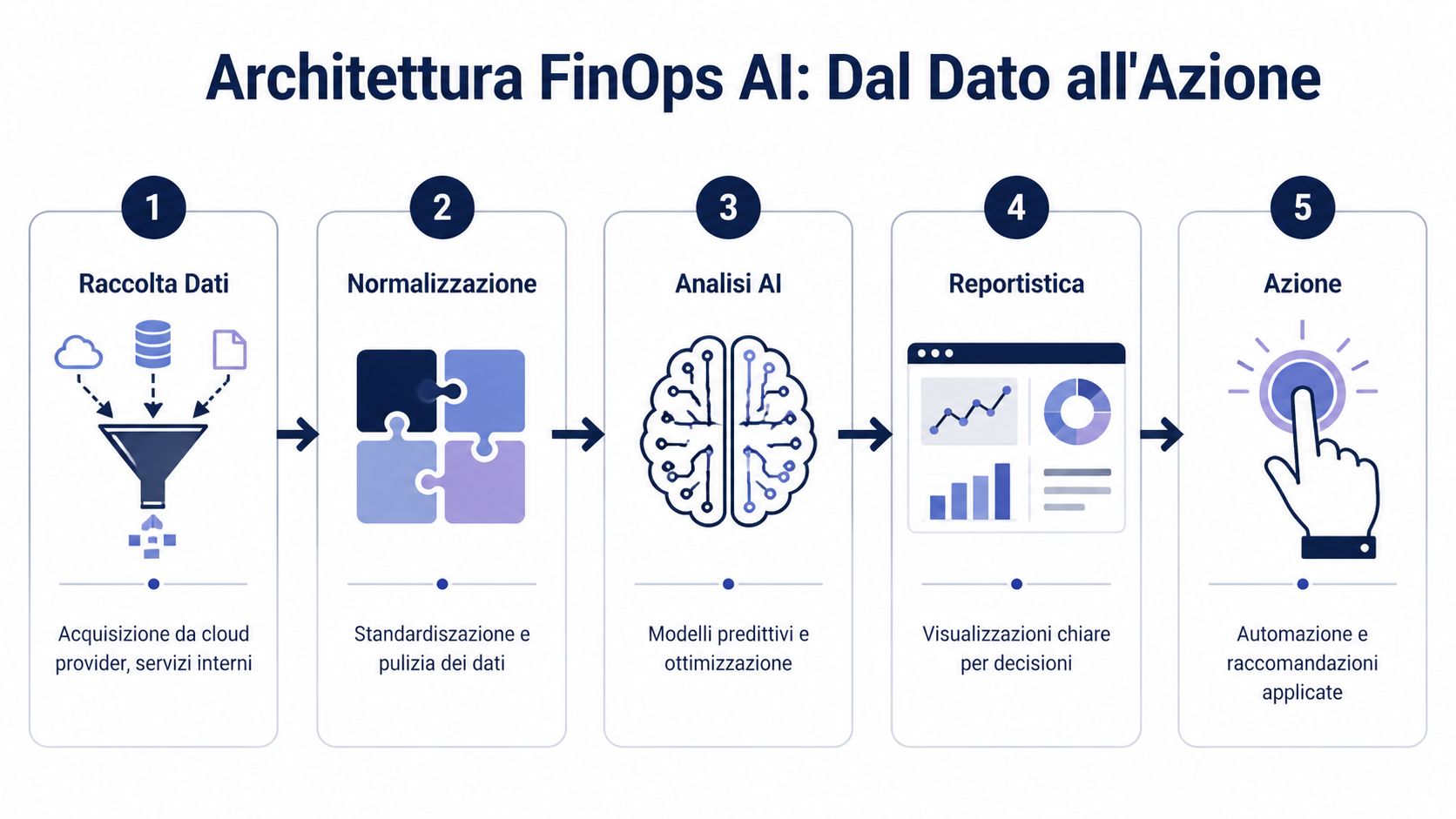
An effective FinOps system must combine at least four categories of signals:
Without this integration, the company sees numbers but fails to identify causal relationships. It’s the classic scenario where a CFO notices an increase, IT confirms it, but no one can pinpoint exactly which decision caused it.
Integrating AI into the FinOps process helps address this very issue. On platforms such as Snowflake and BigQuery, autonomous agents can detect immediate spikes in spending, reduce manual cost management tasks by up to 99% through automatic cluster right-sizing, and lead to 30–40% reductions in cloud costs for data teams (specialized analysis on AI-powered cloud optimization).
When the anomaly is detected as it occurs, the team can correct the operational behavior. When it is detected after the fact, the team can only explain it.
Many companies believe they have visibility simply because they have separate dashboards. In reality, they have isolated windows, not a single view. The result is fragmented governance: AWS tells part of the story, Azure another, OpenAI yet another, and internal systems don’t communicate with anyone.
A more robust FinOps foundation requires integrations between cloud providers, data platforms, and AI services. If you want to assess this in practical terms, it’s best to start with a clear map of the integrations and data sources linked to decision-making processes.
Decisions improve when the architecture enables three things:
End-to-End Attribution: See the cost from the source all the way to the team or process that benefited from it.
Normalization: It brings diverse metrics into a common language, making comparisons meaningful.
Actionability
Insights and solutions. Not just “there’s a problem,” but “here’s where to take action.”
In practice, the data architecture for FinOps AI works like an aircraft’s instrument panel. It’s not enough to have a lot of gauges. They must be synchronized, easy to read, and linked to timely decisions. Otherwise, the pilot has data but no control.
SMEs often put off implementing FinOps because they imagine it to be a complex program designed for organizations with dedicated teams. In reality, it works best when started on a basic level. The key is not to build a perfect system right away, but to quickly establish a cycle of visibility, correction, and learning.

1. Start with the actual spending map
—not with a theoretical budget. Start with actual consumption. List the providers, AI services, data platforms, environments, and business functions involved. If you can’t identify who is consuming what, the first issue isn’t optimization. It’s visibility.
2. Separate experimentation from production
Many companies lump testing, prototyping, and stable workloads into the same cost category. This muddies the waters. Experiments follow a different logic than production. They should be viewed with different expectations.
3. Define ownership and minimum rules
Every AI expense must have a designated person in charge, even if there is no formal FinOps team. You need to know who approves, who monitors, and who takes action if a threshold is exceeded.
Operating rule: if an expense doesn't have an owner, it has no real chance of being managed.
Once you’ve laid this groundwork, the process takes on a new dimension. You’re no longer just gathering information. You’re building a decision-making system.
This is where the real leap in maturity comes in. Accurately forecasting AI workload costs requires predictive modeling using machine learning. By analyzing historical usage data, ML models can detect anomalies and patterns that escape human analysis and prevent budget overruns, reducing cloud waste by 30–40% (FinOps Foundation overview on AI and forecasting).
4. Implement intelligent forecasting and alerts
At this point, it’s not enough to know where you’ve spent money. You need to estimate where you’ll spend it. Forecasting is what transforms FinOps from a snapshot of the past into a management tool. It helps you understand whether a new project, an increase in volume, or a change in the model is likely to alter the initiative’s financial profile.
The following video provides a helpful overview of this operational transition:
5. Link costs to business decisions
The final step is also the most overlooked. If FinOps remains confined to a technical report, it yields little value. If, on the other hand, it is incorporated into project reviews, quarterly budgets, and portfolio priorities, it becomes a competitive advantage.
You can use this quick checklist to assess the level of adoption:
Here’s the least intuitive part. FinOps doesn’t slow down the adoption of AI. It reduces the cost of organizational uncertainty. And for an SME, it’s often that very invisible cost that holds back the most promising projects.
For an Italian SME, measuring only total cloud spending is like looking at an electricity bill without knowing which machines are eating into profits. The key management consideration isn’t the absolute cost. It’s the relationship between consumption, operational value, and financial return.
This is where FinOps AI takes things to the next level. It transforms a technical cost item into a system of signals that finance, operations, and data teams can all interpret in the same way—albeit with different objectives. That’s why it makes sense to complement infrastructure metrics with indicators that are more closely aligned with the business, as explained in this in-depth look at three metrics that distinguish companies that achieve real results from AI.
The most useful metrics in FinOps AI aren’t the ones that impress a technical team. They’re the ones that help an administrator, a CFO, or a department head answer three practical questions: how much does each output cost, how reliable is the spending forecast, and how much value does the service actually generate.
For this reason, metrics such as cost per inference, cost per API call, forecasting accuracy, and the ROI of the AI initiative are more relevant than a simple aggregate view of spending. The logic is simple. If costs rise but the value generated per customer, practice, or process also increases, the problem isn’t volume. If, on the other hand, tokens, calls, or workloads increase without a visible improvement in margin, productivity, or risk control, then spending is funding complexity, not competitive advantage.
For SMEs, this step is even more critical. They have less budgetary leeway than large companies, and in regulated sectors such as finance or ICT services—which are subject to GDPR-related requirements—they must demonstrate not only efficiency but also control.
| Key Performance Indicators for AI FinOps | Description | Why It Matters for SMEs |
|---|---|---|
| Total AI cost | Aggregate view of spending on services, models, platforms, and environments | It provides an overview of the initiative's financial scope, which is useful for budgeting and monitoring |
| Cost per inference | How much does it cost to generate a response or model output? | Show whether the service can grow without squeezing the margin |
| Cost per API call | Cost attributed to each call to an AI service | It highlights inefficiencies in prompts, frequency of use, or application architecture |
| Forecasting Accuracy | How close the forecast is to actual spending | Improve cash flow planning, quarterly budgets, and internal confidence |
| ROI of the AI initiative | Relationship between business value generated and costs incurred | Shift the focus from “how much we spend” to “what we get for every euro invested” |
| Variance by team or project | Difference between budget, forecast, and actual consumption | It helps identify responsibilities, areas of excessive spending, and priorities for action |
Useful metrics reduce decision-making ambiguity. They aren’t meant to generate more reports, but to help you decide sooner where to cut costs, where to make corrections, and where to invest.
The most insightful findings emerge when these metrics are combined. A low cost per inference, on its own, does not guarantee a good result if the model produces outputs that are not very useful and leads to rework. A positive ROI, taken in isolation, can mask significant monthly volatility that makes planning difficult. Good forecasting accuracy, on the other hand, has a value that many SMEs underestimate. It reduces the risk of projects being enthusiastically approved and scaled back a few months later due to cost surprises.
The right question, then, is not how many metrics to monitor. It is which metrics allow you to link spending, operational reliability, and financial performance with sufficient clarity to inform a decision. In an SME, this is the point at which FinOps AI ceases to be merely about cost control and becomes a management discipline.
The value of FinOps AI is most evident where every euro spent has an immediate impact on margins, risk, or operational continuity. For Italian SMEs, retail and finance are two instructive cases because they exhibit the same dynamics but with different constraints. In retail, the pressure is commercial. In finance, it is also regulatory. In both sectors, the most common mistake is treating AI costs as an IT expense rather than a performance variable.

In a small-to-medium-sized retail business that sells online, AI analytics often comes into play in three key areas: demand forecasting, promotion optimization, and near-real-time sales reporting. The benefits are obvious: less dead stock, more targeted campaigns, and faster decision-making. The problem is less obvious. Every model, dashboard refresh, or query on large volumes of data adds variable costs, and those costs tend to rise before anyone connects them to the margin generated.
FinOps AI is designed to make exactly this connection. A company can, for example, compare the cost of a promotional engine with the actual increase in conversion or turnover for a specific category. It may also discover that certain analyses are run too frequently relative to the value they generate. It’s a situation similar to a retail store leaving all the lights in the warehouse on all night. The unit cost seems modest, but when multiplied by days, locations, and processes, it becomes structural margin erosion.
For an Italian SME, this step matters more than it does for large chains. Margins are often tighter, teams are smaller, and there is much less tolerance for AI projects that are “interesting” but not very profitable. Competitive advantage, therefore, does not stem from the number of dashboards or models in production. It stems from the ability to understand which insights truly improve sell-through, average discount, and purchase planning—and which ones simply drain the budget without changing a single operational decision.
In the financial sector, the issue takes on a different scale. An Italian SME that uses AI for scoring, anomaly detection, reconciliations, or compliance reporting isn’t just managing technology costs. It’s also managing traceability, supplier dependency, process auditability, and operational resilience. That’s why FinOps, in this context, resembles less a cloud optimization exercise and more an industrial control system.
CloudZero notes that FinOps applied to AI becomes particularly relevant as variable consumption, the use of different models, and the complexity of cost allocation across teams and workloads increase (analysis on FinOps for AI). For an Italian financial SME, this complexity has a tangible impact. If you don’t know which workloads generate expenses, who approves them, what data they use, and what processes they support, it becomes more difficult to demonstrate operational control within a framework such as that required by DORA.
Here’s a point that many general guides overlook. For a local bank, a specialized fintech, or a small intermediary, compliance and cost are not two separate issues. They are the same conversation viewed from two different functions. Finance asks whether the expense is justified. Risk and compliance ask whether the process is traceable, repeatable, and defensible in an audit. FinOps AI combines these two questions into a single managerial view.
In the financial sector, AI-related spending that is difficult to attribute is also harder to manage, explain, and justify.
For this reason, DORA should also be viewed as a competitive advantage. It requires organizations to formalize responsibilities, monitoring, and technological dependencies. An SME that establishes this framework before its competitors does not merely achieve greater internal order. It also benefits from faster decision-making, fewer budget surprises, and a more credible foundation for scaling AI use cases without simultaneously increasing opacity and operational risk.
When you put all the pieces together, the message is clearer than it seems. FinOps AI analytics and cost management are not just an afterthought in the cloud. They are what determines whether AI will remain a black box expense or become a competitive advantage.
To take practical action, focus on these steps:
The opportunity for Italian SMEs is very real. The most agile companies will not succeed simply because they spend less and less. They will succeed because they will be better at allocating resources, making corrections sooner, and more clearly defending the value of their AI initiatives.
ELECTE, an AI-powered data analytics platform for SMEs, is designed specifically for this transition. It helps teams consolidate data sources, gain a clearer understanding of performance and costs, automate reporting, and transform complex insights into decisions that are accessible even to those without a technical background.
If you want to turn data into clearer decisions and build a smarter AI investment management system, find out how it works ELECTE. You can explore the platform, see how it connects insights with operations, and determine if it’s the right step for your growth.

.svg)


.svg)
.svg)