Do you think European Structural Funds are an impenetrable bureaucratic maze? The reality is quite different: they are strategic catalysts designed to give a decisive boost to the growth of your SME. These funds are the European Union’s main driver of investment, designed to reduce regional disparities and promote smart, sustainable, and inclusive development. For you, this means one thing: concrete opportunities to finance your most ambitious projects.
This guide will show you how to navigate this landscape, turning it from a complex challenge into a strategic ally. You’ll discover which funding options are right for you, how to craft a winning project proposal, and how to leverage data analysis to make your application airtight. Let’s start mapping out the path to growing your business.

The goal is clear: to strengthen economic, social, and territorial cohesion, ensuring that no region is left behind.
Think of these funds not as mere handouts, but as the fuel that drives innovation, competitiveness, and job creation in your company.
An important clarification: the Structural Funds should not be confused with the PNRR (National Recovery and Resilience Plan). Although they share some priorities—digital and green—they are different instruments with their own channels, timelines, and rules. This guide focuses exclusively on the Structural Funds for the 2021–2027 cycle.
For your small business, this translates into real financing opportunities. It’s not just about receiving money, but about gaining access to resources that allow you to carry out ambitious projects—the kind that would otherwise remain on the back burner.
In the current programming cycle, the EU has outlined several strategic guidelines that shape the allocation of funds. For a business, understanding these guidelines is the first step toward aligning your projects and maximizing your chances of success. The two main guidelines are:
Digital transition: This encompasses everything related to the adoption of Industry 4.0 technologies, the digitization of production processes, the development of e-commerce solutions, and the strengthening of cybersecurity. If your goal is to make your business smarter and more connected, there are specific funding programs that are right for you.
Green transition: This includes incentives for energy efficiency, the adoption of renewable energy sources, the development of a circular economy, and the reduction of environmental impact. Funding a "green" project isn't just good for the planet—it also strengthens your brand's reputation and competitiveness.
A practical example? A manufacturing company could secure funding to purchase a new CNC machine that, on the one hand, reduces production waste (ecological transition) and, on the other, integrates with management software to analyze data in real time (digital transition).
The European Structural Funds are an economic policy tool that translates the EU’s strategic priorities into concrete actions on the ground, directly supporting businesses that invest in the future.
Italy is one of the main beneficiaries of these funds. Between 2021 and 2027, our country will receive a total of 42.7 billion euros from the EU through the Cohesion Policy, with a particular focus on the regions of Southern Italy. This financial commitment, which rises to €75 billion with national co-financing, aims to bridge development gaps and stimulate employment. For more information, you can consult the detailson the allocation of cohesion funds for Italy.
Understanding the potential of these funds is the first step toward turning an ambitious idea into a successful project. That is precisely our goal: to turn a seemingly complex world into a strategic ally for the growth of your business.
For your small or medium-sized business, navigating the world of European funds can feel like deciphering a complex map. The good news is that you don’t need to know every single path. Your choice almost always comes down to two main options: the European Regional Development Fund (ERDF) and the European Social Fund Plus (ESF+).
Figuring out which door to knock on is the first step toward securing funding. Think of the ERDF as the fund that helps you build the tangible future of your business. It’s the ideal partner for “tangible” investments you can actually touch: machinery, software, buildings. On the other hand,the ESF+ is the fund that invests in people. Its focus is on human capital: training, employment, social inclusion, and new skills.
Imagine you want to transform your manufacturing company into a flagship of Industry 4.0. You need to purchase new smart machinery that integrates with your ERP system, optimizes production, and reduces waste. Well, this is a perfect project for the ERDF.
The ERDF funds investments that give your business a real competitive edge. Here are some practical examples of what you can fund with the ERDF:
Digitalization and Security: Purchase state-of-the-art software, launch an e-commerce platform, or implement cybersecurity systems to protect your data and that of your customers.
Product and Process Innovation: Fund research and development to create a product that has never been seen before or to redesign your production chain using more efficient technologies.
Sustainability and the green transition: Install solar panels on your warehouse, replace old systems with energy-efficient solutions, or improve the thermal insulation of your facility.
In short, an ERDF project leads to tangible improvements in your business’s productivity, competitiveness, and sustainability.
Now, let’s get back to our Industry 4.0 machine. It’s arrived, been installed, and is ready to go. But there’s a problem: no one in the company knows how to use it to its full potential. Without a properly trained team, even the most brilliant investment risks going to waste. This is where the European Social Fund Plus (ESF+) comes into play.
This fund is specifically designed to bridge the skills gap and ensure that no one is left behind during corporate transformations. It supports the development of people, the true driving force behind every business. Here are some typical projects you can fund throughthe ESF+:
Staff training: Organize upskilling courses (to enhance existing skills) and reskilling courses (to acquire new skills), particularly in the digital and technical fields.
Employment placement: Create programs to hire young people, the long-term unemployed, or individuals from disadvantaged groups, offering them opportunities for professional growth.
Welfare and Equal Opportunity: Promoting initiatives for gender equality, such as career paths for women, or implementing welfare solutions to help balance personal and professional life.
Choosing the right fund is not just a bureaucratic formality. It means aligning your growth vision with Europe’s strategic objectives, thereby maximizing the chances that your project will be viewed as a funding priority.
The key question to ask yourself is: What is the core of my project? Is it an investment in “things” (ERDF) or in “people” (ESF+)? If your project incorporates both aspects, the best strategy is to determine which of the two investments is the primary focus and target the application to the appropriate call for proposals, while still mentioning the other component to ensure the project’s coherence.
Understanding how the European Structural Funds work is like having a treasure map before you even start the hunt. The current program, covering the 2021–2027 period, is the mechanism that translates the European Union’s broad strategies into concrete calls for proposals that even your SME can apply for.
At first glance, it may seem like a bureaucratic maze, but in reality it follows a clear logic: it all starts in Brussels, but it has a direct impact on your local area.
The vast majority of funds operate under shared management. What does that mean? Simply put, the EU sets the general objectives and entrusts the funds and day-to-day management to the member states, which in turn delegate almost everything to the regions.
This is the key point for you: your real points of contact are not anonymous officials in Brussels, but the authorities in your region or the national ministries. They are the ones who draft and publish the calls for proposals, set the requirements, and evaluate the projects.
Understanding this step is crucial. Don’t waste your time searching for calls for proposals on the European Commission’s website. Instead, focus on the websites of your region and the relevant ministries.
Italy has demonstrated a remarkable ability to secure these funds. Between 2014 and 2023, we received approximately €105 billion in EU funding, supporting 740,000 projects in the 2014–2020 cycle alone. The findings of a Eurispes study clearly demonstrate the impact of these funds on our economy.
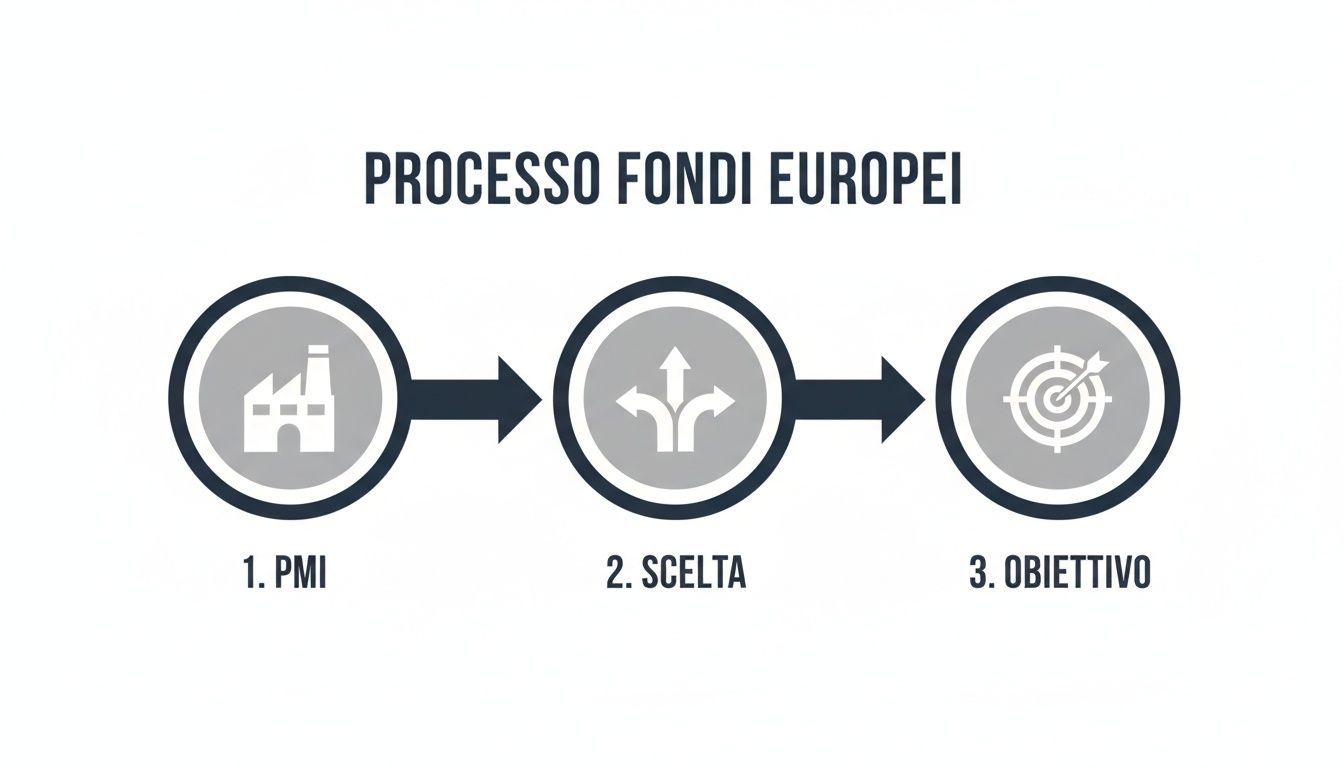
It all starts with an internal analysis. What does your company need? From there, we move on to identifying the most suitable funding source, and then define a clear, measurable, and fundable project objective.
Now that the process is clearer, let’s move on to the practical steps. Here are some concrete steps to follow:
Identify the Managing Authorities: Your first step is to Google “POR FESR [Name of your Region] 2021-2027” or “PN [Program Name] 2021-2027.” You’ll find documents explaining how the funds will be spent in your area.
Sign up for newsletter: It’s the easiest and most direct way to find out when a call for applications is released. Virtually every regional government or ministry website has a dedicated section for this. Do it now.
Keep an eye on the right websites: Bookmark the websites of the government agencies you’ve identified. Calls for proposals often have tight deadlines, so being prepared makes all the difference.
Learn how to interpret the "priority axes": Each call for proposals is linked to a "priority axis" of the funding program. Understanding which major strategic objective your project addresses is key to writing a proposal that hits the mark.
A strategic approach is everything, especially for complex projects like those related to Industry 4.0. If this is your field, learn more by reading our article on the role of the MADE Competence Center for Industry 4.0. Navigating the planning cycle requires preparation and timing, transforming a distant opportunity into a concrete project for your company.

Accessing European structural funds isn’t a matter of luck. It’s the result of strategic planning. A successful proposal isn’t just a filled-out form, but a credible narrative of growth, innovation, and local impact. Your task is to answer the call for proposals’ questions in a direct, clear, and convincing manner.
Even the most brilliant idea is worthless if it remains abstract. To make it concrete, use the SMART method. It forces you to turn a vague concept into a watertight action plan.
Your goals should be:
Specific: Who does what, where, and why? Don’t write “we will improve production,” but rather “we will install a new CNC machine in Department X to increase production capacity by 20%.”
Measurable: How will you know if you’ve hit the mark? Define key performance indicators (KPIs) such as “a 15% reduction in cycle times” or “a 25% increase in e-commerce customers.”
Achievable: Is the goal realistic given the resources you have (and those you’re requesting)? You must demonstrate that you have the right skills to complete the task.
Relevant: Why is this project important to your company and to the objectives of the call for proposals? Link your investment to digital transformation, sustainability, or job creation.
Time-bound: Set a timeline with intermediate deadlines (milestones). A well-thought-out schedule is the first sign that you’re not winging it.
A business plan isn't a shopping list. It's the script for your growth journey, where every figure serves to support the main storyline: the return on investment—not just for you, but for the entire community.
Present your project as the solution to a problem. Instead of asking for funds to “buy software,” present a plan to “streamline logistics, reduce CO2 emissions, and create three new jobs through more efficient warehouse management.” Purchasing the software is merely a means to an end, not the end itself.
Your project must do more than just comply with the call for proposals. It must convince the evaluator that funding your SME is a smart investment in the future of the region and the country.
Even the most solid project can fall apart because of trivial mistakes. Pay close attention to these critical points:
Mismatch between objectives and budget: If you’re asking for €100,000 for a project that promises to revolutionize the global market, something doesn’t add up. Costs must be realistic, and every line item must be justified.
Unquantifiable impact: Simply stating that you will create "new jobs" is not enough. Be specific: "creation of 2 permanent positions for specialized technicians within 18 months."
Incomplete or sloppy documentation: Missing attachments, incorrect signatures, or carelessly filled-out forms are the quickest way to get disqualified. Attention to detail is a sign of professionalism.
Underestimating co-financing: Almost all calls for proposals require the company to contribute a portion of the funds. Demonstrating that you have the financial stability to cover your share is a requirement.
A winning proposal requires preparation, a systematic approach, and a strategy. For inspiration, read some of our case studies on business growth projects.

A funding application backed by solid data isn’t just stronger—it’s virtually unassailable. The ability to back up every claim with numerical evidence becomes your decisive advantage.
Most SMEs rely on projections based on internal estimates, without a verifiable methodology. A data analytics platform like ELECTE solves exactly this problem: it allows you to replace gut-feel estimates with projections based on your historical data, creating a growth narrative that a valuation expert can verify—not just read.
When you submit a business plan to access European structural funds, you need to look to the future. But how can you ensure your projections are more than just wishful thinking? The answer lies in predictive analytics.
ELECTE helps you move beyond "gut-feel" estimates. By uploading your historical sales data, the platform identifies patterns, growth cycles, and external variables, generating much more accurate and reliable revenue forecasts. Instead of writing “we expect to grow by 30%,” you can present a report generated by ELECTE showing a projected growth of 28.5% over 18 months, based on market analysis. This level of precision makes all the difference.
Every euro requested must be justified. You must not only explain what you want to buy, but also why that investment is essential. ELECTE helps you uncover these justifications hidden within your data.
The platform can analyze operational data to identify bottlenecks. For example, you might discover that a piece of equipment has a downtime rate 15% higher than average, causing delays and extra costs. This data isn’t just an opinion—it’s irrefutable evidence that justifies requesting funds to replace it.
Funding evaluators do not finance wishes, but rather projects based on concrete and demonstrable needs. Using data transforms your request from an expense into a strategic investment.
To stand out, your proposal must be flawless and backed by solid data. For more information on the use of funds in Italy, you can consult the official statistics on cohesion policy.
A good project must have a measurable impact. You need to be able to clearly demonstrate these expected results. With ELECTE, you can turn complex tables of numbers into charts and dashboards with a single click, making the impact of your project immediately clear.
Here's how you can use views strategically:
Revenue Growth Chart: Shows the projected sales trend before and after the investment.
Heat map of inefficiencies: Visually identifies the operational areas that the project will improve.
KPI Dashboard: Set up a custom dashboard with the key metrics you want to track. Learn how to create effective analytics dashboards with ELECTE today.
Including these visual elements in your application demonstrates a data-driven business mindset—a quality that evaluators are increasingly looking for. Try to show not only that you have a solid project, but also that you have the tools to measure its success.
You did it—you secured the funding. Congratulations! But now comes the hardest part: proving that those public funds are creating value. Don’t think of monitoring and reporting as a bureaucratic hassle. See them as the litmus test of your success and reliability.
This phase is your chance to turn an administrative requirement into a strategic advantage. Impeccable management will help you build a solid reputation for future opportunities related to European structural funds.
At the heart of it all are the Key Performance Indicators (KPIs)—the targets you promised to meet. Now you need to demonstrate, with data in hand, that you’ve kept your word. The main indicators fall into a few broad categories:
Employment KPIs: How many new jobs have you created? How many hours of training have you provided?
Financial KPIs: How much has revenue grown? Have you increased exports?
Environmental KPIs: How many tons of CO2 have you saved? What percentage of recycled material do you use?
Innovation KPIs: How many new products have you launched? Have you filed any patents?
Tracking this data must be a consistent and meticulous routine. Documenting every step of progress is the only way to pass midterm and final exams without stress.
Reporting isn’t a test you have to pass at the end, but an ongoing dialogue with those who have placed their trust in you. Clear data and timely reports demonstrate transparency and competence.
For an SME, manually managing data collection and report generation can become a full-time job. The risk of making a mistake can jeopardize the entire project. This is where a platform like ELECTE comes in as a valuable ally.
With ELECTE, you can connect your data sources (ERP, CRM, sensors) and let the platform collect and aggregate the information in real time. This not only frees you from a huge administrative burden but also drastically reduces the risk of oversights and inaccuracies.
Imagine having to prepare the quarterly report for your lender. With an analytics platform, you can create intuitive dashboards and customized reports that are ready to send.
With ELECTE's features, you can:
Monitor KPIs in real time: Keep an eye on how your metrics are performing using dynamic dashboards.
Generate automatic reports: Set up the periodic generation of detailed reports on the project status.
Identify deviations immediately: Receive an automatic alert if a KPI is veering off course, giving you time to take action.
Using tools like these sends a strong message to evaluators: your company is data-driven, capable of managing complex projects efficiently, and committed to ensuring that every public euro is invested to generate the greatest possible impact.
When it comes to European structural funds, the first thing that often comes to an entrepreneur’s mind is a maze of red tape. That’s understandable. For those running an SME, time is precious, and uncertainty can be discouraging.
Let’s set the record straight. Here, we answer the most common questions to debunk myths and give you the tools you need to feel more confident.
Absolutely not. This is perhaps the most widespread and harmful myth. In fact, the opposite is true: structural funds are designed precisely to breathe new life into the economic fabric, which is made up overwhelmingly of SMEs.
Many calls for proposals, especially regional ones, are tailored specifically for micro, small, and medium-sized enterprises. It doesn’t matter how big you are; what matters is having a project with a clear vision that aligns with the strategic objectives of the call. The key is finding the right call for your business.
Eligible expenses are at the heart of every application. Although each call for proposals has its own specific requirements, here is a practical list of the most common expense categories:
Capital expenditures: Purchase of machinery, plant, equipment, and hardware.
Intangible assets: Management software (ERP, CRM), software licenses, patents, or e-commerce development.
Consulting services: Fees for external specialists who guide you in marketing, quality certifications, or the implementation of new technologies.
Staff Training: Reskilling and upskilling courses to align your teams’ skills with new business processes.
Construction and renovation work: Some grant programs also cover the costs of adapting the building where the business is located.
There is only one golden rule: consistency. Every single expense must be essential to achieving the project’s objectives. An unnecessary or poorly justified cost is the first red flag for an evaluator.
That’s the classic million-dollar question. The honest answer? It depends. The timeline can vary depending on the grant program and the organization administering it. Realistically, it can take anywhere from 6 to 12 months from the application deadline to final approval.
After signing the contract, the funds aren’t released all at once. There’s often an advance payment, but the most common method is based on progress reports. In practice: you pay the expense upfront, document it, and only then receive reimbursement. This means your company must have working capital—or a line of credit—to cover costs during the period between the expense and reimbursement. It’s the same principle as co-financing: if you don’t have the financial strength to sustain cash flow during the project, the financing risks becoming a problem rather than a solution.
Not always. It is essential to understand the difference between the two main forms of aid:
Grant: This is the most sought-after form of incentive. It is a sum of money that is “given” to the company to carry out the investment. This amount does not have to be repaid and usually covers a percentage of the project (for example, 40% to 70%).
Subsidized loan: This is a loan offered on terms that are much more favorable than market rates, with interest rates of zero or nearly zero and very long repayment terms.
Often, the most interesting calls for proposals offer a combination of both options. It is crucial to read this section of the call for proposals very carefully in order to make a sustainable choice for the future of your business.
Are you ready to turn your data into winning decisions to support your next funding application? With ELECTE, you can create predictive analytics and professional reports to give your project an analytical foundation that stands up to any scrutiny.

.svg)


.svg)
.svg)
.webp)