
Every time a new model is released, the most common advice is always the same: update immediately, because the leap will be decisive. This advice is becoming less and less useful. If you ask today, “What changes with GPT-5.6?”, the honest answer isn’t “everything.” It’s “some important things, but above all, it changes the way you should interpret the market.”
As the CEO of an AI company, I find that the most interesting aspect of GPT-5.6 isn’t a single feature. It’s the signal it sends. The models keep getting better, but the perceived difference for many users is shrinking with each new release. Andrej Karpathy has described these incremental leaps better than anyone else: everything seems a little better, in real ways that are hard to pin down with a single striking example. It’s a useful lens for avoiding being swept up by either hype or disappointment.
For a business audience, this matters a great deal. If progress becomes widespread, continuous, and less dramatic, then the competitive advantage no longer lies in chasing every new model. It lies in building processes, platforms, and use cases that transform a good model into reliable decisions.
The most common mistake, when a new model is released, is to confuse the upgrade with a competitive advantage. For many companies, GPT-5.6 isn’t a game-changer because it adds a spectacular new capability. It changes the correct way to interpret the LLM market.
Progress is happening. It would be wrong to deny it. But we’re in a phase that’s more interesting—and less intuitive—than what’s portrayed by the media cycle surrounding product releases. Karpathy has been implicitly observing this for some time: as models scale, they continue to improve, but the marginal improvement becomes harder to perceive for technology buyers and harder to monetize for manufacturers. It’s the dynamic of diminishing returns applied to artificial intelligence.
With GPT-5.6, this dynamic is no longer just a theory. It’s built into the product itself. OpenAI is moving away from a single version and introducing a lineup: three models—Sol, Terra, and Luna—differentiated by capacity, speed, and cost. The number indicates the generation; the name indicates the tier. When a vendor stops selling “the model” and starts selling a three-tiered lineup, it’s sending a clear message: pure intelligence is becoming an off-the-shelf product, with price-performance ratios to choose from just as you would select a cloud plan.
For a manager, this distinction matters more than the version’s name. If various models all achieve a high level of proficiency in writing, coding, synthesis, and operational reasoning, the model gradually ceases to be the center of economic value. It becomes just one component. The advantage shifts to those who build workflows, interfaces, controls, proprietary data, and integrations capable of transforming a “very good” model into a measurable business outcome.
The key point is this: GPT-5.6 should be seen as a sign of increasing commoditization, not just as a technical advancement.
That’s why the question “What’s new with GPT-5.6?” is only useful if it’s phrased correctly. It’s not enough to simply ask whether the model performs better. You need to ask whether your platform—or the one you’re purchasing—can effectively utilize a good model within a real-world process: customer support, operations, sales, software development, or the impact of LLMs on data analysis. In practice, the difference between those who achieve ROI and those who accumulate inconclusive POCs depends less and less on pure benchmarking and more and more on the system that governs the model.
This is the B+ trap. When many models become good enough to meet most business use cases, chasing every new release generates excitement, but not necessarily an advantage. The winner is the one who can effectively manage even a simply excellent model—not the one who switches models first.
The correct way to interpret GPT-5.6 starts with a simple distinction. There are product features, and there are economic implications. The former are announced by OpenAI. The latter depend on how these capabilities are integrated into business processes.
First point: the product lineup. GPT-5.6 comes in three versions. Sol is the flagship model, designed for the most complex tasks, with an “ultra” mode that allows the system to work longer on a task and delegate parts of the work to submodels. Terra is the balanced option for everyday work. Luna focuses on speed and cost. The most significant factor for a company isn’t Sol’s benchmark performance. It’s that Terra offers performance comparable to the previous GPT-5.5 at about half the cost. When the previous generation of AI becomes available at half the price after just a few months, the right word is deflation. And it’s the clearest confirmation of the path toward commoditization.
Second point: efficiency as a selling point. OpenAI presents the model by emphasizing efficiency per token in agentic coding tasks, and the official message revolves around the relationship between cost and value obtained. It’s worth pausing to consider this point. When the leading vendor stops primarily communicating “how smart the model is” and starts communicating “how much it costs to achieve a result,” it means that even they know the market has entered the “cost-per-outcome” phase. This is precisely the arena where corporate ROI is played out—not that of spectacular benchmarks.
Third point: operational integration. Along with GPT-5.6 comes an agent that gathers context from related applications and files to generate documents, spreadsheets, and presentations, and that operates across the web, desktop, and mobile. This is no minor detail. It shows where the model aims to replace the fragmented workflow that currently requires manual steps, copy-and-paste, repeated checks, and constant switching between interfaces. As with the previous generation, the perceived value does not stem from an abstract capability, but from the fact that AI is integrated into the tools that are already central to daily work.
Fourth, and most unusual: the release process. GPT-5.6 was previewed in late June to a select group of partners, at the request of the U.S. government, and was released publicly only after testing with federal agencies. OpenAI has stated that this process should not become the norm. Regardless of how it evolves, it sets a precedent: the release of state-of-the-art models is no longer just a technical or marketing event. It has also become a regulatory event. We’ll return to what this means for buyers.
The emphasis on security must also be interpreted with caution. Sol is presented as OpenAI’s most capable model in the field of cybersecurity, accompanied by layered safeguards and controlled-access programs for specialized defensive work. The key point is not to treat this information as guarantees. It is to recognize the direction: the product is being pushed into domains where errors and abuse come at a cost, and this increases both its potential utility and the need for controls, policies, and oversight in high-risk processes.
For an SME, this is the most useful summary. GPT-5.6 expands the scope of the LLM into complex, tool-related professional activities and lowers the cost of “sufficient” intelligence. However, it does not change the underlying economic principle. A good model without orchestration remains an isolated capability. A good model integrated into a platform with workflows, permissions, controls, and corporate data can produce results.
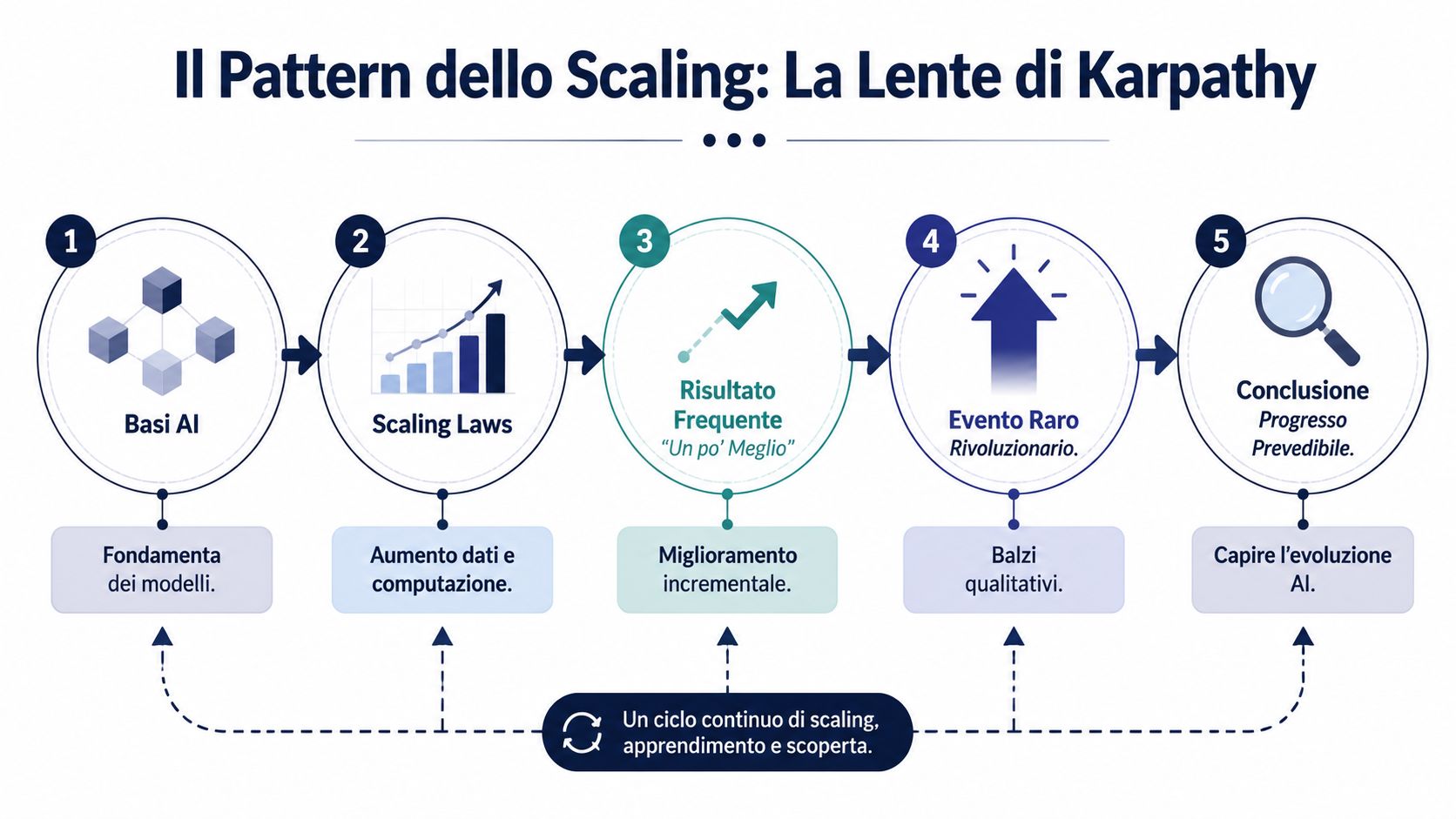
The most useful takeaway from GPT-5.6 stems from an uncomfortable truth: in the later stages of scaling, the progress perceived by users grows faster than its sheer spectacular nature. Andrej Karpathy summed this up well by noting that new models do not necessarily advance through a single, sensational capability. They improve across many areas simultaneously, each by a small amount, but with significant cumulative effects.
"Everything is a little bit better, and that's awesome—but not exactly in ways that are easy to pinpoint."
For a business audience, this statement carries more weight than many demos. It explains why a team adopts a new model and considers it superior almost immediately, even though they struggle to demonstrate a clear “before and after” difference for a single task. The system better interprets tone, makes fewer mistakes in intermediate steps, handles long conversations more consistently, and produces text that requires less manual editing. No single feature, taken on its own, redefines the product. Taken together, however, they change actual productivity.
This is typical of a technology that is entering a phase of maturity.
The official guidelines mentioned earlier should be viewed through this lens. Greater efficiency per token, better performance on long tasks, delegation to submodels, and deeper integration with documents and spreadsheets are not merely cosmetic details. They are signs of distributed optimization. In other words, the model reduces friction throughout the entire interaction chain.
For a business, the point isn't to ask whether there is a "wow" feature. The point is to understand where the economic benefit lies. In practice, it is concentrated in four areas:
This is the point that many people underestimate. The progress of LLMs doesn't come solely from benchmarks, but from the friction that disappears in day-to-day work.
Karpathy also helps us draw a less obvious conclusion. If improvement comes from the sum of widespread optimizations, the competitive advantage of any single model tends to diminish more quickly than marketing would suggest. This gives rise to the dynamic I analyze in "B Plus Trap AI Creative Spectrum": when multiple models reach a generally high level of quality, the economic difference shifts from “pure” intelligence to the ability to effectively integrate it into workflows, data, permissions, and operational metrics.
That is why GPT-5.6 must be interpreted with caution. It represents real progress. But its strategic significance lies not only in the model itself. It lies in the fact that it confirms a broader trend: the marginal returns from scaling remain significant, while the value that can be captured is shifting increasingly toward platforms that can apply a good model to specific problems, with consistency and control.
The least intuitive aspect of LLM progress is this: the more the models improve, the less the competitive advantage lies in the model itself.
This is the paradox of technological maturation. In the early stages, every major leap forward changes the playing field. In later stages, models converge toward a high but similar standard. Karpathy has long observed that scaling produces widespread, often incremental improvements across many aspects of the experience. The economic result is clear. If more models reach a consistently good level of quality, the choice of the “best” one becomes less important than the ability to apply it effectively.
GPT-5.6 makes this trend visible in the pricing list. The balanced version of the new generation costs about half as much as the flagship model from a few months ago, while offering the same perceived performance for most tasks. This is commoditization—it’s no longer just a prediction; it’s now a reality reflected in the price.
This is what I call the “B+ Trap” in my work . Not because the models are mediocre. On the contrary, they’re strong enough to handle many useful tasks. The problem, for technology buyers, is that beyond a certain threshold, the perceived difference narrows more quickly than the promised difference.
GPT-5.6 fits well within this framework. The official improvements point to a more mature, more efficient, and more user-friendly product. They do not, at least for most companies, represent a paradigm shift significant enough to single-handedly rewrite the business case.
Since the average output of many models is already "good enough," the competitive edge is shifting.
It shifts toward what benchmarks measure only to a limited extent and income statements measure extensively:
This is the point that many managers fail to recognize until it’s too late. If GPT-5.6 produces responses that are slightly cleaner, more consistent, or more cost-effective, there is a benefit. But that benefit is truly realized only by those who have already built stable prompts, validation rules, access to the right data, and an interface that minimizes human error. Without this infrastructure, even a better model mainly generates better output that still needs to be corrected manually.
When all models become effective, the winner is whoever builds the most useful system around a good model.
This conclusion has a practical consequence that is often counterintuitive. Switching providers with every release rarely yields a structural advantage. It only makes sense if the new model significantly improves a critical task, with a measurable impact on time, quality, or risk. In most cases, the most defensible advantage comes from the application platform—not from the newest model, but from the way a good model is integrated into processes, data, permissions, and operational metrics.
There is another aspect that many companies underestimate. Product releases aren't just technical events. They are also strategic moves to gain a competitive edge.
When a vendor picks up the pace of its announcements, it’s signaling at least two things. The first is that the pipeline of improvements has become continuous. The second is that it wants to shape the market narrative. In other words, it wants to be perceived as the industry leader that sets the pace.
GPT-5.6, however, adds a third, new dimension. The public release took place in two phases: first, a limited preview for selected partners at the request of the U.S. government, followed by general availability after evaluations conducted with federal agencies. This is the first time a release of this magnitude has gone through such a process, and both the vendor and the administration have been careful to point out that this is not a permanent requirement. But the precedent has been set. Releases of state-of-the-art models are increasingly becoming regulatory and geopolitical events, not just technical and marketing ones.
For buyers, this has a concrete consequence: strategic dependence on the vendor is no longer just a matter of pricing and technical lock-in. It also includes the risk that access to a model could be delayed, restricted, or modified for reasons that have nothing to do with your contract. This is yet another reason to adopt architectures that allow you to replace or combine models without rewriting workflows.
For a manager, this reading changes the lens through which they interpret the news. Instead of immediately asking, “Should we adopt this?”, it’s better to start with other questions:
This approach is more detached, but also more useful. It helps you avoid two costly mistakes. The first is chasing every release as if it were mandatory. The second is ignoring competitive signals, thinking they’re just marketing.
Management Perspective: A rapid release can be a genuine technical step forward and, at the same time, a defensive or offensive move in the market. The two are not mutually exclusive.
Companies that manage AI effectively don’t just follow vendors’ schedules. They assess the impact on their workflows, compliance, operating costs, and strategic dependence. It’s a more tedious process than social media benchmarking, but it leads to better decisions.
The relevant question for an SME is not whether GPT-5.6 is better than the previous generation. It is. The question that matters is a different one: in which processes does this improvement actually change cost, risk, or execution speed?
This is where the “B+ Trap” comes into play. While many models are now good enough for general tasks, competitive advantage doesn’t come from upgrading to the latest version every month. It comes from knowing how to integrate a good model into a controlled workflow, with accurate data, validations, permissions, and tools the team is already using.
GPT-5.6 is worth paying attention to if the AI isn't just writing text, but is participating in an operational process.
Three signs can help you understand this:
This point is often underestimated. A slightly better chatbot is less valuable than a reasonably good one that updates a spreadsheet, compiles a sales proposal with the correct data, or assists an agent without forcing them to copy and paste between five different systems.
If you currently use AI for emails, meeting summaries, first drafts, and general support, GPT-5.6 alone is unlikely to justify a change in your tech stack, provider, or process. In these cases, the model market is becoming more like a market for intelligent commodities. The difference still exists, but it’s narrowing. And the very fact that the new lineup includes a stated budget tier confirms this.
That's why it's important to be disciplined.
Map out the use cases that drive real KPIs. Separate the tasks that impact timelines, margins, quality, or conversion from those that merely produce more appealing outputs.
Design the control mechanism, not just the prompt. A good, stable result requires templates, rules, authorized data, logging, and human review at critical points.
Measure the entire process. Track the total time required to achieve a reliable result. If the bottleneck lies in dirty data, approvals, or integration with internal systems, changing the model won't help much.
Reduce your reliance on the vendor of the moment. Karpathy has long observed that value is shifting toward the product layer. And the two-phase release of GPT-5.6 has shown that access to state-of-the-art models can also depend on regulatory factors. For an SME, this means choosing an architecture that allows you to replace or combine models without rewriting every workflow.
Decide based on the platform. The real choice isn't just "GPT-5.6, yes or no," nor is it "Sol, Terra, or Luna." It's which system best applies an already very good model to your specific context.
Anyone considering whether to build a solution in-house or adopt a ready-made one should start here: not with the model, but with the system that governs it.

.svg)


.svg)
.svg)