
You’re already facing the problem that High Performance Computing solves—even if you might not call it that. You have a forecast that takes too long to run. A report arrives when the context has already changed. A promising demand, risk, or pricing model comes to a standstill—not because of a lack of data, but because the computation time makes it of little use to the business.
For many SMEs, the challenge is no longer gathering information. The challenge is turning that information into timely decisions. This is whereHigh Performance Computing stops being a lab-based topic and becomes a managerial issue: how many simulations can you run, how quickly can you update a forecast, and how many alternatives can you compare before the market forces you to make a choice?
In Italy, this issue also has national strategic significance. CINECA’s Leonardo supercomputer, inaugurated in Bologna in 2022 as part of the EuroHPC initiative, was presented at the time of its installation as one of the most powerful systems in the world, underscoring that HPC is now a key driver for industry and applied research, not just for academia (background on the HPC market and Leonardo).
Monday morning. The sales director is asking for a new forecast by this afternoon, the supply chain team wants to review inventory levels before confirming orders, and the finance team is demanding both a conservative and an aggressive scenario for the meeting the next day. We have the data. The problem is the time it takes to analyze it properly.
That is exactly what high-performance computing is for: performing many complex calculations at the same time, so that useful answers are available when they’re needed. For an SME, the point isn’t to own a supercomputer. The point is to prevent slow analyses from delaying decisions that have a direct impact on margins, service, and inventory.
A traditional system performs the work in a more linear fashion. HPC distributes the workload across multiple coordinated resources, much like a well-organized team working toward a tight deadline. The result is not just speed. It is the ability to test more hypotheses, update forecasts more frequently, and make more precise decisions.
At ELECTE, we see this in very concrete contexts. A forecast that’s recalculated more quickly helps reduce stockouts and overstock. A faster optimization engine allows you to compare different scenarios before allocating budgets, inventory, or operational capacity. In practice, the calculation becomes a management tool, not just an IT issue.
HPC comes into play when the cost of being late with an analysis exceeds the cost of running it in parallel.
A common misconception among managers is to associate HPC solely with enormous volumes of data. In business decision-making, the limit is often reached sooner—when the complexity of the problem to be solved increases.
This happens, for example, when a dataset that is, all things considered, manageable needs to power calculations that are much more resource-intensive than simple reporting. Some typical examples are as follows:
Here, the right question isn't "How much data do I have?" It's "How much does it cost to make decisions based on a simplified model or on results that come too late?"
From a technical standpoint, HPC combines many computing resources to handle computations that a single machine would process more slowly or with greater limitations. From an SME’s perspective, the benefits are simpler: forecasts available sooner, more frequent simulations, better-calibrated inventory plans, and shorter wait times between a business request and a reliable response.
And this is where the perspective shifts from the more academic content on the subject. For a small or medium-sized business, HPC doesn’t mean entering the world of research centers. It means using scalable computing power to solve complex business problems, without having to build a team of engineers or an infrastructure that’s difficult to manage from scratch. It’s the kind of approach that platforms like ELECTE make feasible even outside of large enterprises.
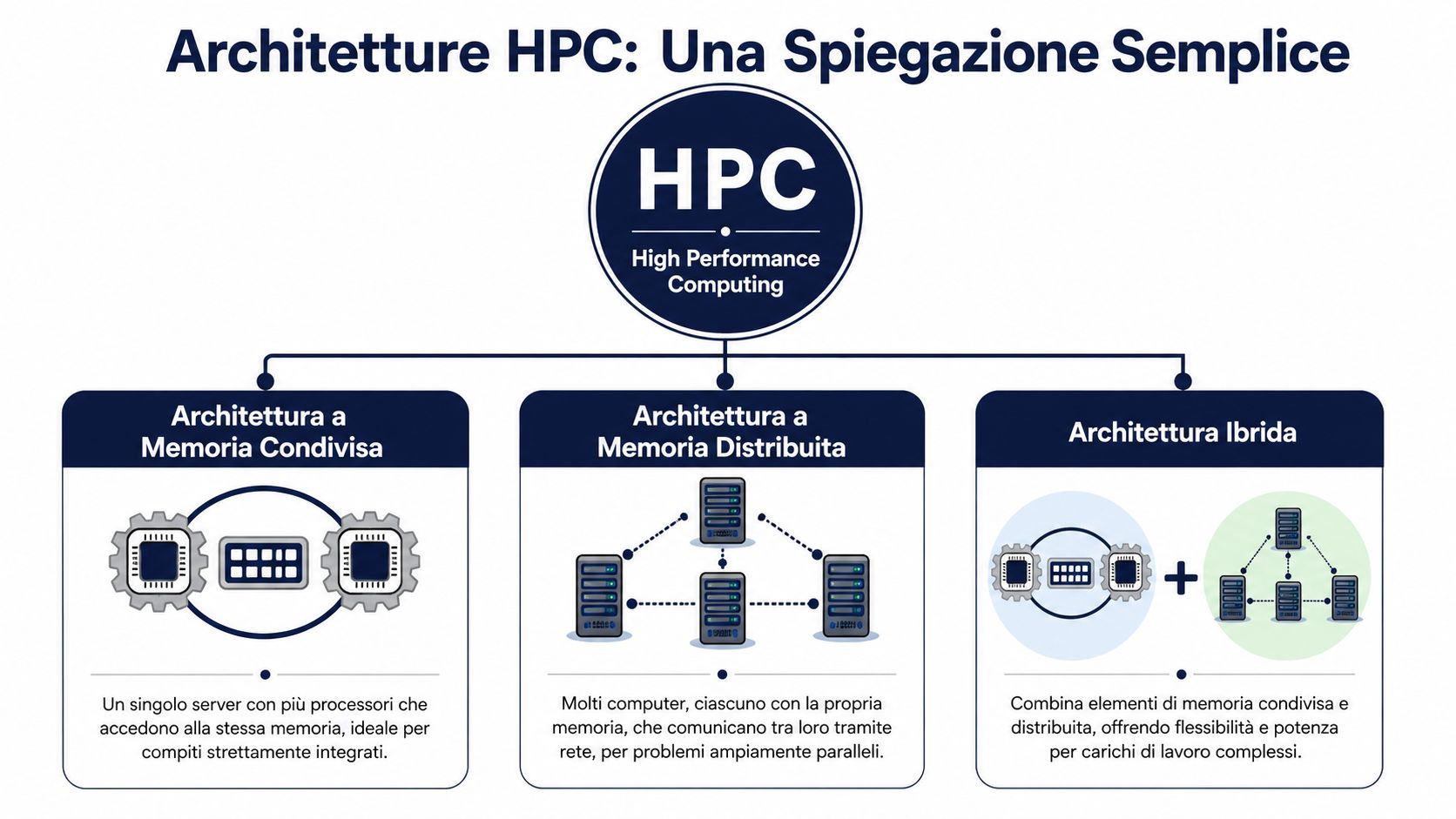
HPC works because of several components that work together. The three terms that really matter are cluster, GPU, and cloud.
A cluster brings together multiple machines, called nodes, to perform the same task in parallel. In practice, a task that is too demanding for a single server is broken down into smaller parts and assigned to multiple nodes that coordinate with one another. For a manager, the issue is not technical but operational: less waiting time between requesting an analysis and making a decision on inventory, pricing, or forecasting.
In ELECTE, this principle is useful, for example, when a company needs to recalculate forecasts for many combinations of product, store, and time period. If the work remains on a single machine, processing times increase, and the team tends to run fewer simulations. If the workload is distributed, it becomes feasible to compare multiple scenarios within the same decision-making cycle.
GPUs are used for a different type of acceleration. They are very effective when the same type of calculation needs to be repeated a very large number of times, as is the case in machine learning, certain optimization tasks, and some advanced analytics. The business benefit is clear: training or testing models more quickly, updating forecasts sooner, and reducing the time between a hypothesis and its verification.
Cloud HPC adds elasticity to computing capacity. Instead of purchasing resources designed to handle the year’s peak demand, a company can activate them only when they’re actually needed. For an SME, this is often the difference between having to forego a complex analysis and being able to perform it at the right time, without having to build an in-house infrastructure that’s difficult to maintain. If you want to understand how these delivery models fit into the bigger picture, this in-depth look at IaaS, PaaS, and SaaS in the cloud may be helpful.
In business practice, the best choice rarely comes down to a single architecture. What matters most is combining resources effectively.
An on-premises environment offers direct control, predictability, and, in some cases, more manageable latency. The cloud adds on-demand capacity. GPUs accelerate workloads suited for massive parallelism. Clusters distribute the workload across multiple nodes. A hybrid architecture arises precisely from this mix, tailored to the type of analysis, the frequency of peaks, and governance constraints.
For an SME, the right approach is simple. If you have stable, recurring processes that are sensitive to response times, an on-premises solution may make sense. If, on the other hand, workloads spike at certain times—such as at the end of a reporting period, during re-forecasting, or for special simulations—the cloud allows you to scale up capacity without tying up budget all year round.
There is also one point that often causes confusion. Scaling doesn’t just mean adding cores or servers. In a real-world workload, the network, memory, and storage also matter, because the nodes must exchange data quickly and efficiently. Technical explanations of HPC data centers clearly illustrate this principle, especially in the relationship between nodes, interconnects, and memory (in-depth look at nodes, interconnects, and memory in HPC data centers).
In business terms, the right architecture is one that reduces the bottlenecks that slow down the business. You don’t need a lab-grade supercomputer. What you need is a scalable configuration that enables more frequent analyses, timelier forecasts, and operational decisions based on better data. This is where platforms like ELECTE make HPC a reality even for companies that don’t have an in-house team of specialized engineers.
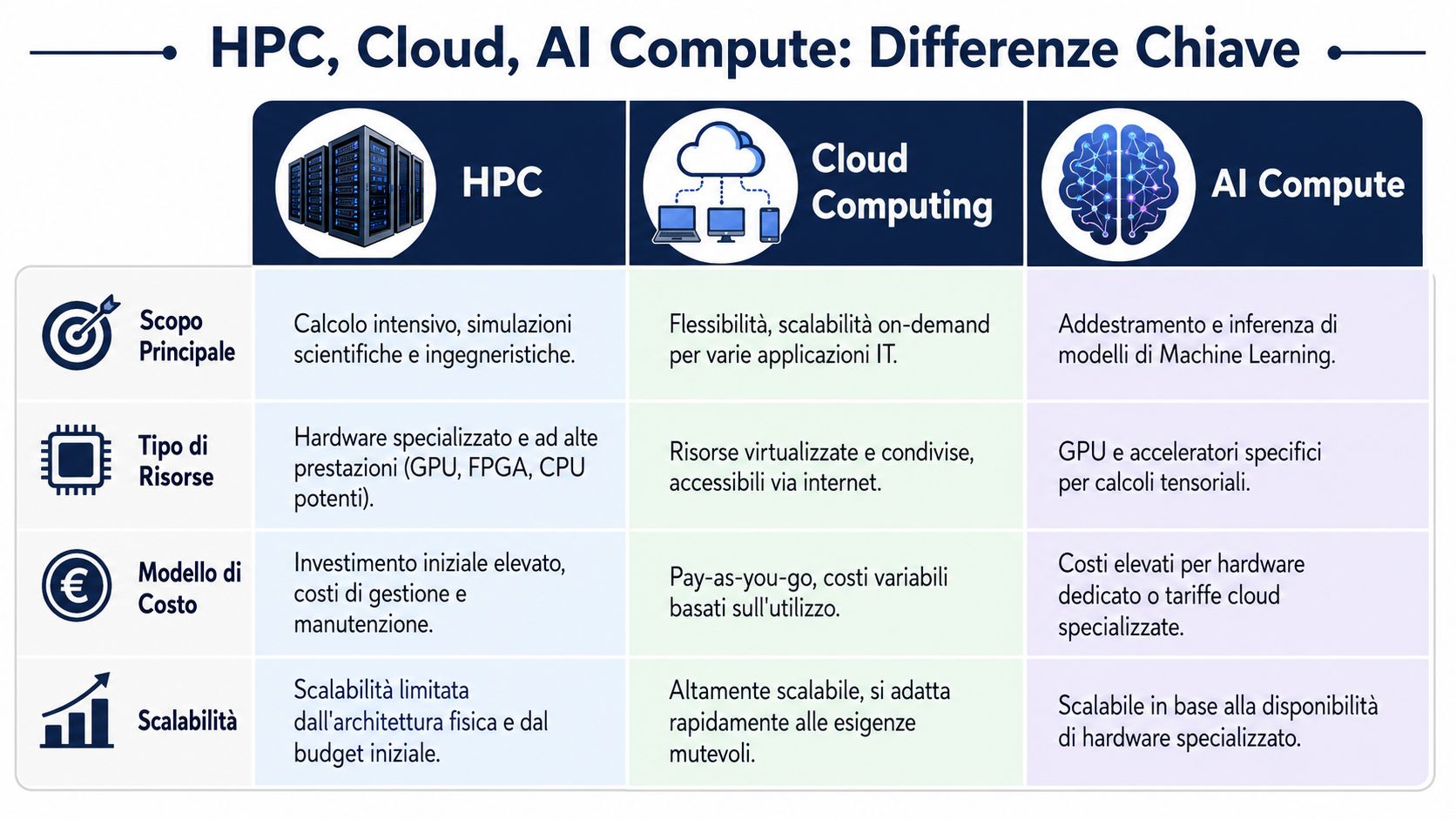
These three terms are often confused, but they refer to different levels of the same reality.
A simple phrase helps distinguish them. HPC is the engine. The cloud is the way you access it. AI compute is the kind of task you're performing.
| Appearance | HPC | Cloud Computing | AI Compute |
|---|---|---|---|
| A question that is answered by | How can I speed up computationally intensive calculations? | Where can I find flexible resources? | What kind of processing am I performing? |
| Typical Use | Simulations, complex forecasting, optimization | Elastic environments, rapid provisioning, burst capacity | Training and Inference of ML Models |
| Managerial Advantage | Reduces processing time | Avoid making fixed investments based on sporadic spikes | Unlock AI Use Cases |
| Relationships with Others | It can run on-premises or in the cloud | It can support HPC and AI workloads | It often uses HPC infrastructure |
If you're considering broader digital services, it may also help to clarify the difference between infrastructure and application models—such as IaaS, PaaS, and SaaS—in cloud architectures.
The cloud doesn't automatically mean HPC. And AI doesn't automatically mean a well-designed architecture.
A cloud-based HPC cluster is therefore possible. Running an AI workload on HPC infrastructure is standard practice. A general-purpose cloud environment, on the other hand, is not necessarily suitable for tasks that require high-level parallelization, schedulers, accelerators, and consistent throughput.
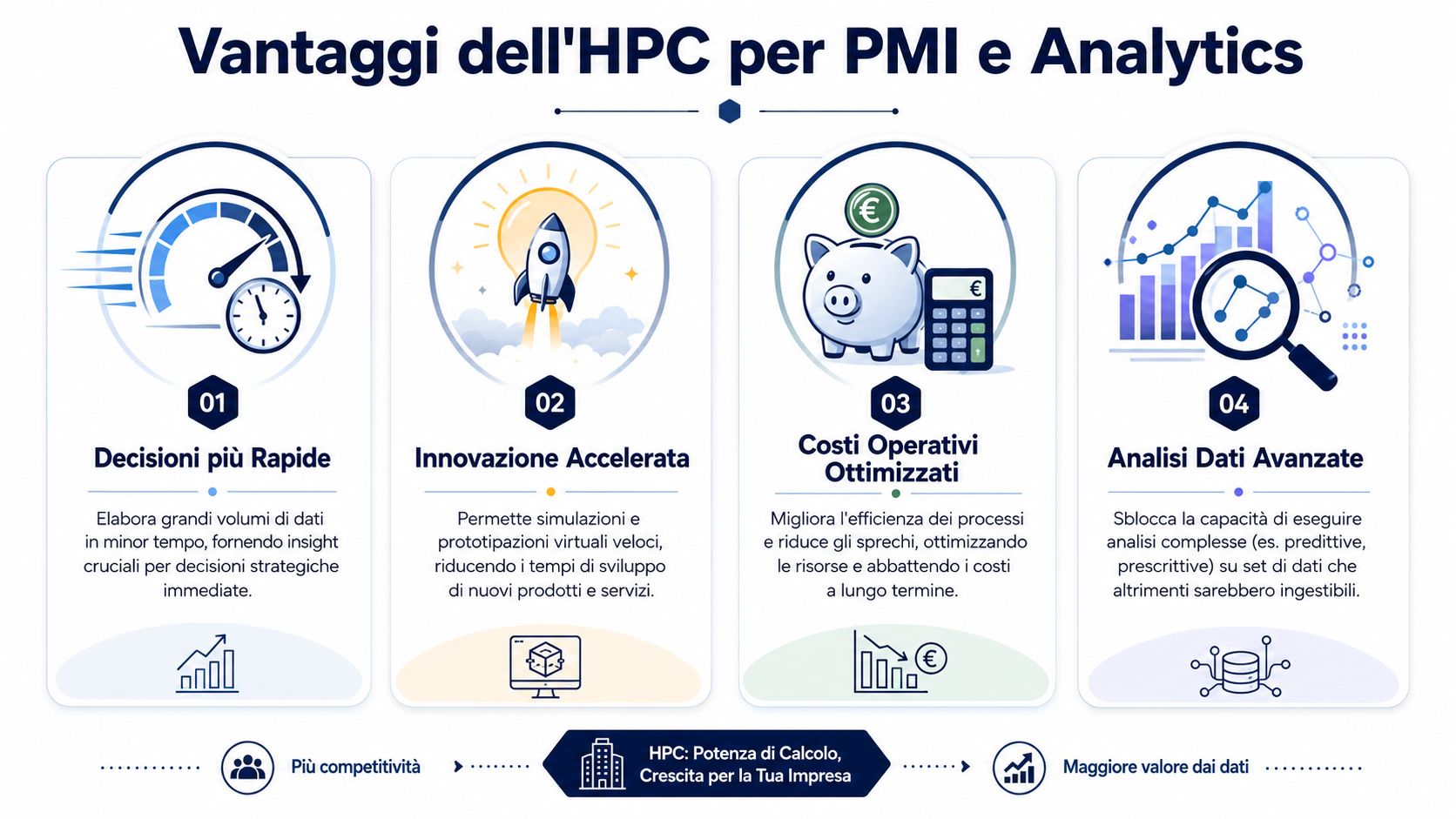
One of the clearest ways to understand the value of HPC is to observe what happens when processing times are no longer acceptable to the business.
In a retail project managed by ELECTE, a client with 42 retail locations needed to recalculate weekly demand forecasts for 8,600 SKUs, taking into account seasonality, promotions, calendar effects, and product cannibalization. The previous process, based on sequential Python scripts running on a single server, took approximately 50 hours to complete a full cycle. After migrating to a distributed architecture with parallelization by product cluster, the time was reduced to 4 hours.
The most important benefit wasn't just speed. It was organizational. The team could run the model much more frequently, rather than working with forecasts that were already outdated by the time they reached the category managers.
This leads to very concrete decisions:
In the energy sector, ELECTE handled a case where the bottleneck was not “big data” in the traditional sense. The dataset included 14 million hourly consumption records spanning 36 months, cross-referenced with weather, tariff, and production capacity variables. The forecasting model required the simultaneous optimization of over 200 combinations of hyperparameters across five algorithms.
On a single machine with 32 GB of RAM, the process would hang after 18 hours without completing the grid search. By distributing the load across a cluster with 128 vCPUs and 512 GB of aggregate RAM, the entire pipeline completed in less than 3 hours.
This clearly illustrates the point: the value of HPC does not stem solely from data volume. It stems from the combinatorial complexity of the problem.
For those who run an SME, these examples are more valuable than a technical definition. They show that HPC improves business by shortening the time between a request and a decision.
There is also the issue of market maturity. In Italy, in 2024, only 5.7% of companies with at least 10 employees reported using AI, compared to an EU average of 13.5% (data on AI adoption in Italian companies). This gap is a problem, but it is also an opportunity for those who can bring analytics and AI into production more quickly.
To understand why data volume alone is not enough to explain these scenarios, it is helpful to clearly distinguish between cases where distributed analytics is truly needed and standard BI workloads. A good starting point is this in-depth article on big data analytics and analytical complexity.

The real obstacle to HPC adoption in SMEs isn't understanding that it's needed. It's managing it without turning every analytical project into an infrastructure project.
This is where ELECTE’s approach comes into play. The platform separates the user experience from the technical complexity. Users of the system see data, models, reports, and insights. They don’t have to decide where to schedule a job, how to distribute a dataframe, or which node has enough free memory.
This changes the economic viability of HPC. Not because computing magically becomes free, but because the operational cost of complexity decreases. In practice, managers get the computing power they need when they need it without having to set up a dedicated engineering department.
Behind the scenes, ELECTE uses a stack designed to scale without having to rewrite the logic as data volume or complexity increases:
For forecasting, ELECTE's proprietary models run on an orchestration layer that automatically determines whether to execute them locally or distribute the workload across the cluster, based on the size of the input and the complexity of the pipeline.
Practical tip: The best approach is not to tie yourself to a single framework. Instead, build a replaceable architecture so that the platform can evolve without having to rewrite the business logic.
This approach has a very tangible impact for an SME. The team isn’t buying “power” in the abstract. It’s buying analytical continuity. If the use case grows, the infrastructure grows. If the workload decreases, the team isn’t left with an oversized machine that drains the budget and demands attention.
The right question isn't "How much does HPC cost?" The right question is "What configuration do my actual workloads really need?"
ELECTE’s experience has revealed a very practical rule: do not size your system for a permanent peak. Most SMEs have intermittent workloads. Forecasts, quarterly closings, ad hoc recalculations, and simulations do not require the same level of intensity every day.
For a typical customer with a dataset ranging from 5 to 50 million records, infrastructure costs can range from 400 to 1,200 euros per month, with a base cluster covering most needs and additional on-demand capacity for peak periods. The most common mistake is the opposite: purchasing capacity “just in case” and ending up with a large portion of the infrastructure sitting idle for most of the year.
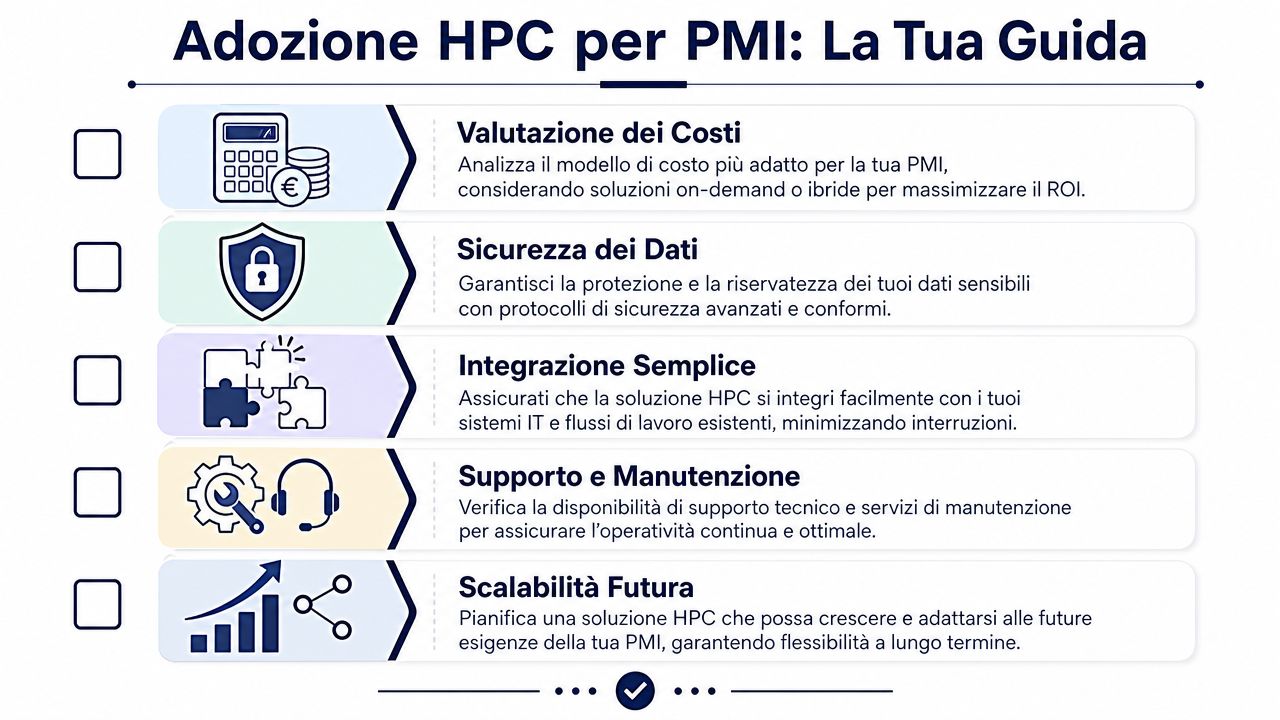
A helpful checklist to aid in your decision:
Security cannot be an afterthought. In 2024, the National Cybersecurity Agency reported a 40% increase in cyber events and a 45% increase in confirmed incidents compared to 2023 (ACN data cited in the reference provided). This alone makes one thing clear: a high-performance computing platform must be secure from the very beginning of its design.
For controlled or sensitive environments, it is advisable to check at least the following aspects:
| Area | Management Question |
|---|---|
| Segmentation | Are critical workloads separated from the rest of the infrastructure? |
| Data Residency | Do you know where the data is stored and where it is processed? |
| Audit | Can you figure out who did what and when? |
| Scalability | Does the increased load maintain the same controls? |
Integration is just as important as security. If HPC remains isolated, it ends up being underutilized. If it becomes part of the corporate data flow, it becomes a continuous driver of value. To understand how to connect advanced analytics with existing systems, it may help to evaluate the data and application integration options in ELECTE.
High-Performance Computing is no longer a concept far removed from the reality of small and medium-sized businesses. It is a concrete solution to a very common problem: you have data, you have models, you have important questions, but you don’t have enough time to turn them into useful decisions.
The key point to remember is simple. HPC becomes valuable as analytical complexity increases. There’s no need to chase the idea of a supercomputer. What’s important is understanding where parallel computing can shorten the cycle between insight and action.
If you're thinking about your next steps, start here:
As forecasting, optimization, and AI become faster, the way the company operates changes as well. Decisions no longer wait for reports. Reports begin to keep pace with the business.
If you want to turn complex data into clear insights without having to manage the underlying infrastructure, check out ELECTE, the AI-powered data analytics platform for SMEs. See how you can automate reporting, forecasting, and advanced analytics with an experience designed for business teams—not just technical specialists.

.svg)


.svg)
.svg)