
Total automation is an enticing prospect. But when it comes to serious business decisions—those involving risk, margins, compliance, and customers—AI alone is often not enough. In the Italian IT landscape, the adoption of Human-in-the-Loop (HITL ) processes is accelerating: in tech companies with fewer than 250 employees, the use of HITL AI for data analysis has grown by 40% in six months, rising from 6.3% to 8.8% through September 2025, according to data reported by Software Oasis. This is not a technical detail. It is a strategic signal.
The reason is simple. AI excels at handling volume, speed, and repetition. People excel when context, judgment, and accountability are required. If you separate these two worlds, you end up with either slowness or errors. If you combine them effectively, you transform analytics into a more robust decision-making system.
That is why human-in-the-loop AI analytics is becoming an operational model, not just a technological category. For many Italian SMEs, it is also the most realistic way to adopt AI without having to build a team of data scientists from scratch. And it explains why prompt engineering alone is of little use when the real challenge is not generating a response, but making a reliable decision.
A fully automated system works well as long as the world behaves as expected. The problem is that business, customers, supply chains, and fraud never follow a neat script. All it takes is an anomaly, a regulatory change, or an ambiguous signal, and an output that is statistically correct can turn into a poor business decision.
This is where the logic behind HITL comes into play. It doesn’t add a human reviewer “downstream” out of bureaucratic caution. Instead, it redesigns the process so that the AI works where it’s strongest and only calls for human intervention where it really matters.
The goal isn't to slow down automation. It's to prevent automation from making mistakes in the decisions that cost the most.
For an experienced business leader, this shifts the question. It’s no longer “How much can I automate?” but “Which part of the decision must remain contextual, explainable, and controllable?” That’s where human-in-the-loop AI analytics becomes a competitive advantage, especially in finance and retail, where speed and judgment must go hand in hand.
For a company, HITL is not just an additional technical feature. It is an operational model for determining who does what—whether the system or people—along the analytical workflow.
In human-in-the-loop AI analytics, the AI examines large volumes of data, generates a classification, a prediction, or an alert, and then directs human intervention only to cases that require contextual judgment. This occurs, for example, when the signal is ambiguous, the economic stakes of the decision are high, or regulatory risk precludes an automated response without verification.
The relationship is similar to that between an airline pilot and the autopilot system. The machine handles the standardized and repeatable tasks effectively. The person oversees the critical junctures where experience, context, and responsibility matter.
In practice, the cycle works like this:
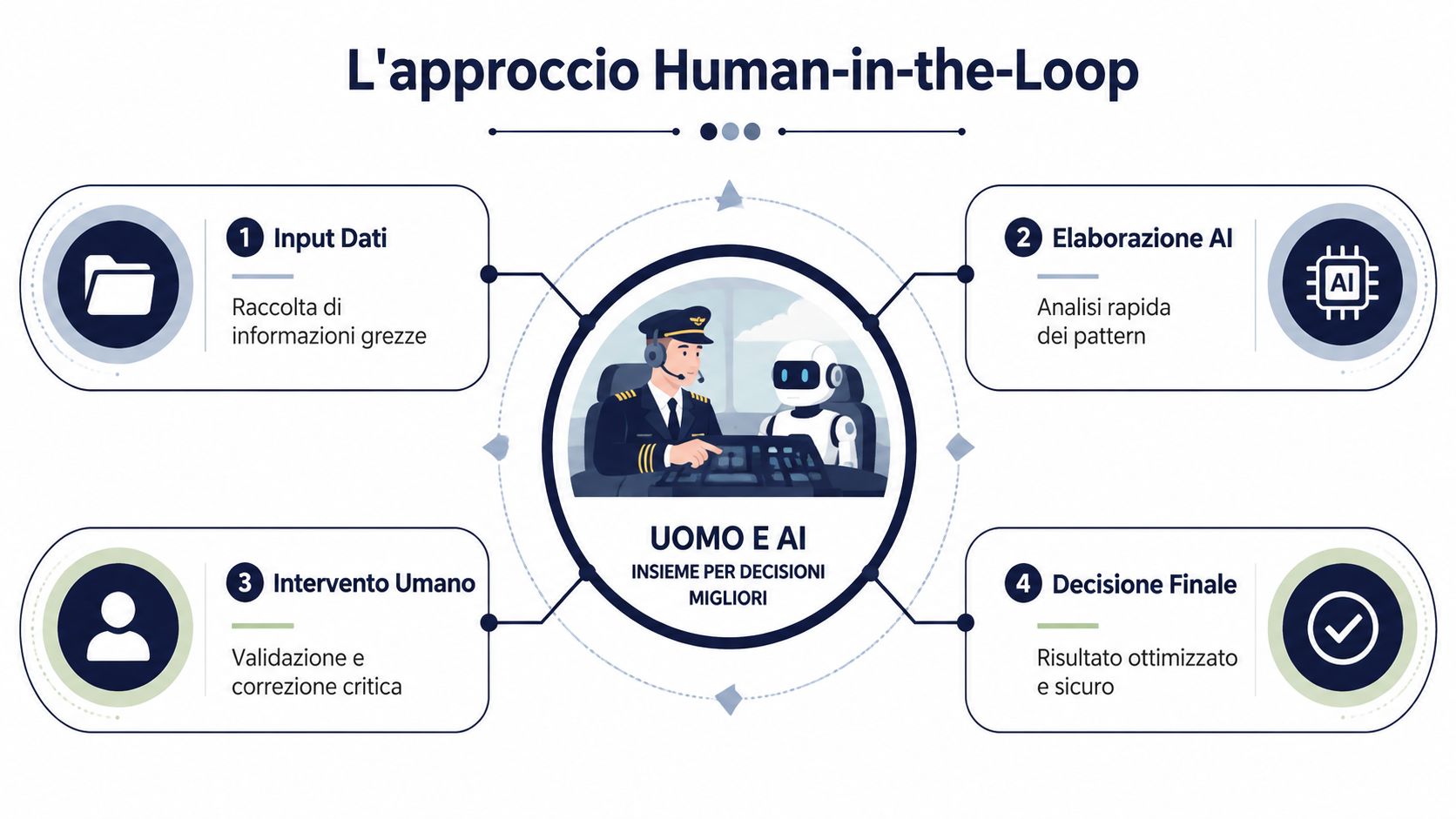
This is where the difference between theory and ROI comes into play. A good HITL system doesn’t send everything to manual review. If it did, it would lose the economies of scale that automation provides. If, on the other hand, it always left the decision to the model, it would expose the company to the most costly errors. Value comes from intelligently selecting the points at which human intervention truly changes the financial outcome or the risk profile.
For an Italian SME, this aspect matters more than the sophistication of the algorithm. In finance, it means having an analyst review only those cases with anomalous profiles or inconsistent documentation. In retail, it means forwarding to the category manager or e-commerce manager only those alerts regarding pricing, inventory, or churn that the system cannot interpret with sufficient certainty. Platforms like ELECTE this approach feasible even without an in-house team of data scientists, because they transform operational feedback into a structured part of the process.
To avoid confusion, it is best to distinguish between three models.
| Model | How it works | Where it fits best |
|---|---|---|
| Human-in-the-loop | The person actively intervenes in the selected cases | High-stakes decisions, finance, critical retail |
| Human-in-the-loop | The person supervises and intervenes only when the situation escalates | Mature processes with high volumes |
| Human-out-of-the-loop | The system decides on its own | Repetitive, low-risk tasks |
The difference is architectural, not semantic. It determines response times, operating costs, the quality of decisions, and the level of control that management maintains over the process.
A useful rule of thumb is simple: HITL makes sense when the cost of a targeted review is lower than the potential cost of an automated error. This is why it is more readily adopted in processes where even a few errors can erode margins, create friction with customers, or lead to compliance issues.
In short, human-in-the-loop AI analytics doesn’t involve people just to be safe. It assigns people to the steps where their judgment yields the greatest economic value and provides the most managerial control.
For a business leader, the point isn’t to add human oversight out of an abundance of caution. The point is to deploy human judgment where automation loses its cost-effectiveness. HITL works when it reduces the cost of errors by more than it increases the cost of the process.

This changes how we should interpret the value of AI analytics. A pure model maximizes scale and speed. A human-in-the-loop model maximizes the balance between automation and decision-making quality in the steps that impact margins, risk, and internal trust. For many Italian SMEs, especially in finance and retail, this is a strategic difference. There is no need to pursue total automation. What is needed is to effectively automate high-volume workflows and have people intervene in cases that could lead to losses, disputes, or poor business decisions.
The value lies in the bottlenecks of the process, not in human oversight itself.
Three benefits stand out consistently:
The business outcome is clear: fewer decisions are automatically approved without verification in areas where errors are most costly.
A useful analogy is that of industrial quality control. No reputable company assigns an inspector to every single item if the defect is rare and inexpensive to fix. But no company would leave batches unchecked if a defect could lead to returns, fines, or reputational damage. HITL applies the same logic to data-driven decisions. It samples, filters, and escalates only where the risk warrants it.
That’s why this approach is also appealing to companies without a team of data scientists. Platforms like ELECTE operational complexity by transforming feedback from those working on credit, pricing, inventory, or customers into a manageable step within the workflow, rather than a separate technical project.
The benefits aren't automatic. A poorly designed process remains a poorly designed process, even if it includes a human reviewer.
The most common risks are as follows:
A HITL project often fails for a very specific reason. The company integrates people into an automated process without redesigning the decision points, response times, and criteria for when a case is escalated for review.
There is also a fundamental managerial misconception. Some teams treat HITL as a temporary phase, useful only until the model is “good” enough to operate on its own. In high-impact processes, this assumption rarely holds true. In credit, anti-fraud, product assortment, or promotional pricing, selective supervision is not a residual cost to be eliminated. It is a stable component of the operating model because it protects the bottom line and makes decisions defensible.
The question, therefore, is not whether to eliminate supervision entirely. The question is where supervision generates the highest ROI and where it slows things down without adding value. Much of the return on investment depends on this distinction, especially for SMEs that need to adopt AI analytics with limited resources and short-term, measurable goals.
In finance, the value of HITL is most evident in cases that have the greatest impact on the income statement and regulatory compliance. Not in standard procedures—which automation handles well—but in highly ambiguous decisions where a mistake costs time, reputational capital, or triggers an audit.

The clearest example is anti-money laundering. The model analyzes large volumes of transactions, identifies anomalous patterns, and prioritizes cases. The analyst steps in only where judgment is required. In practice, the AI functions as a high-speed screening system, while the compliance officer handles exceptions that require context, experience, and the ability to justify a decision.
Let’s consider a corporate client whose transaction patterns deviate from their historical profile. An automated system might flag the case as suspicious because it detects a statistical deviation. An analyst, however, might attribute that deviation to a corporate restructuring, a seasonal business cycle, or information already stored in internal systems.
This is where the real ROI is generated.
If every anomaly is treated as a full-blown risk, the bank increases the number of false positives, slows down the monitoring teams, and takes time away from truly critical cases. If, on the other hand, the model filters out borderline cases and the operator validates them, the institution reduces the operational cost of the review without compromising the quality of oversight. For a financial SME or an organization with a small compliance team, this has a greater impact on the sustainability of the process than the model’s theoretical accuracy.
For those who want to see how this concept is applied in practice, this video provides a useful reference:
In the credit sector, the logic is similar, but the managerial benefits are even more evident. A scoring model can quickly process many structured variables. However, some profiles remain difficult to assess using standard rules—for example, freelancers, micro-enterprises, companies with significant seasonal fluctuations, or those with complex financial situations.
In these cases, HITL improves three operational outcomes:
For an experienced business leader, this is the key point. HITL doesn’t simply add a human signature at the end of the process. It redesigns the decision-making flow to focus expert attention only where automation is most likely to fail or where the regulatory impact is greatest.
From a regulatory standpoint, it is advisable to maintain a cautious approach. It is not appropriate to treat a specific Consob requirement regarding HITL in the context of AI analytics as a given without a direct and verifiable regulatory reference in the relevant provision. The direction, however, is clear: in compliance, control, and credit-granting activities, expectations regarding traceability, human oversight, and the justification of automated decisions are on the rise.
For Italian SMEs, this distinction matters a great deal. A well-designed HITL project does not necessarily require an in-house team of data scientists. It requires a platform that routes ambiguous cases, collects feedback, maintains audit trails, and simplifies the work of finance and risk teams. This is where tools like ELECTE the barrier to entry. They transform HITL from a theoretical framework into a measurable process, delivering tangible benefits in terms of audit times, decision quality, and compliance costs.
In retail, the most costly mistake does not stem from an inherently flawed forecast. It stems from a forecast that is accurate based on historical data but incorrect when applied to the actual context of the store, the local area, or the promotional week. This is why the human-in-the-loop approach has direct operational value. It incorporates business judgment in cases where the model, on its own, risks interpreting the past accurately but the present with a delay.
A retailer uses AI to forecast demand, reorders, and inventory allocation across channels and stores. The model recognizes seasonality, sell-out trends, the effects of past promotions, and turnover by SKU. The category manager, however, sees signals that rarely show up immediately in the datasets: social media content that drives demand, a local holiday, a supplier delay, or an aggressive campaign by a competitor in the same area.

The point isn’t to constantly adjust the model. The point is to intervene only when the cost of the error exceeds the cost of human review. In retail, this often happens with seasonal products, high-margin items, promotional launches, and local product assortments.
For an Italian SME, the benefits are tangible. Fewer stockouts on the products they actually sell. Less capital tied up in slow-moving items. Fewer forced discounts at the end of the sales cycle. In practice, HITL functions like a control tower: the AI manages day-to-day operations, while the sales manager handles exceptions that could impact margins and service.
The delay in adoption makes this approach all the more relevant. According to ISTAT, only a limited proportion of companies with at least 10 employees use artificial intelligence technologies, with significant differences by company size and sector, as reported in the official survey on ICT use in businesses: ISTAT, Businesses and ICT. For many SMEs, the problem is not understanding whether AI is useful. It is adopting it without building a dedicated technical team. A platform that brings the manager into the decision-making loop reduces this barrier.
The same principle applies to pricing and marketing, where pure automation can improve speed but also lead to short-sighted decisions.
This highlights a strategic point that is often overlooked. In retail, the goal is not to maximize every single forecast. It is to make repeatable decisions that protect margins, on-shelf availability, and brand consistency. HITL shifts human effort from repetitive tasks to high-impact exceptions.
For an e-commerce business or a local chain, this difference matters more than the sophistication of the model. A predictive system simply provides alerts. A human-in-the-loop system helps the team make decisions earlier, with more context and less operational friction. And this is precisely where solutions like ELECTE appealing to SMEs. They make feasible a process that, until just a few years ago, seemed reserved for retailers with in-house data scientists and enterprise-level budgets.
A HITL model is only useful if the operational workflow is understandable to decision-makers. If the review requires data scientists, manual queries, or complex technical steps, many SMEs give up before they even start.
On a well-designed platform, the process should look something like this:
Data Source Connections: CRM, ERP, e-commerce, operational spreadsheets, and financial systems are integrated into a single information flow.
's Automated Signal Analysis AI processes data and generates forecasts, alerts, reports, and anomaly detections.
Confidence and Priority Assignment Not all insights are equally valuable. Some are clear-cut, while others require further review.
Selective escalation to the user
Uncertain or high-impact cases are routed to a review dashboard.
Human feedback
The manager validates, corrects, or rejects the insight with the context visible.
's continuous learning The system uses that feedback to refine the model over time.
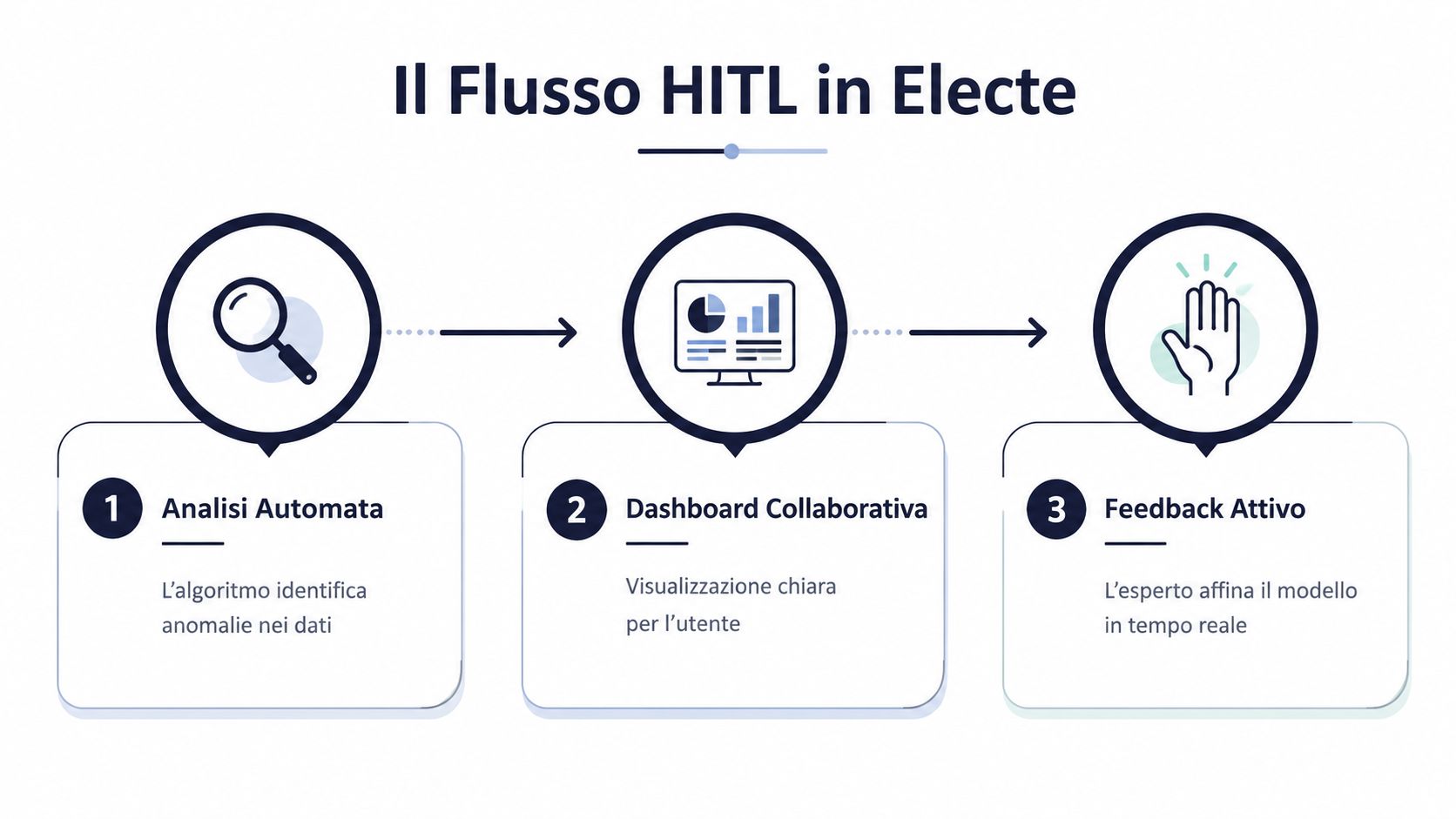
This approach is consistent with the active feedback loop architecture described in the peer-reviewed literature: the AI seeks human validation at points of greatest uncertainty, rather than requiring oversight of the entire dataset. It is this approach that makes HITL sustainable, not just theoretically sound.
For an SME, the real challenge isn’t “using AI.” It’s being able to use it without setting up a dedicated technical department. That’s why the interface matters just as much as the model.
An effective approach should provide:
If the auditor has to interpret a model without context, the loop breaks down. If they see insights, motivation, and impact all in the same space, the loop becomes a decision.
This is the key point. HITL shouldn’t require SMEs to adapt to the technology. Instead, the platform should translate analytical complexity into a process that a finance, operations, or retail manager can manage in just a few steps.
HITL projects create value when they reduce the cost of decision-making, not when they add another layer of oversight. For an Italian SME, the key is not to introduce human review at every step. It is to identify the specific points where human judgment can correct costly errors, expedite exceptions, and make the model more effective over time.
That is why the starting point matters more than the initial ambition. A good first use case combines three characteristics: visible economic impact, sufficient historical data, and a decision that already depends on a person’s experience today. Finance and retail often fit this profile. In commercial credit, for example, a targeted review of ambiguous cases can reduce assessment errors without slowing down the entire workflow. In retail, the same principle applies to reorders, promotional pricing, and stock anomaly management.
| Criterion | Why it matters |
|---|---|
| Economic impact of the error | The company can measure the value of the correction |
| Availability of historical data | The model can be based on signals already present in the processes |
| Existence of pre-existing human judgment | Feedback shouldn't be made up. It should be structured. |
This is where ROI comes into play.
If the human team intervenes in every decision, the AI becomes merely an intermediate step. If it intervenes only in cases involving high uncertainty or high impact, the company achieves a very different outcome: less operational burden on simple cases and more focus on the cases that truly impact the bottom line. This is the logic mentioned earlier. By focusing feedback on the right areas, the organization makes better use of both people’s time and the model’s capabilities.
The second best practice concerns the design of the human intervention point. In many implementations, the problem isn’t the algorithm, but the ambiguity of the process. If it isn’t clear who approves, based on what thresholds, and based on what information, the loop doesn’t learn. It simply shifts friction from one step to the next.
Before going live, it is advisable to define four operational elements:
A rule of thumb can help you determine whether the project is ready: if the reviewer doesn't know why that case was assigned to them, the implementation isn't ready yet.
There is also a common mistake made by SMEs. It is often thought that management needs to be trained in the mathematics of the model. In reality, something else is needed: the ability to spot an anomaly, assess the plausibility of the insight, and provide coherent feedback. This is an important distinction. A category manager does not need to train the algorithm. They must recognize whether a reordering proposal overlooks a local promotion, a supplier change, or a stockout already known to the team.
Platforms like ELECTE this approach more accessible precisely because they hide the technical complexity behind a user-friendly interface. For many SMEs, this is where the strategic advantage lies: they don’t need to build a team of data scientists to make effective use of AI analytics, but can instead empower finance and retail teams to refine, validate, and improve the system as part of their daily workflow.
The quality of implementation is measured by a few concrete metrics: time spent reviewing exceptions, the rate at which recommendations are accepted, the reduction in recurring errors, and the economic impact of corrections. If these numbers do not improve, the project is merely automating outputs. It is not yet improving decision-making.
Effective human-in-the-loop AI analytics relies on a few well-placed and traceable human interventions. This is how human-machine collaboration moves beyond a technical promise and becomes an operational discipline with measurable returns.
When AI is involved in a process that affects credit, pricing, fraud, or compliance, the key question changes. It’s not just about whether the model produces an accurate prediction. What matters is whether the company can trace how that prediction became a decision, who approved it, and based on what criteria.
Here, governance is not an administrative layer added as an afterthought. It functions like the quality control system on a production line: if the checkpoints are well-defined, the company can reduce costly errors before they reach the customer, the auditor, or the regulator. In hybrid AI, this is also where the value of human intervention lies: making a process observable that, in pure automation, risks remaining opaque.
The first issue is bias. In the financial sector, as mentioned earlier, the problem stems not only from historical data but also from how the model translates that data into trading signals. A well-designed human-in-the-loop mechanism helps identify anomalies that the system considers normal because it has learned them from past data.
Human involvement, however, does not by definition solve the problem. It merely shifts it to another level if there is a lack of operational discipline. A reviewer may improve a decision, but may also mechanically endorse the model’s recommendations or introduce subjective preferences that are difficult to detect.
For this reason, SMEs seeking to achieve a real return on investment from HITL projects in finance and retail should treat these three elements as process components, not as mere audit formalities:
This distinction has a direct economic impact. If human feedback isn’t tracked and reusable, the company ends up paying twice. First for the technology. Then for a manual review that doesn’t lead to learning.
The second issue is accountability. When making a sensitive decision, simply saying that "the algorithm suggested it" is not enough for an auditor, a corporate client, or a risk management function. A transparent decision-making process is required: the inputs used, the threshold that triggered the escalation, human intervention, and the final decision.
From a GDPR perspective, this approach is helpful because it makes it easier to demonstrate data minimization, access control, and oversight of decisions involving sensitive information. It does not automatically guarantee compliance. However, it does address a common weakness in AI projects at SMEs: having a model that works technically but is difficult to justify in documentation.
This is where many initiatives come to a standstill. Not because of limitations in the algorithm, but because no one has defined who can correct a recommendation, under what circumstances, based on what evidence, and with what ultimate responsibility.
For a business leader, the test is simple: can this decision be explained coherently to an internal auditor, a client, or a regulatory authority? If the answer is uncertain, the risk is not merely theoretical. It is operational.
To implement these safeguards in a practical way, without creating unmanageable complexity for small teams, ELECTE guide ELECTE responsible AI and the ethical implementation of artificial intelligence is also helpful.
The most important lesson is this: human-in-the-loop AI analytics is not a stopgap measure while we wait for “more autonomous” AI. It is often the most mature approach for turning data analysis into reliable, explainable, and business-relevant decisions.
AI handles scaling, speed, and pattern recognition. People handle exceptions, accountability, and context. When these two levels work together, the company doesn’t just get more automation. It gets better decision-making.
If you want to turn raw data into more reliable decisions without increasing operational complexity, find out how ELECTE, an AI-powered data analytics platform for SMEs, can support a Human-in-the-Loop approach with a personalized demo.

.svg)


.svg)
.svg)