

Severance pay (TFR) is not simply a piggy bank where money sits idle. It is more like a growing asset that increases in value year after year to keep pace with inflation. This growth is driven by a specific mechanism: revaluation, a process basedon the ISTAT index for severance pay that every HR manager and CFO must master.
In this guide, we’ll show you how the revaluation calculation works, how to interpret ISTAT data, and, most importantly, how to turn this legal requirement into a strategic opportunity. You’ll learn not only how to calculate severance pay accurately, but also how to use the data to make accurate budget forecasts and make better decisions for your company.

For your company, managing salary adjustments effectively means having full control over personnel costs and planning your finances without any surprises. Even a minor miscalculation can throw your budget off balance and turn into an administrative nightmare.
On the other hand, for your employees, this mechanism is a fundamental safeguard. It ensures that their accrued severance pay isn’t eroded by rising living costs, keeping its purchasing power intact over time.
The driving force behind all of this is a very specific indicator,the ISTAT FOI index (the Consumer Price Index for Blue-Collar and White-Collar Workers), which tracks inflation trends. This is not a matter of choice, but a legal requirement set forth in black and white in Article 2120 of the Civil Code.
In short, revaluation acts as a small growth engine applied to the accrued severance pay. Each year, this capital grows thanks to a formula that combines a fixed rate with a percentage linked to inflation. It is a system designed to protect the real value of that sum.
Gaining a thorough understanding of this mechanism is the first step toward truly efficient and transparent HR management. We’ll examine the exact formula together, breaking it down into fixed and variable components, and use a numerical example to see how it applies in practice. You’ll discover howthe ISTAT index for severance pay affects the final result and how a data analytics platform like ELECTE can turn this legal requirement into an opportunity for analysis.
The revaluation of severance pay is not based on some incomprehensible formula, but on a two-pronged mechanism designed with a specific goal in mind: to ensure a reliable foundation for growth while, at the same time, protecting capital from inflation.
Think of it as a safety net. The first component is a solid, predictable foundation: a fixed rate of 1.5% per year. This rate isn’t paid out all at once, but is distributed month by month, with 0.125% credited every thirty days. It’s a guarantee of steady growth—a foundation you can rely on.
The second component, on the other hand, is the mechanism that adjusts to the real economy—a dynamic safeguard that responds to rising living costs. This is where the well-known ISTAT index for severance pay comes into play, which is none other than the FOI index (for blue-collar and white-collar workers’ households), the official measure of inflation in our country.
The law stipulates that 75% of the increase in this index—calculated based on its value in December of the previous year—must be applied to severance pay. In simple terms: if inflation rises, severance pay is adjusted to maintain its purchasing power.
Putting it all together, the formula that determines the final coefficient is as follows:
Revaluation Coefficient = (75% × [ISTAT Index % Change]) + 1.5%
This coefficient is then applied to the total severance pay that the employee had accrued as of December 31 of the previous year.
Essentially, the system combines a guaranteed minimum increase with an adjustment for inflation. This balance is designed to provide peace of mind to employees, whose severance pay is not eroded over time, and predictability to the company, which can plan its costs with greater certainty.
Let’s break it down. In January 2026, for example, ISTAT announced a monthly revaluation coefficient of 0.363025%. Where does this small number come from, given that it applies to all severance pay accrued through December 31, 2025?
It is the sum of two components: the fixed monthly rate of 0.125% and the variable rate, which for that specific month was 0.238025% (i.e., 75% of the change in the FOI index). If you want to dig deeper, you can always consult the official sources on the revaluation of severance pay.
Understanding this mechanism is the first step toward HR and financial management that leaves nothing to chance. The fixed portion provides a stable basis for calculation, while the variable portion—linkedto the ISTAT index for severance pay—ensures that the real value of the severance pay is protected. It is this balance that makes the system fair and sustainable for both employees and the company.
The theory is clear, but it’s the numbers that make the difference. To truly understand how severance pay revaluation works, nothing is more effective than a practical example. Let’s take the case of an employee, Mario, who has accumulated €25,000 in severance pay as of December 31 , 2025 . Let’s walk through, step by step, how this amount changes over the course of 2026.
The starting point is always the same: calculating the revaluation coefficient. Let’s remember: this rate is the result of a fixed component, guaranteed by law, and a variable component, which links severance pay to the performance of the real economy viathe ISTAT index.
For the purposes of this example, let’s assume that in 2026 the annual change in the ISTAT Consumer Price Index (the FOI) will be 2.0%.
The formula is simpler than it seems. You simply add two values together:
At this point, simply add the two components together: 1.5% (fixed portion) + 1.5% (variable portion) = 3.0%.
This 3.0% is the rate we will use to revalue the gross severance pay accumulated by Mario. The diagram below provides a visual summary of this process.
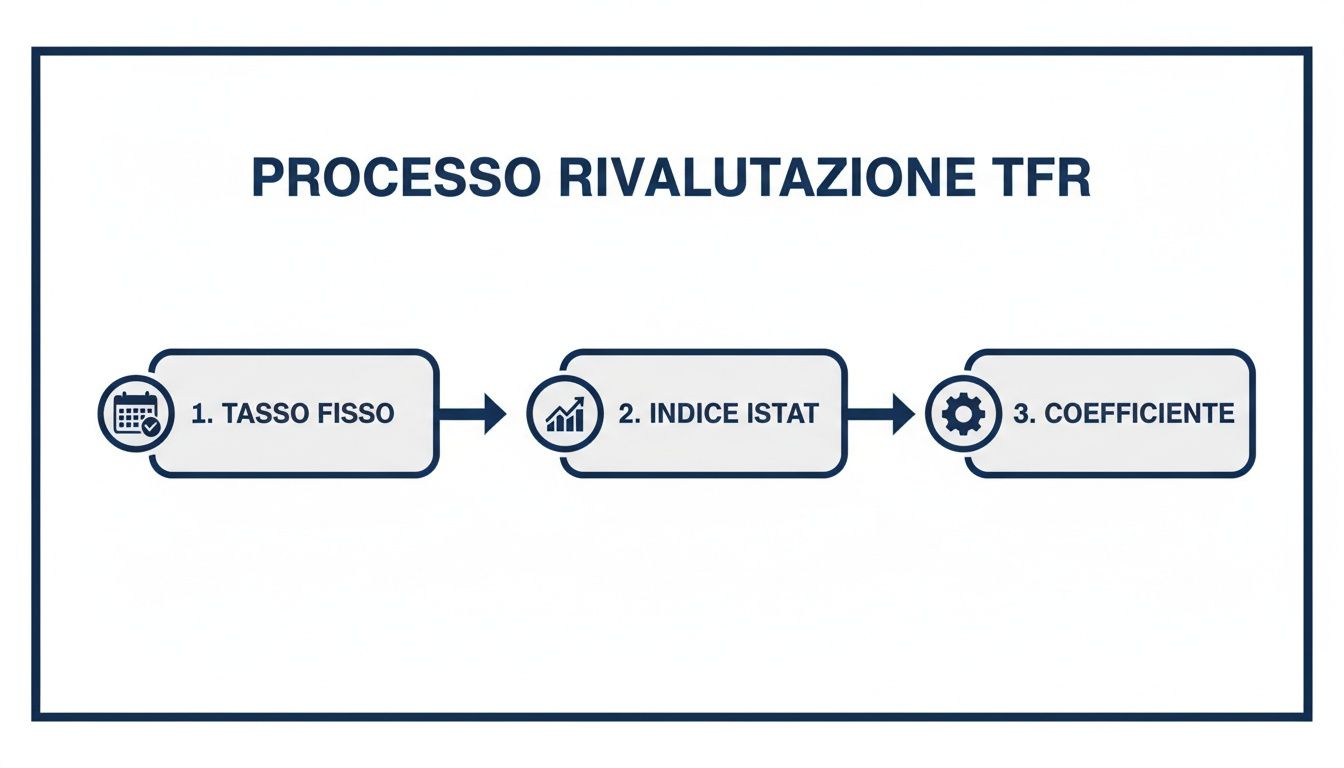
As you can see, the mechanism is straightforward: a fixed base rate is adjusted to reflect the cost of living (the ISTAT index) to arrive at the final coefficient.
Now that we have our coefficient, let’s apply it to Mario’s severance pay:
This is the theoretical increase. However, it is not the final amount that will be added to the employee’s capital. In fact, the government applies a substitute tax to this amount, a step that often causes some confusion.
The substitute tax on the revaluation of severance pay is 17%. The key point to remember is that this tax applies only to the amount of the revaluation (the €750 in our example), not to the entire accumulated severance pay.
Let's see how much tax is due:
This is the amount the company withholds on behalf of the government. The net adjustment—that is, the actual increase for the employee—is calculated by subtracting the tax from the gross increase.
Here we are at the finish line. To find out what Mario’s new severance pay balance will be as of December 31, 2026, all we have to do is add the net revaluation to the initial principal:
This step-by-step simulation, summarized in the table below, shows how each element contributes to the final result.
A step-by-step guide to calculating the annual revaluation of severance pay accrued as of December 31, 2025.
Having a clear understanding of these steps allows you to verify your calculations and ensure maximum transparency. Although the process is logical, it requires precision and, above all, access to up-to-date ISTAT data—a crucial aspect that we will explore how to optimize.
To calculate the revaluation of severance pay correctly and, above all, to analyze its trends over time, official data are not merely useful—they are the only reliable guide. Revaluation coefficients, in fact, are not static figures. On the contrary, they are a direct reflection of economic fluctuations and inflation, making the management of severance pay a dynamic process.
For an error-proof calculation, you should refer to the tables published periodically by ISTAT. These values are central to the mechanism and serve to ensure that severance pay retains its purchasing power.
When an employment relationship ends during the year, a generic annual rate cannot be applied. Instead, the rate specific to the month in which the employment ends must be used. This small but crucial detail ensures that the calculation is always in line with the inflation rate recorded up to that precise moment.
Below is a projection of the coefficients we expect for the months of 2026. Each row shows the coefficient to be applied if the employment relationship ends in that month, calculated based on available ISTAT data.
This table summarizes the ISTAT indices and monthly coefficients used to calculate the revaluation of severance pay in 2026.
As you can clearly see, the fixed portion accumulates month after month, while the variable portion depends directlyon the ISTAT index for severance pay. Managing this data manually, payslip by payslip, can become a real headache. It’s no surprise that many companies are starting to convert PDF files into Excel reports to centralize the information before moving on to more automated systems.
Looking at historical data is just as important as having current data. Analyzing past trends helps you understand the volatility of currency fluctuations and, as a result, prepare more accurate budget forecasts for the future.
Volatility is an inherent feature of the revaluation of severance pay. In December 2025, for example, the coefficient reached 2.311148%, whereas in December 2015 it was just1.5000%. These peaks and troughs clearly demonstrate how inflation directly impacts personnel costs.
Historical trends in the coefficients are a goldmine for those who need to model future scenarios. Past data show significant volatility: for those who wish to delve deeper, historical series of the revaluation coefficients are available to provide a complete picture.
Understanding these fluctuations is the first, essential step toward transforming what appears to be a simple accounting requirement into a strategic planning tool.
Calculating severance pay revaluation by hand is one of those tasks that seem simple but actually involve a huge cost. It’s a monthly ritual: searching for the latest ISTAT index for severance pay, updating Excel spreadsheets filled with complex formulas, and double- and triple-checking everything. The result? Wasted time and a very high risk of errors that can end up costing your company dearly.

This traditional, fragmented, and manual approach is not just inefficient. It acts as a real brake on HR management, because it prevents you from having a clear and up-to-date view of costs. Every time ISTAT publishes a new index, the cycle starts all over again. A simple regulatory requirement turns into repetitive, low-value work.
The good news is that you can break out of this cycle. An AI-powered data analytics platform like ELECTE designed specifically to eliminate this type of problem at its root. Instead of forcing your team to search for and enter data, the platform connects directly to ISTAT’s official sources, automatically retrieving the coefficients and handling the entire revaluation calculation.
This changes everything, for two key reasons:
For an SME, the benefits are immediate. Having real-time visibility into personnel costs becomes the norm, not the exception. And being able to base budget forecasts on consistently up-to-date and reliable data translates into a tangible competitive advantage.
Moving away from manual methods is not just about process optimization. It is a cultural shift: it means adopting a data-driven mindset, where accuracy and efficiency become the cornerstones of financial and human resources management.
But automation does much more than just perform a calculation. It allows you to integrate severance pay data with all other business metrics, providing an overview that a spreadsheet could never give you. For those who manage people and budgets, this means immediate operational benefits. If you’re looking for practical tips on how to organize data for this type of analysis, check out our article on how to create an Excel table for data management can give you an idea.
Here's what you get in practice:
In short, choosing to automate the calculation of severance pay means turning a legal requirement into a strategic opportunity. You ensure full compliance with regulations while freeing up valuable resources to help your business grow.
Once you’ve automated the calculation, you can take a real leap forward. An AI-powered platform like ELECTE run a formula—it transforms raw dataon severance pay andthe ISTAT severance pay index into actionable insights. Because the real potential lies not in the calculation itself, but in the analysis that follows.
Imagine being able to see, with just one click, how a revaluation affects labor costs for each individual department. Or perhaps comparing current costs with accurate forecasts based on inflation trends, simulating future scenarios for your budget. Instead of reacting to ISTAT data when it’s released, you can start anticipating it.
This shift in perspective transforms the management of severance pay from a passive, almost involuntary process into a proactive one. You are no longer forced to chase after fluctuations in inflation; instead, you learn to anticipate them and manage their effects well in advance.
Here are some practical examples of how you can use this data:
In this way, ELECTE turns an accounting requirement—often seen as a burden—into a powerful business intelligence tool. Proactive management of finances and human resources is finally within reach.
The ultimate goal is clear: it’s not just about calculating, but about understanding. Understanding the impact of each variable gives you the control you need to plan for the future with greater confidence. If you’d like to learn more about how to visualize this data, our article on creating a chart in Excel offers useful tips to get you started. Visual analysis is the first step toward turning complex numbers into clear decisions.
When it comes to the revaluation of severance pay, the same questions always come up. That’s normal. We’ve compiled the most frequently asked questions here to provide you with clear and straightforward answers.
The ISTAT FOI Index (Households of Blue-Collar and White-Collar Workers) is published monthly in the Official Gazette and on the ISTAT website. The problem? Manually searching for this data month after month leaves room for oversights and transcription errors.
This is where data analytics platforms such as ELECTE. They connect directly to official sources, automating data collection. This way, your calculations are always based on accurate and up-to-date coefficients, without you having to lift a finger.
No, and this is a point that often causes confusion. The annual revaluation applies solely and exclusively to the severance pay balance that the employee has accumulated through December 31 of the previous year. The portion of severance pay that accrues during the current year, however, is not affected by that year’s revaluation. It will be added to the existing balance, becoming the new basis for calculation for the following year.
Let’s consider a scenario of deflation, where the change in the FOI index is negative. Does the employee’s severance pay decrease? Absolutely not. The law has provided a safety net: in this case, the variable component of the revaluation is simply set to zero. The principal is not only protected but still grows thanks to the guaranteed fixed rate of 1.5% per year. It is a mechanism that ensures minimal and certain growth.
Managing the revaluation of severance pay doesn’t have to be a complex, manual task. Understanding the formula, knowing where to findthe ISTAT index for severance pay, and—above all—relying on automation can turn a legal requirement into a real competitive advantage.
Switching from manual spreadsheets to an AI-powered platform doesn’t just save time and eliminate errors. It also provides strategic insights into labor costs, enables more accurate budget forecasts, and frees up your HR team to focus on higher-value tasks. Moving from reactive to proactive management is the key step toward making smarter decisions and driving your company’s growth.
Ready to turn your HR data into strategic decisions? Find out how ELECTE works and take your management to the next level.

.svg)


.svg)
.svg)