

That’s why Mistral Science is more important than many other AI launches that have generated more buzz. Whether you work in research, industry, or data strategy, the real news isn’t yet another assistant capable of speaking fluently about science. It’s the emergence of a European effort to build artificial intelligence for scientific research capable of modeling, simulating, and accelerating discoveries in fields where physics, materials science, biology, and financial systems leave no room for approximation. For Europe, this goes far beyond a single company. It touches on a structural weakness the continent has lived with for years: relying on non-European model providers for critical digital infrastructure.
Mistral’s focus on open-weight models and its entry into specialized scientific AI through Emmi AI suggest a different path—one in which European organizations can inspect, adapt, and deploy models with greater control over data, methods, and downstream dependencies.
The following is the key question behind the headlines: why this shift could mark a turning point for European technological sovereignty, and what it means in practice for researchers, SMEs, and tech leaders who are currently choosing their AI stack.
Mistral isn't interesting just because it's European. It's interesting because it's attempting something that Europe has rarely achieved on a global scale: transforming AI from a general-purpose software capability into a strategic infrastructure for research and industry.
The difference matters. A consumer-oriented model can improve individual productivity, writing skills, and access to knowledge. An artificial intelligence platform for scientific research, on the other hand, can shorten discovery cycles, support simulations, accelerate the selection of hypotheses, and transform the relationship between the laboratory, computing, and industrial decision-making.
This issue is not abstract in Italy either. Istat has formalized the use of AI to innovate statistical processes, with activities that include summary data, classifiers, chatbots, and the LAbInn program to automate coding, improve administrative databases, and analyze territory and geospatial imagery, signaling a shift from experimental use to a more structured institutional adoption (Istat’s approach to artificial intelligence).
Topic: Generalist LLM, Mistral Science, and scientific models Main objective: Language, summarization, conversational support Simulation, modeling, accelerated discovery Learning foundation: Statistical patterns in large corpora Specialized data, domain constraints, physical lawsTypical outputPlausible and well-formulated responseUseful prediction in a technical or scientific workflowStrategic valueCross-functional productivityDefensible industrial and scientific advantageEuropean implicationsDependence on global providers if closedGreater control if open-weight and adaptable
Mistral Science should be viewed as a strategic European asset, not merely as a feature.
The first thing to clarify is this: Mistral for Science should not be viewed as an academic version of a chatbot. That interpretation is too narrow and leads to incorrect conclusions.
When a generalist model “talks about science,” it usually recites technical language learned from textbooks, articles, documentation, and code. This can be useful for summarizing, explaining, or proposing hypotheses. But it does not amount to accurately representing a physical system, an engineering dynamic, or a high-fidelity simulation.
In scientific research, the challenge isn't just about saying something that makes sense. The challenge is adhering to real-world constraints.
A general-purpose model can explain aerodynamics to you. An engineering model should help you simulate how a flow behaves under certain conditions. An LLM can summarize papers on materials. A specialized model should help narrow down the range of possibilities to test.
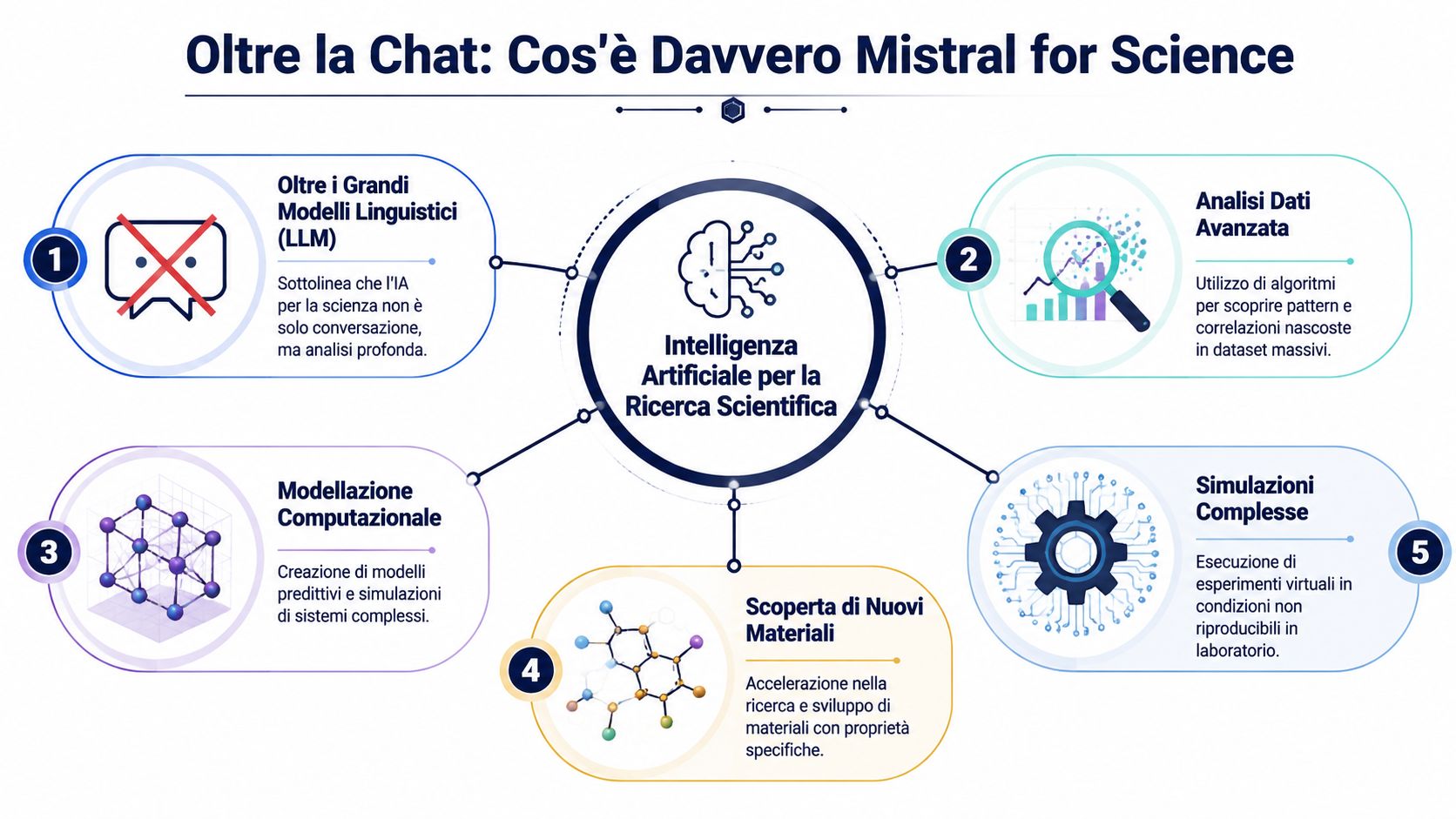
This is why the acquisition of Emmi AI is so significant. The strategic message is clear: Mistral does not want to limit itself to the application layer of language. It is entering a category where the model incorporates the problem structure.
So-called Large Engineering Models point in a clear direction. These are not merely models trained on technical documents, but systems designed to operate in contexts where reality is governed by equations, constraints, and simulations.
For a European reader, this changes the very meaning of “AI for science.” The point is not to create a better assistant for researchers. The point is to build a computational engine that speeds up research on real-world problems.
Three practical implications:
There is also a second level that is often overlooked. In Italy, the institutional adoption of AI by Istat creates a cultural and operational environment more conducive to this leap forward. If a national statistical agency uses AI for data summarization, coding automation, and geospatial data analysis, the message is that scientific AI is no longer confined to elite laboratories but is entering the formal processes of public knowledge production.
A general-purpose LLM is good at explaining the world. A useful scientific model should help you calculate it.
This is the point that many people miss. Mistral Science isn’t important because it “falls under the umbrella of science.” It’s important because it seeks to position Mistral in a more defensible category, where value stems from the integration of model, domain, and industrial process.
The most underrated aspect of Mistral is not the speed at which the company operates. It is its decision to focus on open-weight models. For research and for many European companies, this is a more strategic decision than any demonstration.
A closed model available only via API offers convenience. An open-weight model offers you control. And in Europe, control isn’t a philosophical preference. It’s an operational requirement when working with sensitive data, intellectual property, regulated processes, or critical industrial supply chains.
When the model's weights are accessible, an organization can do things that remain difficult or impossible with a purely black-box service.
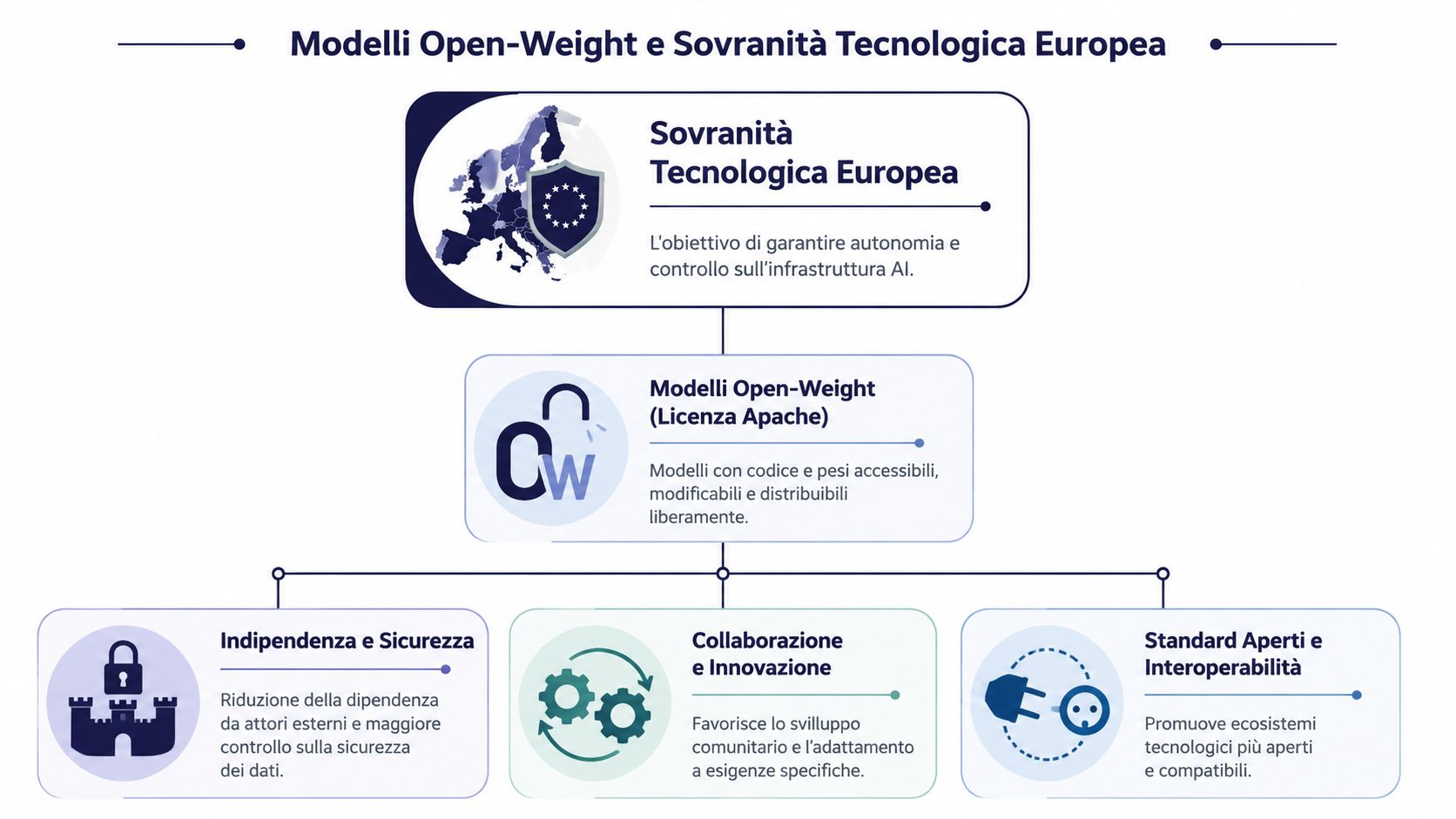
That is why technological sovereignty should not be reduced to a buzzword in policy papers. For a company, it means knowing who controls the platform, where the data flows, how customizable the solution is, and how much it will cost to switch to a different approach in the future.
If you manage research data, intellectual property, or highly regulated processes, your real question isn’t “Which model is the most popular?” It’s “Which model can I manage without handing over my strategic independence to a single external party?”
This also applies from a regulatory and organizational standpoint. Anyone dealing with AI compliance requirements for businesses knows that it’s not just about the model’s performance. The traceability of decisions, an understanding of the model’s limitations, and the ability to document its use are also critical.
There is also an economic reason that is less often discussed. In academia and among SMEs, the value of open-source software lies not only in its cost. It lies in the opportunity to build local expertise. An accessible model fosters learning, adaptation, and the development of in-house tools. A closed API, on the other hand, tends to concentrate cognitive and operational power in the hands of the provider.
Technological sovereignty begins when you can choose how to use a model, not just when you can buy access to it.
From this perspective, Mistral’s move is clear-cut. If Europe wants to establish a credible position in AI, it is not enough to have startups that simply resell others’ capabilities. We need players who can build models, ecosystems, and adoption standards compatible with the European industrial landscape.
To understand where this trajectory might lead, it is worth looking at an operational benchmark already evident in the market. Microsoft reports that Microsoft Quantum and PNNL, using Azure Quantum Elements, have digitally screened over 32 million materials, identifying a new battery material that requires 70% less lithium, with the selection and testing completed in just a few weeks (AI and high-performance computing for scientific discovery).
This example does not directly concern Mistral. However, it illustrates the value proposition the category is moving toward: combining AI, high-performance computing, and rapid validation to drastically narrow the search space.
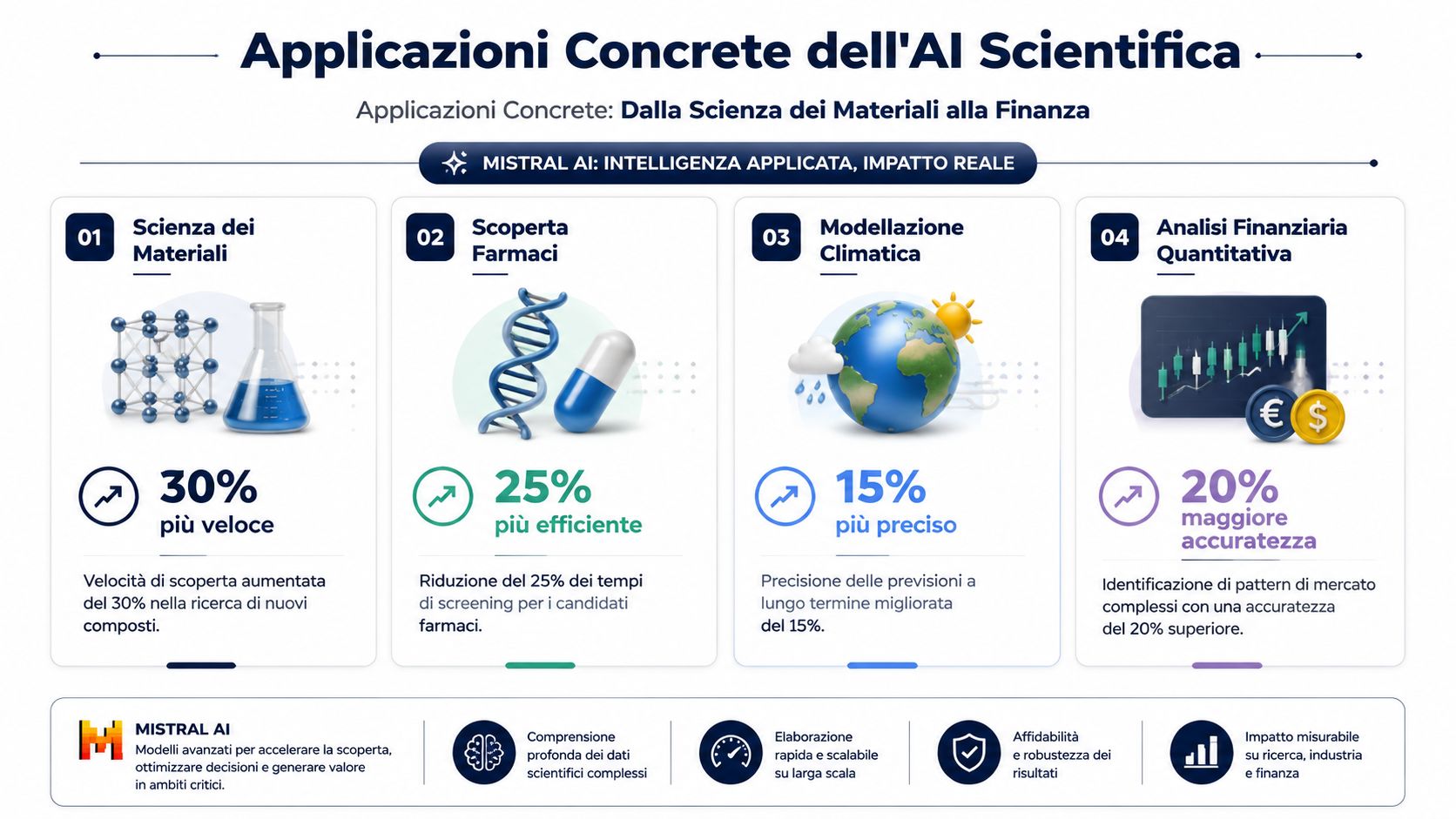
The lesson isn’t that “AI works magic.” The lesson is more practical: the right combination of mass screening, automated prioritization, and targeted testing can reduce both the time and cognitive effort required for research.
When a team stops exploring blindly and begins to better filter its hypotheses, the quality of the decisions made at the outset improves. In this sense, the true promiseof artificial intelligence for scientific research is selective, not flashy.
In practice, an initiative like Mistral Science makes sense in fields where language alone is not enough.
There is also a less obvious point. The study summarized by Il Bo Live indicates that researchers who use AI tools publish about three times as many articles, receive nearly five times as many citations, and rise to leadership positions more quickly. However, the same study also notes a 4.63% reduction in the collective exploration of topics and a 22% decline in citations between articles referencing the same work (Italian analysis of the study in Nature).
This finding suggests an uncomfortable but useful conclusion. AI can boost scientific productivity while simultaneously limiting the diversity of exploration. Those who build research platforms and processes will therefore need to optimize not only for efficiency but also for the variety of hypotheses.
The discussion about Mistral becomes unproductive when it veers toward two extremes. On the one hand, there is the automatic enthusiasm for any European player. On the other, there is the tendency to dismiss as irrelevant anyone who doesn’t dominate every general-purpose benchmark.
The reality is more interesting. When it comes to the most challenging cross-disciplinary reasoning tasks, the entire field is still far from achieving truly reassuring results.
An Italian guide to benchmarks notes that NinjaTech’s Deep Research model achieved 17.47% accuracy on Humanity’s Last Exam, a test described as one of the most difficult for multi-domain reasoning. The same guide observes that benchmarks useful for research must also take into account latency, reasoning quality, and network performance when used via API (AI benchmarks for research contexts).
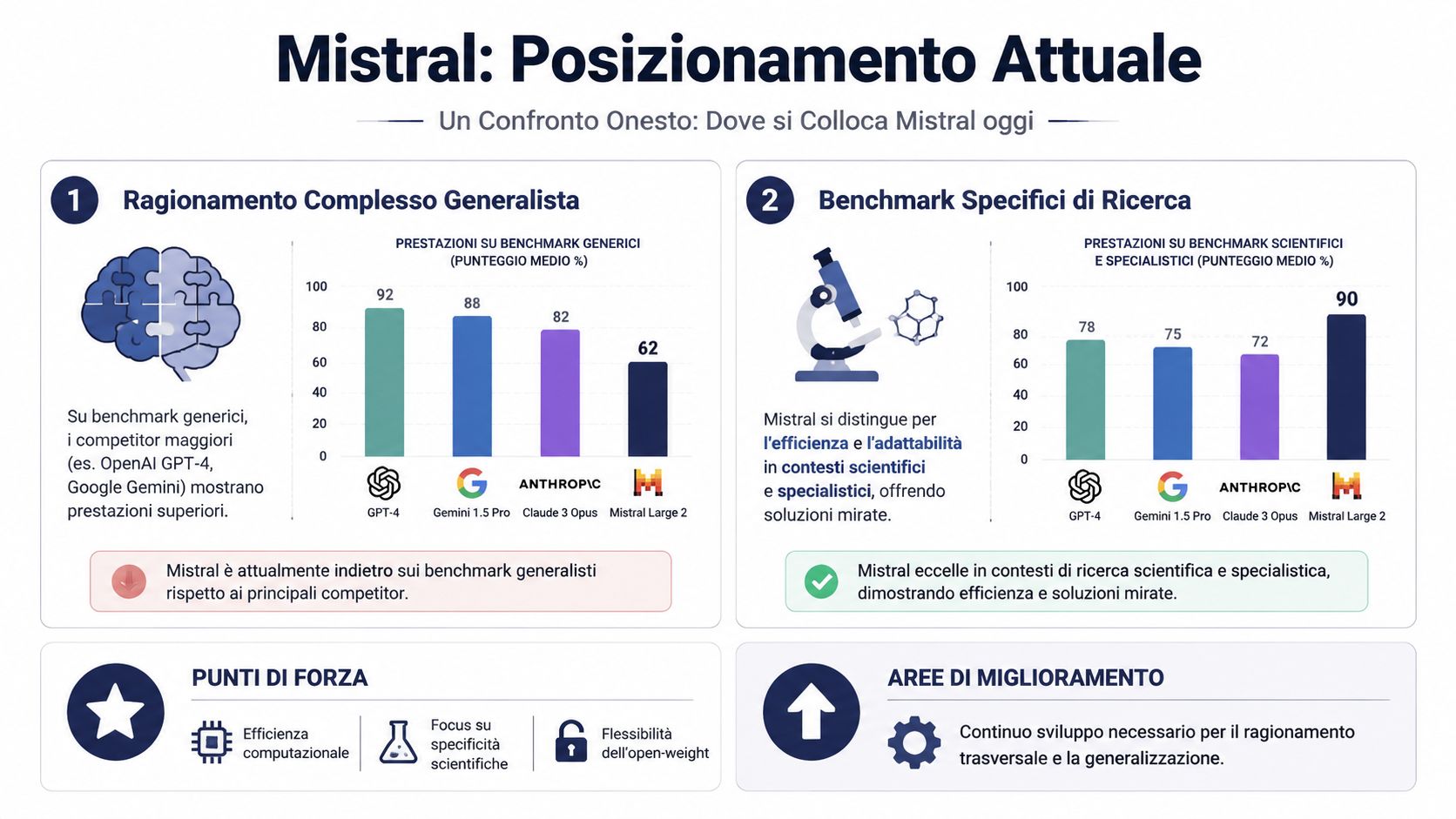
This figure should be interpreted carefully. It does not prove that any single model is weak. It shows that even advanced models still struggle with problems that require robust generalization. Therefore, it would be naive to describe Mistral today as generally equivalent to the best U.S. frontier models on the most complex tasks.
But the right question isn’t “which one wins everywhere.” It’s “which architecture and which strategy are best for a specific task.”
Mistral may be less strong in some general areas but much more compelling where it really matters:
If you view the market solely as a race to the absolute benchmark, Mistral risks appearing to be playing catch-up. If you view it as the development of a European infrastructure for specialized use cases, the picture changes radically. In that context, the goal is not to beat every competitor in the most crowded arena. It is to occupy a high-value segment where the combination of openness, efficiency, and specialization matters more than sheer scale.
To put this development into context, it is helpful to understand the market for large language models, but without limiting ourselves to rankings of general-purpose models.
Mistral’s strategic advantage does not stem from trying to be everything to everyone. It stems from being able to be highly effective in areas where dominance matters more than scale.
There is also a word of caution that the market often overlooks. Italian studies on the use of generative AI in scientific research have highlighted issues with source verifiability, potential copyright risks, and a decline in scientific quality when these systems are misused. Here’s a simple reminder: the more the model’s apparent autonomy increases, the more human methodological discipline must increase as well.
For a European company, the conclusion isn’t “always choose Mistral” or “always choose the most powerful model.” That would be the wrong approach. The right choice depends on the type of problem you’re trying to solve.
Whether your problem is cross-functional, documentation-related, language-related, or involves general-purpose productivity, a general-purpose LLM might be a good fit.
If, on the other hand, you work with:
Then the question changes. In those cases, you need to assess whether a specialized model—or at least one that is adaptable and controllable—delivers more strategic value than a closed-source service that looks more impressive in a demo.
A practical framework can be based on five criteria:
Some market players will continue to view AI as a utility. This is a valid approach for many use cases. However, those operating in highly specialized European sectors should start thinking of AI as strategic infrastructure. It is in this shift that initiatives like Mistral Science become significant.
The most useful lesson is simple: don’t confuse the appeal of general-purpose AI with the value of specialized AI.
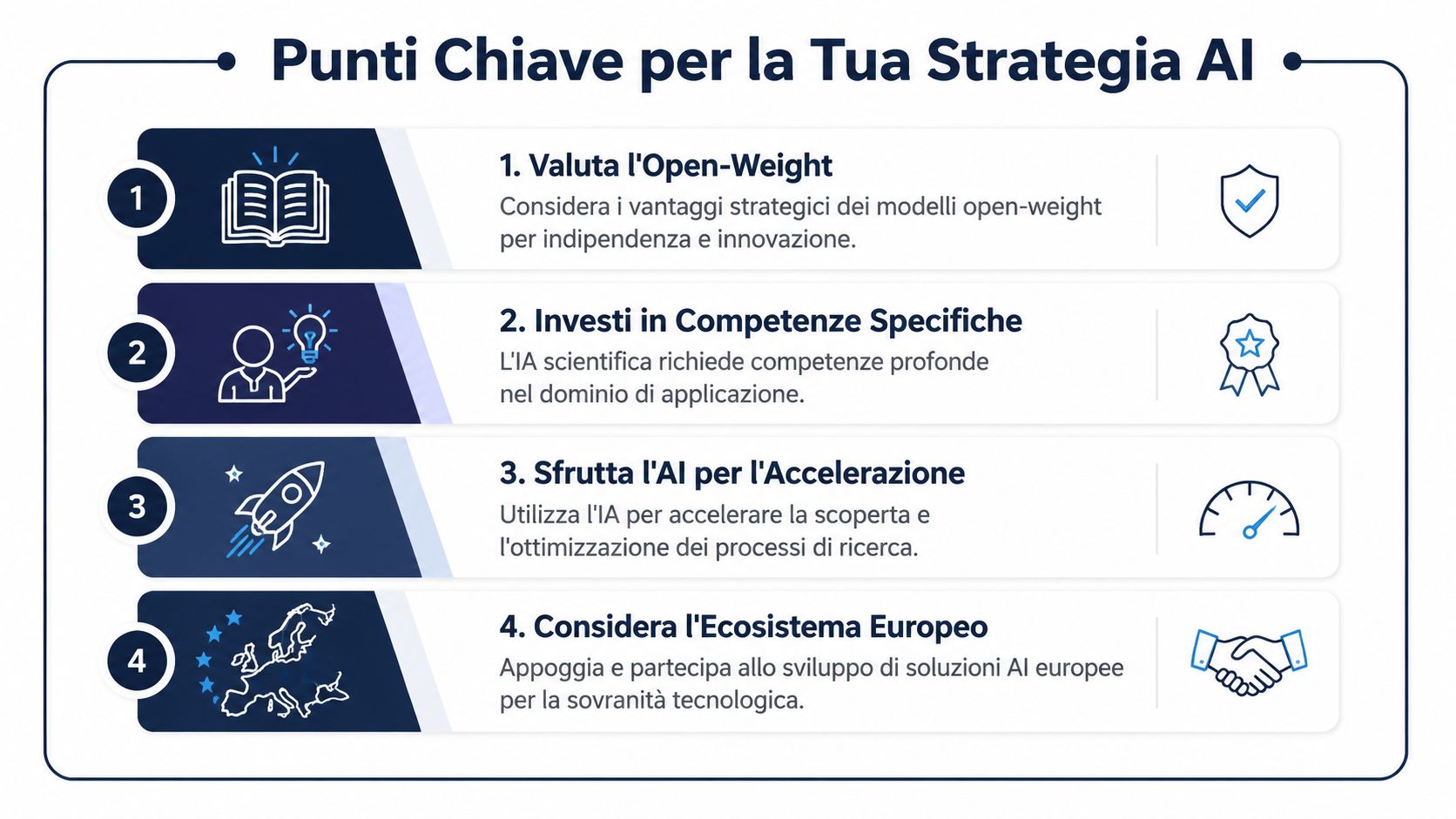
Here are the points to bring up at the meeting:
Mistral Science is not yet the pinnacle of European AI. However, it is one of the strongest signs that Europe has begun to play a smarter game. Rather than merely imitating global leaders, it is choosing where it can create its own competitive advantage.
If you’re looking for ways to integrate AI into real-world decision-making processes without adding unnecessary complexity, check out ELECTE. It’s an AI-powered data analytics platform designed to transform raw data into actionable insights, with an approach that’s accessible even to non-technical teams. You can see how it works and determine which AI architecture is best suited to your needs.

.svg)


.svg)
.svg)