
Simply put, interest expense is the cost your business pays for using money that isn’t its own. Think of it as the “rent” you pay for borrowed capital, whether from a bank, a supplier, or any other lender. If you’ve ever wondered, “What is interest expense?”, you’ve come to the right place for a clear and practical answer.
Fully understanding this concept is the first step toward turning an unavoidable liability into something you can actively manage. These aren’t just numbers on a balance sheet; they’re valuable indicators of your company’s health and efficiency.
In this guide, we’ll walk you through the process step by step. We’ll start with the basics, look at how to calculate these costs using real-world examples, and move on to practical strategies for optimizing this expense—including through the use of data analytics platforms like ELECTE. You’ll discover how to not only reduce costs but also strengthen your SME’s financial stability for the future.

When you hear the term "debt interest," your mind immediately jumps to mortgage payments or bank loans. And that’s true, but the reality is much broader and touches nearly every aspect of an SME’s financial management.
Every time your business uses capital that doesn't belong to it, it incurs a cost. That is interest expense.
In fact, this cost isn’t limited to traditional financing alone. It arises in many situations that, as an entrepreneur, you find yourself dealing with almost every day. Keeping them under control is crucial, because if they pile up, they can erode profitability and hinder your company’s ability to invest.
To better understand how these costs fit into your accounting structure, check out our guide on how to create an effective chart of accounts for your small business.
Here are some specific examples of situations that accrue interest, sometimes without you realizing it right away:
Gaining a thorough understanding of what interest expense is represents the first, crucial step in transforming it from an unavoidable liability into an element you can actively manage as part of your financial strategy. It’s not just numbers on a balance sheet, but valuable indicators of your business’s health and efficiency.
Putting interest expenses in writing is not just an accounting requirement, but a critical strategic move. Understanding how they are calculated gives you full control over one of the most critical—and often underestimated—business costs.
This isn’t just a mathematical exercise. It’s a tool that helps you make more informed financing decisions, turning a cost into a strategic investment. Let’s start with the basics to see how to apply them to the scenarios that every small business faces on a daily basis.
The starting point issimple interest. It is the mechanism that governs short-term debt, such as overdrafts or invoice advances. The logic behind it is straightforward, and the formula is easy to grasp.
Simple Interest = Principal × Annual Interest Rate × Time
One important note: "Time" must always be expressed as a fraction of a year. If the calculation is based on days, for example, you must divide the number of days by 365.
Let’s look at a real-life example. Imagine your company needs cash and takes out an overdraft of €10,000 for 90 days. The bank charges an annual interest rate of 10% (0.10).
Here is the cost you’ll incur for having that cash available for three months. Accurate tracking is crucial, especially if you manage multiple lines of credit at the same time. To do this, a customized template can be very helpful, as we explain in our article on how to create a sample Excel spreadsheet for financial tracking.
When things get more serious and we’re talking about medium- to long-term financing—a mortgage for a new warehouse, a lease for machinery—compound interest comes into play. This is where things change: the interest accrued during a given period isn’t simply paid off, but is added to the principal. Starting from the next period, interest will be calculated on this new, higher total.
This mechanism, also known as compound interest or the "snowball effect," causes the debt to grow exponentially. That’s why a 30-year mortgage can end up costing nearly twice the principal amount you borrowed at the start.
Finally, there is one type of interest that no one would ever want to pay: late payment interest. It kicks in like a trap as soon as you miss a payment deadline, whether it’s a loan installment or a supplier’s invoice.
Their rates are almost always higher than standard rates and are subject to specific regulations, often linked to European Central Bank (ECB) rates plus several percentage points. Don’t treat them as a financing cost: they are a genuine penalty. A direct hit that erodes your profit margins and that careful cash management must treat as an absolute priority to avoid.
The interest expenses your small business pays aren’t just a cost to be recorded. They’re a strategic tool with significant tax implications. If managed carefully, they can turn an expense into an opportunity for optimization, but the tax authorities have established very specific rules. Ignoring them could cost you dearly.
From an accounting perspective, it’s simple: interest expense goes straight into the income statement, reducing pre-tax profit. But be careful: this doesn’t mean you can “write off” the entire amount. This is where tax regulations come into play, specificallyArticle 96 of the TUIR (Consolidated Income Tax Law), which sets clear limits.
The concept that every entrepreneur or CFO must master is EBITDA, which stands for Earnings Before Interest, Taxes, Depreciation, and Amortization. Think of EBITDA as the true engine of your business: it represents the profitability of your core operations, net of depreciation, amortization, and all financial activities.
The law establishes a two-step process for determining how much interest expense you can actually deduct:
This diagram visually illustrates the steps to follow to avoid making mistakes.
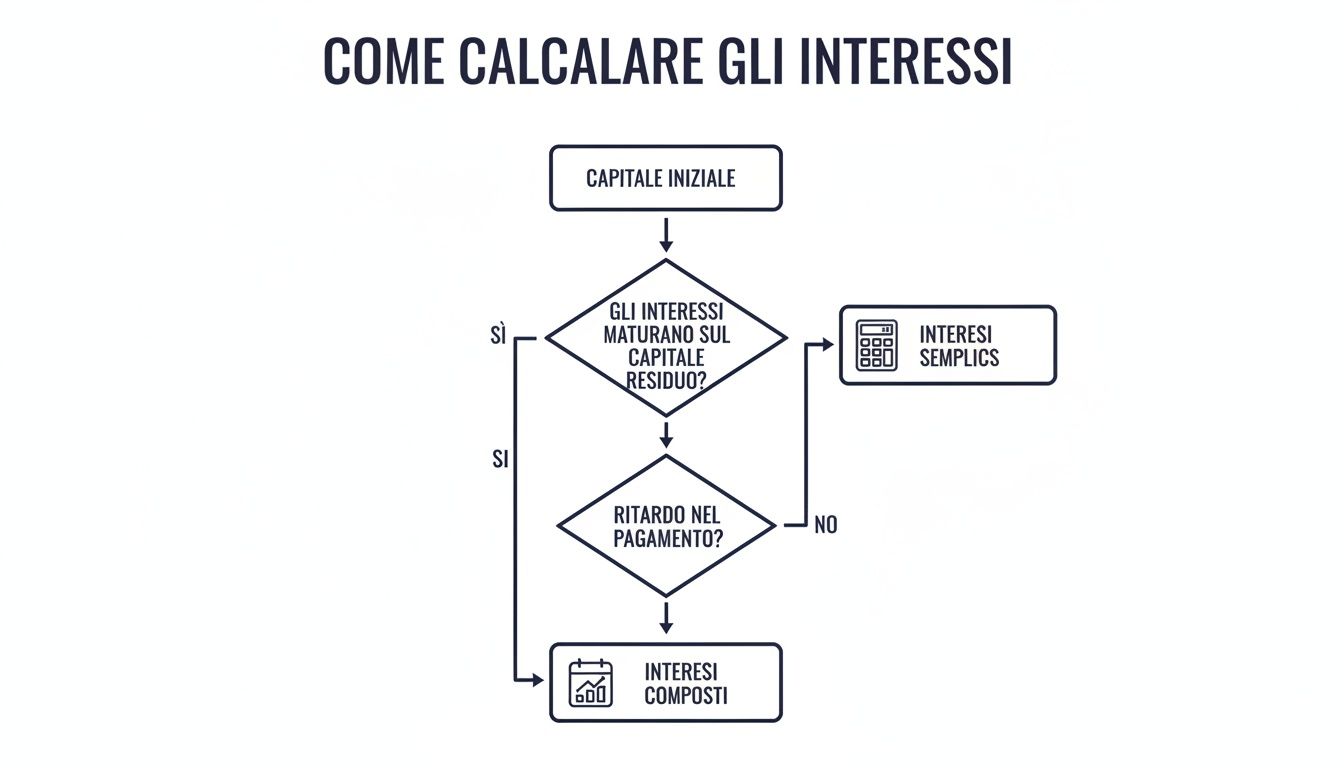
As you can see, once interest expenses are covered, everything depends on the company’s operating performance, which is measured by the ROL. A healthy ROL allows for greater deductibility.
Let’s look at a concrete example:
Your SME has a net operating profit (ROL) of €50,000. During the year, it paid €25,000 in interest expense and received €5,000 in interest income.
- Interest expense to be covered by ROL: €25,000 - €5,000 = €20,000
- Maximum deductible amount from taxable income: 30% of €50,000 = €15,000
- Total deductible amount: €5,000 (covered by interest income) + €15,000 (ROL limit) = €20,000
- Non-deductible interest this year: €25,000 (total) - €20,000 (deductible) = €5,000
In this case, €5,000 in interest expense is not deductible in the current fiscal year. But all is not lost. The law allows you to carry forward this excess and use it to reduce your taxable income over the next five fiscal years.
Gaining a thorough understanding of what interest on debt entails from a tax perspective is not merely a theoretical exercise, but a necessary step toward intelligently planning your financial structure and taking full advantage of every opportunity for optimization.
The cost of capital that your small or medium-sized business faces is never just a matter of internal decisions. It is a direct reflection of the macroeconomic environment—a complex landscape in which government policies and the health of the national economy play a crucial role.
Understanding these dynamics is not merely an exercise in style, but a strategic move. It gives you the tools to anticipate future financing conditions and plan with clarity, rather than passively enduring market fluctuations.
One of the factors that most influences the cost of borrowing is the level of public debt. The logic is strikingly simple: when a government has a very high debt burden, it must offer higher yields to convince investors to buy its securities (such as BTPs). This triggers a chain reaction throughout the financial system.
Think about it: if the government—considered the most reliable borrower in the market—pays high interest rates to finance itself, a bank will inevitably charge even higher rates when lending money to a business. By its very nature, a business carries a higher risk profile than a sovereign government, and this “risk premium” translates into higher costs for you.
In practice, the BTP rate serves as a sort of starting point, a baseline. When it rises, all other rates—including those on loans to your SME—are bound to follow suit.
The most recent analyses confirm this scenario. Projections indicate that Italy’s public debt will reach 139.7% of GDP by the end of 2026, with interest payments estimated to reach 3.9% of GDP in 2025. As you can read in this Morgan Stanley analysis of Italian debt, with 10-year BTPs trading around 3.5–3.6%, banks have no choice but to adjust the rates they offer to businesses accordingly.
Adding to the complexity of the situation is the sluggish economic growth. With GDP struggling to gain momentum—and a modest growth forecast of around 0.7% for 2026—this has two direct consequences for your company:
It is a vicious cycle that puts further pressure on interest rates. Faced with a stagnant economy, banks become more cautious and raise borrowing costs to offset the increased risk of default.
That’s why keeping an eye on macroeconomic trends isn’t an option—it’s a necessity. It allows you to understand not only what interest rates are today, but how they’ll move tomorrow, putting you in a position to make the right move at the right time.

Understanding what interest on debt is represents only the first step. The real challenge for every entrepreneur is to turn this knowledge into concrete action. In a competitive market, passively managing debt is not an option: it is a surefire way to slowly erode margins and financial stability.
The goal is not to demonize debt, but to use it as a strategic lever for growth, without its cost becoming an unsustainable burden. A proactive and consistent approach is needed.
The starting point is to keep a close eye on your financial structure. You need to maintain a healthy balance between the capital you contribute (equity) and the capital you borrow (debt).
One key metric you should always keep an eye on is the debt-to-equity ratio, calculated as total debt divided by equity. Industry analyses, such as this one on key financial ratios for businesses, show that an ideal structure consists of 60% equity and 40% debt.
When the debt-to-equity ratio exceeds 1.5, the risk to the company increases exponentially. The company becomes overly dependent on external lenders and extremely vulnerable to even the slightest fluctuation in interest rates. Exceeding a debt threshold of 65%, especially with government bond yields at 3.5–3.6%, can seriously jeopardize its stability.
It’s a balancing act. A debt-free company risks missing out on valuable growth opportunities. On the other hand, a company that’s too heavily in debt ends up working almost exclusively to pay interest to its creditors. The real skill lies in finding the perfect balance for your specific industry and business model.
In today’s high-interest-rate environment, even small improvements can lead to significant savings over the long term. Here are some practical steps you can take right away.
Renegotiate your existing loans: Market conditions change. Your creditworthiness may have improved since you signed that contract. Talk to your bank. Often, a simple renegotiation can lead to a lower interest rate or more favorable repayment terms, making each installment more manageable.
Optimize working capital: Many debt-related costs stem from poor working capital management. An efficiently managed inventory and a careful accounts receivable policy reduce the need to rely on costly overdrafts. The rule is simple: collect payments as soon as possible and pay suppliers on time, without paying too early or too late.
Consider alternative financing options: The world of finance is no longer limited to traditional banking channels. Today, there are many options available. Explore solutions such as crowdfunding, mini-bonds, or peer-to-peer lending. They may offer more favorable and flexible terms than a standard loan.
To figure out where to start and where to focus your efforts, an approach like the Pareto analysis can be enlightening. It helps you identify the 20% of causes that account for 80% of interest costs, allowing you to take action where the impact is greatest.

Saying goodbye to sprawling spreadsheets and hours wasted on manual calculations is finally possible. For SMEs looking to optimize their financial management, artificial intelligence is no longer an abstract concept, but a practical tool for automating the tracking of accounts receivable and, above all, for turning data into strategic decisions.
Platforms like ELECTE, the AI-powered data analytics platform for small and medium-sized businesses, were created precisely for this purpose. The solution connects directly to your bank accounts, accounting software, and management systems, centralizing all your financial data in a single secure and easy-to-navigate ecosystem.
Imagine never having to manually export data to calculate financial costs again. An AI analytics platform does exactly that for you: it calculates and monitors interest expense in real time, showing you the immediate impact on cash flow and profitability through intuitive dashboards.
This ongoing visibility is the first, crucial step. It allows you to immediately identify anomalies, unexpected costs, or an unusual increase in financial expenses, giving you the opportunity to take action before the problem escalates.
The real game-changer, however, is the ability to look to the future. By leveraging machine learning algorithms, a platform like ELECTE can predict future interest costs based on various scenarios, such as interest rate trends or the opening of new lines of credit.
This forecasting capability is crucial, especially in a volatile environment. The OECD projects that debt issuance will reach $18 trillion by 2026. With interest expenses in Italy standing at 3.9% of GDP, SMEs are navigating an increasingly complex financial landscape. AI platforms integrate this macroeconomic data to model risk scenarios and enable accurate forecasts.
With a tool like this, you can simulate the impact of new financing on your balance sheet before you even apply for it, or generate automated reports for tax deductibility, such as calculating the ROL. Automation thus transforms an accounting burden into a powerful engine for strategic analysis.
Automating the monitoring of accounts receivable isn’t just about saving time. It’s about giving your small or medium-sized business the kind of financial insight that was once only available to large corporations. Specifically, the platform allows you to:
In essence, ELECTE transforms a reactive, manual task into a proactive function that improves your company’s financial health and profitability. If you’d like to explore more practical examples of AI for business, our dedicated article offers further insights.
Having a full understanding of accounts receivable is not just a matter of accounting. It’s a shift in mindset: it transforms financial management from a necessary evil into a genuine strategic advantage. It’s not just an expense item, but a barometer that measures the health of your business.
We’ve broken down the key concepts into four practical steps so you can start strengthening the financial foundation of your small business right away.
Keep an eye on your debt-to-equity ratio. Calculate this metric regularly (total debt / equity). It serves as your safeguard against becoming overly reliant on creditors. The goal? Keep it below 1.5. This isn’t a hard-and-fast rule, but it’s a crucial threshold for balancing financial leverage with stability.
Take full advantage of tax deductions—without any mistakes. Every year, before closing your financial statements, don’t leave anything to chance. Accurately calculate the portion of interest expense you can deduct based on your taxable income. Sound tax planning isn’t just an option—it’s a tool for optimizing your tax burden and maximizing your benefits.
Get to the root of the problem. A thorough analysis of cash flow is like a CT scan for your business. It helps you understand why you’re running an overdraft, rather than just dealing with the consequences. Improving your working capital management is the smartest and most effective way to reduce your reliance on costly overdraft interest.
Simulate, don’t just hope. Before signing up for a new loan, look beyond the monthly payment. Use an analysis tool to simulate the real impact that new debt will have on your budget and, above all, on your ability to pay it off without stress. Prevention is better than cure, especially when it comes to finances.
Handling these processes manually can be a huge, complex task fraught with pitfalls. With ELECTE, you can automate financial analysis, simulate scenarios, and gain predictive insights to make faster, more informed decisions.

.svg)


.svg)
.svg)