

Converting JSON to CSV isn’t just a technical exercise—it’s a critical strategic move for making sense of the data that drives your business. Today, the most valuable information for your company comes from APIs, apps, and sensors in JSON format. But to truly analyze it with tools like Excel or AI platforms, you need to convert it into the familiar CSV table format. This guide will show you how to do it efficiently, whether you prefer to use code or no-code tools.

Imagine receiving sales data from your e-commerce platform every day. Most likely, it comes in JSON format: a flexible structure that’s perfect for web applications, but a real headache when you need to import it into a spreadsheet to crunch some numbers or create a chart. Its hierarchical nature, consisting of nested objects, doesn’t mesh well with the rows and columns you and your team are used to working with.
This is where conversion to CSV (Comma-Separated Values) comes into play. Converting a file from JSON to CSV essentially means “flattening” that complex structure into a simple, clean table. Each row becomes a record—an order, a customer—and each column represents a specific attribute: price, date, product.
Before we get into how to do it, let’s quickly explain why these two formats are so different and why conversion is often unavoidable.
This table neatly sums up the crux of the matter: JSON is designed for machines and developers, while CSV is designed for analysis and human readability. Conversion thus serves as the bridge between these two worlds.
This process immediately opens up new operational possibilities for your company.
This step is so crucial that it is becoming standard practice for Italian SMEs. Recent data shows that over 28% of internet users in Italy have already used generative AI applications, fueling a growing demand for clean, easily processable data. This trend is confirmed by the increase in requests to export data from structured formats such as JSON to CSV for business analysis. If you’d like to learn more about how AI is reshaping data analysis in our country, you can read this in-depth article on the adoption of generative AI.

If you’re familiar with coding or comfortable using the command line, there are incredibly powerful ways to convert data from JSON to CSV. It’s not just about converting a file—it’s about having complete control over the process. These approaches are ideal for automating workflows, saving you a tremendous amount of time.
If your job involves working with data, you’ve almost certainly come across Python and its famous library pandas. Calling it a "tool" is almost an understatement: it’s the de facto standard for anyone who needs to manipulate and analyze data. Its magic lies in its ability to process complex structures—such as a JSON file—and load them into an object called a DataFrame. Think of it as a supercharged table where you can do just about anything.
With pandas, the conversion from JSON to CSV becomes almost a trivial task. All it takes is a few lines of code to read a JSON file—even if it contains nested objects—and save it neatly in CSV format. The function read_json is smart enough to figure out the structure on its own, while to_csv is in charge of exports.
Let's look at a concrete example. Let's say you have a file named sales_data.json with a structure like this:
[{"ordine_id": "A123","cliente": { "nome": "Mario Rossi", "citta": "Roma" },"importo": 150.50,"articoli": 3},{"ordine_id": "B456","cliente": { "nome": "Laura Bianchi", "citta": "Milano" },"importo": 75.00,"articoli": 1}]The Python script to convert it is surprisingly concise:
import pandas as pd# Reads the JSON file and loads it into a DataFrame# json_normalize automatically "flattens" the structuredf = pd.json_normalize(pd.read_json('sales_data.json', lines=True).to_dict('records'))# Exports the DataFrame to a CSV file, without the pandas numerical indexdf.to_csv('sales.csv', index=False)print("Conversion completed successfully!")The file sales.csv The generated file will have the data perfectly organized into columns, with columns such as customer.name and customer.city. This process, known as "flattening," is one of the many features that make you love this library.
Sometimes, though, you don't need to write a script. For quick tasks right from the terminal, a great tool is jq. It’s a lightweight yet extremely powerful command-line tool, a sort of sed or awk Designed specifically for JSON. With a single command, you can filter, map, and reshape your data however you like.
Expert tip: Learn the basic commands for
jq. It’s unbeatable for quickly checking an API’s response, cleaning up a log file, or preparing a dataset for a quick analysis—all without having to open an entire development environment.
Going back to our example, to convert the same JSON to CSV using jq, the command would be this:
jq -r '(.[0] | keys_unsorted) as $keys | $keys, (.[] | [.[$keys[]]]) | @csv' sales_data.json > sales_jq.csvSure, the syntax is a bit cryptic, but its power is undeniable. This command extracts the headers from the first object, then loops through all the elements and formats the output into CSV format. It’s the perfect solution to include in a shell script to automate an import process.
And what about developers who work primarily in a JavaScript environment? No problem—Node.js offers equally effective solutions. There are NPM packages, such as json2csv, which make the process incredibly simple, allowing you to stay within the same technological ecosystem.
This approach is particularly useful if, for example, you need to convert JSON data received from an API within a Node.js-based backend application. Speaking of APIs, if you often find yourself working with JSON data streams, you might be interested in our article on how to integrate and use our APIs with Postman.
You don’t have to be a programmer to master your data. For managers, analysts, and anyone who prefers a hands-on, visual approach, there are tools that make converting JSON to CSV a breeze—without writing a single line of code.
These methods let you skip the technical details and focus on what really matters: getting clean data that’s ready for analysis. There are two main approaches: using software you’re already familiar with, such as spreadsheets, or relying on specialized online converters.
Both Microsoft Excel and Google Sheets have a hidden ace up their sleeves: Power Query (in Google Sheets, it’s part of the data import features). It’s not just a simple add-on, but a full-fledged data transformation engine with a graphical interface that guides you step by step. It allows you to connect to a JSON file, view its structure, and “flatten” it into a neat table.
The process is surprisingly intuitive:
Practical tip: The real magic of Power Query is that it remembers every step you take. If you need to convert the same type of JSON file every week, all you have to do is refresh the data source: all the transformations will be applied automatically, saving you a huge amount of time and improving the ROI of your analytics work.
Another option for those in a hurry is online converters. Generally, the process is simple: you upload the JSON file, click a button, and download the CSV. They’re very convenient for quick conversions, but you should choose them carefully, especially if you’re working with business data.
Before using a service like this, ask yourself these questions:
The adoption of no-code methods is having a significant impact, especially in the context of open data in Italy, where converting data from JSON to CSV is a daily necessity. The use of simple tools, for example, has enabled SMEs to reduce reporting costs by 28%, demonstrating how these solutions are democratizing data analysis. To get an idea of how these tools are used in the public sector, take a look at the data conversion tools offered by the Chambers of Commerce.
But automation doesn’t stop there. Many of these workflows can be taken to the next level. For example, you could connect your Google Sheets to other applications to create automated reports that update themselves. If this interests you, find out how you can integrate ELECTE with hundreds of apps via Zapier to build truly powerful data workflows.
Thinking that converting JSON to CSV is a simple "click-and-go" process is the most common mistake. The real challenge lies not so much in the conversion itself, but in anticipating and resolving those obstacles that, if ignored, can turn a potential treasure trove of data into a useless file.
Approaching these points with the right mindset is what distinguishes a superficial data transformation from a clean, reliable dataset that is truly ready for analysis.
The first hurdle—and an almost inevitable one—is "nested" JSON structures. Imagine you have data for an e-commerce order: the JSON file might contain an object customer which in turn includes name, surname and address. A hasty conversion might overlook these details or, even worse, cram them all into a single unreadable cell, effectively rendering the data useless for any serious analysis.
The technique for resolving this chaos is called flattening. Basically, you take the nested elements and convert them into separate columns in the final CSV file. Instead of a generic column customer, you'll end up with specific columns such as customer_name, customer_last_name and customer_address.
This not only saves every piece of data, but also makes it immediately available for filtering, aggregation, and visualization. Almost all modern tools, from Python with the library pandas including Power Query in Excel, which includes features for managing data flattening in a precise and controlled manner.
Another key challenge is field mapping. You’ll rarely need all the columns from the original JSON. And, even more often, the key names are technical abbreviations that aren’t very intuitive. A well-designed conversion process should allow you to:
product_id or ts_creation in voice labels such as Product ID or Date Created.A well-mapped CSV is like a well-told story. It doesn’t just contain data; it presents it in a way that guides the user toward understanding and insight.
This step is what transforms a simple "dump" of raw data into a fully functional tool.
This infographic provides a clear overview of the no-code workflow, showing how choosing the right tools leads to effective methods and, ultimately, to results ready for analysis.
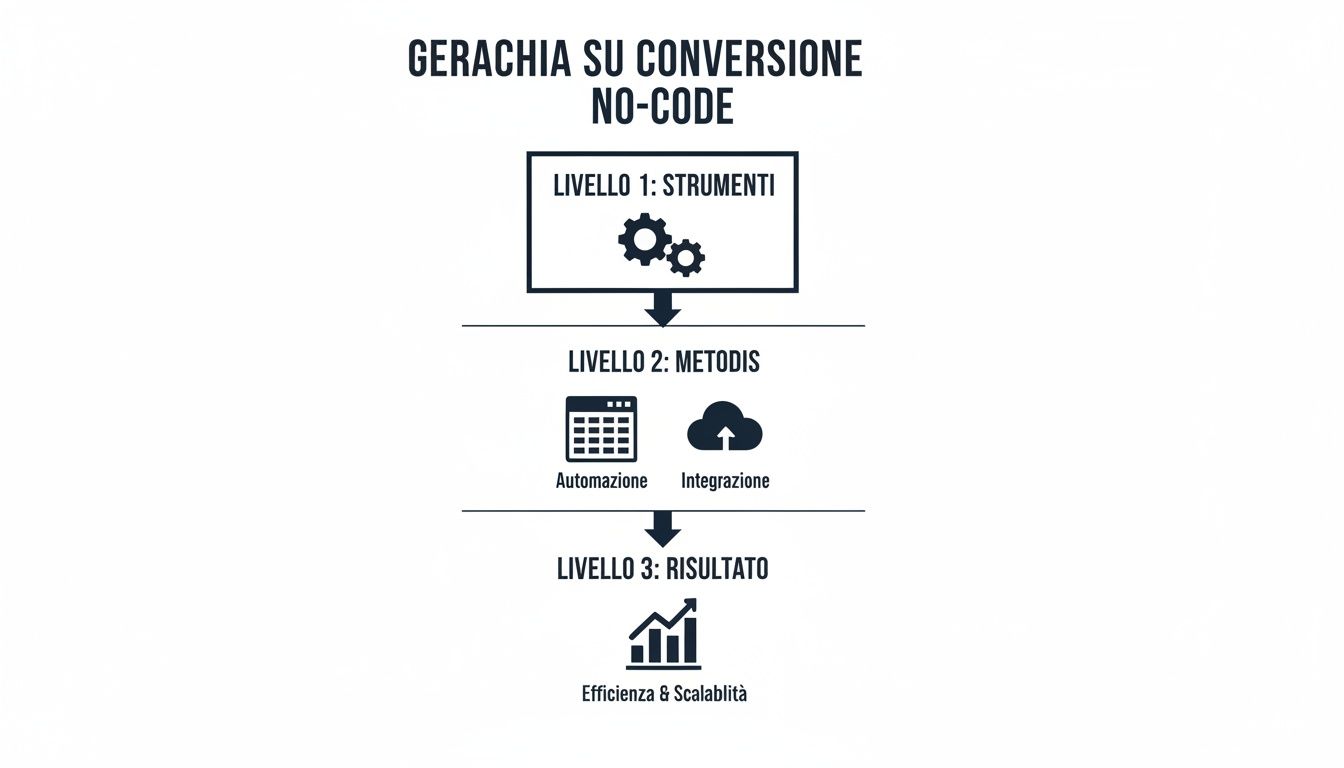
As you can see, success doesn't just depend on the tool itself, but on how you use it to produce a clean, well-structured result.
Finally, there are two technical details that are often overlooked but can undermine hours of work: character encoding and data type consistency. If you’re working with Italian text, it’s essential to save the CSV file with the correct encoding UTF-8. This is the only way to ensure that special characters such as accents (à, is, ì) and symbols (such as €) are displayed correctly, avoiding the usual question mark icons and corrupted data.
Similarly, it is crucial to ensure that data types are consistent. Numbers must be treated as numbers (and not as text), and dates must follow a single format (such as YYYY-MM-DD) and Boolean values must be consistent (for example, always true/false or 1/0).
This consistency is the cornerstone of any reliable analysis, especially when that data needs to be imported into a data analytics platform like ELECTE. Taking care of these details from the start will save you hours of frustration and data cleaning down the line.

Let’s face it: the real game isn’t about converting a single file. The real challenge for your company is automating the entire workflow to enable continuous, uninterrupted analysis. This is where ELECTE, an AI-powered data analytics platform for SMEs, radically transforms the way you work with data.
Instead of focusing on the technical process of converting from JSON to CSV, imagine a system that connects directly to your data sources, such as APIs that provide real-time data. ELECTE does just that: it automatically handles extraction, cleaning, and transformation. The conversion to an analyzable format thus becomes a seamless, fully integrated process.
This approach immediately eliminates the need for manual scripts, repetitive tasks, and intermediate steps, which are often a source of errors and delays.
Let’s look at a real-world example: analyzing e-commerce sales data. Every day, your platform generates thousands of JSON records about orders, customers, and products. Instead of manually exporting and converting files, you can connect ELECTE to your store’s API.
At that point, our data analytics platform will take care of everything:
The effectiveness of this automation is also evident on a large scale. Just look at the government data from the Digital Public Administration 2026 initiative: 100% of PNRR datasets are available in both JSON and CSV formats, with over 1,800 active projects. Platforms like ELECTE is the ideal tool for automating the acquisition and monitoring of these data streams, transforming raw data into trend analysis. If you’re curious to see how open data is becoming a driver of analysis, you can explore the Italian government’s datasets.
With ELECTE, converting JSON to CSV is no longer a task you have to perform—it’s a process that happens in the background. This frees up your team, allowing them to focus on interpreting insights rather than preparing data.
Adopting an automated approach with ELECTE brings measurable benefits. On average, SMEs that use our platform are able to reduce repetitive data preparation tasks by up to 75%.
This translates directly to:
The ultimate goal is to turn your data—regardless of its original format—into a tangible competitive advantage. To learn where to start building your automated reports, find out more about how to create analytics dashboards directly in ELECTE.
We’ve looked at several techniques for converting data from JSON to CSV. Here are the key steps you can take right away:
pandas is the most powerful option. For a visual approach, use Power Query in Excel or Google Sheets.Converting data from JSON to CSV is more than just a technical task—it’s the first step toward making your data accessible, understandable, and, above all, useful. Whether you choose to use code, no-code tools, or an AI-powered platform, the key is to transform raw data into insights that guide your business toward smarter decisions and sustainable growth.
Are you ready to turn your data into a competitive advantage?
Learn how ELECTE works and start making better decisions today →

.svg)


.svg)
.svg)