

If you’re setting up a simulation to estimate demand, risk, or inventory, you’ve probably already encountered the problem: the results vary too much from one run to the next, and certain combinations of inputs never seem to appear. In an SME, this isn’t just an academic detail—it’s the kind of uncertainty that can undermine a forecast or prolong the time needed to trust a model. Latin Hypercube Sampling was developed precisely to provide more systematic coverage of uncertain inputs, so that a Monte Carlo simulation works with a sample that is more informative and less scattered.
For managers and analysts, the point isn’t to learn a new acronym. The point is to understand how to choose a more efficient sampling method when the number of variables increases, the computational budget is limited, and decisions depend on credible scenarios. Here, you’ll learn the method step by step, with simple examples, real code in Python and R, and use cases related to the workflows of SMEs that use predictive analytics.
A financial manager opens the model file, sets up a simulation with thousands of scenarios, and expects a clear picture of the risk. Instead, they see results that fluctuate too much, with clusters of values in some areas and nearly empty sections of the distribution. This often happens when simple random sampling leaves gaps in the coverage of the input space.
In SMEs, the problem is magnified because models almost never have just one uncertain variable. There’s demand, margins, delivery times, returns, default rates, seasonality, promotions, and currencies. If the sample includes many points that are similar to one another, the simulation appears accurate, but in reality, it’s only showing part of the picture.
Rule of thumb: If a model has multiple sources of uncertainty, the quality of the sample matters almost as much as the quality of the formula.
The risk is not just technical. A forecast with insufficient coverage can lead to excessively high inventory levels, incorrect risk hedging, or budgets based on scenarios that are not representative. In other words, the model may be correct, yet the simulation may still be flawed.
In classical Monte Carlo simulation, each input is drawn independently. This is useful, but it does not guarantee that all important features of the distribution will be observed in a balanced manner. As the number of variables increases, the random variation in the sample can obscure the outliers that are truly of interest to the business.
This is precisely where Latin Hypercube Sampling comes into play, because it ensures a more orderly coverage of the probability intervals. It does not eliminate uncertainty, but it reduces the likelihood that the simulation will depend too heavily on the chance of a few lucky or unlucky samples.
A good business simulation shouldn't just run. It must also explore the input space with enough rigor to produce estimates that are meaningful to decision-makers.
The basic logic is simpler than it seems. If you were to cut a cake into equal slices and taste a piece from each slice, you’d get a much more balanced picture of the overall flavor than if you tasted pieces from the same area. Latin Hypercube Sampling does something similar with probability distributions.
The method starts with the cumulative distribution of each variable and divides it into N equally likely intervals. It then draws one value from each interval, so that every part of the distribution is represented at least once. Finally, it shuffles the points across the variables to avoid unwanted correlations among the inputs.
This step is the heart of the method. You’re not just sampling randomly from a continuous sea; you’re asking the sample to cover every range of the distribution.
Practical rule: When you want to determine whether the sample is representative, ask yourself whether each probability stratum has been included at least once.
Imagine a national survey. A random sample may focus too much on certain areas and ignore others, while a stratified approach ensures that different regions are represented. In Latin Hypercube Sampling, each variable is treated as if it had its own map to cover uniformly.
The steps are as follows:
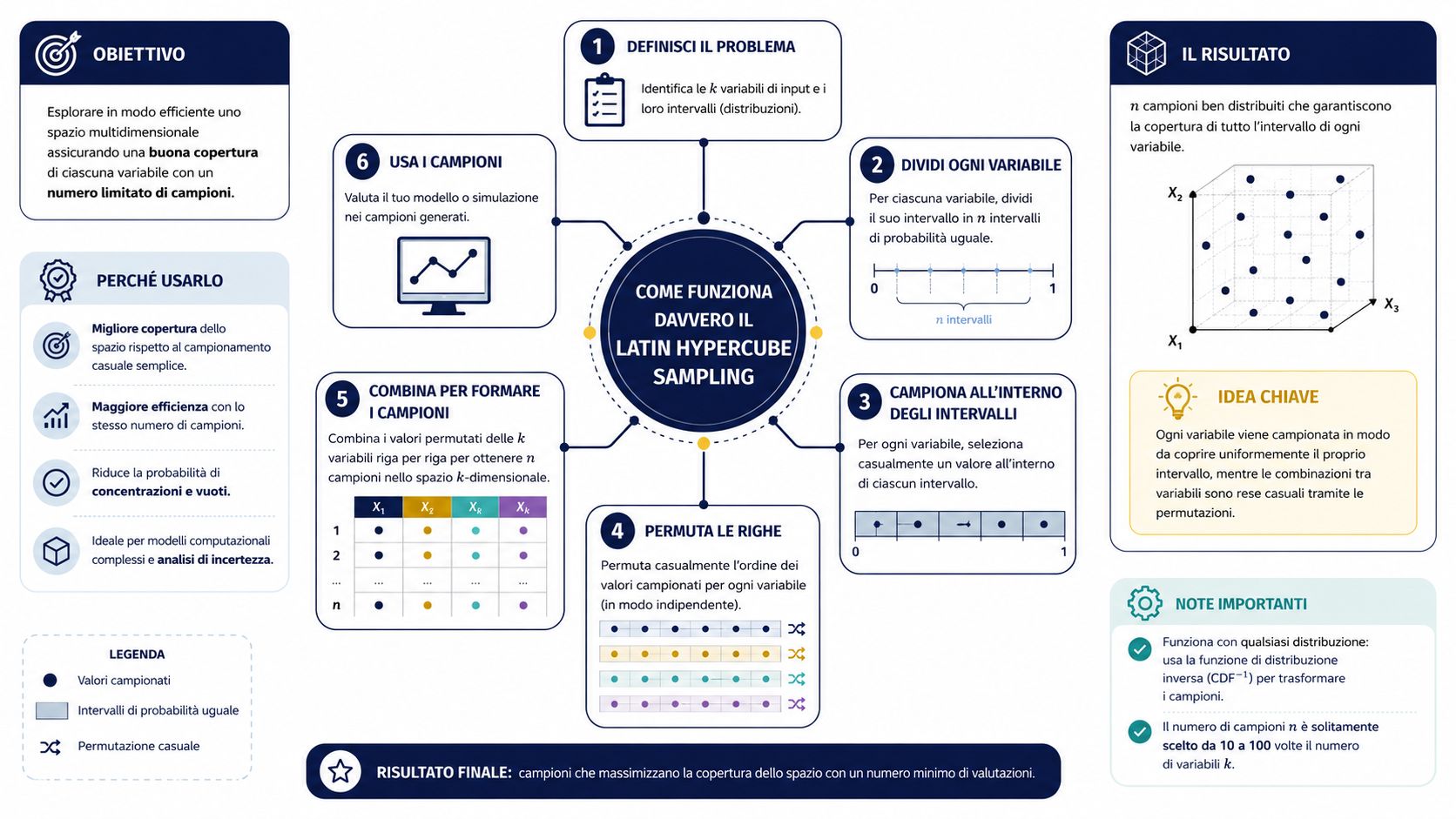
The part that often causes confusion is permutation. It’s not meant to complicate the method; rather, it’s meant to prevent the variables from being too closely aligned simply because they were drawn from the same strata in the same order. This way, you achieve both coverage and variety within the same sample.
The choice of method depends on what you want to optimize. If simplicity is your priority, simple random sampling remains easy to implement. If, on the other hand, you want a more uniform coverage of the input space, Latin Hypercube Sampling often offers a better balance between accuracy and resource usage.
For an overview of how it works, take a look at this comparison.
| Technique | Spatial Coverage | Computational Cost | Ideal use case |
|---|---|---|---|
| Simple Random Sampling | It varies; it really depends on the specific case | Low | Rapid prototypes and models with minimal precision requirements |
| Classic stratified sampling | Good for a known dimension | Medium | When you want to thoroughly check a key variable |
| Latin Hypercube Sampling | Wider and more uniform across inputs | Medium | Monte Carlo simulations with multiple uncertain variables and the need for balanced coverage |
If you want to learn more about experimental design in a broader context, you can explore DOE with ELECTE, which is useful when sampling is only one part of the analytical design.
Simple random sampling is convenient, but it may require many more runs to yield a stable result. Classic stratified sampling works well when the dimension to be tested is clear, but it becomes less straightforward if the model has many inputs. LHS, on the other hand, is effective when you want more even coverage without having to design a complex plan from scratch.
Here's a good rule of thumb: if your model has many variables and you still need to keep the computation lightweight, LHS is worth considering.
Importance sampling follows a different logic, because it assigns greater weight to certain regions of space than to others. It is useful for targeted problems, but it is not the most natural choice if your main goal is to distribute the sample well across multiple uncertain variables.
Here, the method goes beyond being just a concept and becomes a tool you can test. The idea is to generate an LHS sample for a typical input, then feed it into a broader simulation. If you use risk models or forecasts, this is the part that helps you integrate the sample into the actual workflow.

import numpy as npfrom scipy.stats import qmc, norm# Set the number of samples and the dimension.n = 100d = 1# Create the Latin Hypercube sampler.sampler = qmc.LatinHypercube(d=d)# Generate uniform samples in unitary space.u = sampler.random(n=n)# Transform the uniform values into a standard normal distribution.x = norm.ppf(u)# Print the first few sampled values.print(x[:5])This example generates uniform points in the unit cube and transforms them using the quantile function of the normal distribution. If you need to adapt it to a business variable, replace the standard normal distribution with the distribution that best describes your input.
library(lhs)library(stats)# Imposta il numero di campioni e le dimensioni del problema.n <- 100d <- 1# Genera un campione Latin Hypercube nello spazio unitario.u <- randomLHS(n, d)# Trasforma i valori uniformi in una normale standard.x <- qnorm(u)# Mostra i primi valori.head(x)In R, the workflow is just as straightforward. First you sample, then you transform. The key point is that the sample isn’t generated directly in the “final unit of measurement,” but in uniform space, from which you then derive the distribution you need.
If your model calculates a risk metric, the LHS sample can be fed directly into the pipeline. For more information on the risk workflow, you can learn how to calculate VaR, which serves as a useful operational framework for those working on loss scenarios.
A typical implementation works like this:
If you're working with more resource-intensive environments or very large models, resource usage becomes a key consideration. For that reason, it may be helpful to explore HPC solutions for SMBs on ELECTE, especially when simulation times start to impact your daily workflow.
The value of this method really becomes apparent when you apply it to real-world problems. In an SME, sampling isn’t a theoretical exercise—it’s how a model determines whether a forecast is reliable, whether a risk is acceptable, or whether an inventory level is too high. Latin Hypercube Sampling is particularly helpful because it makes scenario exploration more systematic.
When demand depends on promotions, seasonality, channels, and response times, the number of combinations grows rapidly. A random sample may overlap very similar scenarios and leave some areas under-explored, while LHS distributes the inputs more effectively and makes the forecast more accurate at the tails of the distribution.
In practice, the sales team can consider a wider range of scenarios, and the finance team has a better foundation for budgeting and cash flow planning. Profit isn't a guaranteed certainty; it's a simulation that better accounts for real-world uncertainty.
In credit analysis, the problem often lies in the quality of the inputs, not just the scoring formula. Default rates, exposure, probability of recovery, and payment delays can change in tandem, and a poorly distributed sample produces less robust estimates. With LHS, the model captures the possible ranges of these parameters more consistently and assesses risk more reliably.
In inventory management, the bottleneck is often the lead time, not the average demand level. If reorder times fluctuate and demand varies by channel or season, a simulation with weak coverage may underestimate stockouts. Latin Hypercube sampling helps build more evenly distributed scenarios and thus allows for better decision-making regarding reorders, buffers, and customer service.
For those who also work in parts and technical support, an AI-powered parts ticket management system is a useful resource, because it demonstrates just how important it is to have well-organized processes when operational constraints pile up.
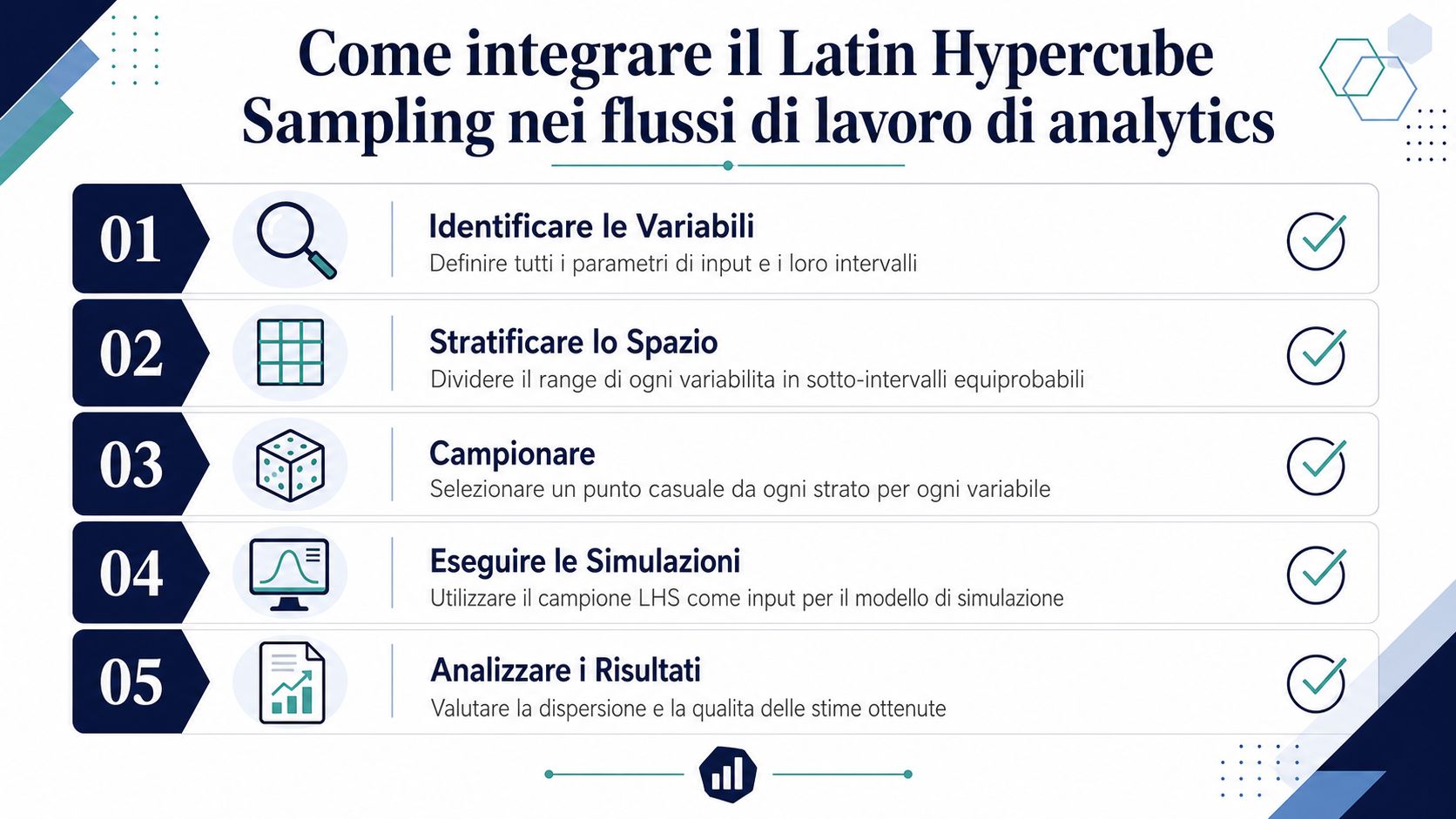
Integration works well when you treat it as part of your workflow, not as an isolated technique. First, identify which inputs are uncertain; then, decide how to stratify them; and finally, check whether the sample truly covers the space you’re interested in. In an analytics platform, this logic can be automated within the forecasting and risk analysis modules.
When the process is integrated into an analytics environment, the main advantage is the reduction in manual work. You don’t have to build the script from scratch every time, and you don’t have to manually double-check every set of scenarios. A platform like ELECTE, an AI-powered data analytics platform for SMEs, can automatically handle the generation of samples within the forecasting and risk modules, leaving you to review the results.
True efficiency isn't just about generating more scenarios; it's about arriving first at scenarios that you can defend in front of management.
The result is a cleaner workflow, especially when you need to switch from simulation to reporting. If the sample is well-designed, the final dashboards also become more useful for those who need to make quick decisions.
Latin Hypercube Sampling does not replace the model, but it improves the way the model is explored. It provides a more uniform coverage of the inputs, makes Monte Carlo simulations more reliable, and helps avoid wasting computational resources on poorly distributed samples. This is precisely why it is of interest to SMEs, because a better sample can improve the performance of the process without adding unnecessary complexity.
If you’re already working with simulations and want to make them more effective, the key isn’t to complicate the model. It’s to improve the quality of the input data, because that’s where a large part of the stability of the results is determined. For an SME looking to make more sound decisions, this is often the most practical step to take.
If you want to integrate Latin Hypercube Sampling into a more user-friendly analytics workflow, ELECTE helps you transform data, simulations, and forecasts into actionable insights without having to build everything from scratch. Visit ELECTE to see how the platform supports forecasting, risk management, and automated reporting, and to learn how to apply these methods to your daily processes.

.svg)


.svg)
.svg)