
Most content comparing AI models starts with the most popular—and least useful—question: Which model is the best? In 2026, for an Italian company, this is often the wrong question to ask. State-of-the-art models are so powerful and so closely matched in everyday use that chasing the top spot in the rankings can easily lead you astray.
As a practitioner, not a spectator, I see a different reality. When you integrate models into a product, you’re not choosing a technological trophy. You’re choosing an operational component. You need to understand which model handles a specific task best—in terms of latency, cost, lock-in risk, and data guarantees. This is where my “B+ Trap” theory comes in: many LLMs today are good enough to be indistinguishable in most common enterprise use cases.
That is why a true comparison of AI models for 2026 is not a ranking. It is an architectural, economic, and geopolitical decision. For a European SME, practical factors matter more than rhetoric: governance, data residency, integration, provider substitutability, and alignment with real-world processes.
The market is crowded, but it isn’t chaotic if you look at it the right way. Instead of listing dozens of names, it makes more sense to categorize the players based on strategic logic: generalist proprietary models, open-weight models, European players focused on sovereignty, and specialists that prioritize speed, multimodality, or cost.
| Family | Examples Cited in the 2026 Market Report | Where they tend to stand out | Practical Trade-off |
|---|---|---|---|
| Generalist Owners | OpenAI, Anthropic, Google | Broad task coverage, consistent quality, API ecosystem | Less direct control over the model and provider changes |
| Open-weight | Meta Llama, Mistral, and others | Greater control, the option to self-host, customization | Greater operational complexity and infrastructure responsibilities |
| Europeans Committed to Sovereignty | Mistral, Euro-Canadian Initiatives | Alignment with European standards on governance and data | Ecosystems that are often smaller than the U.S. giants |
| Optimized for speed or cost | Various specialized models | Throughput, latency, or cost-effectiveness for specific tasks | Not always the best choice as a standalone model |
An Italian comparative guide published in 2026 notes that Claude Opus 4.8 tops the rankings of models already released with a score of 67.9 on LLM Stats as of June 3, 2026, ahead of GPT-5.5 with 62.9 and Claude Opus 4.7 with 60.5, but it also emphasizes that there is no single, absolute best model. There is a best model for each specific task, ranging from reliable all-rounders to cost-effective or open-source options, as reported in Punku’s 2026 AI comparison guide.
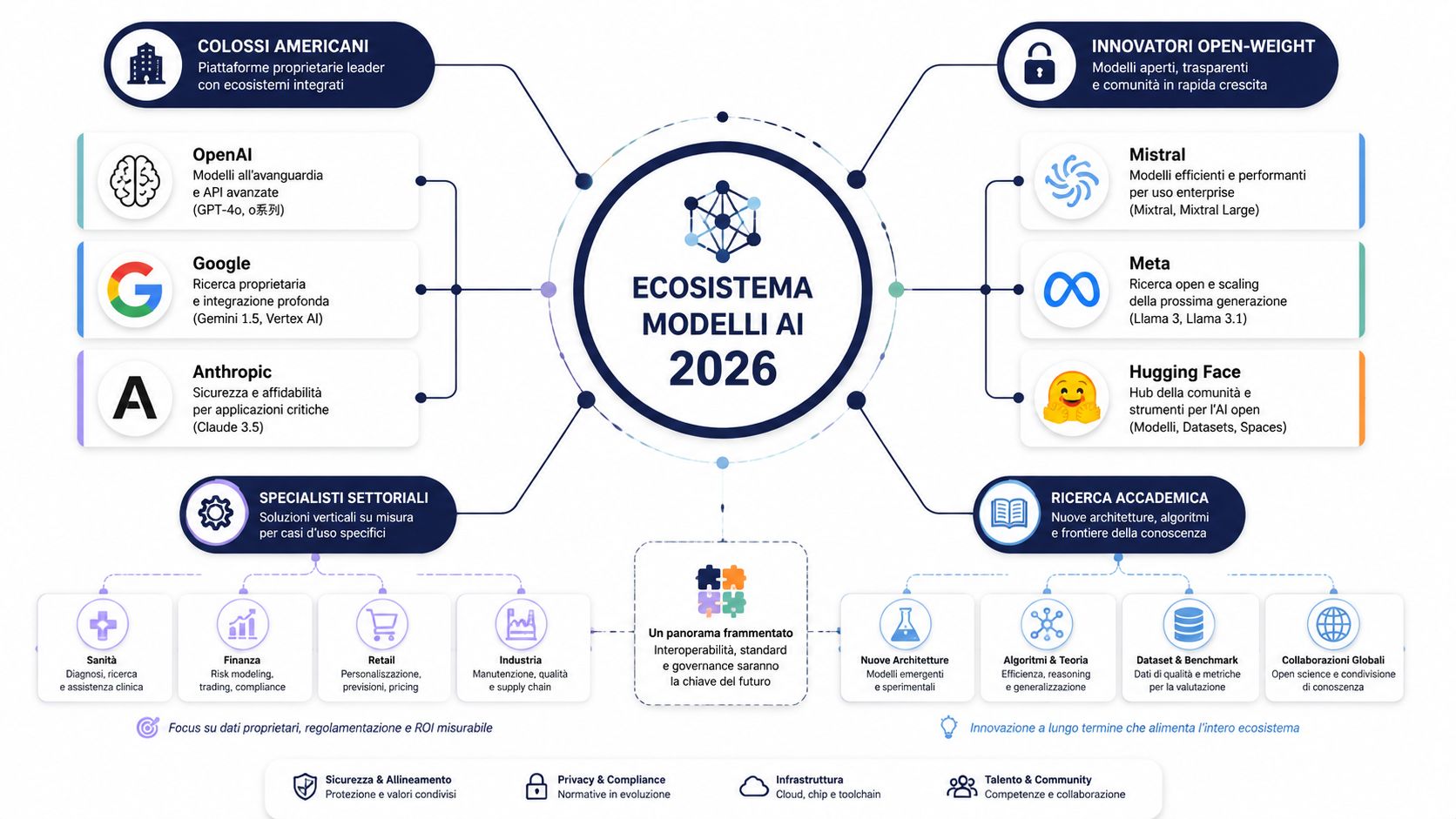
The American giants remain the benchmark for the breadth of their ecosystems. OpenAI dominates the general-purpose and reasoning segments. Anthropic is often chosen when conversational reliability and consistency are key. Google is pushing hard in areas where multimodality and integration with its own tech stack make a difference. xAI is positioning itself more aggressively in terms of context and pricing.
On the European front, Mistral plays a role that goes beyond that of a mere “alternative.” For many European companies, it represents an opportunity to align their technology stack, jurisdiction, and control. Meta, on the other hand, continues to shift the center of gravity in the open-source landscape with Llama, making self-hosting a practical reality rather than just a theoretical concept.
A serious decision doesn't just compare models. It compares business philosophies, technological dependencies, and the ability to integrate into the business.
For those who want a broader view of how the market is evolving, ELECTE’s insights into the LLM market are also useful, especially for understanding the players as components of a stack rather than as brands to root for.
The most overrated aspect of the debate is benchmarking. Not because benchmarks are useless, but because many decision-makers interpret them as if they directly reflected the value being produced. They do not.
In real-world applications, companies don’t ask LLMs to pass a test. They ask them to analyze structured data, summarize documents, write a readable report, classify requests, extract insights, and assist a human operator. In these cases, the perceived difference between state-of-the-art models tends to narrow.
This is where I discuss the “B+ Trap.” If three or four models all produce output that is sufficiently accurate, understandable, and usable, the competitive advantage no longer lies in minute differences in quality. It lies in everything surrounding the output.

In our work on the platform, the meaningful comparison wasn’t “who writes the most elegant answer.” It was:
We tested different models on real-world tasks. For the AI agent designed for data analysis and report generation, a practical comparison of Claude, GPT-4o, and Gemini revealed one simple fact: the difference in quality, across the most common frontier use cases, was marginal. The differences in integration, model behavior, cost, and latency, however, were not.
Rule of thumb: If two models lead the user to the same decision, you’re no longer choosing the best model. You’re choosing the most manageable system.
This has an important implication for those searching for “AI models 2026 comparison” from a business perspective. It’s not advisable to design your adoption strategy around the highest benchmark. Instead, it’s better to design your architecture with replaceability in mind. Providers change prices, versions, and output formats. If your stack relies too heavily on a specific model behavior, you’re introducing fragility precisely where you wanted to achieve efficiency.
For a European SME, the choice of model isn’t determined by looking at who scored half a point higher on a leaderboard. It’s determined by which model reduces operational risk, external dependence, and friction with compliance, procurement, and IT. This is where many companies fall into the B+ Trap. They chase the “very good” model based on benchmarks and discover too late that the real problem was something else entirely: data, costs, contracts, and jurisdiction.
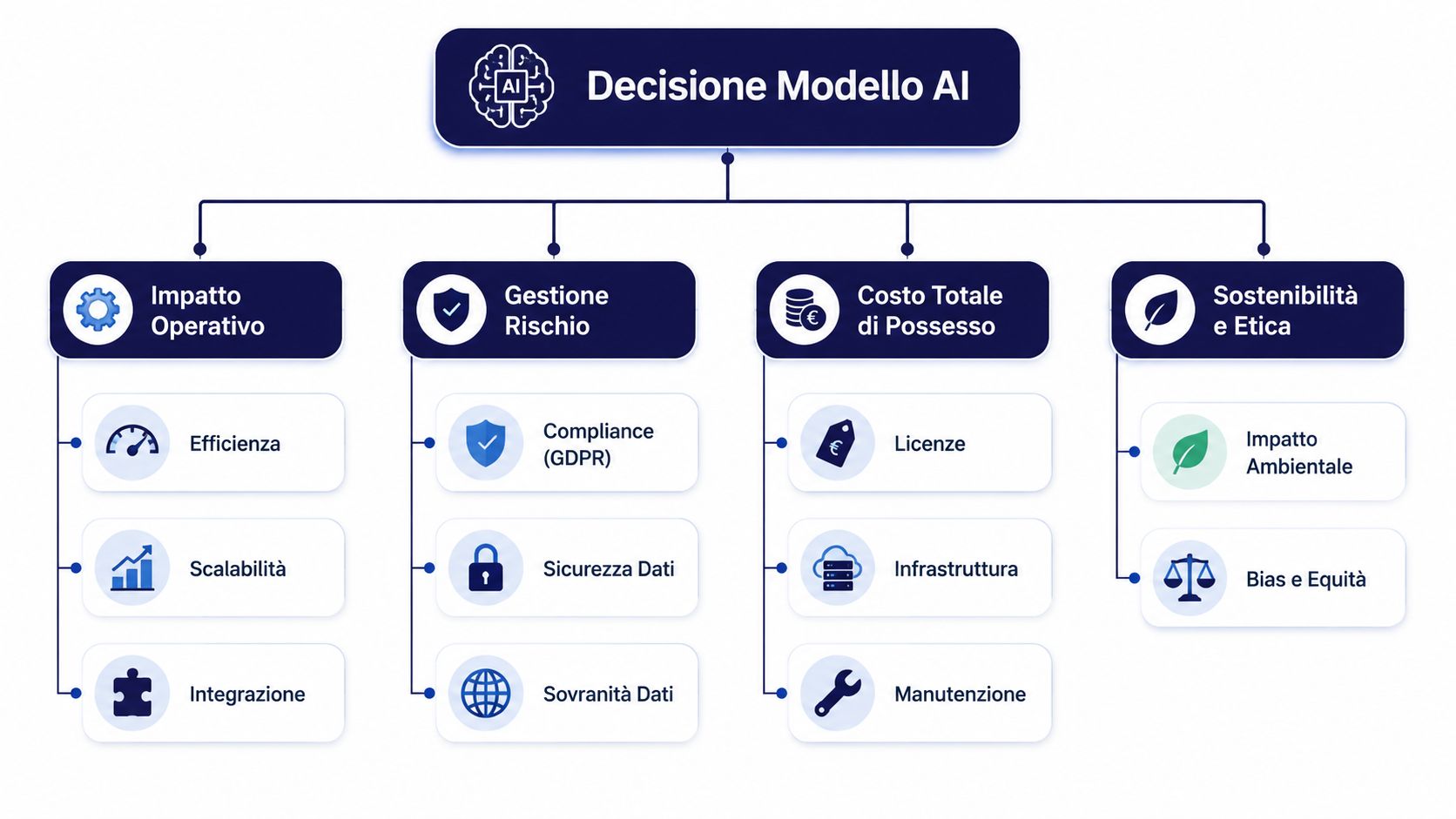
In 2026, the first key consideration is governability. A model that looks brilliant in a demo can turn out to be a poor choice if you don’t know where the data goes, how logs are stored, what contractual guarantees you have regarding data processing, and how verifiable the data flow is in the event of an audit.
For this reason, in companies that handle sensitive data, the initial question changes. It’s not “How well does it reason?” It’s “How much control do I have over the process?”
The useful checks are very practical:
SME leaders often underestimate this step because AI is purchased as software. In practice, it becomes part of the company’s decision-making processes. This is why PTManagement’s guide for SMEs remains useful; it emphasizes a valid point: value depends on the operational context in which you implement the tool, not solely on the theoretical quality of the response.
The second criterion is total cost of ownership. The price per token matters, but it rarely determines the decision on its own. In practice, the provider’s update frequency, the effort required to maintain prompts and tests, the quality of the APIs, throughput limits, error handling, and the time lost when an integration changes its behavior without notice all have a greater impact.
I often see a budgeting mistake here. The CFO approves a relatively small “AI API” line item. After six months, the significant cost isn’t the provider’s invoice. It’s the team hours spent stabilizing the pipeline, rerunning validations, and handling exceptions.
It is therefore advisable to consider at least four aspects:
A model with slightly better output, but with costs that are difficult to control and inflexible contracts, weakens the business case. For an SME, this is the most common form of the B+ Trap.
For a European company, geopolitics is not an abstract concept. It influences the choice of model through contractual clauses, export controls, sovereignty requirements, regional service availability, and supplier continuity.
The right question is simple: if the regulatory or business environment changes, will your tech stack continue to function without disrupting your business?
This leads to a preference for replaceable architectures, with a level of abstraction above the model and clear fallback criteria. In some cases, it makes more sense to purchase application capabilities rather than a specific model. ELECTE, an AI-powered data analytics platform for SMEs, follows this logic: defined tasks, data analysis, automated reports, and AI agents integrated into the application stack. For many SMEs, this is a more sensible choice than manually selecting the “winning model” of the quarter, because it shifts the focus to operational results, compliance, and service continuity.
The useful distinction is not philosophical. It is practical. For a European SME, the right question is: Which option reduces risk, total cost, and future dependence without slowing down the business?
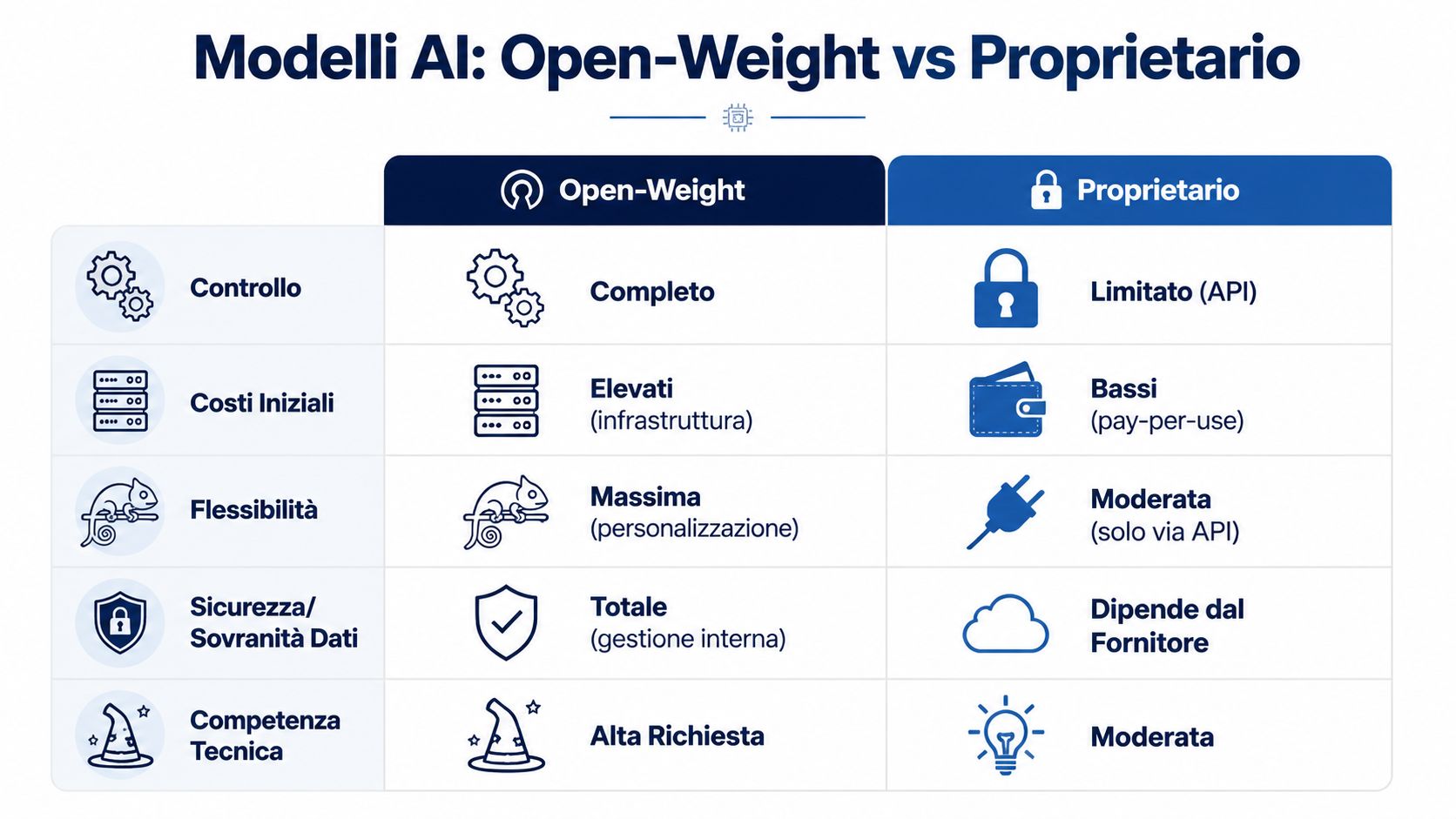
In practice, the proprietary API-based model remains the best choice for many companies. The reason isn't its absolute technical superiority. It's the fact that it buys time, reduces internal complexity, and allows companies to test real-world use cases before investing in infrastructure.
This approach works well if you need to go into production quickly, if volumes are still fluctuating, or if the AI is a feature within a broader process rather than the core of the product. In these cases, paying on a pay-as-you-go basis is often a better option than building capacity that the team isn't yet able to manage effectively.
There is also a managerial advantage that is often underestimated. With an API, the cost of an initial mistake is lower. If a use case doesn't generate profit, you can shut it down or switch providers without having to deal with servers, pipelines, and specialized staff.
Open-weight makes sense when it provides a tangible benefit. This is particularly true in three situations: when dealing with sensitive or regulated data, when data volumes are high enough to make inference optimization worthwhile, or when there is a need for deep customization within the business domain.
This is where many companies fall into the “B+ Trap.” They see an open-weight model that’s almost on par with the leaders in public tests and conclude that it’s the most rational choice. But the point isn’t to come close to the benchmark. The point is to understand whether that additional control actually improves your bottom line, compliance, or business continuity.
Speed, for example, matters only in specific contexts. It matters if you’re serving many users simultaneously, if you have strict latency constraints, or if the cost per token determines the service’s profit margin. If, on the other hand, the AI generates a small number of high-value responses, the real difference lies not in theoretical throughput but in the system’s reliability, the quality of the prompt stack, and the ability to handle exceptions.
Self-hosting, in fact, doesn’t just mean “keeping the model in-house.” It means managing GPU provisioning, observability, versions, security patches, fallbacks, capacity planning, and incidents. I’ve seen more than one project take a turn for the worse after migrating to open-weight—not because of the model’s limitations, but because the team lacked the operational discipline required for that choice.
Choose open-weight only if you have a verifiable economic, regulatory, or architectural reason.
For those considering the trade-off from a broader perspective, this guide on how to choose artificial intelligence for your business helps you understand when it makes more sense to purchase application capabilities rather than chasing the “quarterly model.”
By 2026, AI will be more than just a software market. It will be strategic infrastructure. This changes the significance of technical choices.
The AI Index Report 2026 notes that over 90% of the most significant state-of-the-art models are developed by companies, not universities, and that the computational power required by these systems has grown by about 3.3 times per year since 2022, as summarized in the analysis published by Il Bo Live on the AI Index Report 2026. This is the statistic that many people overlook or misinterpret.
The implication is clear. The comparison between models no longer depends solely on algorithmic quality. It depends on access to computing infrastructure, supply chains, industrial capacity, strategic partnerships, and the ability to integrate into products. In other words, when you choose a model, you’re also choosing an industrial ecosystem.
For an Italian company, this has at least three consequences.
The first is jurisdictional dependence. If the model and much of the infrastructure belong to a non-European ecosystem, you need to consider not only performance and price, but also the regulatory framework and data governance.
The second issue is roadmap dependency. Major providers don't evolve based on your internal processes. They evolve based on their own business strategy. If a product change disrupts your pipeline, the problem is yours, not theirs.
The third is the value of diversity. In such a concentrated landscape, a resilient strategy isn’t built around a single vendor. It’s built on abstraction, portability, and the ability to renegotiate the stack.
On this topic, I also recommend further reading on the “Guides to AI Tools and Data Sovereignty,” because the issue isn’t about choosing “Europe versus the United States.” It’s about understanding when data sovereignty becomes a competitive advantage, rather than simply a regulatory constraint.
If you need to make a decision in the coming months, don't start with the provider's name. Start with the nature of the problem.
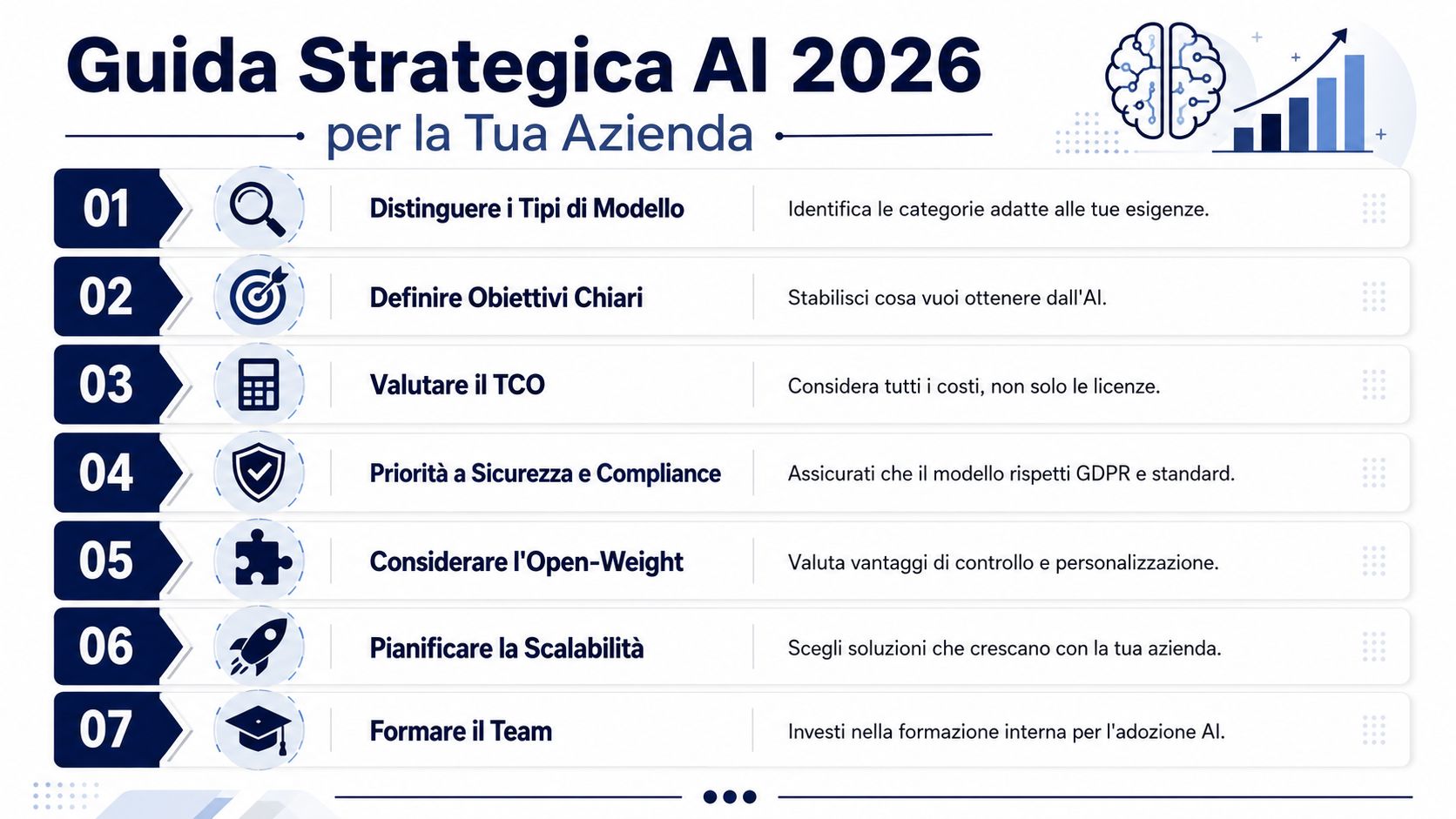
A good AI project doesn't start with "Which model should we choose?" It starts with "Which decision do we want to improve, using what data, and under what constraints?"
One final important note. This article does not constitute legal or regulatory advice. If you operate in regulated industries, you should verify compliance with your legal team, your DPO, and your security officers.
The most useful comparison of AI models in 2026 for a business does not crown an absolute winner. It identifies the right model for the right context. In 2026, basic quality is increasingly accessible. The competitive advantage shifts to integration, total cost, data governance, architectural resilience, and geopolitical alignment.
Those who continue to make choices based solely on rankings risk buying power when what they really need is control. Those who analyze the market from an operational perspective, on the other hand, understand that the real difference isn’t between “strong” and “weak” models, but between manageable stacks and fragile stacks.
For a European SME, this is not a theoretical distinction. It is the difference between experimenting with AI and actually using it for decision-making, analytics, and automation.
If you want to see how ELECTE tackles this complexity in a practical way, you can explore a platform that connects business data, generates insights, automates reports, and integrates AI into real-world processes, with a focus on governance and operational efficiency for European SMEs.

.svg)


.svg)
.svg)