
You've seen this scenario before. The sales team sends you an Excel file with sales figures. Customer support forwards emails with recurring complaints. The warehouse shares photos of damaged products. The admin team keeps invoices and PDFs in separate folders. Each team sees a piece of the problem, but no one sees the whole picture.
This is where multimodal AI business applications become appealing to an SME. Not because they’re trendy, but because they help integrate data that currently exists in silos: text, tables, images, documents, and operational logs. Multimodal AI analyzes them together, just as a person would when listening to an explanation, looking at a chart, and reading a report before making a decision.
For a manager, the issue isn’t technical. It’s operational. If you connect your data sources in an organized way, you can turn scattered signals into insights that are more useful for forecasting, quality control, customer service, and reporting. If you want to know where to start, a good first step is to get a clear picture of the data sources you can connect within your company.
Monday morning. The sales rep checks the CRM, the admin team opens the invoice PDFs, the quality manager reviews photos and reports, and customer service reads emails and tickets. Everyone is looking at the same customer or the same process, but from different perspectives. The result is predictable. Decisions are made too late, or they’re made with a piece of the context missing.
In SMEs, this problem is more common than it seems, because data isn’t stored in a single, organized system. It’s scattered across Excel files, documents, images, chat messages, management systems, and exported reports. Analyzing each source separately is a bit like assessing a store’s performance by looking only at the sales receipt, without considering returns, customer complaints, and photos of the shelves. You get an answer—but it’s not always the right one.
Multimodal AI is designed precisely to piece this picture back together. In practice, it brings together different signals, links them, and interprets them within the same analytical workflow. For a manager, the value does not lie in the technology itself. It lies in the fact that an anomaly can be detected earlier, a priority can become clearer, and a decision can be based on a context that more closely reflects operational reality.
Here’s a point that’s often overlooked. For an SME, adopting multimodal AI doesn’t mean rebuilding the infrastructure from scratch. In most cases, it makes sense to start with existing data sources, connect them effectively, and choose a process where the cost of fragmentation is already apparent—such as document control, customer service, or quality monitoring. A useful starting point is to have a clear overview of the company’s data sources to be integrated, so as to understand where context is lost and where it can generate economic returns.
When sales, operations, and administration teams interpret the same issue differently, the cost isn't just in terms of information. It translates into wasted time, avoidable errors, and shrinking margins.
That’s why the issue isn’t just about innovation. It’s about decision-making coordination. Unifying textual, visual, and structured data helps reduce manual steps, minimize ambiguity, and better measure the ROI of AI projects—without chasing generic use cases or overly ambitious promises.
A traditional system often operates in a single mode: text only, images only, or numbers only. This approach is useful for specific tasks, but it falls short when the business environment mixes everything together.
Multimodal AI, on the other hand, processes multiple types of input simultaneously. It can combine text, images, audio, video, and structured data to uncover relationships that would otherwise remain hidden. McKinsey explains that multimodal models are particularly well-suited for processing multisensory data and combining text, images, audio, and video. In practice, a multimodal analytics engine can unify CRM feeds, support tickets, invoice PDFs, and product images into a single graph, reducing context loss and improving the quality of predictions because weak signals can be automatically correlated (McKinsey’s explanation of multimodal AI).
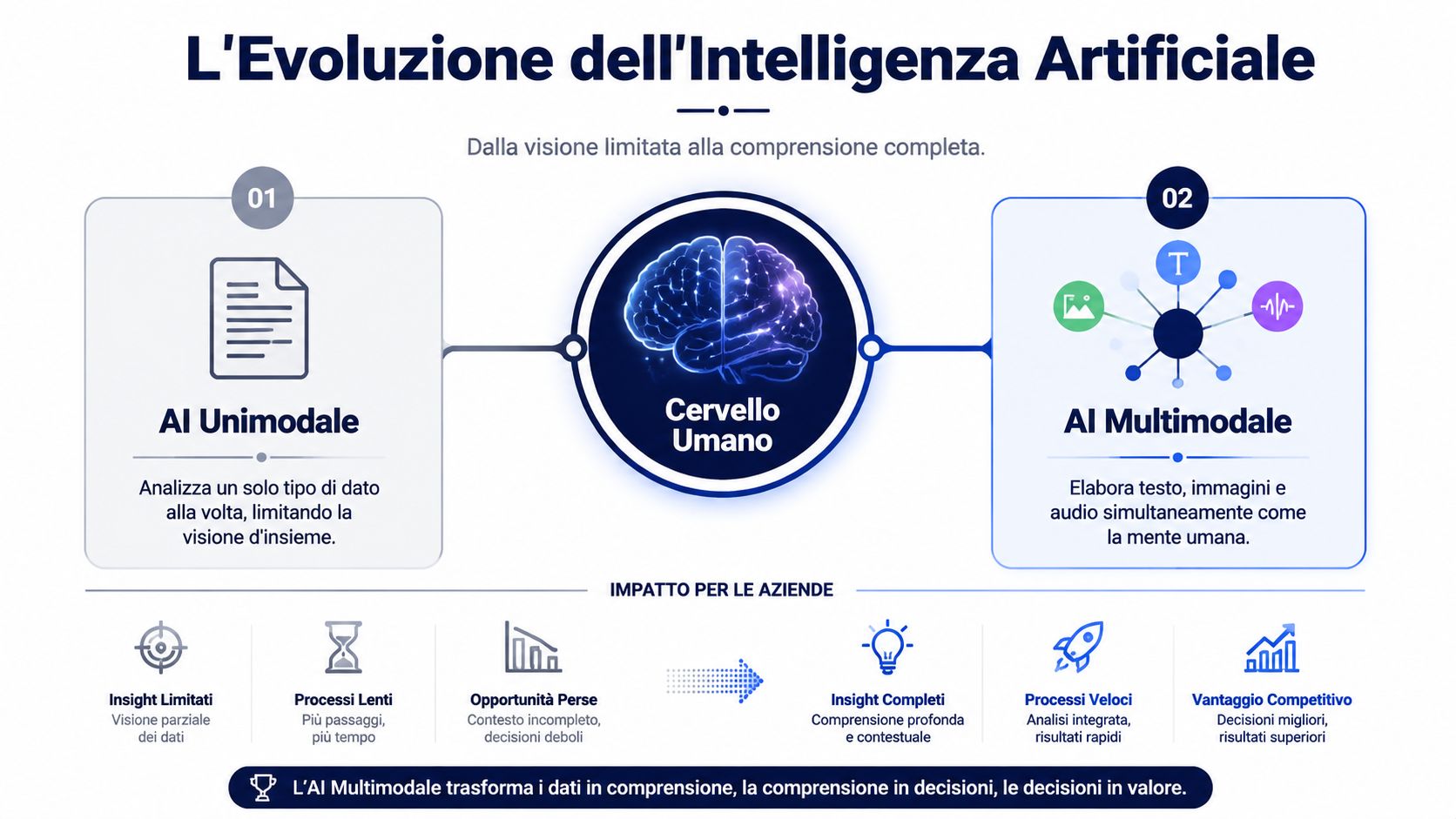
For a manager, the practical difference is this:
| Approach | What does he see? | What You Risk Losing |
|---|---|---|
| Unimodal AI | A single data stream | The context provided by other sources |
| Multimodal AI | The connection between different sources | Weak signals and inconsistencies are less easily detected |
If sales figures, reviews, and shelf images tell three different stories, unimodal AI interprets them separately. Multimodal AI tries to figure out whether they are actually describing the same problem.
This is where many readers get confused. It seems like magic, but the principle is straightforward.
The model takes various types of data and transforms them into a comparable representation. It’s like translating Italian, English, and Spanish into a common language before analyzing an international contract. In the world of AI, this translation is similar to the concept of embedding. Text, images, or numerical signals are converted into mathematical representations that the system can compare.
Then comes the fusion. Instead of analyzing each mode on its own until the end, the system combines them to form a single view. At that point, the value does not come from the individual data points, but from the relationships between them.
Rule of thumb: If your business problem can be fully understood by analyzing a single database, you probably don't need multimodal AI. If, on the other hand, the context is spread across documents, images, and different systems, then everything changes.
The best way to understand it is to follow it through a real-world process.
Before. A retailer notices a drop in sales for a product line. The sales team checks the dashboard. The category manager receives photos from stores. Customer service reviews comments and returns. Each team comes up with its own analysis.
Next. A multimodal system collects sell-out data, shelf photos, customer receipts, and product descriptions. If it detects damaged packaging or inconsistent displays in the images, it can link that signal to text-based complaints and a drop in sales. Decisions are no longer made based on three separate meetings, but on a single view.

The same pattern holds true elsewhere as well:
Not all companies start with sophisticated systems. Many begin with more practical use cases, often involving images and documents. A 2025 overview of the multimodal market indicates that computer vision-based solutions account for 35% of implementations and that the cloud accounts for 57% of deployments, a sign that many companies start with computer vision applications and scalable cloud platforms before expanding their use to documents, dashboards, and more complex workflows (overview of the multimodal market).
This information is helpful because it takes the pressure off. You don't have to build everything all at once.
If your small or medium-sized business has a lot of PDFs, photos, tickets, and Excel spreadsheets, you’re already sitting on multimodal data. The point isn’t to create it. It’s to orchestrate it.

This is one of the areas where ROI tends to be most transparent for an SME. You have repetitive documentation, well-known rules, and significant hidden costs associated with monitoring, reclassification, and verification.
Multimodal systems combine OCR and NLP to extract data from scans, PDFs, and notes, transforming them into structured data that can be used for processes such as invoices, receipts, and contracts (SuperAnnotate’s in-depth look at multimodal AI). In practice, the system doesn’t just “read” a file. It compares what it finds in the document with the context available elsewhere.
A concrete example. An SME receives invoices from multiple suppliers in different formats. A traditional approach extracts standard fields. A multimodal approach can also compare the invoice text, the document image, the supplier history, and the order in the ERP system. If it detects inconsistencies, it flags the case to an operator.
The most realistic benefits here are:
In risk management processes, the value of multimodality is even more evident. A single source may be misleading, incomplete, or simply ambiguous. Multiple sources, if well-aligned, serve as checks and balances on one another.
McKinsey notes that, in the insurance industry, cross-checking customer statements, transaction logs, and photos or videos of attachments helps reduce fraud. For an Italian SME, this principle also applies outside the insurance sector. Consider expense reports, reimbursements, compliance documents, supplier audits, or credit checks. If free-form text, visual attachments, and operational history are compared together, it becomes easier to identify inconsistencies before human validation.
A good multimodal system does not replace human oversight in sensitive cases. It makes the process faster and more targeted.
But here, balance is key. The risk isn't just technical—it's also organizational. If the team doesn't clearly define which anomalies really matter, you'll end up with unnecessary alerts or important issues being overlooked.
In customer service, issues rarely occur through just one channel. A customer opens a ticket, sends a photo, leaves a comment, and may have already experienced delivery delays. If you analyze only the text of the ticket, you miss half the context.
Multimodal AI allows you to view CRM history, support notes, attachments, and operational logs all at once. The benefit isn’t simply “responding with AI” in a general sense. The benefit is better classifying cases, understanding priorities, and identifying recurring patterns.
For example, you can more quickly distinguish between:
In operations, the principle is the same. When you combine machine logs, defect images, technician notes, and production data, you can better understand the chain of events. You’re not just looking at the final error. You’re looking for the cause that led to it.
Many business reports are accurate yet of little use. They explain what happened, but they don't help us understand why.
This is where multimodal AI business applications really come into their own. An executive report becomes more valuable when it combines numbers, operational documents, customer signals, and visual indicators into a coherent narrative. It’s not about replacing traditional BI. It’s about providing more context.
A sales manager, for example, doesn’t just want to know that a category has slowed down. He wants to understand whether the reason is price, inventory, merchandising, complaints, or channel mix. Multimodal reporting brings reporting closer to addressing this managerial question.
The first tangible benefit is a reduction in context loss. When data remains siloed, people spend time manually reconstructing connections. When data communicates with each other, time is shifted from data assembly to decision-making.
The second advantage is the quality of the assessment. A model that compares multiple sources can detect weak signals, inconsistencies, and probable causes with greater reliability than a single-source approach. This is important in processes such as forecasting, document review, anomaly analysis, and executive summaries.
The third benefit is useful automation. Not the kind of automation that produces more output, but the kind that eliminates repetitive work from low-value steps.
This is where many initiatives get stalled. Not because the idea is wrong, but because the project starts out too broad.
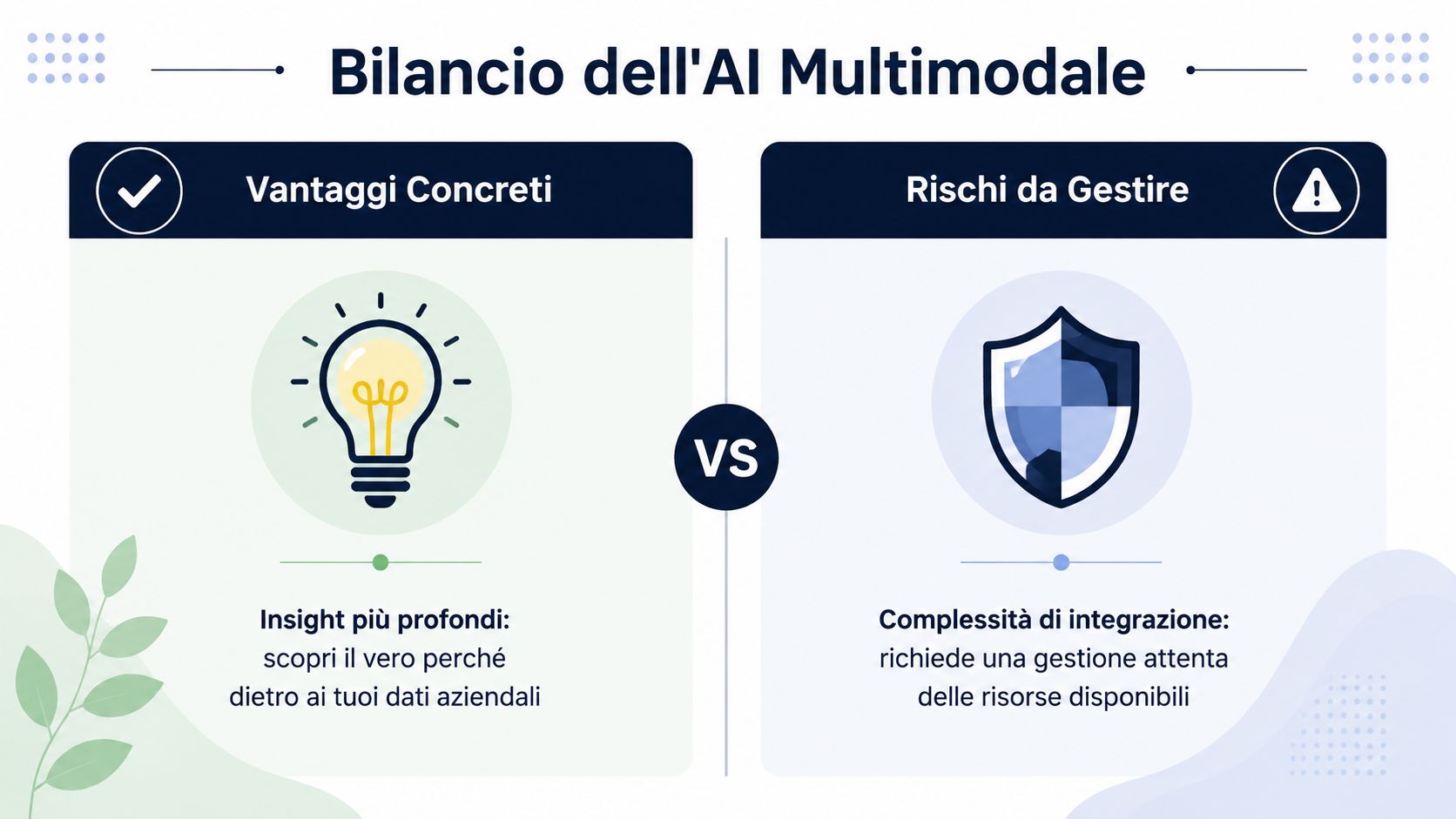
Milvus highlights three key limitations of current multimodal models: high computational intensity, difficulty in correctly contextualizing cross-modal data, and poor generalization to real-world scenarios not encountered during training. This helps explain why many pilot projects fail to scale and why it makes sense to choose platforms with pre-optimized models and managed infrastructure (current limitations of multimodal models, according to Milvus).
For an SME, the main risks to manage are as follows:
Start with a narrow scope, a clear process, and fairly well-organized data. In multimodal analysis, discipline is more important than the power of the model.
A prudent SME treats its first project as a learning investment. It doesn't ask AI to revolutionize the company. It asks AI to effectively solve a specific problem.
The most common mistake is falling in love with the technology and then trying to find a use for it. The correct sequence is the opposite. Start with a process where you’re currently losing time, quality, or visibility.
Rasa highlights a point that is often overlooked: companies don’t just ask themselves what AI can do, but also what data is needed, how to manage the data flow, and which processes to automate first. The most solid approach is to start with simple use cases and then expand functionality, focusing on problems where the context arises from the combination of multiple sources (Rasa’s practical guide to multimodal use cases).
A good pilot problem has three characteristics:
Typical examples for an SME:
Here, it’s best to take a very practical approach. There’s no need to start with text, images, audio, and video all at once. Two well-chosen formats are enough.
A realistic workflow might look like this:
| Phase | Question from ports | Expected output |
|---|---|---|
| Data Audit | Where data is stored and in what format it is received | Map of Sources and Minimum Quality Standards |
| Selecting a Use Case | Which process is really affected by silos? | A driver with a clear goal |
| Integration | How do I align keys, timestamps, and metadata? | Usable dataset |
| Validation | Insights really do help decision-makers | Operational Feedback |
| Extension | It's worth replicating elsewhere | Stair landing |
The most challenging part is alignment. If you gather customer tickets and images but can’t link them to the same order, the project gets off to a bad start. If, on the other hand, you have a common ID, a reliable date, or a shared matching logic, the quality of the test improves immediately.
For many SMEs, it’s also helpful to follow a step-by-step implementation guide, such as this 90-day roadmap for AI adoption, because it helps turn an abstract idea into weekly tasks.
The pilot must answer a simple question: Is the process working better now, or not?
It measures both operational elements and the quality of decision-making. For example:
If you don't first define what you're going to improve, you'll end up confusing the activity with the result.
Once the value has been confirmed, expand the scope to adjacent areas. Move from invoice verification to contracts. Move from product images to in-store images. Move from receipts to call transcripts. The right approach isn’t “more AI.” It’s “the same method, applied to another process where the data is already available.”
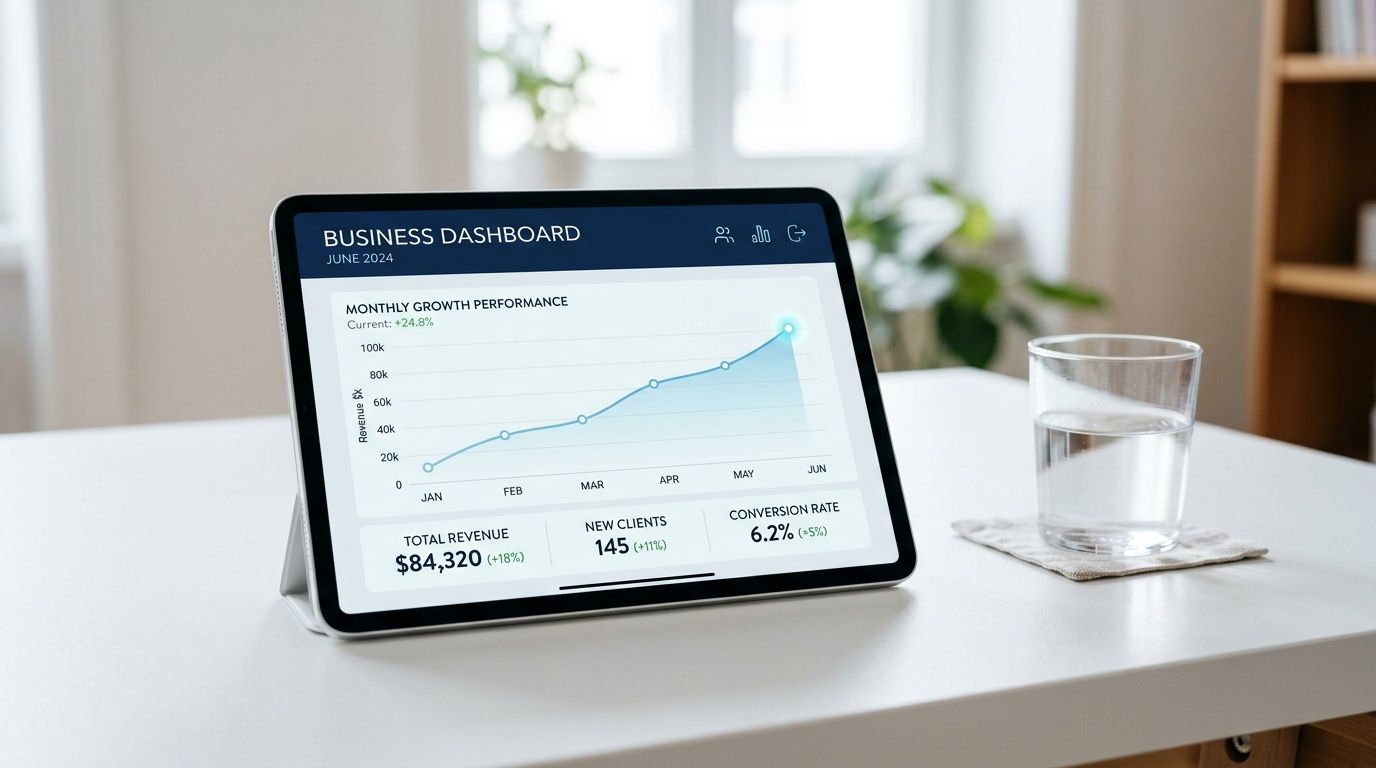
An SME manager doesn't just need to know whether the model "works." They need to understand whether the process is less expensive, whether decisions are made faster, and whether the team trusts the outcome. That's the difference between an interesting prototype and a tool that truly becomes part of day-to-day management.
That’s why the most useful KPIs are those that link multimodal AI to the income statement and operational quality. In practice, it’s worth tracking:
A simple rule of thumb helps prevent mistakes. If a KPI doesn't influence an operational decision, it's probably not the right KPI.
On the market front, the message is clear. Investment in GenAI is growing rapidly, and many companies are integrating AI into a wider range of functions—not just isolated projects. For an SME, this doesn’t mean jumping on a bandwagon. It means understanding where the combined use of text, documents, images, and business data can yield a measurable return—without having to rebuild existing systems from scratch.
In practice, value isn't created by the model alone. It's created at the point where different data sets are collected, cleaned, linked, and made readable to decision-makers. If this step is weak, even a good algorithm produces little value.
An analytics platform functions like a control room. It does not replace ERP, CRM, or document management systems. Instead, it coordinates them. It connects data sources, maintains a consistent interpretation framework, applies access rules, and transforms technical outputs into dashboards and reports that are useful to business leaders.
For an SME, this factor has a significant impact on ROI. Building separate integrations for each data source increases time, maintenance costs, and reliance on specialized expertise. Using a platform specifically designed to unify data and insights reduces organizational friction and allows you to start with a limited scope, then expand the project only where the benefits are clear.
In this context, ELECTE, an AI-powered data analytics platform for SMEs, can be used as a hub to connect diverse data sources, automate pre-processing, generate insights, and produce visual reports without having to build the entire technical stack in-house.
There is also one point that many projects overlook. Integration is not just a technical matter. If administration, operations, and management gain new insights but continue to make decisions as before, the value remains limited. For this reason, it is advisable to accompany the rollout with clear guidelines on how to manage change within the company, especially when the new workflow alters responsibilities, verification timelines, and reporting procedures.
Ultimately, the right question is a practical one. Does the platform help managers spot a problem sooner, better understand its cause, and take action with fewer manual steps? If the answer is yes, the integration is generating real value. If the answer is vague, the project needs to be adjusted before it is rolled out.
Multimodal AI isn't interesting simply because it combines multiple technologies. It's useful because it better reflects the reality of your business. Where you currently have separate spreadsheets, documents, images, and operational signals, you can begin to build a single view that more closely mirrors how managers actually make decisions.
For an SME, the sensible approach isn't to revolutionize everything right away. It's to choose a concrete process, combine two information sources, measure the results, and scale up only when the value is clear. That way, the ROI becomes measurable and the risks remain under control.
The best multimodal AI business applications don't come from spectacular demos. They come from real-world problems, readily available data, and a well-structured roadmap.
If you want to learn how to connect your data, automate insights, and turn scattered reports into faster decisions, check out how ELECTE works.

.svg)


.svg)
.svg)