
You have your sales data in an Excel file, your CRM on another platform, your marketing campaigns in a separate dashboard, and your financial data in your accounting software. Every week, someone exports CSV files, pastes columns, corrects errors, and tries to figure out what’s really going on. Meanwhile, the market is changing, customer behavior is shifting, and decisions are coming too late.
This is the situation many SMEs find themselves in today. It’s not that they lack data. What they lack is the ability to turn that data into clear insights in a timely manner, without having to rely on technical specialists every time. This is precisely where the no-code AI analytics platform comes into play.
Context matters. The global market for no-code AI analytics platforms reached $8.6 billion in 2026 and is projected to reach $75.14 billion by 2034, with a CAGR of 31.13%, driven in part by the need to reduce dependence on highly skilled AI developers, as reported by Fortune Business Insights on the no-code AI platform market.
If you run an SME, the point isn’t to follow the latest tech trends. The point is to figure out how to move from operational chaos to a faster, more transparent, and more sustainable decision-making system.
Spreadsheets remain useful. The problem arises when they become the centerpiece of a company’s decision-making process. At that point, every analysis depends on manual tasks, repeated checks, and differing interpretations by different teams.
A no-code AI analytics platform changes this paradigm. It doesn’t replace business knowledge—it enhances it. It allows non-technical users to connect data, ask questions in plain language, read dashboards, identify anomalies, and build forecasts without writing code.
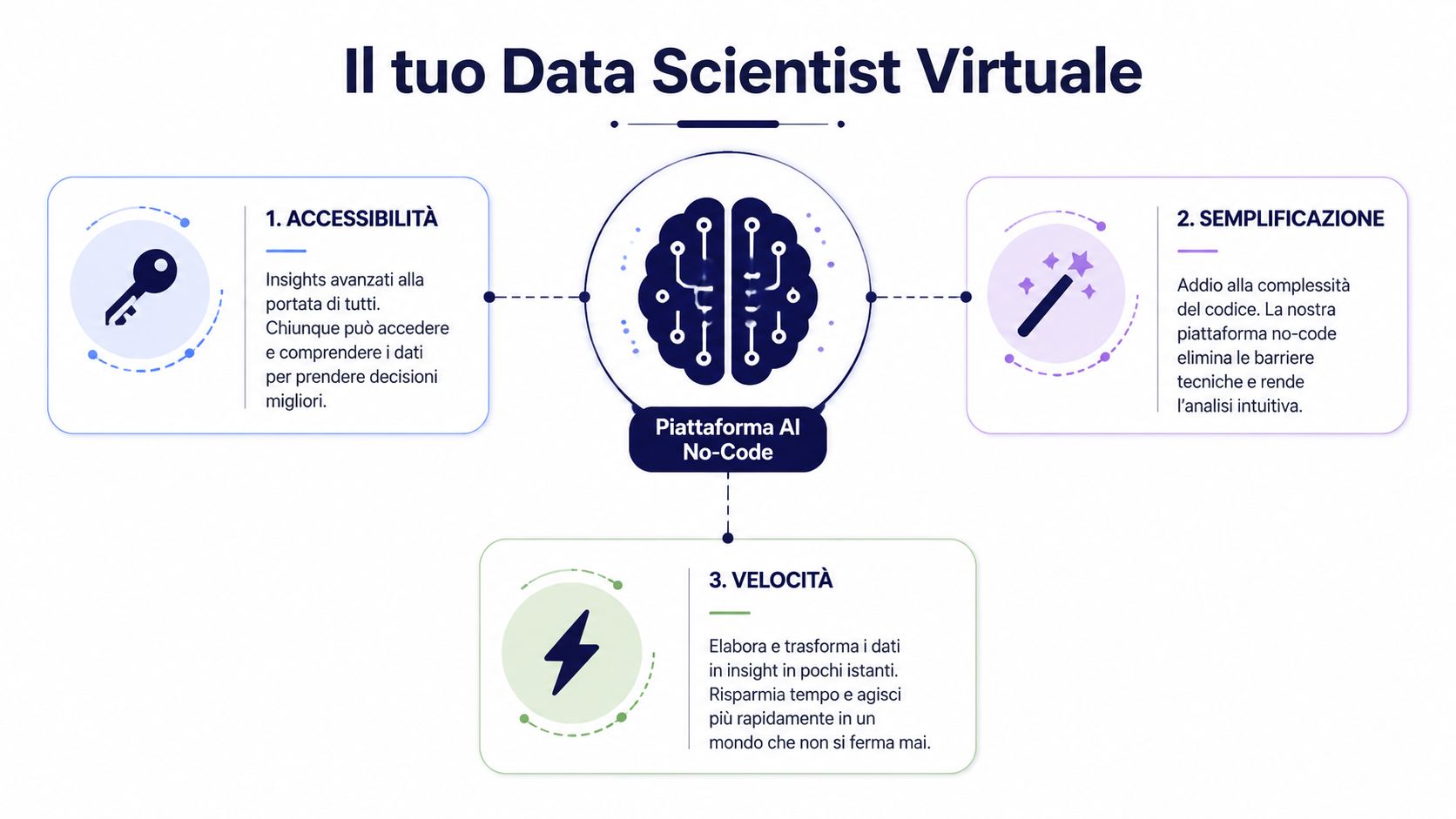
The most useful analogy is this: think of a platform like this as a virtual data scientist available to the team, but with an interface designed for managers, business analysts, sales managers, and finance professionals.
In short, a no-code AI analytics platform allows you to:
Many SME leaders confuse three different categories. It is important to distinguish them clearly.
| Approach | What is required | Main limitation |
|---|---|---|
| Traditional BI | Dashboards, queries, analytical support | Often, you need someone to prepare the data |
| Code-based development | Data scientists, developers, dedicated pipelines | High organizational costs and longer lead times |
| No-code AI analytics platform | Visual interface and wizard-based logic | It must be properly managed to prevent unregulated use |
The most important difference isn't just technical. It's organizational. With traditional tools, the business makes requests and waits. With no-code, the business explores directly, within clear guidelines.
A good no-code platform doesn’t eliminate the need for discipline. It eliminates the need to hold up every question by waiting for the technical team.
For an SME, this is crucial. When the sales manager wants to understand why a region is slowing down, or the finance team wants to compare margins and promotional costs, waiting days often means making decisions too late.
The process only seems complex as long as you think of it as an IT project. In practice, the workflow is much more like a well-organized sequence of steps. The platform connects, cleans, analyzes, and translates.
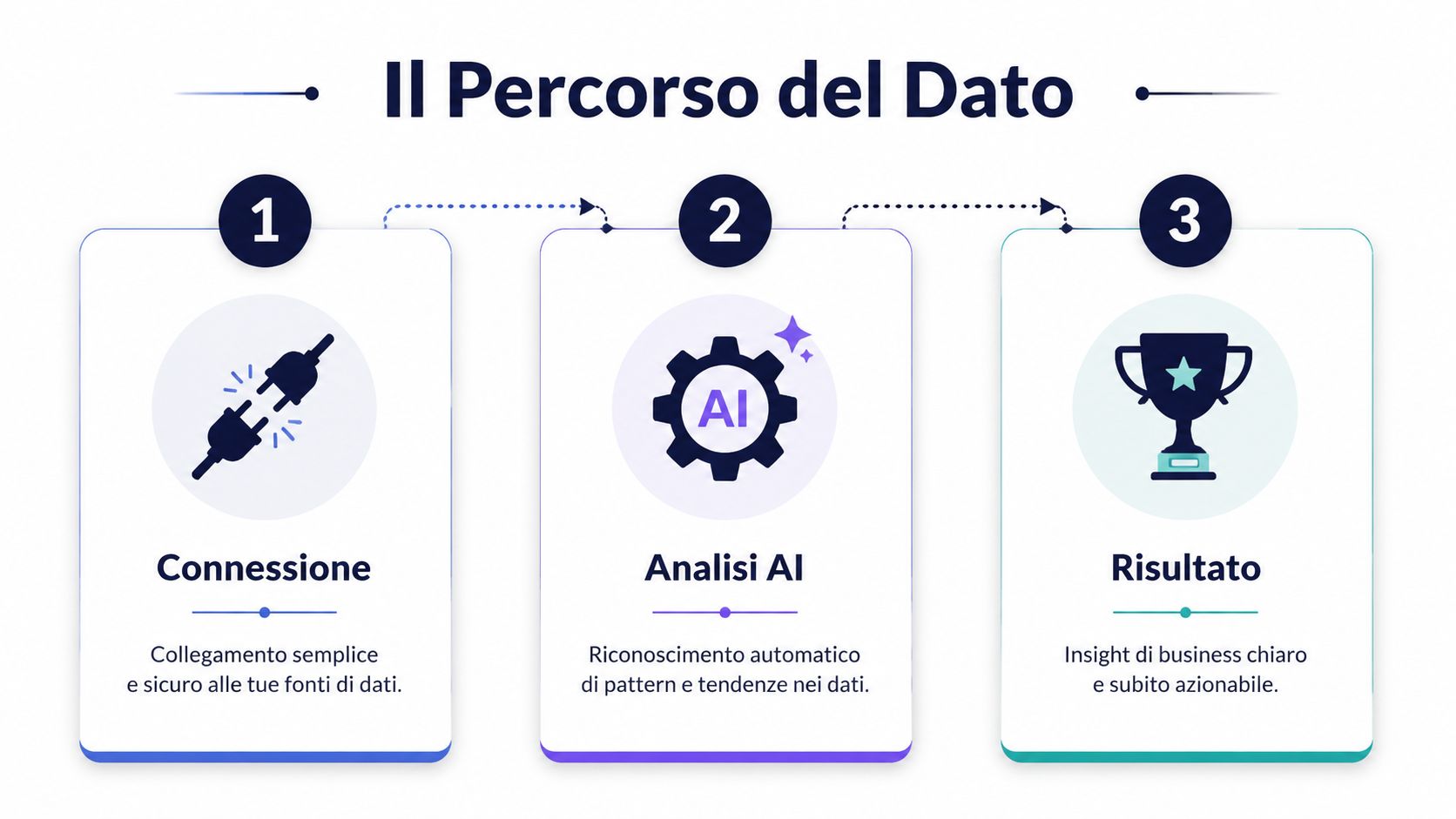
The first step is connecting to your data sources. A reliable platform integrates with the tools you already use, rather than asking you to start from scratch. This is a critical point because adoption often fails when a project begins with a migration that’s too cumbersome.
Enterprise-grade platforms establish direct, native connections to business systems, such as SAP and Oracle, without the need for data migration, reducing latency and accelerating time-to-value for analytics initiatives by a factor of 20 compared to traditional approaches, as Lumi AI explains in its overview of enterprise no-code analytics tools.
The second step is automatic data preparation. Here, the platform helps identify errors, missing fields, inconsistent formats, and duplicates. It’s a behind-the-scenes process, but it determines the final quality of the analysis.
Once the data is prepared, the analytical engine kicks in. The AI looks for patterns, compares variables, flags anomalies, and builds predictive or diagnostic models as needed. You don’t see the code. You see the questions and answers.
For example, a manager might ask:
The decisive part comes at the end. The results aren’t just confined to technical tables. They are transformed into:
Rule of thumb: If your team can’t explain an insight during an operational meeting, the problem isn’t just the data. It’s the tool you’re using to analyze it.
This is where many readers get confused. They think that “no-code” means “magic” or “blind automation.” That’s not the case. The platform speeds up the analytical process, but it remains essential to ask the right questions, verify the input data, and interpret the outputs within the business context.
For an SME, the value doesn’t lie in having new technology. It lies in changing the relationship between time, expertise, and decision-making quality. When data becomes more accessible, the company stops relying on isolated insights and begins to build a common language.

The most tangible benefits can be seen in five areas.
For many organizations, this shift marks the difference between reacting and anticipating.
There is also a less-discussed but crucial issue. A no-code AI analytics platform restores confidence to non-technical teams. The retail manager can monitor the performance of promotions without having to open a dozen files. The finance team can analyze scenarios and variances with a more solid foundation. The sales team can enter meetings armed with data, not just impressions.
If you're considering how to implement advanced analytics in your company, it may be helpful to see how ELECTE sets up analytics for SMEs using a model designed for teams that don't have an in-house data science department.
The real benefit isn’t just “getting more reports.” It’s making fewer decisions in the dark.
When that happens, meetings change too. Less time is spent arguing about which file is correct. More time is spent deciding what to do.
Useful applications aren’t abstract. They almost always stem from very practical questions. Where are we losing margin? What will happen to inventory next month? Which customers are becoming riskier? Which indicators warrant immediate attention?
Predictive and prescriptive analytics accounted for 50.35% of the no-code AI platform market share in 2025, while multimodal generative AI is projected to grow at an annual rate of 44.26% through 2031, according to Mordor Intelligence’s analysis of the no-code AI platform market. This helps explain why the market is favoring platforms capable of going beyond simple historical reporting.

A common scenario. A retailer is facing stockouts on some items and excess inventory on others. The sales team attributes the problem to unpredictable demand. The finance team sees it as tied-up capital. Marketing, on the other hand, believes that promotions are what shifted the volumes.
A no-code AI platform links sales data, promotions, seasonality, and inventory turnover. This can provide a much more useful overview:
The result isn’t just “more analysis” in the abstract. It’s better decision-making regarding purchasing, pricing, and sales planning.
In finance, the problem takes on a different form. The data is often more sensitive, the processes are more tightly controlled, and errors carry reputational as well as operational costs.
A team can use the platform to identify anomalies, compare historical trends, build forecasts, and create shared views across compliance, risk, and management. The interesting thing is that the platform isn’t just for specialists. It’s also for decision-makers who need to quickly figure out where to look.
For those interested in seeing practical examples more closely aligned with business contexts, ELECTE’s collection of case studies demonstrates how AI-powered analytics can be applied in various business scenarios.
When a use case is well-chosen, the platform doesn’t just “add a dashboard.” It removes friction from an existing decision.
The differences between platforms only become apparent when you start to evaluate them closely. They all promise simplicity. But not all of them offer the same level of integration, control, and operational sustainability.
Use this checklist as a reference.
| Criterion | Specific question |
|---|---|
| Integrations | Can it be integrated with the systems we use today without lengthy development cycles? |
| Governance | Who can view, edit, and share analyses and reports? |
| Security | Where does the data pass through, and what controls are in place? |
| Scalability | Does it work well both for a small team and for expanding to other teams? |
| Ease of use | Can a non-technical manager use it with reasonable initial support? |
| Support | Does the vendor provide support for implementation, or does it just provide the license? |
| Pricing | Is this model understandable and sustainable for an SME? |
The question of data integration is often the most critical one. If connecting the data requires complex steps, the company will end up reverting to manually exported files. And that’s when the project loses momentum.
There are a few red flags worth paying attention to:
A platform should be chosen as an execution partner, not as a technological showcase.
For an SME, the bottom line is simple: Does this solution help my team make better decisions, with fewer steps and without losing control?
The most common mistake is to treat adoption as if it were buying software. It isn’t. It’s an operational change. That’s why it’s best to start with a clear, concise roadmap that the entire organization can understand.
For Italian SMEs, there is a gap between the adoption of no-code tools and operational sustainability. Companies want quick decision-making—“minutes, not days”—but fear losing control over data quality. This is the gap described by Julius AI in its analysis of no-code analytics platforms.
The first step isn't to digitize everything. It's to choose a pilot project with three key characteristics:
Visible impact
An area where the problem is clear, such as sales forecasts, promotion tracking, cash flow, or operational anomalies.
: Low Risk It’s better to have a process that’s important but not so critical that it would bring the company to a standstill if the test needs to be adjusted.
Available data:
If it takes months of preparation to get started, it’s not the right project.
A good pilot project should address a real business need, not merely demonstrate in a general way that AI “works.”
After the pilot phase comes the tricky part. Anyone can grant access to multiple users. Few companies actually build a sustainable model.
At least four elements are needed:
This is where the risk of shadow analytics comes in. If every team builds analyses independently without shared guidelines, the initial speed turns into confusion. The solution isn’t to stifle autonomy. It’s to design it well.
For those who want to structure the rollout in a phased manner, the 90-day roadmap for adopting artificial intelligence provides a useful guide for moving from testing to everyday use.
Adoption is successful when the company gains greater autonomy without sacrificing reliability and control.
The most useful test is always this: what happens when faced with a real-world problem? Not a generic demo. A concrete question that today requires phone calls, data exports, and hours of verification.

Suppose a manager notices a decline in monthly sales. The point isn’t just to measure the decline. The point is to determine the cause. Is it a problem with the product, the geographic area, the sales channel, the promotion, the price, or the customer mix?
With a no-code interface, the ideal workflow is as follows: you upload or connect your data, the platform automatically organizes the information, compares relevant variables, and returns a clear, easy-to-read view. Managers can then explore the data without having to resort to manual queries or complex constructions.
The second scenario is even more common. You need to set the sales or operating budget for the coming quarter, but you don’t want to rely solely on historical averages. You need a more solid foundation.
Here , a platform like ELECTE—an AI-powered data analytics platform for SMEs—can be used to generate automatic forecasts based on available data, produce visual reports, and provide insights that are accessible even to non-technical users. The value doesn’t lie in automation itself. It lies in reducing the time between a managerial request and an operational response.
In both cases, the lesson is the same. A no-code AI analytics platform is useful when it makes business decision-making faster, more transparent, and easier to share.
SMEs don’t need more data. They need a framework that transforms the data they already have into timely, understandable, and reliable decisions. This is where the no-code AI analytics platform comes into play—not as a passing trend, but as a solution to a real-world operational challenge.
You’ve seen what sets this category apart from traditional tools, how it works in practice, where it offers benefits for non-technical teams, and what criteria to use to make the right choice. You also have a practical roadmap to get started without causing internal chaos.
The key issue is not whether AI will become part of decision-making processes in SMEs. It already has. The real question is whether this will happen in an unplanned or a controlled manner.
| Concept | Recommended Action |
|---|---|
| Access to insights | Reduce your reliance on manual reports and centralize your data sources |
| Sustainable adoption | Start with a pilot project that delivers visible results and involves limited risk |
| Governance | Define roles, permissions, and shared metrics before scaling |
| Choosing a platform | Consider integrations, ease of use, security, and support |
| Business value | Focus on faster, more readable decisions, not on the features themselves |
If you want to make your day-to-day decisions clearer, the next step isn’t to complicate your tech stack. It’s to simplify the path from data to action.
If you want to learn how to turn scattered files, disconnected systems, and manual reports into actionable insights, you can see how it works ELECTE and assess whether the model fits your company’s processes.

.svg)


.svg)
.svg)