
Think of the production planner not as just an employee, but as the conductor of your factory. This strategic role takes customer orders and turns them into a concrete action plan, ensuring that materials, people, and machinery are in the right place at the right time. In a market where efficiency and speed are everything, this role is key to your company’s competitiveness.
This article will guide you in discovering this crucial role. You’ll learn who they are, what skills they need, and how their work is evolving thanks to technologies like artificial intelligence. You’ll understand why equipping your planner with the right tools isn’t a cost, but a direct investment in the growth and resilience of your SME.
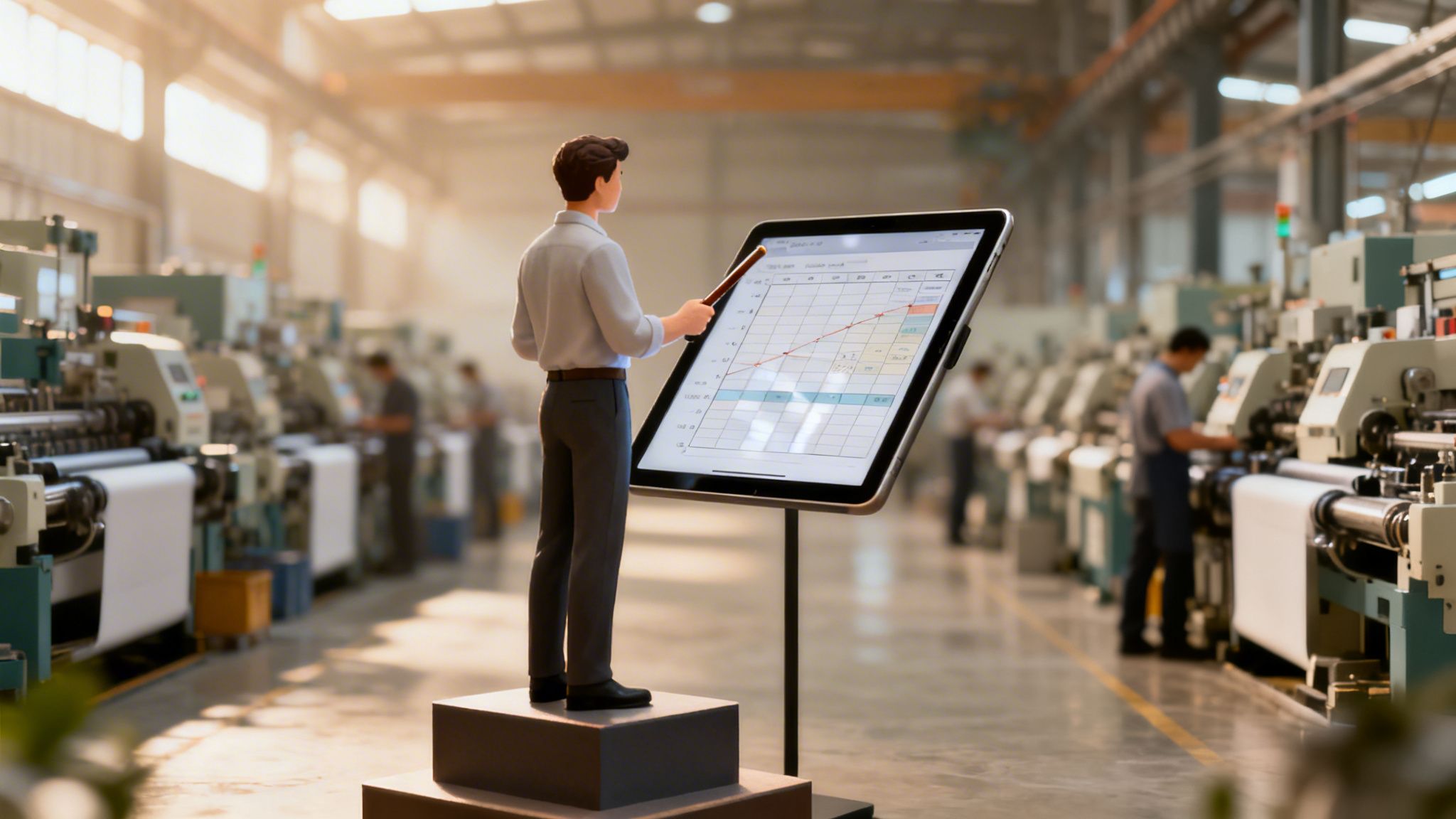
Imagine your company as an orchestra. The conductor doesn’t play every instrument, but it’s thanks to his vision that the violins, woodwinds, and percussion come together in a perfect symphony. The production planner does exactly that: he doesn’t tighten bolts, but he coordinates every department to create a seamless production flow.
This role serves as the driving force that translates sales forecasts and actual orders into a realistic—and, above all, optimized—production plan. The job doesn’t end with drawing up a schedule; it involves continuously refining it and adapting it to any unforeseen circumstances.
The work of a production planner has a direct and measurable impact on the company’s bottom line and efficiency. Their primary responsibilities are few but critical:
Effective production planning is not just a best practice; it is a tangible competitive advantage. Companies that master it can reduce inventory costs by up to 20% and improve on-time delivery rates by as much as 15% or more.
Its role is critical to the competitiveness of an SME. Haphazard planning leads to hidden costs, such as unanticipated overtime, late fees, and wasted resources. Conversely, a well-thought-out plan frees up cash flow, increases customer satisfaction, and lays the groundwork for solid growth—a central theme in the transition towardIndustry 4.0 and smart factories.
Forget the image of the meticulous planner hunched over a calendar. Today, being an excellent production planner means navigating two worlds at once: the world of data, algorithms, and ERP systems, and the far more unpredictable world of people, sudden breakdowns, and customer emergencies.
Success isn't just about devising a theoretically perfect plan, but about knowing how to make it work in the real world—navigating with equal ease between a spreadsheet and a negotiation with a department head. It is this balance that distinguishes a plan that remains on paper from an efficient and responsive production process.
Technical skills, or hard skills, are a planner’s lifeline. Without them, every decision would be based on instinct—a luxury no modern company can afford.
While technical skills provide the map, soft skills are the compass that helps you navigate a dynamic environment full of unexpected challenges. A great planner cannot and must not isolate themselves behind a computer screen.
A production plan that looks perfect on paper is completely useless if it isn’t communicated clearly and if you aren’t prepared to handle the inevitable deviations. True mastery lies in navigating human complexity with the same skill with which you navigate data.
The personal qualities that distinguish an experienced professional from a beginner are few, but essential:
How does a simple customer order turn into a perfectly synchronized production flow? It’s not magic, but a methodical process that the production planner orchestrates with precision, combining forecasts, resources, and concrete actions. It is the strategic brain that translates market demand into tangible operations on the production line.
It always starts with one question: What will the market demand? Here, the planner takes on the role of an analyst. They compile historical sales data, incoming orders, and the sales team’s projections to shape the Aggregate Production Plan (APP). This is not just a spreadsheet, but a strategic document that defines what and how much to produce in the coming months, seeking the balance between projected demand and the company’s actual production capacity.
Once the consolidated plan is approved, the actual transformation begins. Macro estimates are turned into detailed work orders, ready for the factory.
This process, which begins with analysis and extends through management and communication, is not a one-way street. It is a continuous cycle, as this diagram clearly illustrates.
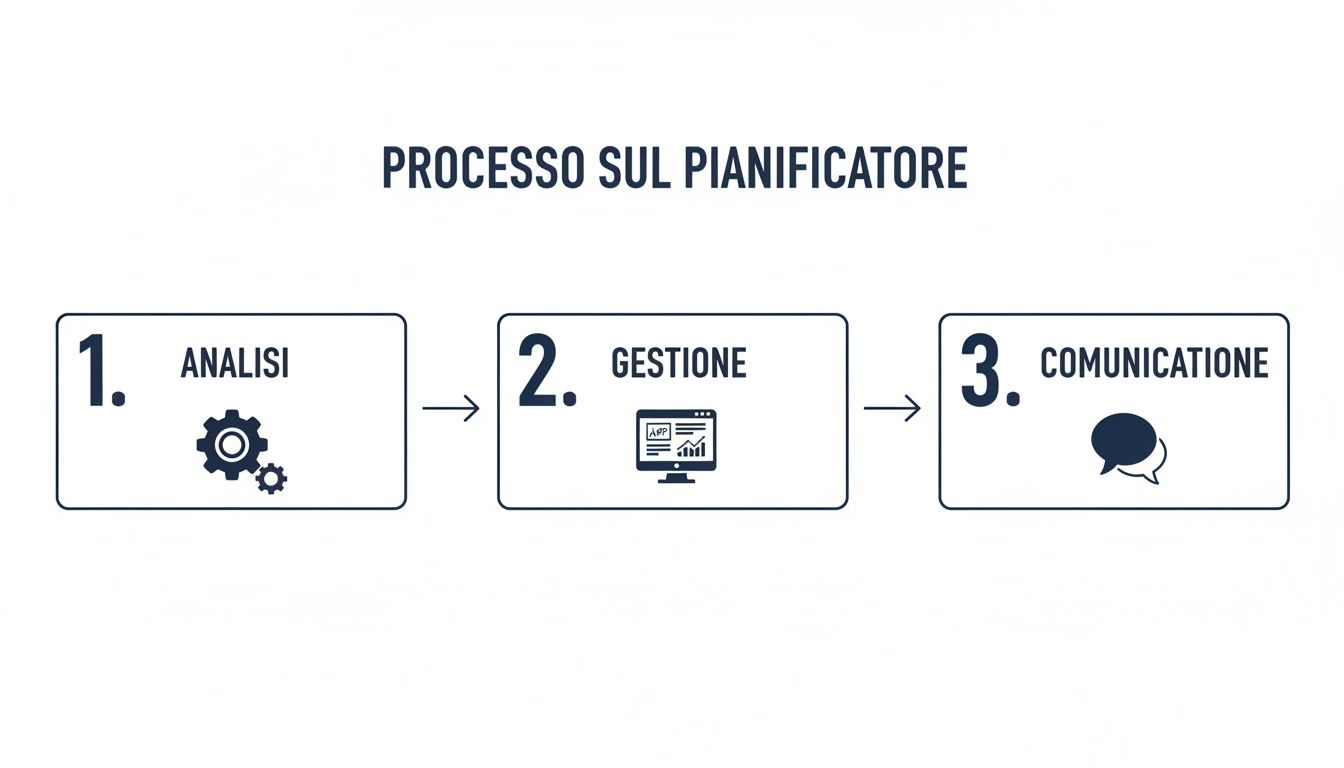
Analysis informs management, management requires communication, and feedback from the departments improves subsequent analysis. This is how a cycle of continuous improvement is set in motion.
The real turning point for a modern production planner is the shift from manual processes—often based on complex spreadsheets—to automated systems that deliver speed and accuracy. The difference is not trivial; it is a paradigm shift.
FeatureManual Planning (e.g., Excel)Automated Planning (e.g., ERP with AI)SpeedSlow. Takes hours, sometimes days, to update plans.Almost instantaneous, with real-time recalculations for every change.AccuracyLow. The risk of human calculation or copying errors is very high.Very high. Calculations are handled by the algorithm, eliminating human error.FlexibilityRigid. Simulating alternative scenarios (“what-if”) is a nightmare.Dynamic. Allows you to create and compare scenarios with a single click.VisibilityFragmented. Data resides in separate files; a holistic view is a mirage. Centralized. Offers a single, shared view across the entire supply chain.
Adopting an automated system isn’t just about doing the same things faster. It means freeing the planner from the drudgery of data entry and manual data management. It allows them to look up and devote their time to what really matters: strategic analysis, exception management, and proactively resolving issues before they even arise.
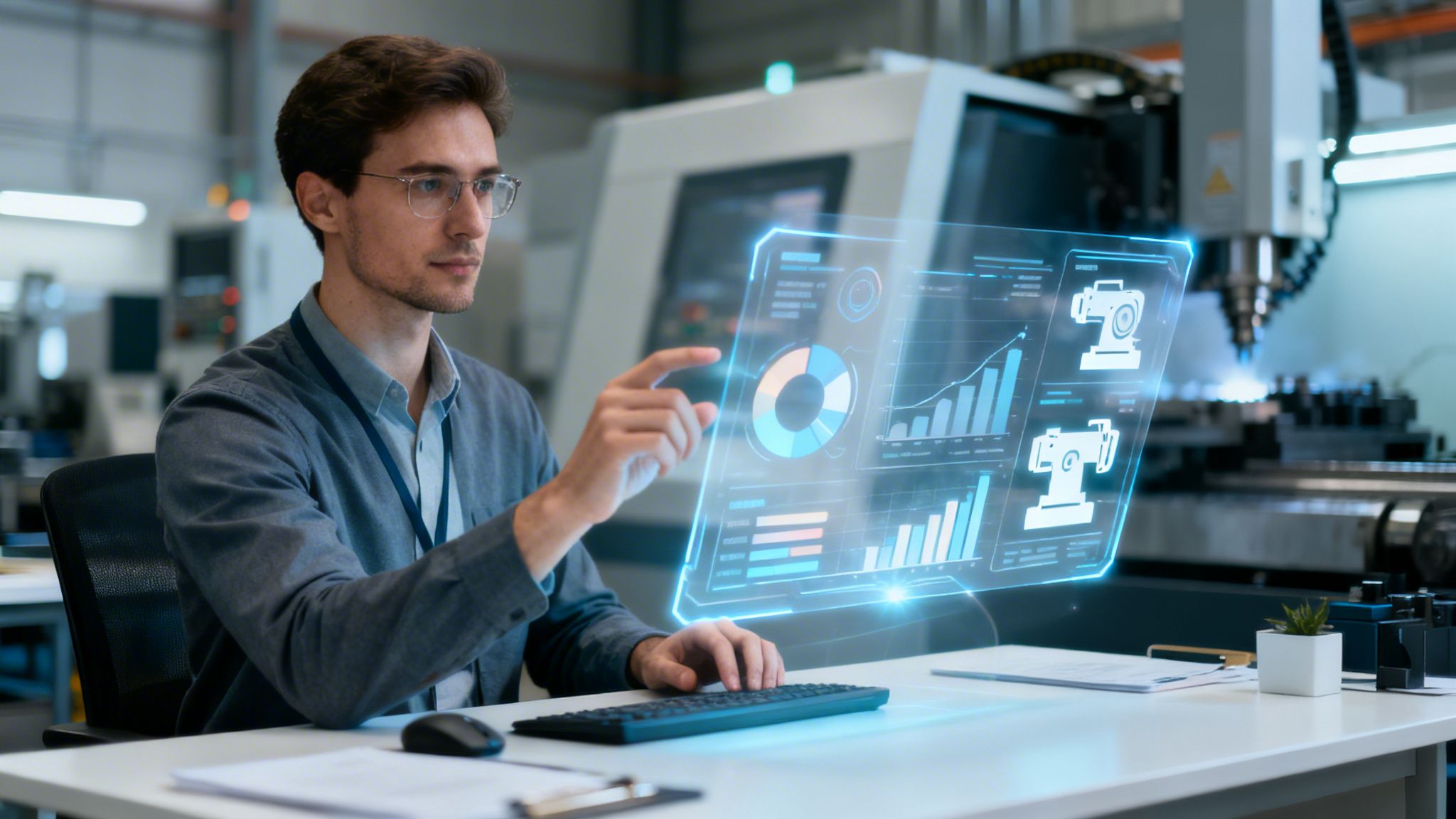
Artificial intelligence doesn’t take jobs away from production planners. If anything, it makes their jobs better. It frees professionals from the drudgery of manual analysis—those hours spent exporting data and crossing their fingers while working on endless spreadsheets.
Thanks to AI, the role is evolving. It’s shifting from being a meticulous executor—often bogged down in repetitive tasks—to becoming a true strategic decision-maker. Artificial intelligence handles the heavy lifting of analysis, freeing up the planner’s mental energy for what really matters: interpreting insights, resolving exceptions, and making decisions that drive efficiency and margins.
The real leap forward isn’t having more data, but using it to look ahead. We’re moving from an analysis that describes what has happened to one that predicts what will happen and, above all, suggests what to do. Advanced analytics platforms like ELECTE, an AI-powered data analytics platform for SMEs, make this possible with practical tools.
AI doesn't just give you a clearer picture of the future—it provides a roadmap for reaching it as efficiently as possible. It turns uncertainty into a competitive advantage by suggesting the right move at the right time.
And the results are already evident. The adoption of MRP software has improved efficiency by 28% among SMEs in the Emilia-Romagna region. AI-powered tools achieve 95% accuracy in demand forecasting, cutting stockouts by 15% and reducing excess inventory by 22%. It is no coincidence that, as early as 2026, 42% of Italian manufacturing companies had adopted real-time monitoring systems to shorten production times. For those interested in learning more, ISTAT statistics on business competitiveness are available.
Imagine connecting ELECTE to your ERP system. From that moment on, the platform starts working for you, transforming raw data into actionable insights.
For example, it could independently analyze incoming orders and production capacity, generating a report that flags a critical bottleneck on an assembly line expected to occur in three weeks. Instead of discovering the problem when it’s already too late, the production planner receives a proactive alert and can take immediate action.
This is just one of the many ways artificial intelligence is transforming business operations. AI acts as a tireless co-pilot that monitors, analyzes, and advises, leaving the pilot—the planner—free to focus on the course ahead.
"You can't improve what you can't measure." This old adage is more relevant than ever and serves as a mantra for any self-respecting production planner. The success of their work, in fact, isn't based on intuition or gut feelings, but on solid data that provides a clear snapshot of the health of the production flow.
But be careful: collecting random numbers is pointless. The secret is to focus on the key performance indicators (KPIs) that really matter. These aren’t just metrics; they’re the compasses that tell you whether you’re heading toward efficiency or, on the contrary, whether your course is leading straight to waste and delays.
Choosing the right KPIs means turning raw data into a clear picture that enables you to take action. Although there are dozens of possible metrics, four of them form the foundation for truly evaluating and improving factory performance.
A skilled production planner knows that these metrics do not exist in isolation but are closely interlinked. For example, pushing a machine’s utilization to the limit to improve OEE could create a bottleneck downstream and lead to excess inventory, thereby worsening other metrics. Balance is the true key to success.
Monitoring these KPIs isn’t optional—it’s vital. Industry data speaks for itself: companies that adopt advanced planning are able to cut waste by 25% and increase average OEE from 75% to over 85%. Not only that: integration with ERP systems for coordinated sales and operations planning (S&OP) can lead to a reduction in lead time of up to 40%. You can find more details on how data monitoring improves production at pro-control.it.
This is where technology comes into play. An AI-powered analytics platform like ELECTE fully automates this process. Instead of spending hours extracting data from spreadsheets and compiling manual reports, planners have access to interactive dashboards that calculate and display KPIs in real time.
This is a game-changer. It frees planners from repetitive, low-value tasks, giving them an instant and transparent view of performance. This way, you can finally focus on what really matters: analyzing data, identifying the root causes of problems, and implementing effective corrective actions.
Theory is useful, but to truly understand the impact of a data-driven approach, nothing beats a real-world example. And what better example than that of a typical small or medium-sized business in our industrial landscape—a story you can relate to.
Imagine "Manifattura Rossi," an Italian company that manufactures mechanical components. Like so many others, it has been struggling with the same issues for months: delivery delays that infuriate long-time customers and a warehouse bursting at the seams with inventory, tying up valuable cash flow.
Their production planner, Marco, is one of those experts who knows every nut and bolt of the company. The problem is that he spends his days putting out fires, jumping from one Excel spreadsheet to another, trying to make sense of the fragmented data spewed out by the old ERP system.
The issue wasn't a lack of data. Quite the contrary. The problem was the inability to turn that sea of numbers into quick, smart decisions. Manifattura Rossi, in fact, was operating in a sort of "operational blindness," always reacting to problems a split second too late, instead of anticipating them.
Tired of playing catch-up, they decided to give Marco a new tool: an AI analytics platform. Let’s see how this changed the game, step by step.
The results? In just six months, Manifattura Rossi saw its inventory costs drop by 20% and on-time deliveries increase by 15%. A tangible ROI that demonstrated one key point: Marco wasn’t replaced by technology. He was empowered.
You’ve made it this far, and now you have a clear understanding of the role of a production planner and how technology is revolutionizing their work. Here are the key takeaways:
The production planner is much more than an operational role; they are the strategic linchpin that determines the agility and profitability of a manufacturing SME. In a world that demands increasingly rapid and precise decisions, equipping this role with the right tools is no longer an option, but a necessity. Artificial intelligence is transforming planning from a reactive activity into a predictive process, capable of anticipating problems and optimizing resources.
Embracing this evolution means shifting from reacting to events to driving them, transforming data from mere facts into a catalyst for growth. Are you ready to give your planner the superpowers to take your production to the next level?
Discover how ELECTE works with a personalized demo and start turning your data into a competitive advantage today.

.svg)


.svg)
.svg)
.webp)