
Every SME is all too familiar with this scenario. A meeting is organized, an improvement plan is drafted, goals are assigned, and then—amid operational emergencies, emails, and overlapping meetings—the document ends up in a drawer. The problem isn’t a lack of goodwill; it’s the lack of a system that translates priorities into metrics, accountability, and regular follow-ups.
In Italy, the concept of improvement truly works when it is not just a list of activities, but becomes a governance framework. Public guidelines and the INDIRE model emphasize objectives, targets, monitoring, and corrective actions, while ISPRA data show that in 2023, air quality demonstrated a “general improvement” and a downward trend that has solidified over time, based on multi-year time series of NO2, PM10, PM2.5, and O3 (ISPRA). The lesson is simple: improvement is not achieved through intention alone; it is achieved through oversight.
A manufacturing SME that I’ve been working with for years had done everything “right” on paper. It had defined three priorities, outlined actions, and assigned responsibility to certain individuals; but then the project stalled because no one had established a simple, consistent monitoring routine. After a month, the operations manager only remembered the plan when something went wrong.

The weak point is almost never the strategy itself. The weak point lies in translating the strategy into a workflow that integrates measurement, decision-making, and corrective actions. The INDIRE model for the Improvement Plan in Italian schools, for example, requires selecting process objectives, defining actions, planning, evaluating, and disseminating results, using an approach that clearly outlines KPIs, timelines, and responsibilities (INDIRE).
A plan works when someone can answer, at any time, three questions: where we are, what we’re doing, and what we’ll change if the numbers don’t add up.
SMEs often fall into three traps. The first is confusing a plan with a list of initiatives. The second is taking on too many projects at once, so that none of them receives enough attention. The third is expecting to monitor progress “by heart,” without regular follow-up.
This is where the difference between a static document and a decision-making system lies. In the first case, the plan is meant to be approved. In the second, it serves to guide meetings, allocate resources, and shift priorities when the data warrants it. Those who work in a data-driven way know this well: the value lies not in a plan written once, but in its ability to remain dynamic.
A useful parallel can be drawn with the recurring mistakes made when adopting AI in business, where initial enthusiasm often outweighs the ability to integrate it into actual processes, as discussed in our in-depth analysis of these same AI mistakes. The principle is the same: without operational discipline, even the best project will fizzle out.
A good improvement plan starts with process objectives, not slogans. If the objective remains “improving service,” the plan remains vague because it does not clarify who is responsible, by when, and what metrics will be used to determine whether the change was successful. In the INDIRE model, this step is crucial: verifying the alignment between priorities and objectives, assigning priority levels, and redefining expected outcomes and measurement methods in advance.
In the context of SMEs, the maximum limit of three improvement initiatives is a healthy threshold. Not because it’s a rule set in stone, but because it forces you to choose and let go of what distracts your attention. Public guidelines on improvement planning for SMEs emphasize general objectives, indicators, targets, responsibilities, timelines, resources, and monitoring, and this structure helps keep the plan clear even when the team is small and priorities overlap.
A simple framework helps you evaluate each goal more clearly:
In Italian SMEs, things work best when each objective is linked to a process that someone is already overseeing. In sales, this might be “reducing the average response time to qualified leads”; in operations, “reducing downtime due to rework”; and in customer service, “increasing the percentage of requests resolved on the first contact.” The form varies by function, but the logic remains the same: you start with an observable process and arrive at a result that can be verified without forced interpretations.
For each goal, write the following on a single line:
If you can't measure it first, you can't manage it later.
This structure works well because it forces you to think like a process consultant would, not like someone who’s just compiling a to-do list. In the SMEs I work with, the real leap forward happens when the plan stops being just a document to be approved and becomes the reference point for meetings, priorities, and course corrections. This is where the improvement plan moves from the narrative level to the decision-making level, and begins to support continuous monitoring backed by AI analytics, with alerts and rapid reporting when the numbers change.
Many plans fail because they address only the symptoms. The warehouse is behind schedule, so we demand faster service. Customers are complaining, so we respond more quickly. The right question, however, is always the same: What is the root cause of the problem?
In SMEs, root cause analysis doesn't have to be sophisticated—it just has to be repeatable. All it takes is three well-executed steps. First, describe the symptom in concrete terms. Then ask yourself what operating conditions cause it. Finally, determine whether the cause is technical, organizational, or informational.
The three most common causes I see are almost always these:
The priority should not be the easiest action, but the one that truly addresses the problem. This is why we need an impact-effort matrix, considered alongside a strategic relevance score. The idea is simple: if an action requires little effort but makes little difference, it is not a true priority. If, on the other hand, it requires more work but addresses the root cause, it deserves a place in the plan.
In the INDIRE materials and improvement guides, priority is not intuitive; it is also linked to criteria such as duration in months and level of relevance, and thus to a more rigorous planning and monitoring approach (INDIRE tutorial). For an SME, this translates into a very practical matrix:
An effective meeting doesn't ask, "What should we do right away?" but rather, "What action will resolve the issue without distracting the team?" This distinction helps avoid the "urgency bias," which is one of the most common causes of unstable plans in small and medium-sized businesses.
An improvement plan becomes truly manageable when every action has a clear metric, a concrete deadline, and a single point of accountability. Without these three elements, the plan remains a list of intentions—useful for outlining what you want to do but ill-suited for determining whether the problem is actually being addressed. For Italian SMEs, the key is not to simply compile a well-organized document, but to build a decision-making system that allows them to immediately see where to take action, what the priorities are, and what the expected outcomes will be.
Selecting KPIs is the first practical filter. A useful metric doesn’t measure everything; it effectively measures what drives a decision. If a manager looks at it and doesn’t understand whether they need to take action, that KPI is just taking up space without helping the work.
In the companies I work with, the most effective KPIs have three characteristics: they are linked to a specific process, they can be updated regularly, and they show a clear discrepancy between expected and actual results. This avoids “decorative” metrics—those that end up in reports but don’t change behavior.
| Corporate Section | Example KPI | Target Type | Monitoring Frequency |
|---|---|---|---|
| Sales | Average response time to leads | Reduction from the initial value | Weekly |
| Operations | Production Cycle Time | Reducing Bottlenecks | Weekly or monthly |
| Customer Satisfaction | Requests Resolved on the First Contact | Increased closing capacity on the first pass | Monthly |
| Operational efficiency | Number of rework operations | Reduction of Process Waste | Monthly |
The criterion to use is simple but rigorous. The KPI must be understandable to decision-makers, linked to an action that the team can influence, and stable enough to avoid creative interpretations. If you need a practical foundation for selecting and translating indicators into operational metrics, the in-depth guide on KPIs—with practical examples for business growth —helps distinguish truly useful indicators from those that are merely descriptive.
Accountability only works if it’s clear. Every action must have a single owner, because when responsibility is shared, oversight becomes fragmented and no one is truly in charge of the next step. Teamwork remains essential, but it must be channeled through a clear chain of roles.
In practice, it’s best to define just a few elements, but define them well:
This approach mitigates a very common problem in SMEs: overlap between departments. If an initiative involves both sales and operations, responsibility can be shared at the operational level, but oversight must be centralized under a single leader. Otherwise, the plan becomes fragmented, and the review turns into a general discussion rather than a progress check.
The roadmap isn’t meant to give the plan an elegant structure; it’s meant to prevent everything from starting at once and then stalling after the initial momentum. Actions should be spread out over time based on their interdependencies, the team’s availability, and how quickly results become visible. In SMEs, the trade-off is clear: concentrating too many initiatives in the same period creates confusion, while spreading them out too much makes them invisible.
A good implementation schedule includes intermediate checkpoints, not just a final deadline. This way, the person in charge doesn’t have to wait until the end of the cycle to determine whether the initiative is working. Periodic reviews also allow for adjustments to the plan when circumstances change, without having to rewrite everything from scratch.
Ultimately, the key is clarity. A well-structured improvement plan allows management and the team to answer three questions without wasting time: what are we measuring, who takes action if the data moves in the wrong direction, and when do we expect to see the first meaningful signal? If these answers aren’t immediate, the document remains theoretical.
That’s why the most effective approach for SMEs isn’t to write a lot first and then review it, but to select a few KPIs, assign a clear point person, and develop a roadmap that makes monitoring part of daily work. This is where the plan stops being just an attachment and starts functioning as an operating system for improvement.
The most useful step for an SME isn’t to add more meetings—it’s to reduce manual monitoring. Even very attentive people can make mistakes when reviewing a plan, but if every check requires data exports, scattered spreadsheets, and manual checks, the risk of the plan being abandoned remains high. The key idea is to link the plan to an AI analytics platform that continuously monitors KPIs and flags anomalies before they become structural problems.
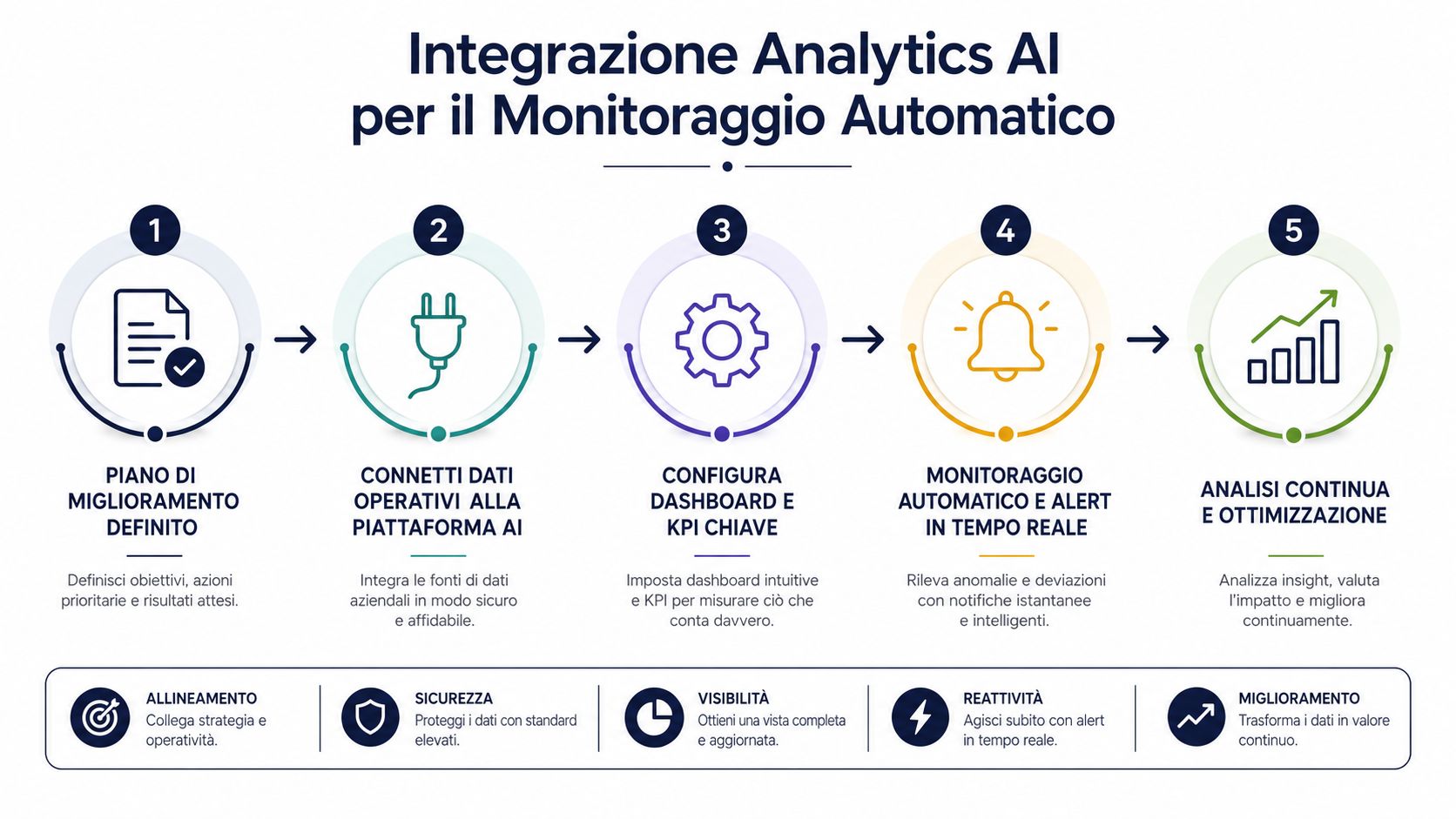
The proper workflow starts with organized data sources, moves on to defining KPIs, and culminates in automated dashboards that display deviations, trends, and anomalies. The real difference compared to traditional monitoring is time—you don’t have to wait until the end-of-month meeting to realize that the process has gone off track. If the system detects a deviation, the team can take action before the problem becomes entrenched.
This approach aligns well with a guide to AI-driven data analysis, especially when you want to turn static reports into ongoing insights, as discussed in our in-depth guide to AI-driven data analysis. The benefit lies not only in speed but also in the consistency of the monitoring.
In the right context, an AI agent acts as an analyst that’s always on the job. It monitors sources, identifies anomalies, summarizes findings, and generates reports without requiring the team to repeat the same manual work every time. For an SME, this means lightening the operational load and making the improvement plan less dependent on the memory of just a few people.
A healthy work cycle consists of three simple steps:
When the analysis is automated, the plan is no longer just a file to track down. It becomes a dynamic, readable, and up-to-date stream.
In retail, improvement happens when inventory and promotions are analyzed together. A store manager doesn’t need more reports; they need to know which categories are not selling well, which promotions are eating into margins, and where shelf availability is falling short. The plan, in this case, focuses on a few key objectives, such as more efficient inventory management and stricter control over sales initiatives.
In the area of finance and compliance, the plan takes a more cautious approach. Here, the focus is on the timeliness of audits, the scope of controls, and the clarity of responsibilities, because the goal is not just to move quickly, but to reduce organizational risk. The quality of the plan depends on the ability to distinguish between controls that are truly essential and those that are repetitive and of little use.
In operations, on the other hand, improvement almost always revolves around productivity, quality, and waste. A company that manufactures products or provides technical services must ask itself where rework accumulates, which steps slow down the workflow, and what data is missing to better forecast the workload. Here, the improvement plan is most effective when it links causes, KPIs, and corrective actions without juggling too many priorities.
Three replicable models stand out clearly:
The logic remains the same across sectors. Only the indicators to watch and the frequency with which they should be monitored change. Those who manage to maintain this discipline will see the plan evolve from an occasional meeting into a system of governance.
An effective first cycle starts with a few well-executed steps. Choose no more than three priority objectives, define KPIs and numerical targets, assign responsibilities with deadlines, set up automated monitoring, and schedule the first checkpoint. If any of these steps is missing, the plan quickly loses touch with reality.
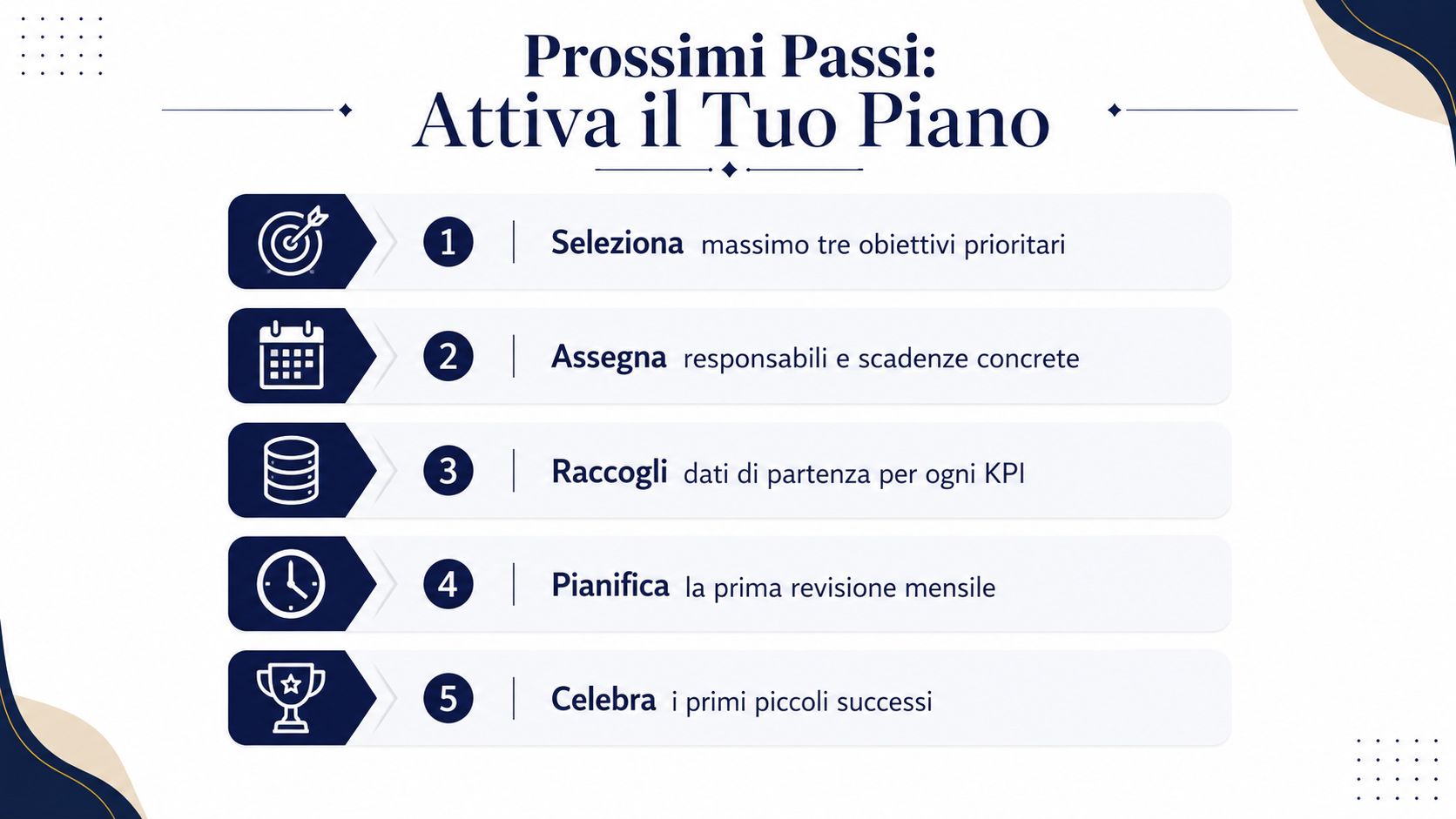
Here's a helpful checklist to go over before you leave:
The real leap forward comes when the plan no longer depends on the patience of those implementing it, but on a system that keeps it on track. Italian SMEs can compete much more effectively than they often realize, provided they treat data as a tool for day-to-day decision-making rather than as an archive to be consulted after the fact.
If you want to turn your improvement plan into a dynamic process—with clearly visible KPIs, automated reports, and continuous monitoring—visit ELECTE and discover how to make managing your plan simpler, faster, and more aligned with your data. ELECTE helps SMEs move from scattered spreadsheets to actionable insights, so that improvement isn’t just a document—it becomes a daily practice.

.svg)


.svg)
.svg)