
Your business is growing, hiring talented people, investing in technology, and perhaps developing a proprietary product. Yet you feel like you’re leaving value on the table. This often happens in Italian SMEs that have already moved past the startup phase but haven’t yet turned their innovation into a competitive advantage recognized beyond the company.
This is where the issue of innovative SME requirements comes into play. Many view them merely as an administrative formality. That is too narrow a view. In reality, these requirements describe the profile of a company that invests in research, attracts skilled talent, protects its intellectual property, and maintains sound financial management. In other words, a company that is more credible in the eyes of banks, partners, investors, and the market.
This difference matters more today than it did yesterday because competition is no longer just about price or speed of delivery. It hinges on the ability to establish innovation as a sustainable process. The status of “innovative SME,” introduced under Decree Law 3/2015, was created precisely for this purpose: to support existing companies that continue to innovate in a measurable way.
If you’re considering the requirements for innovative SMEs, the right question isn’t just “Can I apply?” The more useful question is “Is my company already structured as an innovative business, or do I need to make some key adjustments?” This guide is designed to answer exactly that.
For many companies, the real bottleneck isn’t the idea. It’s the structure. You already have a business that’s up and running, active customers, and perhaps even a distinctive product. But when you try to take the next step, the same challenges always arise: investments that are hard to sustain, talent to attract, intellectual property to protect, and credibility to build.
The requirements for innovative SMEs are particularly appealing because they translate these key points into concrete criteria. They do not reward a generic narrative about innovation. Instead, they reward companies that demonstrate, through verifiable evidence, that they invest in research and development, build qualified teams, and leverage intangible assets.
This changes how the regulations should be interpreted. If you treat them as a checklist, the most you’ll get is a registration. If you view them as a model of corporate maturity, you can use them to improve hiring decisions, budget allocation, governance, and access to incentives.
Being an innovative SME doesn’t mean just appearing to be innovative. It means making innovation traceable, documentable, and defensible.
For an ambitious entrepreneur, this is a crucial distinction. Companies that meet these criteria aren’t just complying with a standard. They’re building a business that’s more transparent to the outside world and easier to manage internally.
A manufacturing company with an established customer base decides to digitize its production, implements proprietary quality control software, and hires senior technical staff. The revenue is already there. At this stage, the point is no longer to prove that you have a good idea. It is to demonstrate that growth is underpinned by repeatable investments, skilled expertise, and defensible assets. This is where the designation of “innovative SME” takes on a specific economic meaning.

This designation does not simply refer to a “modern” business. It identifies a company that falls within the scope of SMEs, operates with an established corporate structure, and can demonstrate compliance with specific formal requirements: a small size relative to European standards, suitable business premises, audited financial statements, and the absence of a listing on regulated markets.
This scope yields an interesting selection. It excludes both companies that are still too immature—those still in the process of validating their business model—and larger firms, which operate under different financial and governance frameworks. The result is a category designed for companies that have already moved beyond the “promise” phase and must now demonstrate their ability to execute effectively.
From a strategic perspective, the legislature has created a specific pathway for companies that are no longer in their early stages but continue to invest as businesses focused on research, development, and the commercialization of intellectual property.
Many entrepreneurs view the status as merely an administrative label. A more useful interpretation is that the requirements for innovative SMEs serve as a test of a company’s maturity.
To qualify, a company must disclose information that often remains unclear even internally: how much it actually invests in development, the qualifications of its workforce, what intangible assets it owns or controls, and how well-organized its financial records are. These aspects are not merely for the purpose of obtaining registration; they also make the company more transparent to external evaluators.
The effects are evident in four specific areas:
This is the least obvious point, but the most useful one for an ambitious management team. The standard rewards behaviors that, in practice, also improve the quality of the business.
If your company generates innovation but fails to document it through financial statements, contracts, qualifications, and recorded assets, the problem isn’t just a regulatory one. It’s a corporate governance issue.
The qualification applies to companies that are already in operation. This shifts the focus of the evaluation. It is not enough to simply intend to innovate. What matters is the ability to translate innovation into processes, skills, and assets that remain within the company.
For a manager, the relevant question is therefore not simply, “Am I meeting the targets?” The smarter question is: “Is my company building a solid track record of its ability to grow through technology, research, and skilled human capital?” If the answer is yes, that status ceases to be merely a compliance requirement and becomes a sign of market positioning.
In other words, being an innovative SME means making innovation measurable, transferable, and credible. And it is precisely this transformation that tends to boost growth, reputation, and value over the medium term.
A company may have a good product, loyal customers, and growing margins, but still fail to qualify. In practice, the reason is almost always the same: the company innovates, but fails to translate that activity into measurable evidence. The standard, however, requires concrete proof. To qualify, the SME must meet at least two out of three criteria: investment in research and development, a qualified workforce, and ownership or availability of intellectual property related to the business activity.
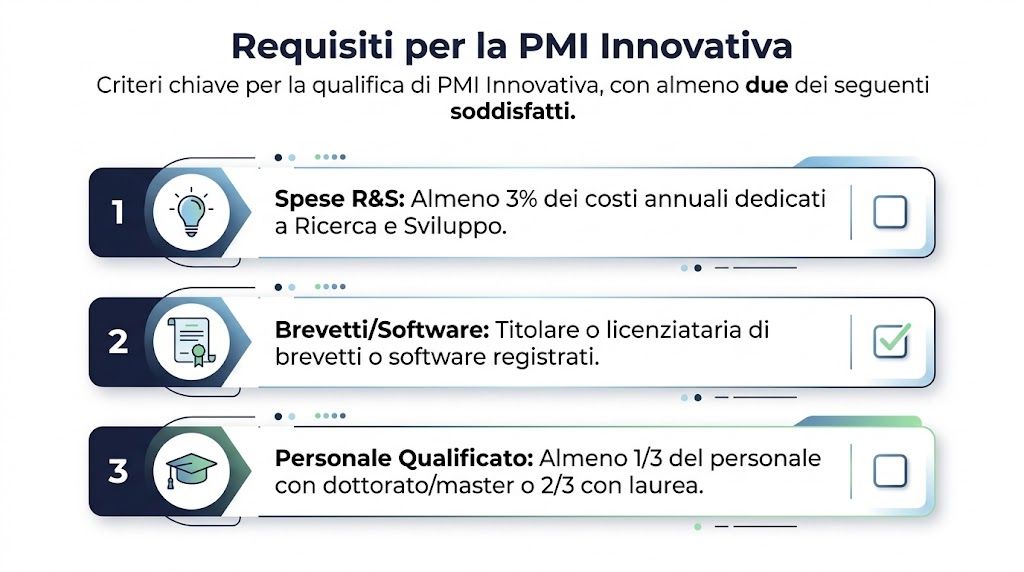
The interesting point is something else. These three criteria do not merely measure compliance with a rule. They measure whether the company is building capabilities that are difficult to replicate. For this reason, they should be viewed as indicators of managerial quality, not as a simple checklist.
The first requirement concerns R&D expenses, which must amount to at least 3% of the higher of production costs or revenue. On paper, this appears to be an accounting metric. In reality, it identifies companies that are able to allocate resources, time, and responsibilities to actual development projects.
This is where many SMEs hit a roadblock. They invest in prototypes, software enhancements, process testing, or new product solutions, but record all of it as ordinary operations. The result is paradoxical: the company incurs development costs but is unable to demonstrate them in a defensible manner.
From a strategic perspective, this criterion rewards those who have already implemented basic internal policies in four areas:
A manufacturing company testing a new energy-efficient production line, for example, is not merely improving its production. It is undertaking a development project that, if properly documented, can help meet regulatory requirements while also clarifying which investments are boosting productivity and raising barriers to entry.
If R&D isn't tracked, it's of little value to the company. It's even less valuable to management, because it prevents them from understanding which projects are creating value and which are merely eating up the budget.
The second criterion concerns the composition of the staff. The threshold relates to the proportion of employees holding a master’s degree, a doctoral degree, or research experience, in accordance with the percentages specified in the regulations.
This metric goes beyond educational qualifications. It indicates whether the company possesses the expertise needed to formalize knowledge, validate hypotheses, design experiments, and transform operational insights into repeatable processes. In other words, it measures the extent to which the company relies on individual talent and, conversely, its ability to transform that talent into organizational capital.
For an entrepreneur, the key metric isn’t “how many employees I have,” but “how much stable technical expertise I’m building.” The difference is crucial. Two companies may have the same revenue. The one with a qualified technical team tends to learn faster, make mistakes in a more systematic way, and better protect its margins.
It also serves as an external signal. A team with advanced expertise makes the business plan more credible to investors, technology partners, and major clients, especially in industries where the choice of supplier depends on the ability to develop proprietary solutions over time.
This requirement compels management to address questions that are often left unspoken:
If the responses are lackluster, the problem isn’t just about access to the qualification. It’s about the company’s scalability.
The third requirement is the most visible from the outside. The existence of a patent, registered software, or a design patent related to the company’s business purpose indicates that part of the competitive advantage has been transformed into a recognizable asset.
This is particularly important in situations that affect a company’s value. A business negotiation is stronger if the company sells not only its operational capabilities but also its technology or proprietary know-how. An industrial partnership is more balanced if the company brings to the table a right that is both usable and verifiable. A due diligence review tends to scrutinize more closely a business that has already distinguished between what it can do and what it owns.
For a software SME, the most practical approach may be to register the software. For a mechatronics or biomedical company, the most natural path may involve patents or other forms of industrial protection. The tool changes, but the logic remains the same: to make the value generated by technical activities protectable.
ReadingWhat itreally meansLegalThe companycan demonstrate ownership or control of aprotectedassetCompetitivePart of the advantage is harder tocopyFinancialThevalue created becomes more transparent in terms of partnerships, fundraising, or divestitures
In practice, the most powerful combination is often one that brings together well-targeted development spending, a skilled technical team, and formalized intellectual property. In such cases, the company is not merely meeting the requirements for innovative SMEs; it is building a system that tends to enhance growth, its ability to attract talent, and the perception of its value over the medium term.
A manufacturing company with a decade of history already has customers, margins to protect, and processes to streamline. A company that was founded just a few months ago, on the other hand, is still trying to validate its business model. Lumping both together often leads to a misinterpretation of the company’s stage of development, and consequently to less informed decisions regarding finance, governance, and growth.
This is precisely where the distinction between an innovative SME and an innovative startup comes into play. It is not a mere technicality. It is a way to determine whether the company is still demonstrating its potential or whether it has already transformed research, technology, and expertise into an organization capable of delivering results.
The most obvious difference lies in the nature of the business. The innovative startup is designed for young companies still in the early stages of their lifecycle. The innovative SME is at a more advanced stage. It is aimed at companies that have already passed the startup phase and need to make their competitive advantage more apparent.
CharacteristicInnovative SMEInnovativeStartupCompany AgeNoage limitLess than 5yearsCertified financial statementsRequiredNot listedhere asa primary distinguishing featureInnovation requirementsAt least2 out of 3At least 1out of 3Implicit positioningMature companythat continues to develop distinctive technology and expertiseYoung company in the startup or early consolidation phase
This difference has very tangible consequences. An innovative startup is often valued primarily for its expected growth trajectory. An innovative SME, on the other hand, is also evaluated based on the quality of its internal processes, the traceability of its investments, the rigor with which it documents its development, its qualified staff, and its intellectual property.
For an entrepreneur, the point isn’t to choose the most attractive label. The point is to use one that’s consistent with the company’s current stage.
If the company already has a sales network, historical financial data, organizational responsibilities, and an active customer base, its status as an innovative SME tends to be more firmly established. In this context, the requirements serve not only to obtain formal recognition. They serve to demonstrate to the market that growth no longer depends on isolated insights, but on a system that generates development in a repeatable manner.
This is where the most useful strategic insight emerges. Innovative startups help protect and support the early stages of a business. Innovative SMEs help make scalability more credible.
This distinction also matters in relationships with investors, banks, and industrial partners. An outside observer tends to view an innovative SME as a company that has already established an organizational foundation and is now formalizing the factors that make it stronger than average: technical capabilities, investment in research, data governance, and protectable assets. This can influence risk perception and the quality of the dialogue during due diligence.
For those working in software, AI, or digital products, the transition from a promising startup to a well-established company is particularly significant. For this reason, it can be helpful to consider these criteria alongside a broader examination of the growth trajectories of AI startups and their development models.
In short, an innovative startup is often the right choice for those who are still in the validation phase. An innovative SME is the most suitable framework for those who have already validated their concept and now want to translate those strengths into greater appeal, a better ability to attract talent, and a more transparent corporate value.
Once the requirements are met, the critical factor becomes the quality of execution. The process is digital, but that doesn’t make it automatic. A strong application is one that has been thoroughly prepared before submission.
The first mistake is to start with the platform instead of the documents. It’s better to do the opposite. First, build the company’s logical framework, then translate it into compliance.
The documentation typically consists of four main components:
The right question isn’t “What do I need to attach?”, but “Could an outside party verify my statement without any ambiguity?”
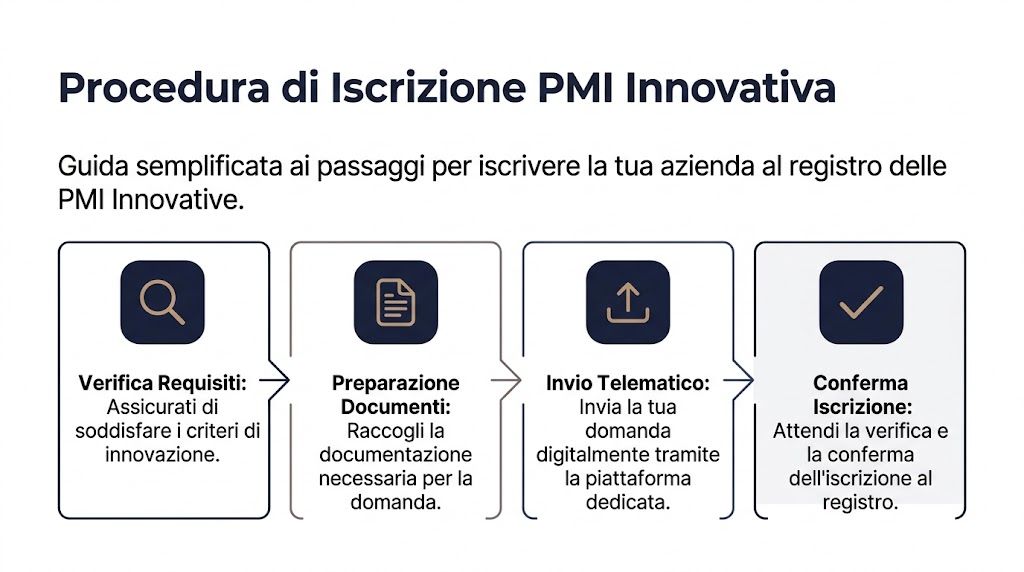
Registration is carried out through the Single Communication system with the Registry of Companies. The process is conducted electronically and requires particular attention to ensure that the declarations match the supporting documentation.
Here is an effective workflow for an administrative team or for the consultant coordinating the work:
An administrative process is only simple when the company has already put its affairs in order beforehand. If that happens later, every step becomes more complicated.
For companies that are also working on process digitization and advanced manufacturing, it may be helpful to integrate this planning with the approaches described in ELECTE’s feature on the MADE Competence Center for Industry 4.0.
Many companies treat certification as a milestone. In reality, it is more accurate to view it as a status that must be maintained. This means updating the certification annually, ensuring compliance with requirements, and not assuming that what was true a year ago is still true today.
The best-organized companies use an internal mini-dashboard with simple metrics:
AreaAudit RequestR&DAreeligibleexpensesproperly tracked?TeamDoes thestaff composition remain consistent with the selected requirement?IPIs thedocumentation on intangible assets up to date and accessible?Financial StatementsHasthe certification process been planned in a timely manner?
Those who handle these matters in advance avoid the classic last-minute rush—that is, scrambling to gather documents when the window of opportunity is already closing.
A manufacturing company with a solid customer base and a strong product often reaches a clear crossroads: whether to continue growing with processes that are still not fully formalized, or to use regulatory requirements to become more transparent to investors, more attractive to technical professionals, and more disciplined in managing R&D, data, and intellectual property. This is where that status creates real value. Not as an administrative formality, but as a framework that improves the quality of the company.

Economic benefits only make sense when viewed from an allocative perspective. Tax breaks, specialized financial instruments, and regulatory simplifications do not improve a business on their own. They improve the way a business uses capital.
For a manager, the key question is simple: If I free up resources or reduce administrative friction, where will I see the highest return over the next 12 or 24 months?
In practice, there are three most sensible options:
This interpretation changes the meaning of the requirements. The company does not incur a cost to join a category. It uses a legal framework to redirect more resources toward activities that increase margins, defensibility, and future value.
This status also enhances the company’s external visibility. External evaluators will notice several key factors that are hard to overlook: a portion of the budget allocated to development, a team structure aligned with technological goals, and a greater focus on formalizing assets.
For an investor, this reduces uncertainty. For a bank, it improves the perception of management order. For a senior candidate, it signals that the company does not rely solely on entrepreneurial intuition but has begun to establish repeatable processes.
The less obvious point is this: the criteria select companies that have already taken their first step up the management ladder. And that step has a much greater impact on the evaluation than it might seem during fundraising, industrial partnerships, and complex commercial negotiations.
Those who are integrating these themes into a broader growth strategy can link them to a digital transformation journey for process- and data-driven SMEs.
For those working in software, industrial design, trademarks, patents, or codifiable know-how, it is also important to stay informed about developments in intellectual property and funds dedicated to SMEs. In many cases, a company’s value increases first in its intangible assets and only later in its revenue.
Now that we’ve clarified the overall picture, a visual aid that clearly summarizes the logic behind the incentives and positioning might be helpful:
A well-managed, innovative SME uses incentives to focus capital on its products, expertise, and intellectual property. It is this combination that strengthens its competitive advantage.
The most underrated benefit concerns the quality of internal decision-making. To maintain its status, a company must track expenses more effectively, clarify exactly what capabilities it possesses, distinguish strategic assets from non-strategic ones, and consistently document what creates value.
This means we have to get organized.
Many SMEs discover an unexpected benefit right here. The process fosters a sense of discipline that remains valuable even beyond the regulatory framework. Budgets become easier to understand, technical priorities are less ambiguous, and there is greater clarity on what to protect and what to fund. In other words, these requirements serve as a foundation for building a more competitive, more measurable, and more attractive business in the market.
A common scenario. The company has invested in product development, hired skilled technical staff, and filed software or patent applications, but the process comes to a halt because the evidence does not stand up to formal scrutiny. In the qualification process, the value created only counts if it is consistently documented.
The most costly mistake, therefore, almost always stems from the gap between a company’s operations and its administrative procedures. It is not a lack of research or technical expertise. What is missing is a clear link between financial statements, contracts, personnel roles, and ownership of intangible assets.
The classic example is the audited financial statements. Many companies treat this as a final step to be completed just before filing. In practice, it is a critical juncture that affects the timing, documentation, and credibility of the entire application.
That is why the mistake is not merely operational. It is managerial. If the audit is initiated too late, the company enters a predictable cycle of extra costs, requests for additional information, and rushed revisions. The result is not just a risk of rejection. It also paints an unflattering picture of the internal quality of the processes.
The certification recognizes companies that can demonstrate how they create value, not those that try to fabricate it at the last minute.
Before filing, it’s a good idea to perform three checks, approaching them with an internal audit mindset rather than merely as a formality.
The most underestimated mistake is treating the requirements for innovative SMEs as a task to be delegated to a consultant just a few days before the application is due.
The strongest applications come from companies that have already established a basic decision-making framework: organized data, systematically categorized costs, clear lines of responsibility, and an up-to-date contract database. In these companies, certification isn’t just about gaining status; it serves to clarify the growth model.
The most vulnerable companies do the opposite. They collect documents late, uncover inconsistencies between administrative and technical departments, correct vague descriptions, and scramble for supporting documentation. This increases the workload, lowers the quality of the application, and signals a weakness that investors, banks, and industrial partners pick up on much sooner than one might think.
This is the key point. Qualification errors are not isolated incidents. They often foreshadow broader issues in the management of capital, expertise, and investment measurement. Correcting them before they arise improves not only compliance but also the company’s competitiveness.
The requirements for innovative SMEs are far more valuable than they appear at first glance. Of course, they are necessary for obtaining legal status and accessing tangible benefits. But their most significant value lies elsewhere. They force you to view your business through the eyes of a serious investor, an industrial partner, or a meticulous auditor.
If you invest in research systematically, build a truly qualified team, protect your know-how, and keep your finances in order, you’re not just preparing an application. You’re enhancing the company’s structural quality. This is the strategic step that many underestimate.
When you read them carefully, these requirements serve as a growth model. They tell you where to invest capital, which skills to strengthen, and which assets to make more defensible.
Ultimately, innovation is measured by data rather than by messages. If you want to grow in an organized way, you need the ability to track investments, monitor performance, and understand which decisions are creating real value.
If you want to turn scattered business data into clearer decisions, ELECTE helps you monitor KPIs, analyze investments, and assess your company’s performance with a simple yet advanced approach. It’s a practical way to support more disciplined growth, even when issues like R&D, efficiency, and planning take center stage.

.svg)


.svg)
.svg)