
For years, we have referred to AI as an industry. Today, given the U.S. stance, it is more accurate to think of it as strategic infrastructure. The issue is not just technological. It is political, industrial, and, increasingly, a matter of national security.
The comparison with the Manhattan Project did not come out of nowhere. The Manhattan Project was formally launched in 1942 and, under the direction of Leslie Groves from 1942 to 1946, transformed theoretical research, central coordination, and industrial capacity into a program with measurable operational objectives. It involved three main sites, more than 100 secondary sites, and approximately 130,000 people at any given time between 1942 and 1946, according to the Wikipedia entry on the Manhattan Project. This scale helps illustrate a clear logic: when Washington decides that a technology is strategic, it accelerates the transition from research to industrialization.
For an Italian entrepreneur, this is not an academic debate. If the United States treats AI as a lever of sovereignty, the balance of power shifts throughout the entire supply chain. The dominant suppliers change, technological dependencies shift, and the risks related to data, compliance, and business continuity also change. In this context, considerations regarding AI security become central—not only for those who develop models, but for every company that adopts them.
Here, an essential distinction must be made. The metaphor of the Manhattan Project is powerful as a political tool. But to understand what is really happening, we must separate the narrative from the operational structure.
When a government uses the language of the Manhattan Project to talk about artificial intelligence, it is doing more than just making a rhetorical choice. It is saying that it considers AI an asset to be safeguarded through national priorities, industrial capacity, and central coordination.
This change matters because AI, unlike other recent digital technologies, encompasses software, hardware, energy, data, scientific research, and security. It is not just any vertical market. It is a general-purpose technology that can reshape entire value chains.
Key point: If Washington treats AI as strategic infrastructure, then even those who use AI for forecasting, operations, or analytics indirectly enter that geopolitical arena.
For Italian companies, the key issue is not taking an ideological stance. The key issue is understanding the operational ecosystem they are entering. The topic of the Manhattan Project for artificial intelligence is therefore of interest not only to those who follow U.S. policy, but also to those who must decide today on technology stacks, data residency, and dependence on suppliers.
In public discourse, there is talk of a “Genesis Mission” as a major U.S. initiative on AI. The narrative portrays it as a leap in scale. The challenge lies in distinguishing between what is already established and what, at this point, is still being presented as an announcement, a policy direction, or a strategic ambition.
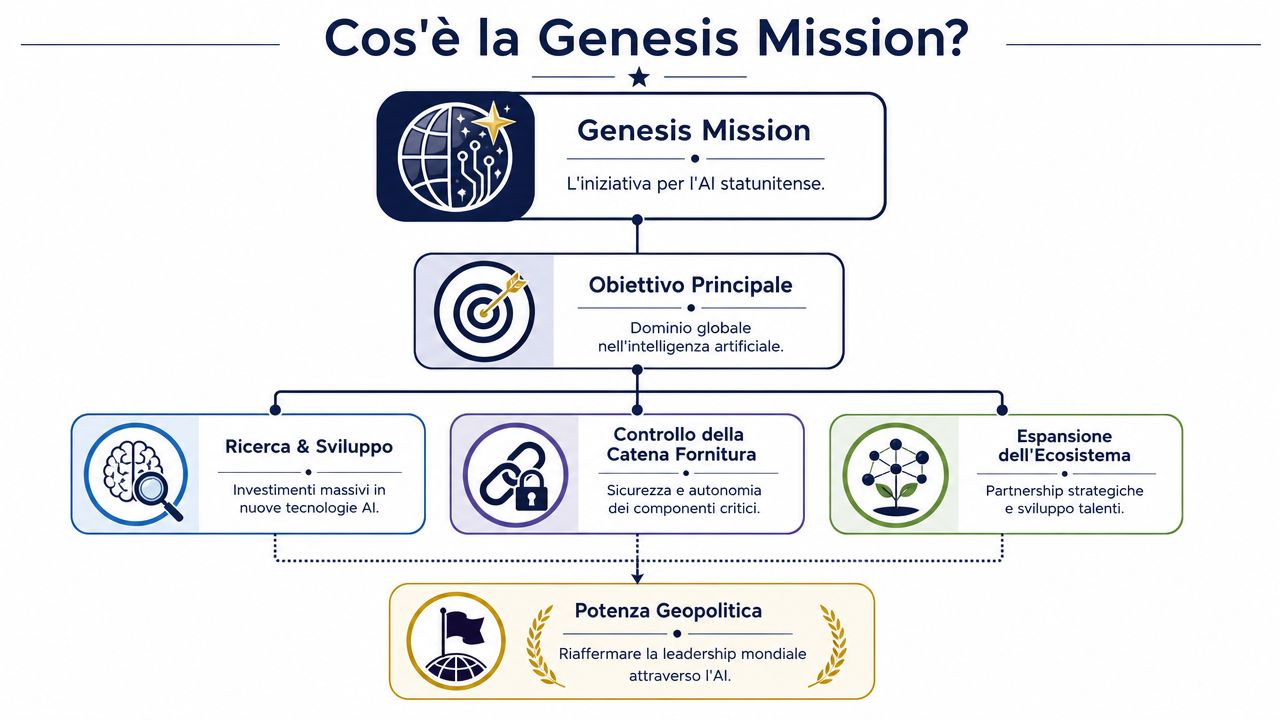
Based on the available information, the Genesis Mission should be viewed first and foremost as an act of industrial policy and national security—not merely as a research program. Its strategic significance lies in the fact that AI is being placed within the same framework through which the United States has historically addressed critical capabilities.
There are a few key elements that clearly define this approach:
This approach is reminiscent of the logic behind “mission-driven” programs, as described in the case of the Manhattan Project: a concentration of talent, central coordination, and measurable objectives, as detailed in the Wikipedia entry on the Manhattan Project.
The strategic point is not just what will be accomplished. It is what the language enables. If political leaders use a metaphor of national mobilization, they pave the way for decisions that would otherwise seem exceptional: budget priorities, fast-track infrastructure projects, enhanced cooperation between the government and industry, and greater selectivity regarding suppliers and supply chains.
It isn't necessary for every detail to be worked out for the market to change its behavior. Often, a political signal is enough.
That is why the Genesis Mission must be analyzed objectively. Not as a founding myth, but as an indicator that the United States views AI as part of a systemic competition. For a European reader, the implication is not that “a new Oppenheimer is coming.” The implication is that Washington is positioning itself to turn technological capabilities into a lasting geopolitical advantage.
The Manhattan Project metaphor works because it evokes a rapid, centralized, and top-priority mobilization. But taken literally, it is inaccurate. To truly understand the “Manhattan Project” of artificial intelligence, we need to look less at the Oppenheimer epic and more at the actual structure of the original program.
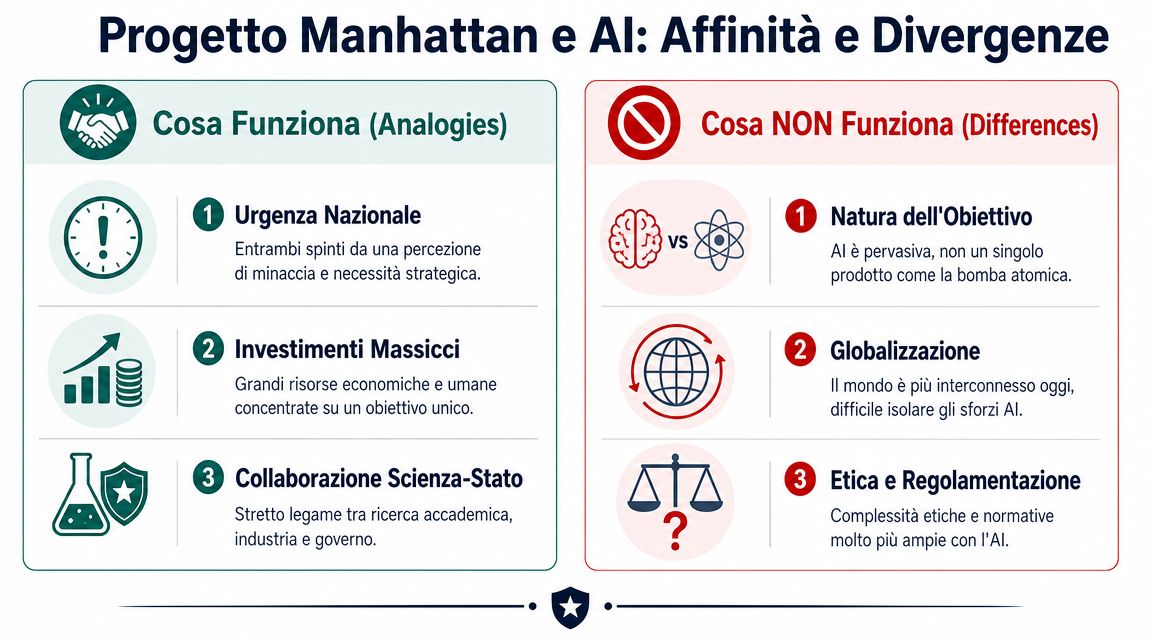
The Manhattan Project was a program of exceptional scale. The Trinity test on July 16, 1945, marked the first nuclear test in history and ushered in the atomic age. Available sources also indicate a cost of approximately $2 billion at the time, with initial funding of $500 million and more than half of the funds allocated to the separation of fissile materials, as detailed in this historical analysis of the Manhattan Project.
This is the first key point to keep in mind when thinking about AI. Major breakthroughs don't come from a good scientific idea alone. They happen when three factors come together:
There is also a second, even more interesting aspect. In the original project, over 90% of the costs were accounted for by buildings and the production of fissile material, with activities spread across more than 30 sites and a strategy described as “parallel”—that is, research, facilities, and organizational adaptation developed simultaneously, as Mimesis Scenari points out.
For AI, this parallel is illuminating. The bottleneck isn't just the algorithm. It's the infrastructure, the data, the energy, the industrial processes, and the ability to coordinate everything quickly.
AI is not a bomb. It is not a single artifact with a single operational objective. It is a family of capabilities that spans software, models, embedded systems, cloud platforms, enterprise tools, and security systems.
Here, the Manhattan metaphor begins to lose its precision.
Rule of thumb: The right question isn’t “Who is the new Oppenheimer?” It’s “Who controls computing power, data, the supply chain, and market access?”
For anyone reading about SMEs and artificial intelligence today, the implication is clear. If you take the metaphor too literally, you underestimate what truly determines scale in AI: not the isolated genius, but industrial organization.
Major national strategies are never straightforward. Even the U.S. strategy on AI contains internal tensions that a European observer must interpret carefully, because they are part of the substance, not mere background noise.

The first contradiction is simple. The United States identifies AI as a strategic priority, but any acceleration of this kind must contend with political constraints, budget negotiations, competing industrial interests, and implementation timelines that rarely align with the public narrative.
This gives rise to a phenomenon typical of large-scale technology policies. The statement of intent appears monolithic. Actual implementation, however, is fragmented. Some components are moving quickly, while others are moving more slowly. Some aspects are very clear, such as the geopolitical signal. Others, however, remain unclear, such as operational governance, long-term structures, or the actual scope of priorities.
For an Italian company, this ambiguity is not just a minor detail for observers in Washington. It means that the AI market in the coming months and years could be influenced by decisions that are not purely economic. A provider could gain a stronger foothold because it aligns with a national priority. A piece of infrastructure could become more critical because it is part of a security strategy. A dependency that is “technical” today could become political tomorrow.
Businesses do not operate outside the realm of geopolitics. They are affected by it in terms of their cost structure, the availability of services, and their range of options.
This is even more true when considering competition between blocs. The United States is increasingly treating AI as an asset of sovereignty. China, in its own way, is making a similar choice. Caught in the middle, Europe risks finding itself in a position where it regulates extensively but has less control over key industrial sectors.
The problem for Europe is not merely that it is lagging behind in a technological race. It is the fact that the race is turning into a competition between blocs that integrate industry, security, and foreign policy. In this scenario, Europe often approaches the issue primarily from a regulatory perspective.
The EU AI Act is important because it defines boundaries, responsibilities, and risk categories. In the context mentioned by Sanoma Italia, generative AI falls under the “limited risk” category when used responsibly. But this, on its own, does not answer the more concrete question: Is Europe also building comparable industrial capacity?
In Italy, the situation remains uneven. Data cited by Sanoma indicate that, according to ISTAT, the adoption of AI in businesses and the public sector is patchy, and that the skills gap is one of the main obstacles, as summarized in Sanoma’s article on the long-term impact of Prometeo. This shifts the focus: the problem is not just regulating the use of AI, but understanding who truly has the capacity to scale it.
In practice, Europe faces the risk of a twofold asymmetry:
Theme: U.S. andChina; Europe; Strategic Vision; AIas a source of power; AI as an area requiring governance andcoordination; Infrastructure; strong integration between the government and industry; greater dependence onexternal suppliers; Domestic adoption;national and industrialdrive; uneven adoption
For an SME, this is not just geopolitical theory. It has a direct impact on three operational decisions.
If AI becomes a strategic infrastructure for nations, choosing an AI provider is no longer just a matter of procurement. It is risk management.
In this context, it is also helpful to follow the discussion on ELECTE regarding the AI Act, because for many Italian companies, the real challenge is balancing rapid innovation with operational control and compliance with European regulations.
The word “sovereignty” may seem far removed from SMEs. In reality, it describes a very practical need: maintaining a degree of control over technologies that have become central to sales, operations, forecasting, compliance, and reporting.
If you're evaluating AI or analytics platforms, I recommend taking a practical approach to the issue of sovereignty. Here are the criteria that really matter.
Many SMEs purchase AI based on demos, ease of use, and upfront cost. This is understandable, but today it’s not enough. The right question isn’t just “Does this solution do what I need it to do?” The complete question is “Will this solution remain consistent with my operational, regulatory, and strategic constraints if the geopolitical context worsens or changes?”
At this point, the discussion about the Manhattan Project of artificial intelligence no longer seems so far-fetched. If the United States and China treat AI as national infrastructure, every European company should at least ask itself where it fits into that picture.
Management decision: The best AI partner isn't just the one with the most features. It's the one that reduces your unnecessary exposure without slowing down innovation.
That is why technological sovereignty is not autarky. It is the ability to make informed choices, spread risk, and maintain control over critical processes.
The most useful lesson is not that we are experiencing a repeat of the Manhattan Project. It isn't. The lesson is more concrete. AI has now crossed the boundary of the tech market alone and entered the realm of national strategy.
Italian entrepreneurs would be well advised to keep an eye on certain developments in the coming months: the actual level of coordination between the U.S. government and industry; how this narrative translates into operational capabilities; the evolution of Europe’s stance between regulation and investment; and, above all, how these dynamics play out in the areas of cloud computing, models, access to computing resources, and data governance.
The most rational choice today is not to wait for complete clarity. That won’t come anytime soon. The rational choice is to develop an AI strategy that balances innovation, compliance, and reducing critical dependence.
In a world where geopolitics is becoming part of the technology stack, choosing the right partners is just as important as choosing the right tools.
If you want to build a more robust AI strategy that’s consistent with the European context, check out ELECTE, an AI-powered data analytics platform designed to transform business data into clear operational decisions, with an approach tailored to the needs of European companies. You can see how it works and assess whether it fits into your tech stack without any unnecessary complications.

.svg)


.svg)
.svg)