
Are you overwhelmed by projects that miss deadlines and go over budget? Do you only realize at the end that the result isn’t what the client wanted? Agile project management software is the tool that transforms this chaos into a clear, flexible, and results-oriented process, enabling your team to plan, execute, and complete projects using an iterative approach. Unlike rigid traditional methods, the goal here is to deliver value in small cycles, adapting quickly to any changes.
This guide will show you why the Agile approach is a game-changer for SMEs, how to choose the right framework (Scrum, Kanban, or a hybrid), and which features are essential in software. You’ll also learn how to enhance your project management with data analysis to make decisions that truly accelerate growth.
Imagine building a house, but instead of seeing the final result only once the construction is complete, the client gives you feedback after every single wall is built. Do you like it? Don’t you like it? Should we make it taller? This is the Agile approach: a method that doesn’t just manage projects, but transforms them into a collaborative, dynamic, and flexible process. For an SME, it’s not just a methodology. It’s a huge competitive advantage.
Unlike traditional "waterfall" methods, where you only find out if the result is satisfactory at the very end (and the surprises are often unpleasant), agility is based on a few but extremely powerful principles:
Agile project management software serves as the driving force behind this change—the tool that makes your company not only more efficient, but also more responsive and ready to seize new opportunities.
Before we dive into the tools, it’s important to fully understand what a project manager does to ensure a project’s success. With the agile approach, their role evolves: they are no longer a controller, but a facilitator who helps the team maximize the value created in each sprint.
The impact of this shift in mindset is clear. A study by the Harvard Business Review found that companies that have adopted agile practices have seen an average increase of 60% in revenue and profits . If you’d like to learn more, you can find comprehensive data and statistics in the Echometerapp report.
This diagram visually summarizes the principles of the Agile Manifesto, the document that started it all.
The principle is clear: agility puts people, a working product, collaboration, and responsiveness first. Everything else comes second.
Adopting an agile approach ultimately means stopping wasting time and money on activities that don’t add value. It allows you to constantly align your product with what the market truly wants and to get there before the competition.
To see how these principles apply to real-world technology projects, check out our guide to agile project management in the IT sector. Essentially, every work cycle becomes a learning experience. You learn what works and what doesn’t, investing your resources only in what delivers tangible results.
Once you realize that the Agile approach can make a real difference, the million-dollar question arises: how do you put it into practice? The real skill lies in choosing the framework that best fits the pace, culture, and goals of your small or medium-sized business. Generally, the initial choice comes down to two major options: Scrum and Kanban.
Think of it this way: Scrum is a series of short, intense sprints—a stage race. Kanban, on the other hand, is a river that flows ceaselessly—a continuous stream. This metaphor defines every aspect of the work, from team roles to how you measure success.
Scrum organizes work into fixed-duration cycles called sprints, which typically last one to four weeks. Each sprint is a mini-project in its own right, with a specific goal and the final delivery of a working product increment. It’s the perfect model for complex projects, where requirements change along the way and getting rapid feedback from the client isn’t an option, but a necessity.
To make the process work, Scrum introduces clearly defined roles:
This structured approach is ideal for teams that need a steady pace and clear checkpoints to stay on track.
The diagram below clearly illustrates when an Agile approach outperforms a traditional one, especially as complexity increases.
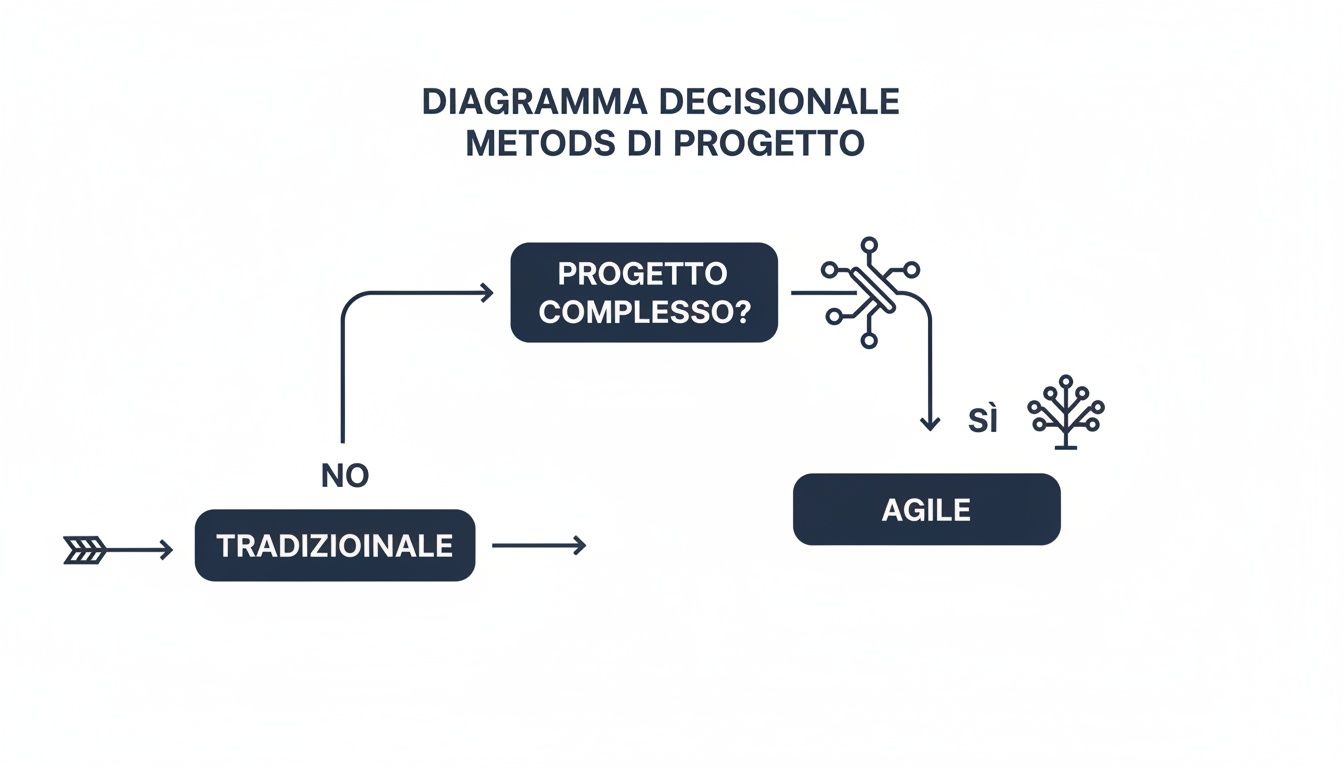
The infographic highlights a fundamental principle: the more unpredictable and complex a project is, the more a flexible framework like Agile becomes an undeniable competitive advantage.
Kanban, on the other hand, doesn’t focus on timed sprints. Its mantra is to visualize the workflow and optimize it for maximum efficiency. Tasks move across a Kanban board through columns representing the various stages (e.g., “To Do,” “In Progress,” “Done”). The real key is to limit the number of tasks in progress (Work in Progress —WIP) to avoid bottlenecks and keep the flow moving smoothly.
Kanban is much less prescriptive than Scrum. It doesn’t require specific roles or fixed meetings. This makes it incredibly flexible and easy to adopt, especially for teams that handle a constant stream of requests, such as customer support, maintenance, or content marketing.
To help you better understand the operational differences, here is a direct comparison.
As you can see, the choice depends largely on the nature of your work. Scrum excels at managing complexity, while Kanban excels at managing continuity.
What if you don't have to choose? Often, the best solution lies somewhere in between. A hybrid approach—which many call Scrumban—allows you to combine the structure of Scrum with the visual flexibility of Kanban.
For example, a team might retain Scrum roles and meetings (such as daily stand-ups and retrospectives) but use a Kanban board to visualize work and manage the workflow, without the pressure of having to complete a predefined set of tasks by the end of the sprint. This allows you to create a customized system, taking the best of both worlds to perfectly adapt it to your operational dynamics.
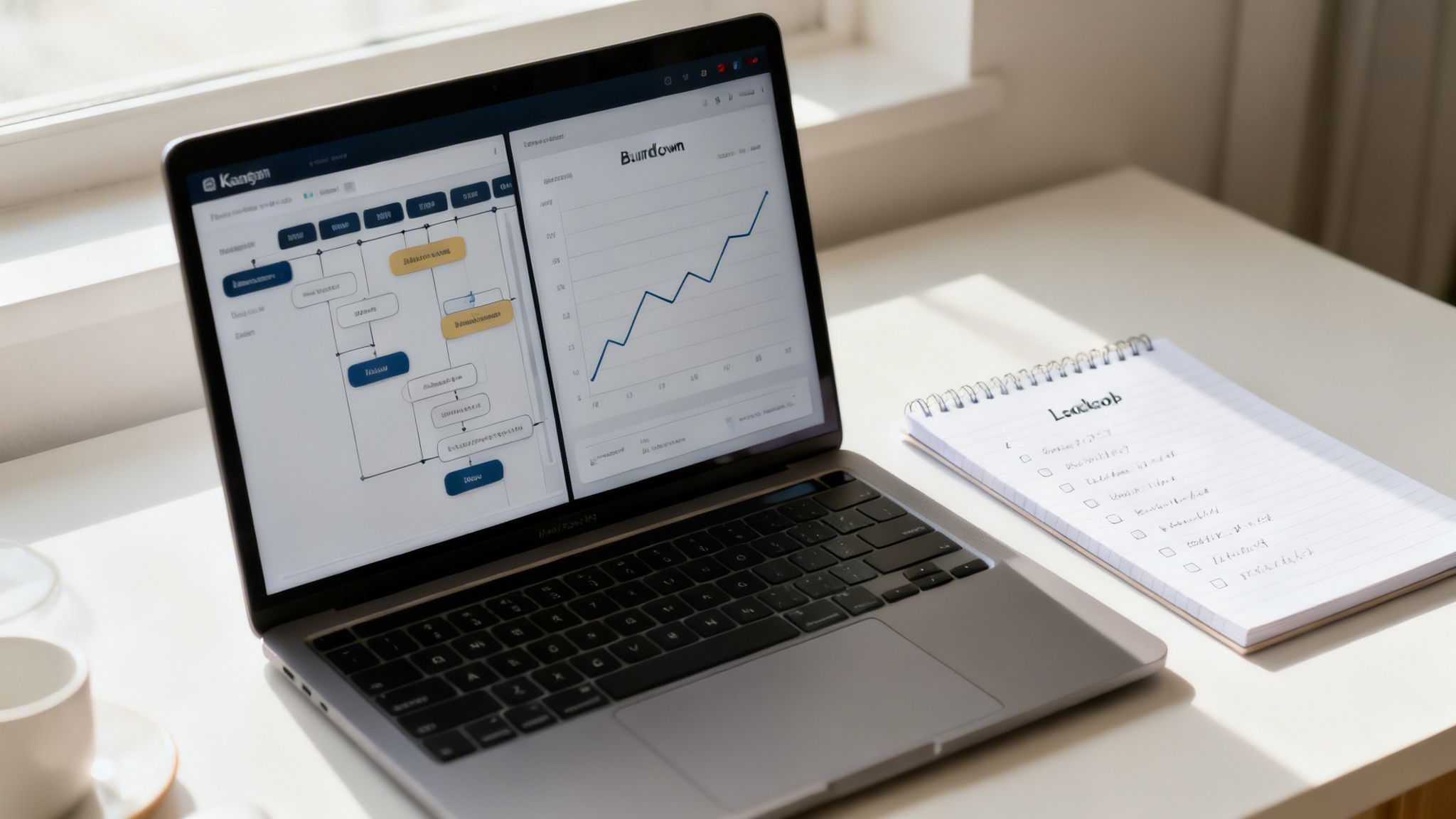
Once you’ve chosen a framework, you need to find the right tool to put it into practice. Effective agile project management software isn’t just a list of tasks—it’s the actual command center of the project.
The market is crowded, but it all comes down to a handful of key features that really make a difference. Let’s take a look at the must-have features.
At the heart of every agile tool is its ability to make work visible. Whether it’s a Kanban board or a sprint view, the goal is to create complete transparency regarding progress, accessible to anyone at any time.
A well-organized visual board is the best antidote to endless update emails. It lets everyone—from the CEO to the developer—know where we stand, fostering team autonomy.
Visualizing the present is essential, but high-quality software must also help you plan for the future and learn from the past. This is where project data stops being mere numbers and becomes strategic insights.
These aren't just "extra features," but the cornerstones of a successful Agile implementation.
Choosing the right tool doesn’t have to be a shot in the dark. Selecting the perfect agile project management software for your small business is a strategic decision. Instead of getting overwhelmed by a sea of features, follow a structured approach.
The first step isn't to look outward, but inward. Before comparing dozens of options, you need to be absolutely clear about the problems you're trying to solve.
Answering these questions will give you a roadmap to help you find your way. If you find that your main challenge is a lack of an overview, then creating a clear Kanban board should become a priority. For practical guidance at this stage, learn more about how to map your business processes.
The price isn't just the cost of the license. A realistic budget must also take into account "hidden" costs, such as the time needed to train the team or the resources required to integrate the new tool with the systems you already use.
Debunking a myth: "The more it costs, the better it is." The best software isn't the most expensive one, but the one that fits your specific needs like a glove, ensuring the highest return on investment (ROI).
Think about the future, too. Your business will grow, and your tool needs to be able to grow with you. Scalable software lets you add users and projects without forcing you to switch platforms every two years.
No software exists in a vacuum. Its ability to "talk" to the tools you already use is a critical factor. Agile project management software that integrates natively with your CRM, analytics platform, or communication systems eliminates manual work and ensures that data flows seamlessly.
Finally, the most important step: never make the decision on your own. Actively involve your team in the free trials. They are the ones who will be using the tool every single day. Their feedback is the most reliable indicator of whether a software solution will be enthusiastically adopted or abandoned after just a few weeks. Team adoption is the only factor that determines the success of your investment.
Task management is just the starting point. True strategic agility—the kind that makes a real difference—is only unlocked when data drives decisions. Let’s see how to connect your new agile project management software to an AI-powered analytics platform like ELECTE to take your operations to the next level.
It’s no longer just about counting how many tasks are “Completed.” The goal is to understand why some tasks take twice as long or where the bottlenecks that are holding back growth are hiding.
This shift from an operational to a strategic perspective is a cultural change, not merely a technological one. Moreover, the Italian ICT market exceeded 44.3 billion euros in 2025, while the artificial intelligence market reached 1.8 billion euros, growing by 50% in just one year. As explained in Webd’s full report, technology is no longer a cost, but a strategic investment.
Integrating your agile tool with ELECTE, our AI-powered data analytics platform for SMEs, means making sense of the data you already generate. Instead of just measuring team velocity, you’ll start linking project performance to business outcomes.
Here are the kinds of questions you can finally answer with concrete answers:
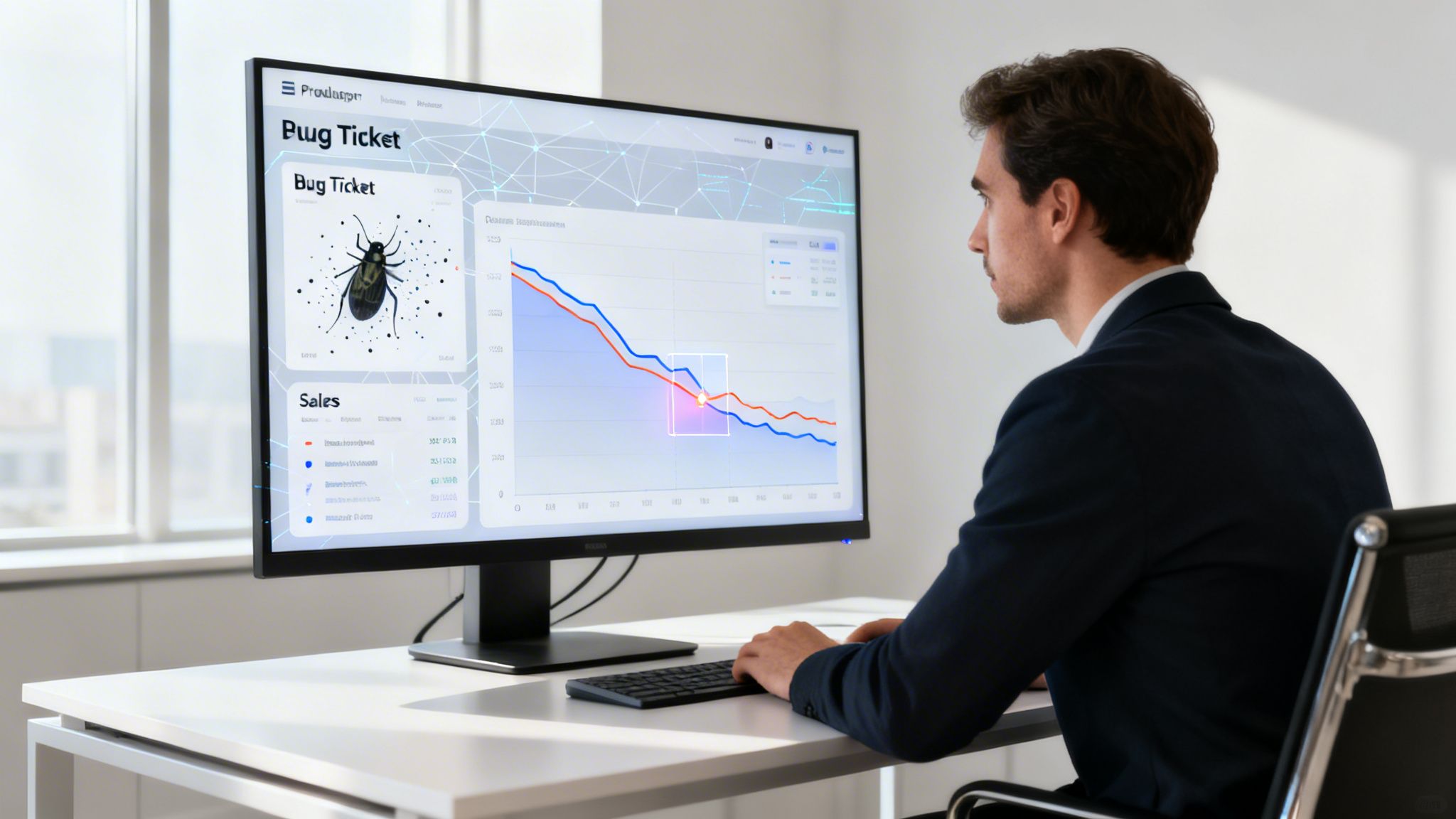
Practical example: An e-commerce company uses agile project management software to develop its platform. The team notices an increase in tickets reporting a bug in the checkout process.
By connecting the data to ELECTE, they discover a direct and alarming correlation: that single bug is causing a 15% drop in the conversion rate. This insight, gained in just a few clicks, radically shifts their priorities. Fixing the bug jumps to the top of the backlog, the team resolves it, and the conversion rate returns to normal, recovering thousands of euros.
This is the power of data-driven agility. If you want to learn how to create effective dashboards, check out our guide on how to create analytics dashboards on ELECTE.
We’ve reached the end. It’s now clear: the Agile approach, combined with the right tools and driven by data, represents a paradigm shift. For an SME, adopting agile project management software is the key investment needed to become faster and more responsive.
Here are the key steps to get started:
Don’t just manage your projects better. Learn how to measure them to guide your decisions and turn every task into an opportunity for growth.
Now is the time to put theory into practice. Sit down with your team, lay out your actual needs in writing, and choose the tool that aligns with your vision. Embracing agility means building a company that doesn’t just endure change—it drives it.
Ready to turn your data into a tangible competitive advantage? Discover how ELECTE shed light on your project performance and guide every strategic decision you make.
Introducing the Agile approach in an SME always raises some questions. Every change and every investment must be carefully evaluated. Let’s try to address the most common concerns.
There’s no one-size-fits-all answer. Prices vary widely. Some tools offer freemium plans that are perfect for getting started, while others charge a monthly fee per user. For a small-to-medium-sized team, costs can range from zero to a few hundred euros per month.
The point, however, is something else: don’t just look at the price. The real question is what the return on investment (ROI) is. Good agile project management software helps you cut waste, deliver projects faster, and keep your customers happier. These benefits are almost always worth much more than the cost of the license.
Forget the idea of flipping a switch. Agile implementation is a gradual process. Many small and medium-sized businesses start by applying agile principles to a single pilot project and then expand from there. It’s the best way to learn by doing.
Is that a realistic estimate? Expect it to take 3 to 6 months to see the first tangible results and the beginnings of a shift in corporate culture. The key is to invest in team training: it’s not enough to simply teach people how to use the tool; you need to help them understand why this new way of working benefits everyone.
This is the most persistent myth. It’s true that Agile originated in the world of IT, but thinking it’s confined to that realm is a mistake that limits a company’s potential. Its principles of flexibility, collaboration, and continuous improvement are universal.
Here are a few examples outside the IT field:
It is no coincidence that the market for these tools is booming. The global agile management software market reached $4.56 billion in 2023, and forecasts indicate it will exceed $24.2 billion by 2037. Research Nester’s comprehensive study shows that the cloud is the primary driver of this growth, as it makes collaboration between teams—even remotely—easier.
Ready to turn your project data into strategic decisions? Discover how the AI-powered analytics platform from ELECTE can give you the insights you need to drive growth. Start your free trial now.

.svg)


.svg)
.svg)