
The problem with many SaaS purchases doesn’t arise when you sign the contract. It arises months later, when the provider stops responding as promised, changes the terms, makes it difficult to export data, or shifts responsibilities onto you that you thought were theirs. At that point, the initial low price disappears. What remains are operational downtime, legal risk, and exit costs.
Anyone who runs an SME knows this all too well. The sales demo is always flawless, but the contract is far from it. And when a vendor has access to critical data, processes, or sales workflows, a poor choice doesn’t just affect IT. It impacts administration, compliance, customer service, and business continuity.
I speak as an entrepreneur who has experienced real-world disputes with providers that lack transparency regarding GDPR, European billing, genuine support, and unilateral changes to terms. The lesson is simple: provider due diligence isn’t just a procurement formality. It’s the way you assess whether a supplier can become a strength or a structural risk.
Here you'll find a practical framework for evaluating a provider just as you would evaluate a business partner. It's not just about price and features, but also the contract, security, operational reliability, portability, and ongoing monitoring.
The website is down on the worst possible day. Orders are getting stuck, the sales team is messaging on three different channels, and customer service doesn’t know what to tell customers. You open a “priority” ticket with your SaaS provider and get an automated response. No technician, no clear escalation process, no estimated resolution time.
That's when you realize what you've really bought.
You didn't just buy a service. You bought the way that provider handles incidents, liability, data, contracts, and termination. If you didn't verify these aspects beforehand, you've accumulated operational debt. You don't see it in the demo, it doesn't appear in the price list, but it all comes crashing down when the provider can't deliver.
When a provider fails at a critical moment, the problem isn't just technical. It becomes a commercial, legal, and reputational issue all at once.
Many business owners treat provider due diligence as a mere administrative formality. They check the price, a couple of features, maybe a certification on the homepage, and then they sign. This is a common mistake. The crucial questions are different: Who is responsible for the data? Where is it stored? How can it be exported? Who actually provides support? What happens if the provider changes ownership or alters the terms of the contract?
The downside is that these questions slow down the negotiations. The upside is that they save you months of trouble later on.
Supplier due diligence helps you understand what risks you’re taking on along with the service. The point isn’t to gather documents just to put your mind at ease when signing the contract. The point is to estimate, up front, how much that supplier will actually cost you if something goes wrong, if the company’s structure changes, if the support falls short, or if you need to walk away quickly in the future.
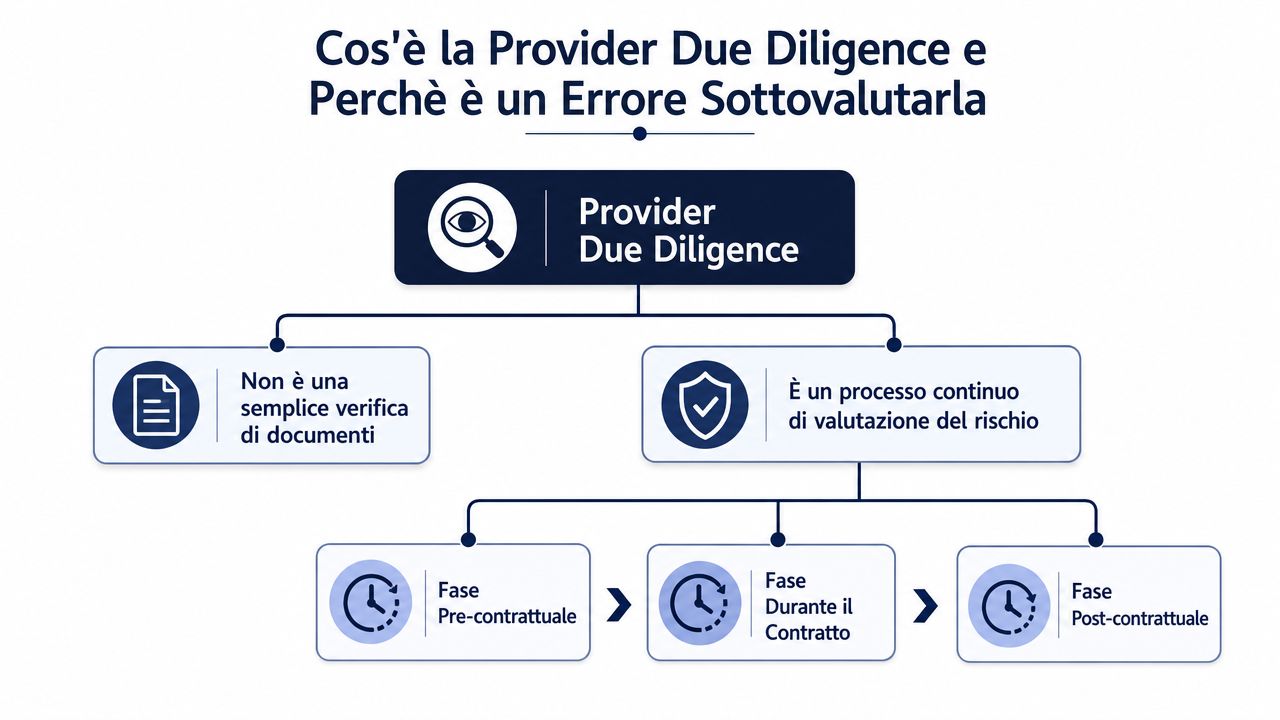
Anyone who has ever dealt with a forced migration or a poorly managed incident knows this all too well. The problem rarely remains confined to the vendor. It seeps into internal processes, halts sales, ties up the technical team’s time, raises legal concerns, and turns a seemingly affordable subscription fee into a hidden operating expense.
That is why a thorough due diligence process operates on four concrete levels:
Rule of thumb: If a supplier handles data, payments, customer service, or a critical process, due diligence should be treated as a business continuity check, not as an administrative formality.
In the Italian context, underestimation is even more costly, because the supply chain consists largely of small and medium-sized enterprises, which are often highly dependent on third parties. SMEs account for 99.9% of active businesses and employ approximately 76.5% of the private sector workforce, according to data reported by the Ministry of Enterprise and Made in Italy. In such a system, the supplier’s risk quickly spreads to the customer.
There is also a common mistake. Many companies evaluate a provider without first clarifying what they are actually purchasing: infrastructure, a platform, application software, or a combination of the three. If you want to set up this analysis properly from the outset, it’s best to start by understanding the differences between cloud services.
Underestimating supplier due diligence means treating a business partner as just another expense. This is where the problems arise that no one mentions in the sales pitch: internal processes that are poorly adapted to the supplier, technical dependencies that are difficult to eliminate, liabilities you only discover after an incident, and exit costs that come when you have the least room to negotiate.
A well-done assessment minimizes surprises. A poorly done assessment merely postpones them.
Most serious problems don't stem from a technical glitch. They stem from a clause that was overlooked. The contract tells you who's in control when something goes wrong.

When evaluating a provider, price is the last thing to consider. The legal scope of the relationship comes first.
Start from these areas:
Many entrepreneurs view the contract as a document designed to protect the provider. That’s correct. That’s why it should be read as a roadmap to the provider’s incentives.
In a sales meeting, it’s best to be direct. There’s no need to speak like a lawyer. You need to speak like a company that wants to avoid hidden costs.
Try asking questions like these:
A good contract isn't one that promises everything. It's one that leaves little room for ambiguity when the relationship sours.
A classic red flag is a provider that answers business-related questions well but struggles with exit-related ones. Another is a standard DPA that exists but doesn’t really clarify responsibilities, data transfers, and timelines. If you currently work with data, automation, or decision-making systems, it’s also worth reading about the European AI Act as it applies to SMEs, because it’s prompting many companies to formalize governance, traceability, and the role of suppliers more rigorously.
One last practical tip. If the provider finds your questions about data, liability, and portability annoying, that already says something about the kind of relationship you’ll have after signing the contract.
A compliance badge helps. But it’s not enough. A certification indicates that a control system is in place. On its own, it doesn’t tell you whether that provider is suitable for your specific context, your data, and your operational exposure.
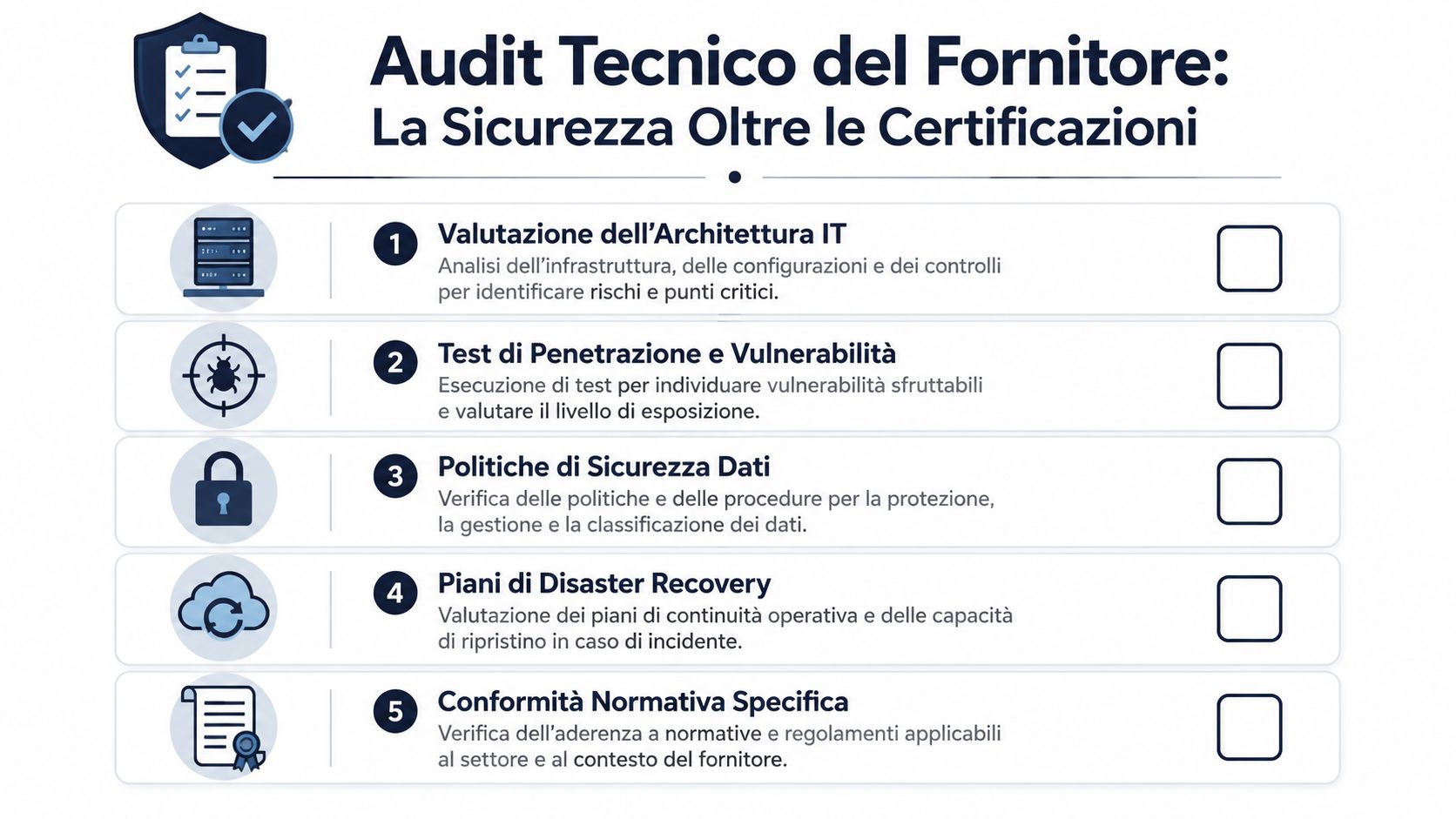
Vendor management frameworks recommend collecting risk questionnaires, financial reports, and certifications such as ISO 27001 and SOC 2, and classifying vendors by risk level. For high-risk vendors, on-site audits and reviews of the external attack surface are also required, as summarized by Mitratech in its guide to vendor due diligence.
This point changes the way we evaluate a supplier. The question isn’t “Does it have certification?” The question is “What operational evidence can it show me in addition to the certification?”
For example, it makes sense to ask:
AreaWhat to AskWhy It MattersHostingRegion Where Data and Infrastructure Subcontractors Are LocatedAffects Jurisdiction and ComplianceBackupPolicies, frequency, and recovery testingAn untested backup is just a hopeAccessControls on privileged accountsReduces internal risk and abuseIncident responseDocumented incident management processTells you who does what under pressureVulnerabilitiesEvidence of exposure surface reviewsHelps you understand how visible and attackable the provider is
Data jurisdiction matters more than many people realize. If the provider hosts or transfers data outside the scope you had assumed, your obligations, assessments, and often even the way you handle incidents and formal requests change.
Then there’s the less glamorous, more practical side: backups and disaster recovery. Don’t just ask if they exist. Ask how they’re tested, how they’re documented, and who steps in if data becomes corrupted or the service goes down.
At the same time, assess the reputation of the party you’re dealing with. In some high-risk sectors, checking for public warnings or alerts is a basic precaution. A useful example is the cryptocurrency scam blacklist, which clearly illustrates why reputation screening and third-party verification aren’t just a formality, but a fundamental safeguard when a provider operates in sensitive or opaque areas.
If a vendor only shows you glossy PDFs and no evidence of how it handles incidents, backups, access, and vulnerabilities, you’re evaluating marketing, not security.
The true quality of a provider becomes apparent when you’re in a rush and have little leeway. Not in the demo. Not in the sales pitch. Not on the “enterprise” page.
You should test the support before becoming a customer. It's a step that almost no one takes.
You can do it easily:
A reliable provider won't take offense if you ask these questions. They consider them normal.
Excellent support isn't about responding quickly when everything is working. It's about taking charge of a complicated problem, knowing how to escalate it, and providing you with a written record of the decisions made.
This is where the most overlooked aspect of provider due diligence lies: lock-in.
Effective technical due diligence must include scanning the code and dependencies to build a comprehensive inventory of third-party software, dependency relationships, and open-source licenses, as well as reviewing the architecture, APIs, and databases to assess the risk of technical debt and vendor lock-in, as FOSSA explains in its guide on technical due diligence.
In business terms, you need to understand three things:
If the provider makes it easy to join but hard to leave, you don't have a partnership. You have a dependency.
When it comes to business continuity, it’s also worth clarifying how the provider approaches data recovery and data loss. If you’re looking for a framework to evaluate these scenarios, ELECTE offers a good reference point on RTO and RPO management.
One simple rule can be very helpful: before signing, ask for a written offboarding procedure. If there isn't one, the cost of leaving is almost certainly higher than you think.
The problem with checklists is that they provide a snapshot of the supplier on a specific day. The risk, however, is constantly changing.
A common shortcoming in provider due diligence is precisely this: almost everyone explains what to ask the provider, but few explain how to reassess its risk over time. Yet the context demands it. The Clusit 2025 report indicates that in 2024, there were 357 cyberattacks against Italian targets—up from 310 in 2023—with 79% classified as high or critical severity. Furthermore, third-party-related breaches cost, on average, over $370,000 more than internal ones, as reported by SecurityScorecard in its checklist for service providers.
This changes the control logic. It’s not enough to simply approve a provider upon entry. You need to decide which providers require more attention and which indicators trigger a reassessment.
A risk-based approach starts with an internal classification. Not all suppliers are the same. At a minimum, the following factors matter:
From there, you can establish effective monitoring, including through data analysis tools: SLA dashboards, tracking of critical tickets, alerts regarding changes to documentation, changes in subcontractors, performance anomalies, or security incidents.
A supplier doesn't become a risk just because it experiences an incident. It becomes a risk when warning signs accumulate and no one interprets them in context.
For an SME, this is where data translates into practical governance. Not to improve bureaucracy, but to respond more quickly.
The checklist serves one purpose only: to help you determine whether you’re choosing a supplier that supports your business or one that leaves you with operating debt, legal disputes, and a costly exit. If the document doesn’t help you say no, it’s not a useful checklist.
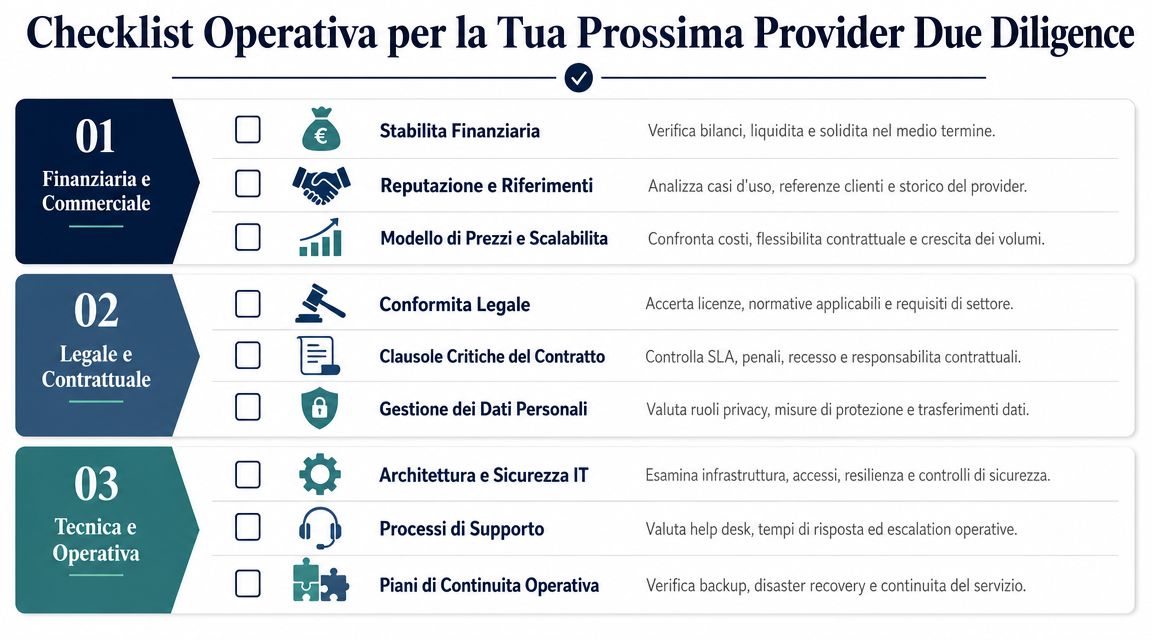
This way, you avoid the kind of problem that only comes to light after signing.
What counts here is performance. Certifications help, but they don't show how the provider performs under pressure.
Many mistakes arise here, not in the contract.
The most common mistake is to stop at the selection phase. The real risk emerges later, when support deteriorates, subcontractors change, exports turn out to be unusable, or a policy change shifts responsibilities onto you that you thought were included. That’s when secondary costs arise.
If you want to boil it all down to a rule of thumb, use this one: evaluate the provider as you would evaluate a business partner. They must be able to weather an incident, a legal dispute, and an orderly separation. If you don’t know how to walk away, you haven’t done enough due diligence.
If you want to transform data on suppliers, SLAs, incidents, and performance into a continuous monitoring system, ELECTE—an AI-powered data analytics platform for SMEs—helps you gather scattered signals and turn them into useful insights for faster, better-informed decisions. It’s a practical way to move from sporadic due diligence to a more mature operational oversight system.

.svg)


.svg)
.svg)