

The most useful answer to the question of how much AI to use in a company is not “as much as possible.” It is “to the extent that it adds value without undermining judgment, quality, and differentiation.”
This matters more today than it might seem. In Italy, the adoption of artificial intelligence in businesses rosefrom 8.2% in 2024 to 16.4% in 2025, according to Istat data reported by Il Foglio. This doubling in just one year tells us one simple thing: the question is no longer whether to take action, but how to adjust the balance.
As the CEO of an AI platform for European SMEs and as a researcher working on the commoditization of language model outputs, I see the same mistake being repeated. Companies treat AI like a light switch. They either ignore it or try to automate everything. Both choices destroy value. The first because it leaves you lagging behind. The second because it floods you with outputs that are correct on the surface but weak in substance.
The framework that works is simpler and more disciplined: use AI where it can reduce routine tasks, and stop using it where responsibility, context, and human judgment are required.
Most companies make mistakes—either by doing too much or by acting too late. The point isn't to adopt AI. The point is to find the threshold beyond which the increase in operational performance is outweighed by the risk you're introducing.
Balaji Srinivasan summed it up better than anyone else: “0% AI is slow. But 100% AI is slop.” As a CEO, this is how I interpret it. Too little AI leaves the company with unnecessary costs. Too much AI replaces judgment with plausible but interchangeable outputs.
The logic is that of the Laffer Curve applied to knowledge work. At first, every additional unit of AI generates a high return: less time wasted on repetitive tasks, faster execution, and more standardized processes. Then a threshold is reached. Beyond that threshold, the marginal benefit declines and costs begin to rise—costs that many managers fail to recognize until it’s too late: well-disguised errors, reduced control, blurred lines of responsibility, and content that all looks the same.

Staying at zero isn't prudence. It's choosing to pay qualified people to do work that doesn't create a competitive advantage.
It happens every day. Finance teams manually reorganizing files. Sales reps rewriting nearly identical emails. Operations teams moving data from one system to another. Marketing teams preparing first drafts and format changes by hand. These activities don’t improve strategy, strengthen positioning, or increase perceived customer value. They simply consume managerial attention and valuable time.
That is why the market is shifting. As noted at the beginning, adoption is growing because the cost of inaction is becoming increasingly apparent—first in terms of time and then in terms of margins.
Without AI, performance slows down. With too much AI, you end up standardizing even what should remain distinctive.
The other mistake is more subtle, because at first it seems like a win in terms of efficiency.
A financial report written entirely by AI may appear accurate, well-organized, and even convincing. But a responsible CFO doesn’t sign off on a document just because it “sounds good.” They cross-check it against orders, collections, inventory, operational delays, and business exceptions. Without this step, the company isn’t automating effectively. It’s merely shifting the risk further down the chain.
The same applies to sales and marketing. An email generated 100% by AI can get the tone, structure, and grammar right. But it often lacks that unique touch: the reference to the customer’s actual challenge, the dynamics of their industry, or the specific friction that came up during the call. That’s where conversion happens. And that’s where total automation starts to erode differentiation.
This is the slop. Content that’s readable, quick to produce, and formally acceptable, but lacking in accountability and competitive advantage. I’ve analyzed this risk in greater detail here: how companies are approaching AI.
Here's the rule of thumb:
AI doesn't automate an entire process very well. It automates the core of the process very well. It works “middle-to-middle.”
At the beginning, you need a human to define the problem, the context, the constraints, and the relevant data. At the end, you need a human to verify the output, put it into context, and take responsibility for it. In between, however, AI can save hours of work.
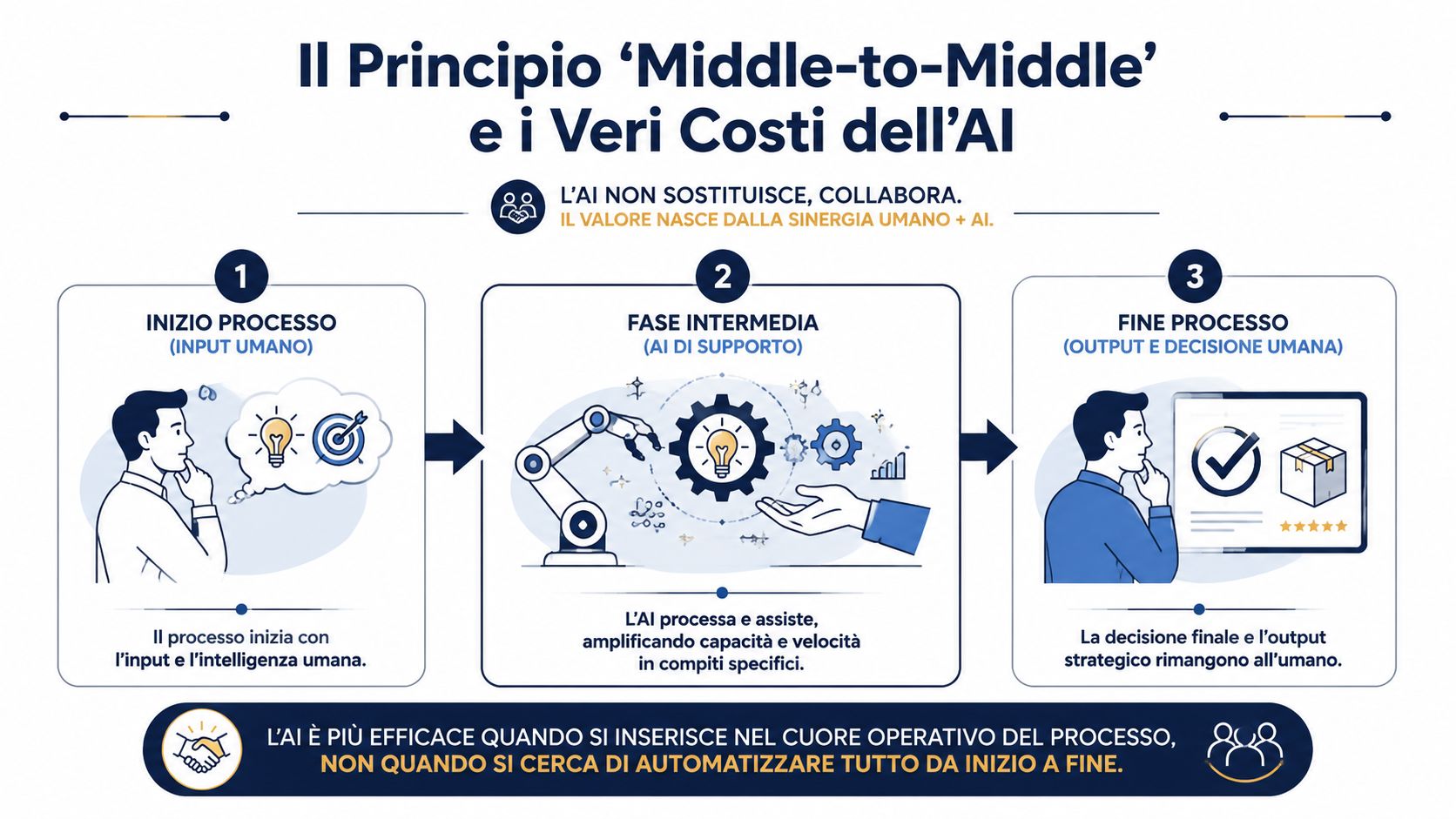
Take a business analysis, for example. Management defines the initial question: Which customers are seeing a slowdown? Which product lines are growing? Where are margins being squeezed? The AI aggregates data, cleans up tables, identifies patterns, and prepares the report. Then an expert reviews the output and decides whether that pattern is a true anomaly or just temporary noise.
The same pattern applies to customer service, finance, operations, and marketing. AI excels at transformation, classification, summarization, format adaptation, and draft generation. On its own, however, it is not well-suited to setting business priorities or taking on the risk of making the final decision.
Many entrepreneurs focus on APIs or licenses. That’s part of the equation, but it’s rarely the deciding factor. The real cost lies in the hours of expertise required to provide clear instructions and verify the output.
Here’s a statistic I often share with teams: Only 10% of AI’s value comes from algorithms, 20% from data, and 70% from people, processes, and corporate culture, as summarized by Archimedia in its practical guide. If you get the organization, governance, and accountability wrong, you can have the best model and still achieve very little.
Management rule: AI does not eliminate the need for expertise. It shifts the focus from mechanical tasks to sound judgment.
That’s why companies that try to “replace people” are often disappointed. Those that redesign roles, on the other hand, achieve more. Less time spent on manual production. More time spent on verification, interpretation, and decision-making.
Three practical implications:
The quickest way to get AI adoption wrong is to treat its limitations as temporary problems. Many of them are not. They are structural boundaries that serve precisely to determine where to stop.
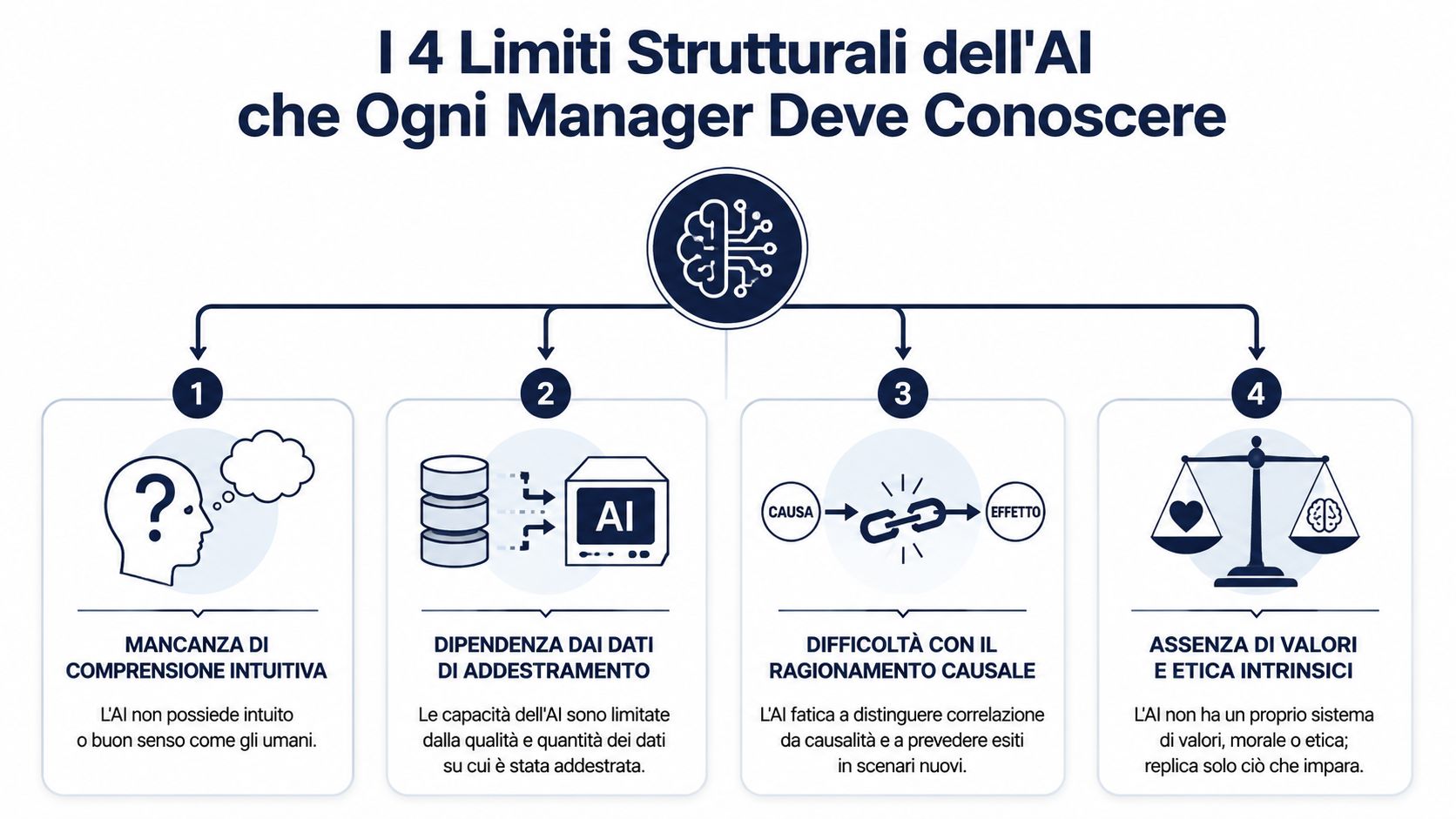
First limitation: cost. Large-scale AI isn’t free. Every call, workflow, orchestration, integration, and control adds to the cost. If the task has little value or requires too many review steps, automation can worsen the bottom line instead of improving it.
Second limitation: mathematical. AI does not magically solve problems where the system is unstable, chaotic, or difficult to observe. A model can help interpret signals. It cannot transform fundamental uncertainty into certainty.
Third limitation: practical. Even when the model is good, the entire task cannot be fully automated. Someone has to formulate the problem, and someone has to check the answer.
Fourth limitation: physical. AI doesn't work on your factory floor, doesn't visit customers, doesn't sense the tension in a negotiation, and doesn't see a machine vibrating abnormally unless someone feeds that information into its data.
If the process requires implicit context, direct perception, or strong legal liability, AI should act as an assistant, not a pilot.
The most underestimated bottleneck is internal expertise. In Italy, 68% of companies with fewer than 50 employees consider the lack of internal expertise to be the main obstacle to AI adoption, and it takes an average of 4–6 weeks of training to achieve independent use, according to this analysis of AI use, data, skills, and training.
This fact matters more than many spectacular demos. If no one in the company knows how to monitor output, automation isn't an advantage. It's an operational risk.
For a manager, the right question isn't “Can AI do it?” It's this:
If the answer to any of these questions is "no," increase the human quota.
The most subtle strategic problem isn't a glaring mistake. It's the tendency for good-quality work to converge toward mediocrity. I call this the B+ Trap.

Major generative models are increasingly producing output that is “good enough.” Clean text. Readable summaries. Well-organized analyses. Correct structures. But when everyone uses the same models, the same prompt patterns, and the same workflows, the results tend to converge.
For many companies, this goes unnoticed at first. They see speed and apparent quality. They don’t see the loss of voice, of edge, of competitive advantage. In marketing, this translates to interchangeable content. In analytics, it translates to insights that anyone else can obtain. In strategy, it translates to decisions based on average market intelligence, not on your proprietary advantage.
A company that leaves standard tasks to AI and then incorporates internal expertise, industry context, proprietary data, and managerial judgment produces a different kind of output. Not necessarily longer or more complex—but more useful.
This is why 100% AI is a competitive dead end. Not because AI is poor, but because if you let it produce everything without human input, you end up with results that are increasingly similar to everyone else’s. The part that creates margin is the non-commodity aspect.
For those who wish to explore this perspective further from a research standpoint, I recommend the AI-driven analytics publications.
The advantage in 2026 isn't having access to AI. It's knowing where to stop automation and add your own proprietary layer.
When an entrepreneur asks me how much AI to use in their company, I start with two factors—not the tool itself.
The first is the nature of the task. Is it mechanical, analytical, or decision-making?
The second is the cost of the mistake. If the output is wrong, do you lose a few minutes, a customer, profit margin, or credibility?
This approach also makes sense for a very practical reason. The most immediate impact of Gen AI is seen in the automation of repetitive tasks such as email management and the generation of standard reports, freeing up human resources for higher-value tasks, as highlighted by Huware in its in-depth analysis of business productivity.
| Task Type | Low Cost of Error | Average Cost of Error | High Cost of Error |
|---|---|---|---|
| Mechanical and repetitive | Nearly 90% AI. Data formatting, scheduling, tagging, content distribution. | About 70% AI. High level of automation with final review. | About 50% AI. The AI generates the text, and a human reviews it line by line. |
| Analytical and interpretive | About 70% AI. The AI identifies patterns; humans confirm them. | About 50% AI. A good balance for management reports. | About 40% AI. A systematic expert review is needed. |
| Decision-Making and Strategy | About 40% AI. Support for scenarios and options. | About 30% AI. AI assists, it doesn't conclude. | Close to 30% AI. Pricing, strategy, hiring, and sensitive communications. |
These percentages are not a natural law. They are a practical starting point. They help avoid two common mistakes: automating high-risk processes too soon, or leaving processes manual that should by now be automated.
In practice, it’s a good idea to review the level of automation on a regular basis. The most useful metrics are simple.
If you want to formalize this step, it’s helpful to consider how to evaluate the return on your AI investment before rolling it out company-wide.
Key Takeaways
The best way to understand this framework is to see it applied without any theoretical embellishments. Internally, the process did not start with an abstract concept regarding the “level of AI.” It began with a simple rule: automate only where the cost of an undetected error is low, while maintaining human control where the cost of error is high.
The clearest example is the editorial pipeline. The first attempt was simple: to automate everything, from the initial draft to distribution across channels, including format adjustments, images, and scheduling. It worked. But the output was only generally correct.
The tone was there. So was the format. What was missing was the element that an experienced reader picks up on right away: the specific angle, the judgment, the point of view.
The calibration was achieved by reintroducing human intervention at just two points: reviewing the key message and selecting the angle for each platform. The AI remained responsible for format adaptation, creative production, and publication. As a result, the process was reduced from three hours to about 30 minutes of human work per cycle, resulting in a final balance of approximately 80% AI and 20% human.
The sweet spot isn't where the AI can do everything. It's where the team stops over-correcting and the output remains credible.
The method used to achieve this can be replicated in any small or medium-sized enterprise.
There are three internal metrics we monitor: the corrective action rate, total end-to-end time, and the quality as perceived by the end user. When any of these metrics deteriorates, the slider must be moved back.
This approach also reflects a product philosophy that I consider sound: AI should replace the analyst’s work when it is repetitive and structured, not business judgment. In other words, it’s designed to replace your analyst, not your judgment.
Competitive advantage doesn't come from using more AI. It comes from knowing how to set a limit before automation begins to erode margins, trust, and the uniqueness of the work.
That’s why the right question isn’t whether to adopt AI, but how much AI to use in the company for each relevant process. The AI Laffer Curve serves exactly this purpose: to find the point at which automation increases productivity and speed without pushing the team into the “B+ trap”—that is, output that’s good enough to pass but too generic to set the company apart.
In practice, AI should be used where it saves time, reduces repetitive work, and keeps verification costs low. It should not be used where the cost of an error outweighs the time saved, where context matters more than format, and where the decision has commercial or reputational implications.
This is where managerial maturity shines through.
In the next competitive cycle, the companies that succeed will be those that set clear boundaries for AI. Not those that cram it into everything, but those that keep human judgment at the core and automate the rest with discipline.
If you want to apply this approach using a platform that automates analysis without taking away your decision-making control, check out ELECTE, an AI-powered data analytics platform for SMEs. You can see how it converts raw data into actionable insights, automated reports, and useful signals to help you make decisions faster—without relying entirely on AI. Ready to act on your data? Start your free trial →

.svg)


.svg)
.svg)





.jpg)