
What would you do if your systems crashed right now?The RTO (Recovery Time Objective) answers the question, "How quickly do we need to be back up and running to survive?", whilethe RPO (Recovery Point Objective) asks, "How much data can we afford to lose without jeopardizing our future?"
Understanding the difference between RTO and RPO isn’t just a technical exercise for a select few—it’s a critical strategic decision for the very survival of your business. In this guide, we’ll show you how to turn these concepts into a concrete action plan that protects your revenue, your reputation, and your customers’ trust. You’ll discover how to set realistic goals, which tools to use, and how AI-powered analysis can make the difference between reacting to a disaster and anticipating it.
Think of your company as a race car speeding down the track. A sudden breakdown forces you to pull into the pits. This is where RTO and RPO become your vital signs—the factors that determine whether you can get back in the race or whether you’ll have to retire.

The RTO is the stopwatch. It represents the maximum amount of time your "car" can remain in the pits for repairs before the damage to the race (and your revenue) becomes irreparable.
An RTO of 30 minutes means that every critical system must be back online within half an hour. Exceeding this limit results in direct financial losses, customers switching to competitors, and reputational damage from which it is difficult to recover. It is a metric focused on uptime and recovery speed.
The RPO represents the history of your data. It indicates the maximum amount of recent data you are willing to lose permanently.
If your last backup was taken an hour ago, your RPO is one hour. This means that, in the event of a failure, you will lose all the data generated in that last hour: orders, contacts, and transactions. A low RPO, close to zero, requires more frequent backups but safeguards your most recent and valuable insights.
Having a clear plan based on RTO and RPO turns uncertainty into a measurable resilience strategy. It’s what protects the beating heart of your business.
Today, with cyber threats becoming increasingly sophisticated, ignoring these two factors is no longer an option—not even for small and medium-sized businesses. A ransomware attack or a simple human error can bring everything to a standstill for hours, if not days. Defining these values is not just a security measure, but a strategic step toward building a stronger, more reliable business. The first step is to thoroughly understand how your processes work. To learn more, check out our guide on business process mapping.
Although RTO and RPO may seem like similar acronyms, in everyday practice they address completely different issues. Understanding their practical implications is the first, essential step toward building a resilience strategy that truly works for your company.
RTO is all about recovery speed. The key question it answers is: "How quickly must we be back up and running?" This metric measures downtime—that critical period when your services are unavailable to customers and employees. It’s a timer that starts ticking the moment a disaster strikes.
RPO, on the other hand, looks back at the data. Here, the question becomes: "How much data can we afford to lose permanently?" It measures the maximum amount of information that will be lost between the last successful backup and the moment everything crashed.
Imagine an e-commerce site in the middle of a sale. A low RTO—perhaps just a few minutes—means getting the site back online almost immediately after an outage, saving thousands of euros in lost sales. Conversely, an RTO of several hours results in a sharp drop in revenue and damage to the company’s reputation that can prove extremely costly.
The values you assign to these two metrics are not just technicalities, but business decisions with direct financial consequences.
An RTO that is too high (a long recovery time) exposes you to:
An RPO that is too high (a large amount of lost data) can result in:
RTO and RPO are not enemies, but two sides of the same coin: business continuity. A good disaster recovery plan balances both to protect the company on all fronts.
Finding this balance is a matter of survival. One statistic gives pause for thought: 73% of Italian SMEs do not have a formalized disaster recovery plan, which exposes them to enormous risk. Without a plan that clearly defines RTO and RPO, even a 24-hour outage can cost an SME between €50,000 and €100,000 in direct losses. You can explore these figures further by reading the full analysis on cyberattacks in Italy.
Setting RTO and RPO targets is not a technical exercise, but a strategic decision that begins with an analysis of your business priorities. The starting point is the Business Impact Analysis (BIA), a process that helps you identify which systems are truly critical.
You don't need an academic treatise. All you need to do is ask the right questions to get a clear picture of what really matters.
To start, imagine the impact of an outage and answer these questions:
The answers to these questions will help you establish a clear hierarchy for your applications and data.
The goal isn't to protect everything in exactly the same way, but to allocate resources wisely. Focus your efforts where a failure would cause the most harm.
This analysis serves as your guide to making informed decisions, helping you strike the right balance between cost and security.
This infographic visually illustrates how the process unfolds during an emergency, highlighting the roles of RTO and RPO.
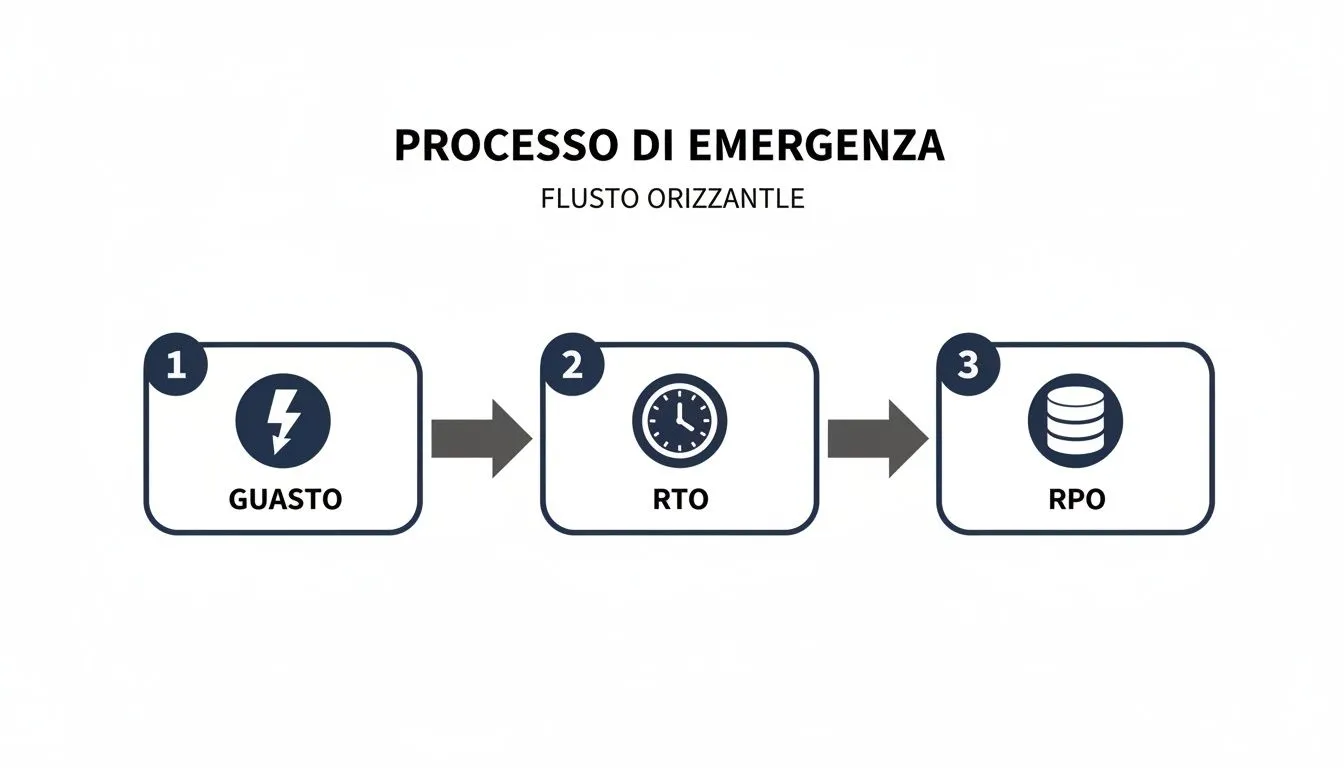
As you can see, RPO defines the point in time to which the "tape is rewound," while RTO measures the time required to resume operations from that point.
Once you have a clear understanding of your critical operations, the next step is to classify your applications into tiers, assigning realistic recovery objectives to each one.
Here's how you can organize this classification:
To give you an even clearer picture, here is a summary table.
Examples of Application Classification and RTO/RPO Values
The e-commerce platform is classified as Tier 1 (Critical): the RTO is less than 15 minutes and the RPO is less than 5 minutes.
The CRM is classified as Tier 2 (Critical), with an RTO of less than 4 hours and an RPO of less than 1 hour.
Warehouse management is also Tier 2 (Important), with an RTO of less than 8 hours and an RPO of less than 4 hours.
The accounting software is classified as Tier 2 (Critical), with an RTO of less than 24 hours and an RPO of less than 12 hours.
Test and development servers are classified as Tier 3 (Non-critical), with a target RTO of less than 72 hours and a target RPO of less than 24 hours.
The historical data archive is also Tier 3 (non-critical), with a target RTO of less than 5 days and a target RPO of less than 48 hours.
This table isn’t a one-size-fits-all rule, but it’s an excellent starting point for tailoring the values to your company’s specific needs. This method provides clear guidance on how to invest in backup technologies in a proportionate way. Effective data management is crucial; to learn more, read our in-depth article on OneDrive for Business. This way, you protect the heart of your business without wasting your budget.
To truly understand what RTO and RPO mean, we need to see them in action. Let’s move beyond theory and dive into two industries where data and business continuity are everything: retail and finance.
These are not mere acronyms. They are strategic levers that, at critical moments, determine the success or failure of entire operations.

Seeing how these two metrics perform under pressure will help you see firsthand how they directly impact business results.
Imagine running an e-commerce site on the busiest day of the year: Black Friday. At 10 a.m., a critical database error causes the entire payment system to crash. At that very moment, RTO and RPO cease to be abstract concepts and become a matter of survival.
In such a scenario, the RPO is also critical. An RPO close to zero—perhaps just a few minutes—means that virtually all orders placed before the outage are safe. But an RPO of one hour could wipe out hundreds of completed transactions, triggering a nightmare for logistics and customer service.
For an e-commerce business, a low RTO isn’t a cost—it’s a direct investment in revenue. Every minute of downtime during a sales peak represents a measurable financial loss.
Let’s change the scenario. Now we’re in the financial sector, where a compliance team uses automated systems to monitor suspicious transactions. Here, accuracy and consistency aren’t just “important”—they’re a legal requirement.
In today's world,RPO plays a critical role. Losing even a few minutes of transaction data could mean missing a fraudulent transaction. The consequences? Hefty fines and legal damages. That is why regulations require an extremely low RPO, often measured in seconds.
At the same time, a lightning-fast RTO is essential to ensure that surveillance systems remain operational at all times. Even a brief outage would create a "blind spot," a window of opportunity for fraudulent activity.
The Impact of RTO and RPO in Finance:
These two examples illustrate a fundamental truth: setting the right RTO and RPO values is not a technical decision, but a business choice that has a direct impact on revenue, reputation, and legal obligations.
Defining your RTO and RPO values is the first, crucial step. But how do you ensure they’re met and improved over time? This is where predictive analytics becomes your best ally. Instead of waiting for a problem to arise, you start anticipating it.
Think of an AI-powered platform like ELECTE. It connects to your data sources—system logs, sales trends, security alerts—and, using machine learning models, begins to identify anomalous patterns that often precede an outage.
For an analyst, this means being able to generate automated reports that simulate the impact of downtime. For a manager, it translates into intuitive dashboards that show, in real time, the health of the systems and their alignment with business objectives.
The real game-changer is moving from detecting a problem to predicting it. Cyber threats are a perfect example. In January 2026 alone, Italian organizations suffered an average of 2,403 attacks per week—a figure 15% higher than the global average. Imagine a retailer hit by ransomware: without an RTO of less than 4 hours, online sales grind to a halt, causing daily losses that can reach 20–30%. You can read the full details on how much Italian companies will invest in ICT.
ELECTE, an AI-powered data analytics platform for SMEs, integrates real-time security data, uses predictive models to identify risks, and generates automated reports on RTO and RPO compliance. In one of our case studies, proactive monitoring helped reduce downtime by 40%.
The screenshot below shows an example of how a reporting dashboard in ELECTE clearly display the status of systems.
With visual indicators, you can track progress toward your goals without having to interpret complex data. This approach allows you to optimize costs and ensure true operational continuity. If you’d like to learn more, read our guide on what predictive analytics is and how it turns data into decisions.
Here are the key points to keep in mind to turn RTO and RPO into a competitive advantage for your company:
So far, we’ve learned one key thing: RTO and RPO aren’t just cold acronyms, but strategic benchmarks that measure your company’s ability to respond. Learning how to define them, understand the differences between them, and apply them to real-world scenarios is the first step toward taking control of the unexpected.
In a market where the only certainty is uncertainty, building a solid business continuity strategy is no longer just an insurance policy. It is a direct investment, a strong signal that builds customer trust and ensures stability when the going gets tough.
Actively managing RTOs and RPOs means protecting revenue, safeguarding your reputation, and building a more agile organization that’s ready to weather the storm and come back stronger than ever.
This is how risk management ceases to be a cost center and becomes a genuine competitive advantage. But the real leap forward lies in shifting from reaction to anticipation. Platforms such as ELECTE help you do just that: they transform your data into an early warning system, lighting the way toward safer growth. Instead of playing catch-up, you start picking up on early warning signs, making informed decisions that secure the future of your business.
Ready to turn your data into an early warning system to protect your business? With ELECTE, you can shift from reactive risk management to a proactive strategy. Start your free trial now and discover how to make your company more resilient.

.svg)


.svg)
.svg)