

Are you a delivery professional or do you manage a company fleet? Then you know all too well that loading and unloading zones can turn into an urban jungle. The yellow and black lines are your daily playground, but a misinterpretation of the rules can cost you precious time and hefty fines. Understanding the regulations for loading and unloading is not optional: it’s a fundamental strategic skill for optimizing your operations, reducing unexpected costs, and working with greater peace of mind.
This guide is designed for you. We’ll help you navigate every aspect of the regulations, from the basics of the Highway Code to the latest updates, such as the 90-minute waiting rule. You’ll learn how to correctly interpret traffic signs, manage ZTL permits without stress, and, if necessary, contest a ticket with full knowledge of the facts. The goal? To turn bureaucratic complexities into a competitive advantage for your business.
To navigate the rules on loading and unloading, you need to start with the basics. And those basics are laid out in black and white in the Highway Code, specifically in Article 157. This article draws the line between two terms you use every day but are often confused: "stopping" and "parking."
Understanding this difference is key to avoiding simple mistakes. A stop is a very brief pause—just long enough for someone to get in or out—with you still in the driver’s seat and ready to drive off again. A break, on the other hand, is when you stop driving, turn off the engine, and can walk away from the vehicle.

Here’s the key point that many people overlook: the loading and unloading zone is a temporary work area, not a free parking spot at your disposal. Its sole purpose is to facilitate the handling of goods. Whether it’s packages, materials, or supplies for a store, the important thing is that the activity is genuine and currently taking place.
This means that your parking is only permitted if you are actively loading or unloading. You must be there, near the van, busy moving the goods.
Using that parking spot for a coffee break or to run a personal errand is one of the most common violations (and rightly penalized). It’s not even enough to stay seated in the driver’s seat: if an officer passes by and sees that you’ve been stationary for a while without moving a muscle, you can still get a ticket. It’s a strict rule, but it ensures that those precious spaces remain free for those who, like you, truly need them to work.
To clear up any confusion, we’ve summarized the key differences in a table. Keep it in mind the next time you’re in a hurry.
Mastering these simple distinctions is the first step toward turning everyday challenges into opportunities. For a business, optimizing loading and unloading operations means faster deliveries, happier customers, and fewer unexpected costs. If you want to learn how to improve these workflows, our guide to business process mapping can provide valuable insights.
For those working in the transportation industry, loading and unloading regulations are part of everyday life. But knowing how to interpret them correctly—especially when it comes to road signs—is an art that can make the difference between a timely delivery and a hefty fine. Signs are the language of the road: ignoring even a small detail can turn a routine stop into a problem.
In fact, every sign tells a different story. Some impose a permanent no-parking restriction, valid 24 hours a day, 7 days a week, for anyone without authorization. Many others, however, are more nuanced and restrict parking to specific times of day, such as only in the morning on weekdays.
The most common mistake? Glancing briefly at the main sign and walking right past it without reading the supplementary signs below. That’s exactly where the rules are hidden.
These additional panels are not optional: they are the heart of the stall regulations. They specify the conditions, exceptions, and limits. Ignoring them is like signing a contract without reading the fine print.
Here's what they tell you, in black and white:
Let’s look at a practical example. A sign reads: “Loading and unloading from 8:00 a.m. to 12:00 p.m., Monday through Friday; maximum parking time 30 minutes.” This means that at 2:00 p.m. on a Wednesday, you cannot use that parking space for your operations.
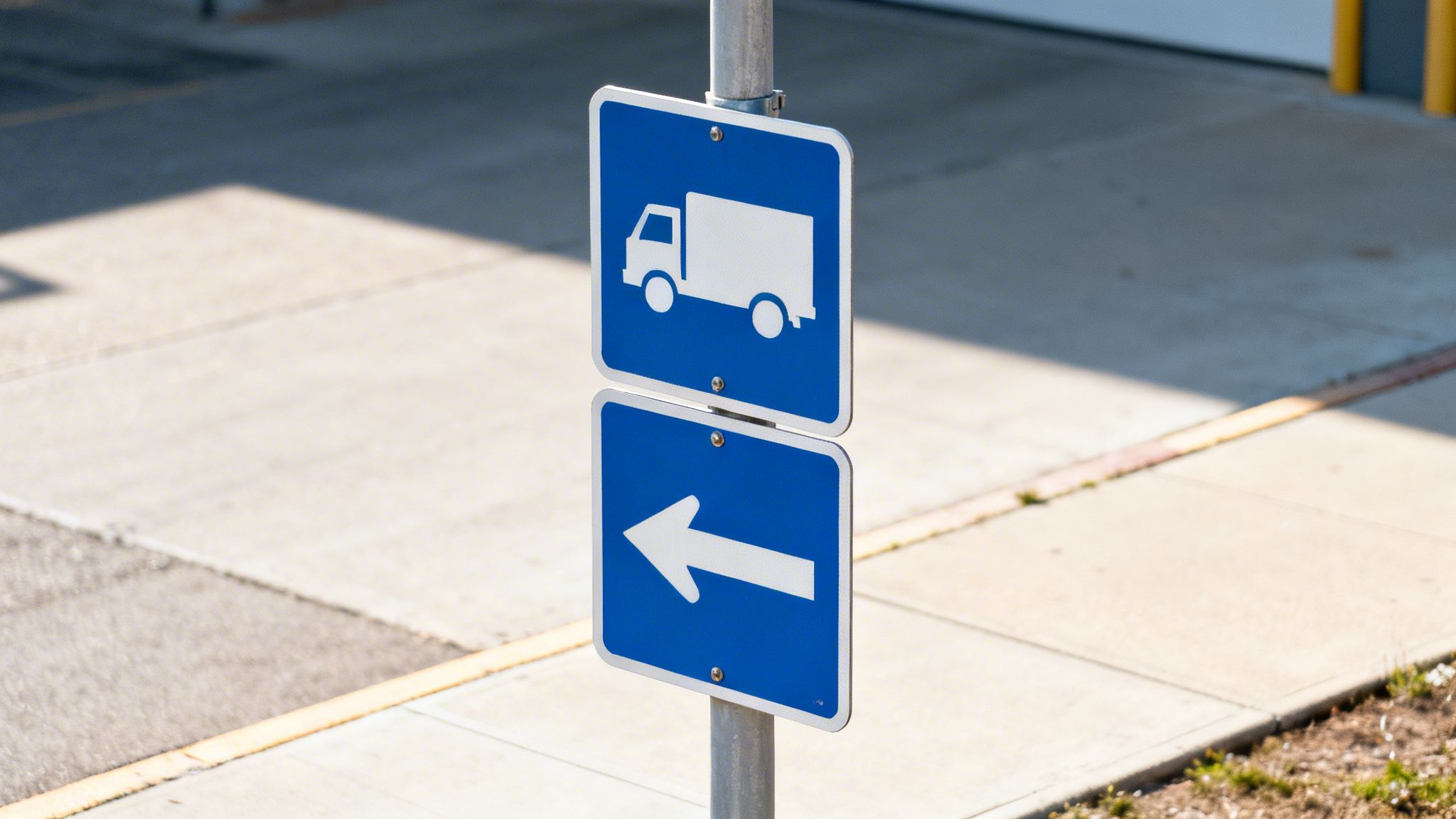
This sign is a great example of how rules are specified in detail. The general no-parking rule is "overridden" by the exception, but only for vehicles loading or unloading, only during the specified times, and only for the maximum permitted duration.
The key to stress-free (and ticket-free) delivery management is planning. Instead of frantically searching for a parking spot at the last minute, it’s much more productive to plan your route in advance. Today, online mapping services and dedicated apps often let you view road signs before you even set out.
Remember: haste makes waste. Taking thirty seconds to carefully read a sign—including any supplementary panels—will always cost you less time and money than dealing with the consequences of a ticket.
This attention to detail isn’t just a way to protect yourself—it’s a real tool for optimizing your work. Knowing in advance where, when, and how you can legally stop allows you to organize your delivery route more smoothly and efficiently, improving punctuality and customer satisfaction.
You know that feeling of helplessness all too well: your truck has been sitting idle for hours, you’re stuck waiting, and the cost meter keeps ticking away. Exhausting waits at loading and unloading points have always been a scourge of the industry—a hidden operational cost that erodes margins and the efficiency of the entire supply chain.
For years, this has been an almost accepted practice, a “necessary evil” that has fallen almost entirely on your shoulders as a carrier. Now, finally, the rules of the game are about to change radically. A new regulation introduces a principle of fairness that transforms waiting from a problem to be endured into a cost to be actively managed.
The change is simple but highly effective: a maximum grace period of 90 minutes is introduced for completing the loading or unloading of goods. In practice, from the moment you arrive at the agreed location, the shipper or consignee has an hour and a half to complete the job.
What if the limit is exceeded? That’s where the real change comes in. Once this limit is exceeded, it’s no longer a matter of courtesy or informal agreements, but of mandatory financial compensation in your favor. It’s a right enshrined in law.
The logic is strikingly simple: your time is money, especially in the world of transportation. Excessive waiting isn’t just an inconvenience—it’s a real financial loss that can no longer be just your problem.
The goal is clearly twofold. On the one hand, to fairly compensate you and your company for the downtime. On the other hand, to create a strong incentive for customers to optimize their bay planning and warehouse efficiency.
This significant innovation is designed to nip in the bud all the practices that have been holding logistics operators back for years. The terms are clear and leave no room for interpretation.
Effective July 1, 2025, pursuant to Legislative Decree 81/2024, the 90-minute grace period will become law. Once this time has elapsed, mandatory compensation of 100 euros per hour or fraction of an hour of delay will be triggered. The measure, as clarified in a circular from the Ministry of Infrastructure and Transport (MIT) whose details were shared by Assotir, aims to put an end once and for all to nerve-wracking waits.
One of the most important questions, of course, is: who is responsible for paying the compensation? The law introduces the principle of joint and several liability here, a mechanism designed to prevent the classic "passing the buck."
Generally speaking, liability falls on the party that actually caused the delay: the shipper (the party entrusting the goods) or the consignee (the party receiving them). The real strength of the regulation, however, lies in the fact that liability also extends to the principal, that is, the company that entered into the transport contract. This system of shared liability ensures that you have a reliable party to turn to in order to obtain fair compensation.
Loading and unloading become more complicated as you head into the heart of cities. Delivering to an Italian historic center is like navigating a maze of specific rules, where the Highway Code takes a back seat and gives way to municipal regulations. Each city has full authority to establish its own rules for managing traffic.

The most critical areas? Without a doubt, the Limited Traffic Zones (ZTL) and Urban Pedestrian Areas (APU). Here, loading and unloading regulations are completely different. Access is not a right, but an exception, granted only if you have a specific permit.
Ignoring this reality almost certainly means facing automatic penalties, detected by unforgiving cameras. For you and your company, managing these permits is not an option, but a fundamental operational necessity.
Municipalities generally offer two types of permits for entering restricted-traffic zones. Choosing the right one is the first step toward a logistics system that works.
Daily or temporary permits: These are the perfect solution for occasional needs, such as a one-time delivery or an urgent repair. You can often apply for them online; they have a limited validity period (usually 24 or 48 hours) and are affordable, but they allow you to operate legally for that specific task.
Annual or permanent passes: These are intended for people who work in the restricted traffic zones every day, such as couriers and suppliers. Obtaining an annual pass involves a more complex bureaucratic process, but in return it offers continuous access throughout the year, greatly simplifying your daily routine.
There’s only one golden rule: always check the website of your local municipality to see which permit best suits your business. Requirements and costs can vary significantly from one city to another.
Local autonomy results in a veritable patchwork of rules. When it comes to restricted traffic zones (ZTLs), there is simply no national standard. When planning a delivery to a historic district, you must check at least three key factors.
1. Access and Parking Hours
Loading and unloading restricted zones (ZTL) are almost always in effect only during very limited time slots, usually early in the morning (for example, from 7:30 a.m. to 10:30 a.m .). Operating outside of those hours constitutes unauthorized access.
2. Permitted vehicle types
Many local governments, especially in cities like Milan or Bologna, have raised their environmental standards. Access may be restricted to commercial vehicles meeting a minimum emissions standard (e.g., Euro 5 or higher) or limited exclusively to electric vehicles.
This push toward sustainable logistics is not just an environmental issue, but a strategic factor. Companies that invest in a low-impact fleet secure a tangible competitive advantage, gaining access to areas that are off-limits to others.
3. Fees and Costs for ZTL Permits
The cost of ZTL passes is another factor that should not be overlooked. Fees may vary depending on the duration, the vehicle’s emissions class (with discounts for “green” vehicles), and its weight. Factoring these permits into your budget is a crucial step in accurately calculating operating costs.
Checking the official municipal websites is the only way to obtain up-to-date and accurate information, turning what might seem like a bureaucratic hassle into a smooth logistical process that complies with loading and unloading regulations.
No one wants to get a ticket. But for you, who spend your days juggling deliveries and pickups, the risk is always lurking around the corner. When the ticket arrives, staying calm is key. Knowing the most common penalties is your first line of defense in making your case.
The most common traffic tickets are almost always the result of minor lapses in attention. The classic one? Exceeding the maximum allowed time, which is usually set at 30 minutes. Often, the problem is failing to display the parking disc—a simple but essential step. Another common mistake is occupying a parking space without actually conducting a transaction there.
The consequences of illegal parking should never be taken lightly. The Highway Code is clear, and the fines can be steep. For example, parking in a loading and unloading zone without authorization can cost between €87 and €344 for motor vehicles.
But it’s not just a matter of money. Many of these violations also result in points being deducted from your driver’s license—usually 2 points for illegal parking in this area.
Please note: the fine isn't the only problem. An illegally parked vehicle may be towed away. In that case, you'll have to add the often substantial costs of the tow truck and impound fees to the fine.
To give you the full picture, here is a summary of the most common violations.
Quick Guide to Loading and Unloading Penalties
This table shows how a simple stop can have different implications. Always remember that local regulations may include additional requirements.
Receiving a traffic ticket doesn’t necessarily mean you have to pay it. If you believe you were unfairly ticketed, you have every right to file an appeal. The two main avenues for doing so are the Prefect and the Justice of the Peace.
To build a strong appeal, documentation is your best ally. Here’s what you need:
You have two options. The first is to file an appeal with the Prefect, which must be submitted within 60 days of receiving the notice (this is a free procedure). Alternatively, you can file a claim with the Justice of the Peace within 30 days, though you will be required to pay a flat fee. Knowing how to handle a fine is just as important as optimizing your routes.
Turning the complex regulations on loading and unloading zones from theory into everyday practice requires a systematic approach. That’s why we’ve developed an operational checklist designed for both you—who’s on the road every day—and those who manage logistics from behind a desk.
The idea is simple: turn every stop into a smooth, compliant process with just a few quick checks. It’s not just about avoiding fines, but about creating a standard procedure that makes your entire workflow more efficient.
Even before you turn off the engine, it only takes thirty seconds to ask yourself the right questions. A small step that can literally save you from getting a ticket.
The chart below provides a simple overview of what to do if, despite everything, you receive a fine.
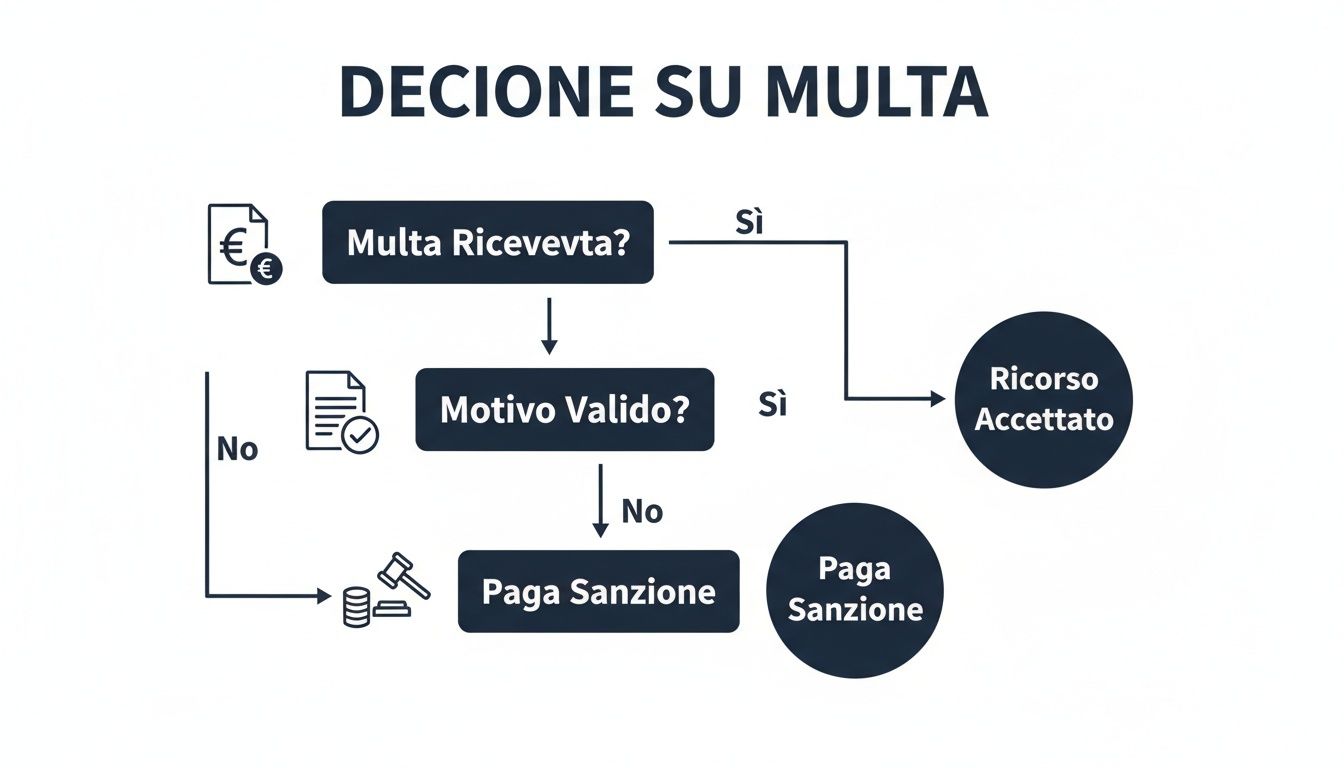
As you can see, the first step when faced with a citation is always the same: take a step back and calmly assess whether there are valid—and, above all, verifiable—grounds for filing an appeal.
This checklist, however, is much more than just a reminder for you. For a company, it is the cornerstone upon which to build solid, shared operating procedures.
When every driver follows the same steps, the margin for error is reduced and the risk of penalties is minimized. This fosters a corporate culture focused on efficiency.
This standardization becomes even more critical with the extension of tachograph requirements to light commercial vehicles starting July 1, 2026. The need for strict compliance will become an issue that can no longer be postponed.
By leveraging data and analytics, logistics managers can monitor compliance with procedures and optimize the entire supply chain. By combining this approach with the right warehouse management programs closes the loop, ensuring total control over logistics, from the warehouse to final delivery.
The road ahead always brings some practical uncertainties. That’s normal. That’s why we’ve compiled the most common questions you ask yourself every day, with clear and straightforward answers designed to solve the real-world problems you encounter in your work.
Absolutely. And this is one of the most common and costly misconceptions. Just because you’re behind the wheel doesn’t magically turn an illegal stop into a permitted one. The law is clear: that space is reserved for loading and unloading “operations.”
If an officer sees you parked for a while without actually moving any goods, a ticket is just around the corner. Your presence is meant to allow you to move the vehicle in an emergency, not to justify occupying the parking space if your activity isn’t genuine and verifiable.
No, it’s not a universal rule. It all depends on what the signs say. The key is to learn to read them carefully, including the supplementary signs.
If the sign displays the parking disc symbol or an additional sign explicitly requires it (for example, with the text "max 30 min"), then you must use it. If, however, there are no such instructions, you are not required to display it. A word of advice? Use it anyway. It shows that you’re acting in good faith.
Here, the situation changes completely. As soon as you step through the gate of a private area, such as a condominium courtyard, the Highway Code no longer applies. The rules are dictated by the condominium bylaws.
This document sets forth the rules for living together, including:
Before driving the van in, the smartest thing to do is always to check the rules or give the building manager a call. To keep track of these activities in an organized way, you can use a simple tool like a sample Excel spreadsheet.
The golden rule is simple: in public areas, the Highway Code applies; in private areas, the internal regulations apply. Acting accordingly is a sign of professionalism.
Yes, without a doubt. The new regulation, which mandates compensation when loading and unloading times exceed 90 minutes, applies to all contracts for the carriage of goods for hire or reward.
The law makes no distinction based on the size or weight of the vehicle. Whether you drive a semi-truck or a small delivery van in the city, you are entitled to this protection. The goal is to protect the entire supply chain from the hidden costs caused by delays and inefficiencies.
Ready to make decisions based on data, not gut feelings? ELECTE turns operational complexities into clear insights. Discover how ELECTE optimize your logistics with a free demo.

.svg)


.svg)
.svg)