
Italian SMEs account for a significant portion of the economy, but the adoption of artificial intelligence remains minimal. Only 7% of small businesses and 15% of medium-sized businesses have launched AI-based projects, even though SMEs generate over 65% of the country’s added value, according to an analysis of the state of AI in Italian SMEs. This statistic changes how we should view the issue: the question is not whether AI is useful, but which AI solutions can actually be implemented in a company without introducing unmanageable complexity.
This is where Support Vector Machines come into play. They aren’t the hottest model on the market right now, but they’re often among the most sensible choices when you have structured data, clear use cases, and a need for reliable decisions. For an SME, this means moving from scattered spreadsheets, individual insights, and delayed reports to operational forecasts that support sales, risk management, customer retention, and planning.
If you view AI as a concrete lever for the income statement, support vector machines are worth considering. Not because they’re “new,” but because in many business contexts, they’re still a smart choice.
SMEs generate a large portion of the value of the Italian economy, but the adoption of artificial intelligence remains concentrated among a minority of companies. This gap matters because it does not concern cutting-edge technology in an abstract sense. It concerns profit margins, response times, credit quality, inventory turnover, and the ability to detect weak signals before competitors do.
In practice, many companies already have the resources they need to get started. The data exists, but it’s scattered across ERP systems, CRM platforms, e-commerce platforms, administrative reports, and Excel spreadsheets created to address day-to-day urgent issues. This is where the operational problem arises: if information remains fragmented, even an informed decision ends up being based on an incomplete view of the business.
For an Italian SME, therefore, the key issue is not to chase after the most talked-about model of the moment. What matters is choosing a method that works with limited datasets, at a sustainable cost, and with processes that cannot be put on hold for months while waiting for a perfect project. This explains why a classic algorithm like Support Vector Machines deserves managerial attention—not just technical attention.
An SVM effectively addresses a common need among SMEs: transforming imperfect but useful data into reliable classifications. In retail, this means identifying customers at risk of churn, estimating the probability of responding to a promotion, and detecting anomalous purchasing behavior. In finance, it means supporting risk assessment, segmenting sensitive positions, and flagging exceptions that require human review. You don’t always need the latest model to gain a competitive advantage. Often, what you need is the model that reaches a defensible decision first.
The European market faces recurring obstacles: limited budgets, analytical expertise that isn’t always available in-house, difficult integration with existing systems, and unrealistic expectations regarding the return on AI investment. The “European SME AI Challenges” report provides a clear picture of this context, which is even more pronounced in Italy in sectors where every technology investment must quickly justify itself on the income statement.
That’s why support vector machines are an interesting choice. They offer a concrete bridge between academic theory and business results: less emphasis on technological spectacle, more focus on the quality of the decision. For an entrepreneur or an analytics manager, the point isn’t to adopt AI in a generic sense. The point is to use an algorithm that helps reduce costly errors, improve business priorities, and bring structure to data that currently generates only reports, not decisions.
Support Vector Machines stem from a geometric idea, not from a black box. They were formally developed in the 1990s at AT&T Bell Laboratories by Vladimir Vapnik, building on theoretical foundations that had been laid as early as the 1970s. Their original purpose was binary classification with the highest possible accuracy, as summarized in the historical entry on the origins of support vector machines.
If you have two groups of customers—for example, those who renew and those who churn—you can draw many dividing lines. Any given line creates a division. An SVM, on the other hand, seeks the boundary that leaves the widest possible margin between the two groups.
The most useful analogy is that of a road between two rows of houses. If you build a road too close to one row, it doesn’t take much to create confusion. If, on the other hand, you design the road to be as wide as possible, the path is more stable and the boundary clearer. In SVMs, this “road” is the margin.
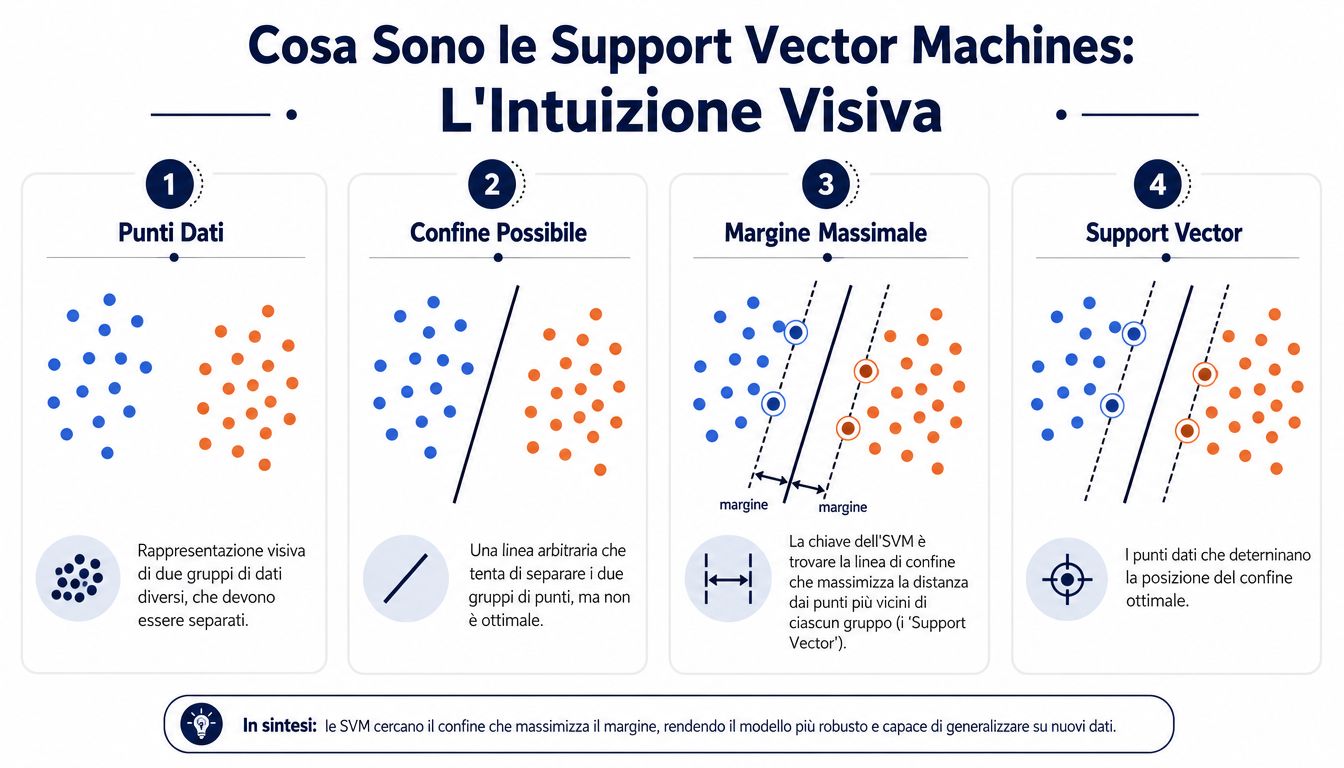
Not all the points matter. It’s the ones closest to the boundary that matter. These points are called support vectors, and they define the position of the optimal separator. In practice, the algorithm pays the most attention to the most ambiguous cases—that is, the ones that really put the decision to the test.
For a business, this translates into a very familiar approach. It’s not difficult to classify a customer as clearly loyal or clearly lost. The value of the model becomes apparent when it addresses borderline cases—those that determine customer retention, credit, promotions, or risk management.
SVM should not be thought of as a mathematical formula for specialists, but rather as a formalized managerial criterion:
Rule of thumb: If your business problem requires reliably distinguishing between two outcomes, support vector machines are worth a serious look.
This explains why they continue to have a place among enterprise machine learning algorithms. Not because they are simple by any means, but because their guiding principle aligns with a very concrete business need: making consistent decisions even when the data isn’t perfect.
When an SVM makes a decision, it doesn’t “guess.” It constructs a mathematical boundary that separates categories or estimates a relationship useful for prediction. The important point, from a business perspective, is that this boundary is not constructed by assigning the same weight to every observation.
SVMs are particularly effective with small datasets and are resilient to overfitting because their decision function is defined solely by a small subset of data—the support vectors. This makes them ideal in contexts where data is limited or expensive, as explained in this educational resource on SVMs and support vectors.
Three concepts are enough to grasp the essence of the model.
Concept | What It Means |Impactonthe Business | Hyperplane| The decision boundary that separates two classes | Determines who belongs to a category and whodoes not | Margin | Thedistance between the boundary and the nearest cases | The wider it is,the betterthe model tends togeneralize | Support Vectors | Thecases at the boundary of the separation | These are the customers, transactions, or records that truly determine the boundary
In a real-world project, the hyperplane is the operating rule. The margin is the safety margin for that rule. Support vectors are the cases that warrant managerial attention, because they reveal where the business is most uncertain.
Many SMEs don't have millions of historical data points. However, they do have enough data to identify patterns. In this scenario, focusing only on the cases that define the boundary is an efficient approach.
This approach yields at least three concrete benefits:
When there is little data, each row has to do more work. SVMs do exactly that.
For those who want to delve deeper into the operational side, the Algorithm Training Process helps you view a model not as an isolated technical object, but as a sequence of choices: input data, data cleaning, training, validation, and decision-making.
There's one point that many teams overlook. A lack of data isn't always a limitation. Sometimes it's a constraint that calls for more modest models—and thus ones that are better suited to the context.
In an Italian SME, this practicality matters. If a model requires years of data, heavy infrastructure, and rare expertise, the likelihood of adoption decreases. If, on the other hand, a model performs well on moderate-sized datasets and produces clear decision boundaries, adoption becomes much more realistic. This is where support vector machines stop being just a college course and become a practical tool.
Not all business problems can be neatly divided along a straight line. Some customers exhibit mixed behavior. Some legitimate transactions resemble fraudulent ones. Some risk signals only emerge when multiple variables interact with one another.
This is where the kernel trick comes into play. The basic idea behind it is simple: if the data is jumbled in the original space, you can view it from a different perspective where the separation becomes more orderly.
Imagine a sheet of paper with blue and red dots arranged in a circular pattern. In two dimensions, you can’t really tell them apart. But if you could lift the sheet and turn it into a three-dimensional surface, those dots might arrange themselves in a much more readable pattern. At that point, a plane—no longer a line—would easily separate them.
This does not mean that the model “makes up” data. It means that it applies a transformation that helps reveal relationships that were previously hidden.
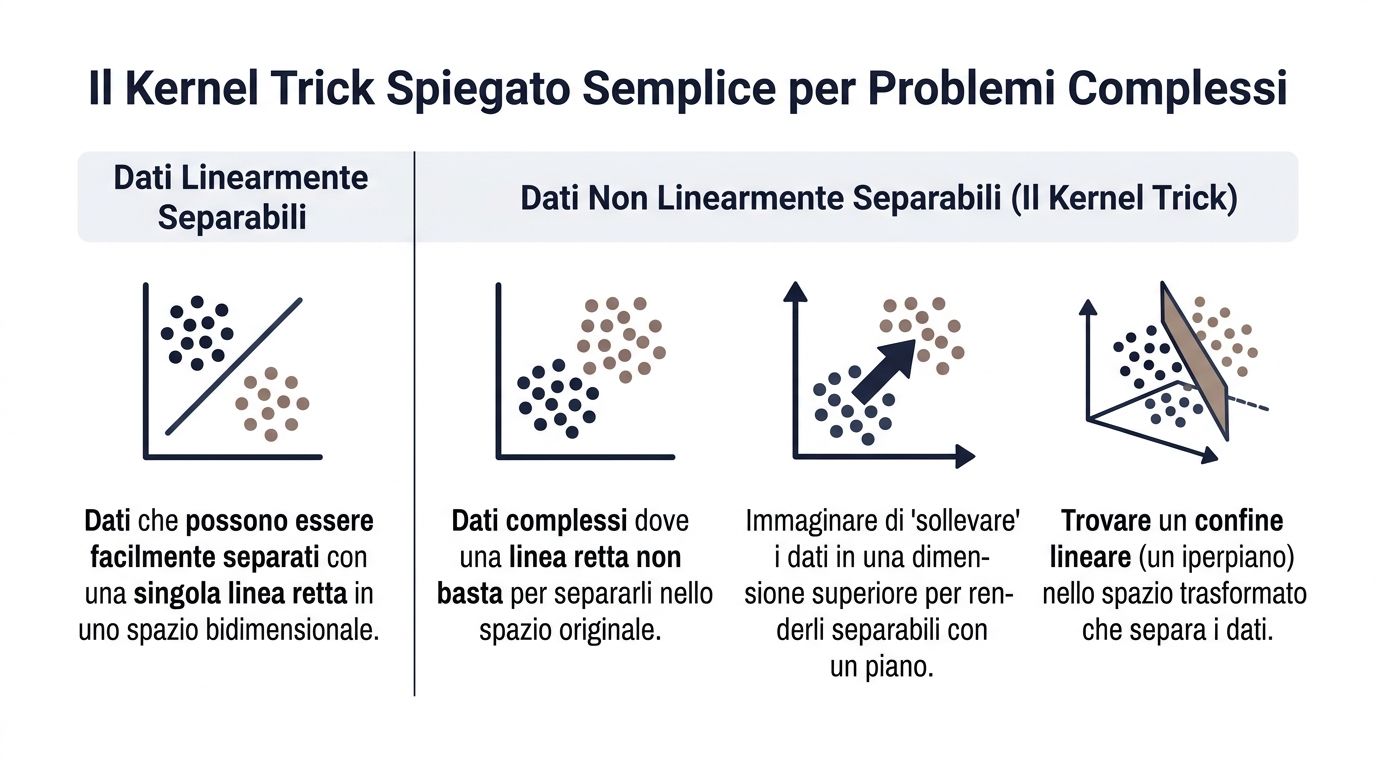
You can think of kernels as different lenses.
In retail, this flexibility can be useful when the risk of customer churn does not depend on a single variable, but rather on the interplay between purchase frequency, discounts received, seasonality, and periods of inactivity. In finance, the same logic can be helpful when the risk profile emerges only from the combination of several weak signals.
The kernel trick doesn't make the problem any less real. It just makes the pattern easier to read.
The practical lesson here is important. If a team rejects an algorithm because “the data is too complex,” it’s often giving up too soon. Sometimes the problem isn’t with the data, but with the way it’s represented.
Support vector machines aren’t the answer to everything. But that’s precisely why they deserve serious consideration. Today, they’re cited less frequently in recent papers than Random Forests or neural networks, yet their reliability with moderately sized datasets makes them an optimal—and often underrated—choice for SMEs seeking reliable and interpretable solutions, as discussed in this comparison of the relevance of SVMs in machine learning.
Their strength isn't fashion. It's discipline.
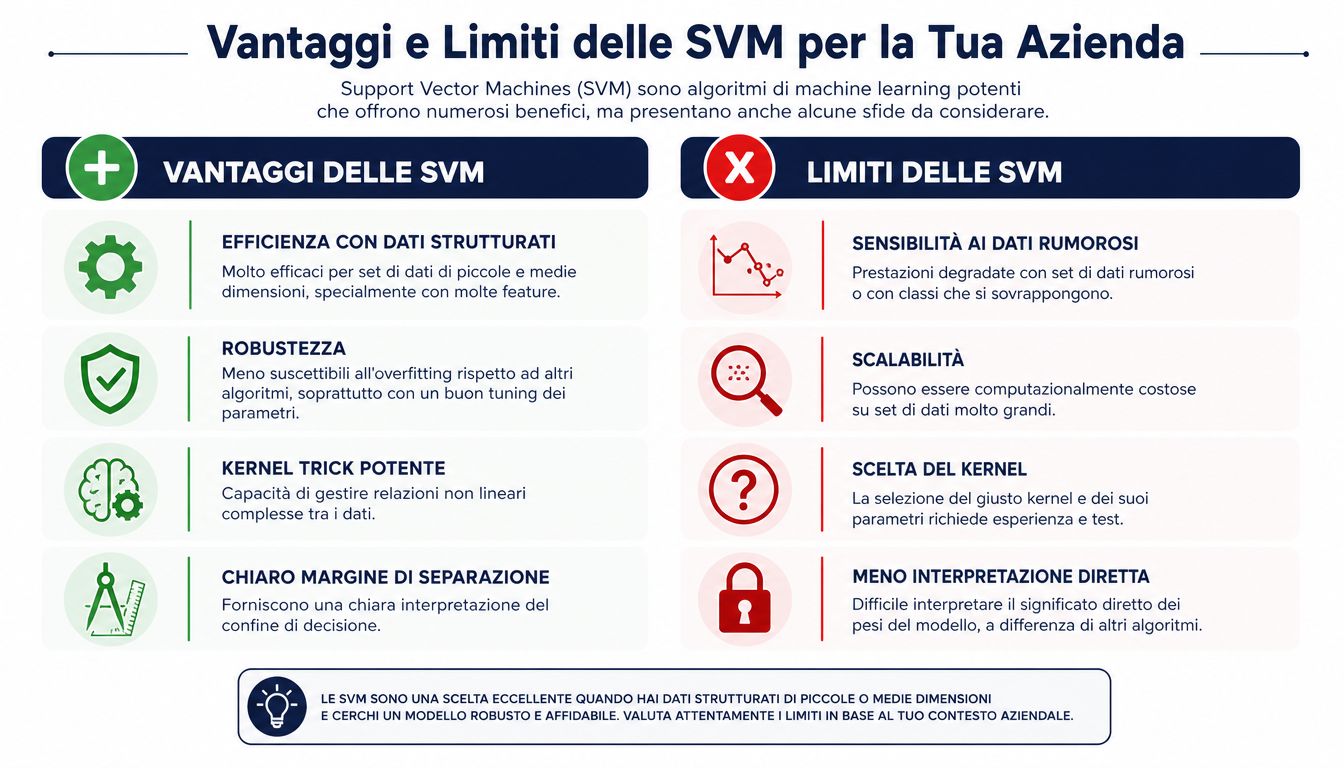
A mature decision also takes limitations into account.
SituationImplicationVery large datasetsTrainingcan become morecomputationally intensiveNoisy or highly overlapping dataTheboundary may be lessstableKernel selectionThe configurationmust bethoroughly tested andvalidatedInternal model interpretationDoes notalways provide the immediate readability of a decision tree
For an SME, the relevant question is not “Is this the most advanced model?” The relevant question is “Does this model improve decision-making with a sustainable effort?”
Key point: A classic algorithm becomes strategic when it bridges the gap between insight and action.
In other words, the gap in SVM popularity does not correspond to a gap in value. It often coincides with a shift in the public discourse on AI. For those who need to optimize product assortments, reduce bad debt, classify leads, or detect anomalies, the relevance remains very real.
The gap between the model and the operating margin narrows when you translate the forecast into a day-to-day decision. This is where support vector machines come in handy for teams that don’t want to “do AI” in the abstract, but rather want to better manage customers, risk, and priorities.

A retailer continuously collects data points: purchase frequency, preferred product category, sensitivity to discounts, average time between orders, returns, and purchase channel. Taken individually, these data points reveal little. When combined in an SVM classifier, they can help distinguish loyal customers from those at risk of churn.
The impact does not lie in the theory behind the model. It lies in the resulting operational sequence:
A second application involves segmentation. Retail SMEs often still segment based on simple criteria, such as geographic area or spending range. An SVM can add a more useful layer: actual behavior. This way, two customers with similar spending but different patterns are no longer treated as if they were the same.
In retail, a good model isn't about describing the customer better. It's about making better decisions about what to do tomorrow morning.
In the financial world, classification has direct value. A team can use an SVM to distinguish applications with lower risk from those that require further analysis. The model’s strength lies in identifying combinations of variables that, when considered individually, are insufficient.
Consider a credit scoring scenario in a company that manages many business customers. No single indicator is sufficient on its own. However, a combination of payment history, order frequency, changes in order volume, and the occurrence of administrative anomalies can help draw a useful distinction between more reliable profiles and those that require closer monitoring.
The same applies to the detection of anomalous transactions. The model does not replace human review; it makes it more selective. Instead of having the team analyze everything, it identifies the cases that truly warrant verification. This improves the risk department’s productivity.
The real mistake isn't failing to use the model. It's stopping at classification without linking it to a decision.
In retail, a churn prediction should trigger a campaign or a review of the customer journey. In finance, an anomaly alert should trigger a control workflow—not a file left forgotten in a shared folder. Support vector machines create value when they’re integrated into operational processes, not when they remain in a notebook.
For an analyst, getting started with an SVM in Python is easier than it seems. For a manager, the point isn't to read the code, but to understand that the model produces a clear output: a classification, a score, or a set of records to manage.
This code snippet uses scikit-learn to train a basic SVM on a classification problem.
from sklearn.model_selection import train_test_splitfrom sklearn.preprocessing import StandardScalerfrom sklearn.pipeline import make_pipelinefrom sklearn.svm import SVCfrom sklearn.metrics import classification_report# X = business variables# y = label to predict, e.g., customer at risk of churn = 1, not at risk = 0X_train, X_test, y_train, y_test = train_test_split(X, y, test_size=0.3, random_state=42, stratify=y)model = make_pipeline(StandardScaler(), SVC(kernel="rbf", C=1.0, gamma="scale"))model.fit(X_train, y_train)predictions = model.predict(X_test)print(classification_report(y_test, predictions))
This example shows three correct choices for many real-world cases:
The real work begins afterward predict(). If the model flags at-risk customers, you need to turn that output into an action list for marketing, customer success, or sales. If it flags questionable practices, you need to route them through an audit process.
An analytics platform reduces precisely this organizational friction. Instead of confining the model to a technical environment, it makes the results easy to understand through dashboards, reports, and alerts that speak the language of business.
Here's what to look for in practice:
A predictive model is useful when the team knows who to call, what to do, and in what order of priority.
Support vector machines offer a useful lesson for any Italian SME. You don’t always have to chase after the most high-profile model to gain a competitive advantage. You need to choose the algorithm that works well with your data, your constraints, and your day-to-day decisions.
That is why SVMs remain relevant today. They are robust in classification, perform well with moderate-sized datasets, and are capable of translating complex signals into decision boundaries that can be used in retail, finance, and management. In a market where many companies are still far from adopting AI, starting with reliable and understandable models is often the smartest approach.
If you want to turn your data into clear insights without adding technical complexity, try ELECTE, an AI-powered data analytics platform for SMEs. It helps you move from scattered reports to operational decisions with dashboards, predictive analytics, and automated insights. ILLUMINATE THE FUTURE WITH AI.

.svg)


.svg)
.svg)
.jpg)