
A retail SME spends months building a model to forecast demand and inventory. The product is ready, but the launch is held up by a much less technical question: how can they prove that this AI can remain on the market without creating regulatory risks?
For many European companies, the challenge isn’t just developing the algorithm. It’s getting it into production without turning compliance into an unmanageable cost or a commercial delay. This is wherethe AI Regulatory Sandbox for European SMEs comes in—one of the most promising tools created under the AI Act to help startups and SMEs test AI systems in a controlled environment, while maintaining direct dialogue with the authorities.
If you run an ambitious small or medium-sized business, the point isn’t to memorize legal provisions. The point is to understand how to use this mechanism to shorten the path to market, build a track record of compliance, and reduce the most costly errors before they become a problem. That is the real competitive advantage. It’s not about pitting regulation against innovation, but about using regulation more effectively than your competitors.
The manager of an SME often finds themselves in the same situation. The team has identified a good use case for AI—perhaps in forecasting, customer support, or risk assessment. The prototype works. Then come the questions that slow everything down: what regulations apply, what data is needed to demonstrate reliability, who takes responsibility if the system makes a mistake, and when the project is ready to move beyond the pilot phase.
For many European companies, the issue isn’t a lack of interest in AI. The challenge lies in turning that interest into a product or service that can withstand both regulatory and commercial scrutiny. An ACT survey of companies in Europe and the United Kingdom highlights this very tension: the willingness to invest remains high, but for smaller businesses, the organizational cost of compliance weighs more heavily and tends to slow down decision-making.
Here’s the key point for an ambitious SME. The AI Act shouldn’t be viewed merely as a list of prohibitions, obligations, and risk categories. It’s better to see it as a market filter. Those who can demonstrate data quality, traceability, human oversight, and risk management before others gain a real advantage in sales, partnerships, and government contracts.
That is why sandboxes deserve managerial attention, not just legal attention.
A superficial reading treats them as a safe space where regulatory flexibility can be obtained. A more business-oriented interpretation views them as a guided process for reducing costly errors before launch, identifying system weaknesses, and presenting a more credible compliance track record to customers and investors. For an SME, this credibility can translate into shorter sales cycles, less friction during due diligence, and fewer last-minute technical reworks.
The advantage, therefore, does not stem simply from “entering” a sandbox. It stems from how the company uses that step to structure development, documentation, and testing in a way that aligns with the European market. Companies that grasp this early on are not merely seeking compliance. They are building a strategy to compete more effectively, with less improvisation and a stronger foundation for growth.
An AI regulatory sandbox is a public program for supervised testing. It allows a company to develop, validate, and document an artificial intelligence system in direct consultation with the relevant regulatory authority, prior to full market launch or large-scale deployment. For an SME, the practical value lies in this: transforming still-abstract requirements into concrete assessments of data, governance, human oversight, security, and traceability.
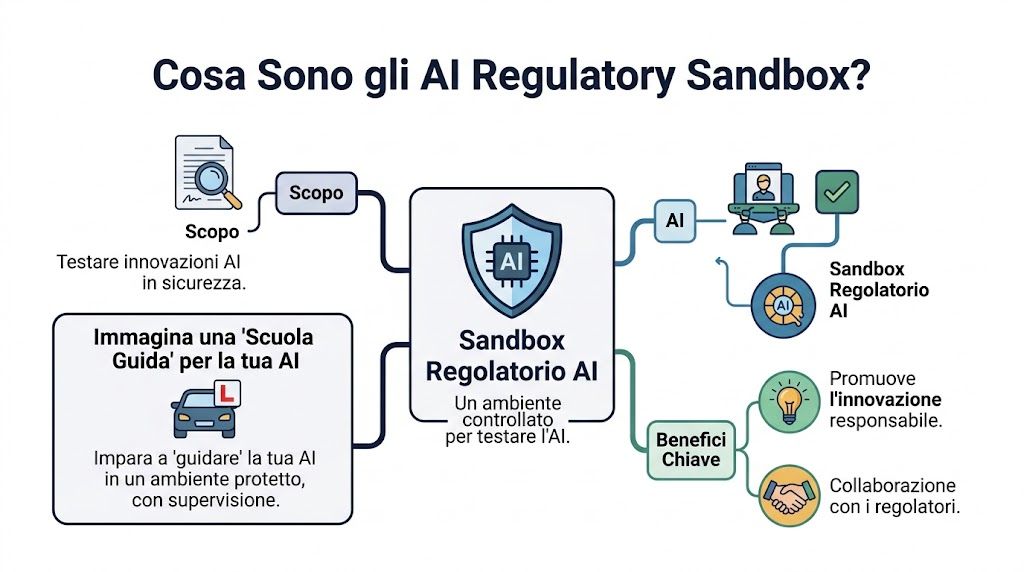
In the sandbox, the company presents a use case, defines the scope of the experiment, and works with regulatory authorities on testing, documentation, and corrective measures. This is particularly important for innovative systems or those that may fall under the most sensitive categories of the AI Act, where interpretive uncertainty can slow down development, procurement, and commercial negotiations.
The key is not just “knowing what the standard says.” It is understanding how that standard applies to your product, what evidence is required, and what operational limitations apply.
For the company, the sandbox serves to identify system weaknesses early on. For the regulator, it serves to observe how certain rules work in real-world scenarios and where they may create friction or leave significant risks unaddressed. In this sense, the sandbox is a tool for mutual learning, designed to reduce costly errors before they become commercial or reputational problems.
The European Union has chosen to institutionalize regulatory sandboxes because it recognizes that, without a guided testing framework, compliance costs tend to disproportionately impact smaller businesses. Spain launched one of the first European pilot projects in 2022, and the AI Act subsequently provided this model with a stable foundation. As outlined in the IAPP analysis of how different jurisdictions approach AI regulatory sandboxes, Article 57 requires Member States to establish a national sandbox or join a multi-state one by August 2, 2026, while Article 55 provides for priority access for SMEs.
For an SME, this changes the strategic significance of the sandbox. It is not a one-off initiative to be considered only if a legal issue arises. It is a channel provided for within the European framework to support the market entry of AI systems that require greater oversight, more evidence, and closer engagement with the authorities.
There are three practical implications worth noting:
The underlying policy goal is to make innovation observable, verifiable, and correctable at stages when intervention is less costly. This is of great interest to entrepreneurs. If you wait until after launch to conduct a serious compliance review, you often end up having to revise the architecture, datasets, interfaces, and documentation once the product has already entered the commercial cycle. At that point, costs rise, timelines lengthen, and negotiations with customers or partners become more difficult.
That’s why sandboxes exist. They’re designed to tackle the hard work early on.
The most valuable takeaway for an SME is this: the sandbox doesn’t just provide a protected environment. It offers a way to determine in advance where the product can withstand an audit, due diligence, or a request for guarantees from an enterprise customer. Those who make good use of this step aren’t merely seeking regulatory clarification. They are building a track record of reliability that will have an impact even beyond the legal scope.
SMEs often fall behind before they even reach the market. Not because their product is weak, but because decisions regarding data, documentation, human oversight, and risk management come too late. The sandbox changes the game at this point. It brings critical issues to light at a stage when fixing them is less costly and has less of an impact on the business.
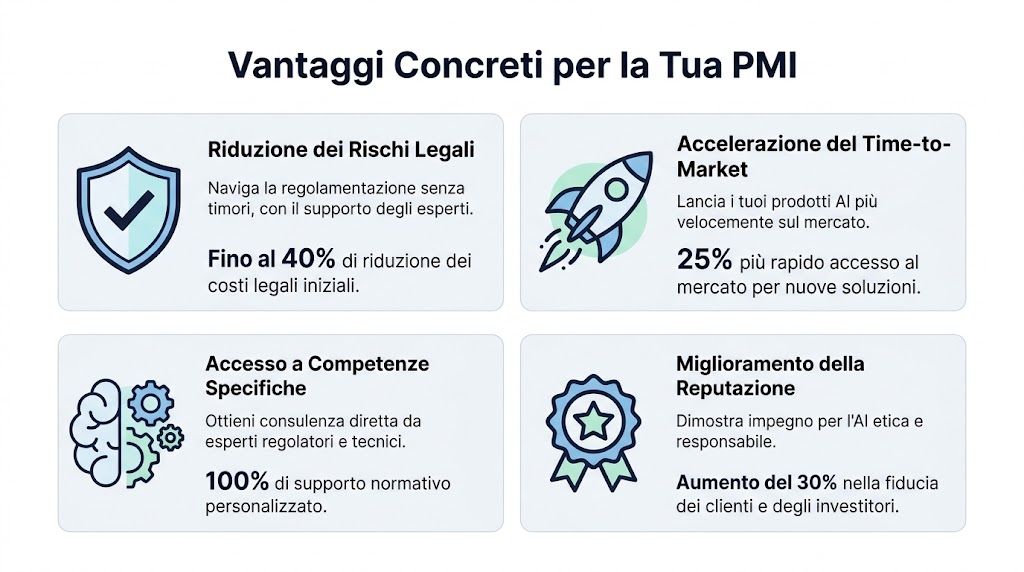
For an entrepreneur, the benefit isn’t found in the legal jargon. It lies in what the process helps avoid: delays in approval, last-minute technical reviews, and business negotiations slowed down by requests for guarantees that the team isn’t yet able to address.
This has a direct impact on the market window.
If your AI system is being sold in a B2B context, enterprise customers rarely buy just a single feature. They buy operational reliability, traceability, and the ability to withstand internal audits. A well-utilized sandbox helps you build this evidence before the customer’s due diligence process begins, rather than having to scramble to provide it afterward.
The first benefit is a reduction in the cost of late-stage errors. In many AI projects, serious problems emerge close to launch. At that point, fixing them means rewriting procedures, retesting, revising datasets, or limiting use cases that have already been promised to the market. In the sandbox, these issues come to light earlier and are addressed by stakeholders who assess risk in a structured manner. The practical result is simple: less costly rework.
The second benefit is more credible marketing. It’s one thing to tell a customer that you’re working on compliance. It’s quite another to demonstrate that the system has been tested in a supervised environment, with predefined assumptions, limits, and control measures. For an SME that sells to corporations, government agencies, or regulated sectors, this distinction often shortens the time needed to overcome the most significant objections.
The third benefit is documentation that remains useful even beyond the test. The SME Test associated with the AI Act indicates that sandboxes can reduce time to market and alleviate certain certification costs for small businesses, especially when they allow for the clarification of applicable obligations in advance and better preparation of technical documentation, as noted in the SME Test associated with the AI Act. For an SME, this means transforming an activity often perceived as an administrative burden into material that can be used in internal audits, in dealings with business partners, and in procurement requests.
The fourth benefit is more direct access to expertise that is otherwise costly on the open market. Many SMEs do not have an in-house risk manager, a data governance expert, or someone capable of translating regulatory requirements into product decisions. The sandbox helps address this imbalance. It does not replace internal work, but it accelerates the team’s learning curve and improves the quality of decisions.
The fifth benefit is organizational maturity. Participating in a sandbox forces the company to clarify who approves what, which metrics really matter, how incidents or deviations are handled, and where human oversight fits in. This kind of discipline is valuable even if the test does not lead to an immediate release. It makes the company more presentable to major clients, investors, and industry partners.
Here’s a point that many SMEs overlook. The value of the sandbox extends beyond its relationship with the authorities. It sends a signal to the outside world.
In markets where AI is purchased through lengthy sales cycles, buyers look for signs of professionalism even before reviewing the technical details. A company that has already identified risks, system limitations, internal responsibilities, and corrective measures starts from a different position. It doesn’t just appear more organized; it also appears less risky to integrate.
This perception matters a great deal in tenders, partnerships, and pilot projects with major clients.
Experience from other regulated sectors, including fintech, illustrates a useful principle: when there is a clear path for supervised experimentation, the market tends to view that process as evidence of regulatory compliance. While this principle does not automatically apply to the European AI sector, the economic logic remains strong. A company capable of conducting effective testing within regulatory constraints also tends to perform better in markets where trust and auditability influence purchasing decisions.
If you’re considering an AI regulatory sandbox for SMEs in Europe, the key question isn’t whether the program “helps with compliance” in the abstract. The key question is a tougher one: Will this approach allow me to enter the market with less friction, more testing, and a stronger track record of reliability than my competitors?
For many SMEs, that’s exactly how the sandbox works. Not as an administrative refuge, but as a competitive tool. Those who use it effectively end up with a better-documented product, a more disciplined team, and fewer hidden vulnerabilities during the critical stages of sales and growth.
Most SMEs get stuck here. Not on the theory, but on the transition from theory to practice. The process seems unclear until you break it down into actionable steps.

The first step is to determine whether your project fits the bill. Generally speaking, regulators are looking for systems with a clear innovative component, the potential for real-world impact, and a genuine need for regulatory review. It’s not enough to simply say, “We use machine learning.” You need to explain where the compliance issue lies and why a controlled environment is the appropriate setting to address it.
A credible application typically includes:
Many SMEs fail in their applications because they submit a sales brochure instead of a proof-of-concept dossier. The regulator doesn’t want to hear that the product is brilliant. It wants to know whether the project is mature enough to yield useful insights and whether the company is capable of managing a supervised trial.
This is where the players who make the European system more navigable come into play. The AI Act directs SMEs and startups toward the European Digital Innovation Hubs, which serve as a support point for accessing sandboxes. At the same time, the EUSAiR project, funded by the Digital Europe Program, is building a standardized framework for all 27 Member States, with the goal of harmonizing practices and facilitating cross-border pathways, as described in the official EUSAiR project roadmap.
This matters far more than it seems. If you sell analytics, scoring, optimization, or forecasting across multiple markets, the real cost isn’t just complying with a rule. It’s managing differences in interpretation among regulatory authorities. A more consistent framework reduces that variation.
According to the roadmap itself, participating in pilot programs can reduce the risk of non-compliance by up to 70% thanks to direct guidance from the authorities. And the mention of fines of up to €35 million serves as a reminder that this phase should not be treated as a mere administrative formality.
If your company aims to expand beyond the domestic market, the value of the sandbox increases. You’re not just testing a model. You’re trying to make your compliance portable.
To fully understand the process, it is helpful to compare it with the traditional approach.
| Appearance | Sandbox Approach | Traditional Approach |
|---|---|---|
| Relationship with the authorities | Conversation during the test, with ongoing feedback | More limited interaction, and often at a later stage |
| Managing Uncertainty | Areas of uncertainty are explored in a controlled environment | Doubtful areas often emerge near the launch |
| Documentation | Generated while the system is being monitored and corrected | Often constructed after the fact, with greater effort required for reconstruction |
| Model adaptation | Iterative, with adjustments made during testing | More rigid, with the risk of having to redo parts of the work |
| Risk of non-compliance | More manageable thanks to direct dialogue | More susceptible to later interpretations |
The typical project cycle ranges from selection through the testing phase to the final report. According to available data, the estimated duration is between 6 and 18 months. For an SME, this means realistically planning resources, internal ownership, and commercial release windows.
In practical terms, the process looks something like this:
Internal pre-screening
Assess whether the system is sufficiently mature and whether there is a concrete regulatory need.
Contact the support ecosystem at
. Reach out to hubs, technical advisors, or relevant national organizations to understand the criteria and availability.
Application: Include the application dossier, use cases, test plan, and safeguards.
Supervised Testing: Run tests, collect logs, measure performance, and document deviations and corrections.
Exits Sandbox Create a set of documents to help you with compliance and go-to-market.
Here’s the most useful shift in mindset: Don’t view the approval process as a mere bureaucratic formality. Treat it as a regulatory validation project with direct implications for your product, sales, and reputation.
An SME enters the sandbox with an apparent goal: to test an AI system. Those that come out on top have actually been working toward a more useful objective: building credible evidence that can be reused in audits, business negotiations, and market launches.

The bottom line is this: compliance within the sandbox isn’t just about satisfying the authority overseeing the test. It’s about reducing duplicate work later on, when you’ll need to explain how the system works, what risks you’ve identified, and why certain design choices make sense. For an SME, this can become a tangible competitive advantage: fewer post-hoc reconstructions, less friction with enterprise clients, and faster internal audits.
Before admission, it’s best to treat the sandbox as if it were already a due diligence process. If you arrive with vague documentation, the testing phase will be filled with requests for clarification. If you arrive with a clear scope, each week of testing will yield useful insights.
Use this checklist as a guide:
System Functional Map: Describe precisely what the system does, for whom it does it, what inputs it uses, and what outputs it produces. Also specify any excluded use cases. This prevents the project scope from changing in the middle of testing.
Preliminary Risk Classification
Determine whether the use case falls within sensitive areas covered by the AI Act, such as employment, access to services, critical infrastructure, or decisions affecting individuals. You don’t need a flawless legal brief. What you need is a well-reasoned initial position.
Risk Register Lists the main error scenarios: inaccurate outputs, bias, misuse, over-reliance on automation, and operational failures. For each scenario, it specifies the impact, probability, countermeasures, and escalation threshold.
Data Inventory
Documents the data source, usage terms, any contractual restrictions, the presence of personal data, data quality, and known limitations. If you’re unclear on these points, the sandbox will slow down almost immediately.
’s Internal Governance: Assigns clear responsibilities for product, architecture, security, privacy, compliance, and change approval. Regulators want to know who makes the decisions. Customers will want to know, too.
Test Plan Define the test environment, metrics, target population, duration, termination conditions, and human supervision procedures. A well-defined test plan helps avoid disputes later on.
Success and Stop Criteria
Determine in advance what constitutes an acceptable outcome and under what conditions you should pause or modify the system. This is a governance decision, not just a technical one.
To place this activity within the broader regulatory framework, it may be helpful to review ELECTE’s guide on the European AI Act. It helps translate general requirements into operational decisions as early as the planning phase.
In the sandbox, it’s not enough to show that the model produces useful outputs. You must demonstrate that the system’s behavior remains observable, correctable, and explainable in the real-world context of use.
The following are the elements that need to be monitored on an ongoing basis:
Performance: Consistency of results over time, error rate, and stability in standard and boundary cases.
Effective human supervision
Who can intervene, in which cases, with what response time, and with what authority to block or correct.
Deviations and Incidents
Recurring errors, unexpected outputs, user complaints, deviations from the test plan.
Technical Traceability: Model versions, changes to datasets, changes to decision rules, prompts, or relevant configurations.
Documentary evidence
s, logs, minutes, escalation decisions, justifications for corrections, validation tests, and internal reviews.
Many SMEs overlook one key point here. Documentation isn’t just an afterthought. It’s part of the product. If it’s well-organized, you can use it to answer questions from regulators, prepare materials for procurement, and reassure partners who are concerned about legal or reputational risks.
When you’re done, you should have a practical guide, not a jumbled collection of scattered files. In practical terms, the minimum you’ll need includes:
This material offers value that goes beyond compliance. It reduces information asymmetry with investors, enterprise customers, and distribution partners. For an ambitious SME, the sandbox works well when it turns what many competitors still treat as an administrative cost into an asset.
A good checklist, therefore, isn’t just about getting into the program. It’s about coming out with a system that’s more marketable, more defensible, and easier to scale.
There’s a rather simplistic narrative about sandboxes. It claims that they protect SMEs, simplify compliance, and open up the market. That’s partly true. But if you stop there, you’re only seeing half the picture.

The first risk is one that many founders realize too late. While the sandbox may provide some relief from certain administrative burdens, liability for damages to third parties remains. This is a line that should not be taken lightly. If your system causes harm, the fact that it is in the testing phase does not automatically eliminate your liability.
This changes the way an SME needs to prepare. It’s not enough to focus solely on compliance and documentation. You also need to assess contracts, internal governance, human oversight, and complaint handling.
The second risk is more subtle. Many SMEs do not fail on a technical level. They fail because the sandbox requires organizational discipline that they have not yet established. Data from similar fintech sandboxes show a 35% dropout rate among SMEs due to complexity, and only 20% of SMEs developing high-risk AI feel ready to participate, according to the overview compiled by the EU Artificial Intelligence Act on sandbox models in member states.
There are also two practical challenges that an entrepreneur should take into account.
Entering the market too early can be almost as costly as entering too late. The right time is when the model already has clear value, but the company is still flexible enough to make adjustments.
There is also a geographical challenge. Europe is striving for harmonization, but practical implementation remains inconsistent. For an Italian SME, this may mean having to carefully consider national pathways, available hubs, and opportunities for cross-border cooperation.
The most useful conclusion is not a pessimistic one. It is a selective one. The sandbox is not suitable for every AI project and does not replace a basic organizational structure. But precisely for this reason, it can become a powerful accelerator for companies that come in with clear objectives, well-defined processes, and a willingness to learn from their tests—not just to pass them.
The best way to understand the value of a sandbox is to see how it changes the life of an SME in two common contexts: retail and financial services. There’s no need for made-up scenarios. Just look at the real challenges businesses face when a model leaves the lab and encounters customers, messy data, and regulatory constraints.
An e-commerce SME can develop an AI system to forecast demand, optimize inventory, or adjust promotional prices. The business value is clear. The risk, however, arises when the model begins to affect margins, product availability, and differential treatment among customer segments.
In a sandbox, the company can test the system in a controlled environment, verifying, for example:
An analytics platform for SMEs isn’t just about “building dashboards.” It’s about collecting logs, comparing model versions, visualizing discrepancies, and creating reports that are easy for managers and supervisors to understand. These are the kinds of capabilities that make an SME better equipped to engage in dialogue within the sandbox and turn insights into operational decisions. For examples of solutions designed for this type of context, see how ELECTE works with SMEs.
The second scenario involves a fintech startup or an SME that uses AI for scoring, risk assessment, or default prediction. Here, the advantage of the sandbox is even more apparent, because the crux of the matter is not just accuracy. It is the combination of accuracy, explainability, and risk control.
In such a context, assisted experimentation makes it possible to verify whether the model:
A well-designed platform helps in three key ways. First, it centralizes data and performance metrics without forcing the team to manage scattered spreadsheets. Second, it automates reports and insights, which, within a sandbox, serve as documented evidence rather than mere internal reporting. Third, it bridges the gap between those who build the model and those who must defend it before compliance teams, management, or regulatory authorities.
The point isn’t that a platform should replace the sandbox. The point is that without a reliable observability infrastructure, the sandbox risks becoming a manual and time-consuming task. With the right database and reporting tools, however, it becomes a catalyst for learning.
The most common mistake is to treat the sandbox as an optional formality or as a path reserved for a select few specialists. In reality, for a European SME with serious ambitions in AI, it can be one of the smartest ways to turn what others see only as a constraint into an advantage.
The picture is clear. Sandboxes can reduce time, costs, and uncertainty. However, they require preparation, minimal governance, and the ability to thoroughly document how the model performs in the real world. And they work best when SMEs incorporate them early into their product plan, rather than using them at the last minute as a defensive measure.
Here is the strategic takeaway fromthe AI Regulatory Sandbox Europe SME initiative: It’s not just about avoiding problems. It’s about building systems that are more credible, more bankable, and better positioned to scale in the European market.
If you’d like to learn more about how to link the AI Act, governance, and operational growth, you can start with ELECTE’s playbook on European SMEs and AI in 2026.
If you want to turn data, models, and compliance into clearer decisions, discover ELECTE. ELECTE is an AI-powered data analytics platform for SMEs that helps business teams and analysts monitor performance, generate reports, and gain operational insights without enterprise-level complexity. Ready to transform your data? Start your free trial →

.svg)


.svg)
.svg)