
It’s a familiar scenario. You open your support inbox, scroll through Google reviews, read comments on social media, and find the same issue expressed in ten different ways. One customer mentions delays, another points out a mixed-up delivery, and yet another simply says, “Service needs improvement.” You know there’s value in there, but reading through it all manually is like searching for a specific product in a warehouse with no aisles.
For many Italian SMEs, the gap between “we have a lot of feedback” and “we know what to do on Monday morning” lies precisely here. Natural language analytics for small businesses is designed to bridge that gap. It transforms raw text into actionable insights: recurring themes, sentiment, frequently asked questions, sales objections, and operational priorities.
The timing is right for market-related reasons as well. In 2025, the global NLP market is valued between $36.8 billion and $53.42 billion, with projected growth to $193.4 billion by 2034, and SMEs represent the dominant segment thanks to the adoption of cloud solutions to reduce costs and automate processes, according to Fortune Business Insights on the NLP market. It is no longer laboratory technology. It is operational infrastructure.
If you’re already working on your reputation and customer experience, you might also find a practical collection of phrases for positive reviews helpful in understanding how to structure consistent responses and better understand the language that customers value.

The owner of a retail SME doesn’t have a data problem. They have too much of it, and it comes in inconvenient forms: emails, tickets, sales notes, reviews, WhatsApp chats, and return requests. The point isn’t to collect it. The point is to identify a direction.
Natural language analytics works best when you treat it like a highly efficient department manager, not a magic wand. It reads thousands of sentences, groups similar signals, highlights what matters most to the customer, and helps you decide whether to take action on a product, service, or process. For an SME, this means less time wasted interpreting scattered feedback and more time spent on actions that improve margins, customer retention, or service quality.
Customer feedback isn't "noise." It's operational data expressed in human language.
Those who get off to a good start usually don’t begin with a massive project. They start with a simple, practical question. Which issues come up most often? Which sales pitches actually lead to support tickets? Which reviews point to a real defect, and which ones reflect a mismatch in expectations? The difference between a project that remains in the testing phase and one that generates a return on investment almost always lies here.
The less glamorous part is what determines whether the project succeeds. If the source text arrives messy, duplicated, or out of context, the analysis will produce a polished version of the initial chaos. It’s not a problem with the algorithm. It’s a problem with the source material.
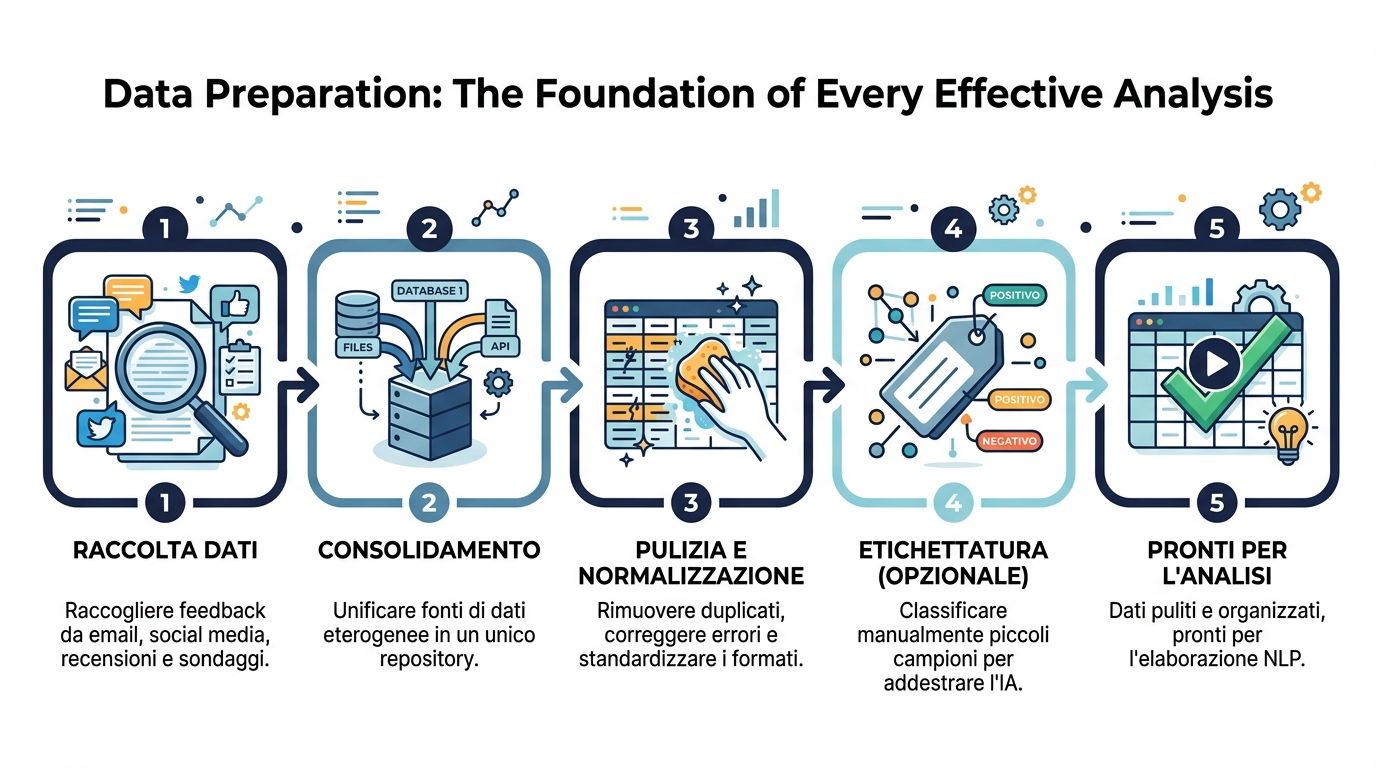
For an SME, the most effective approach is this:
The industry literature cited by OvalEdge on natural language analytics indicates that preprocessing—including tokenization and lemmatization—can achieve 92% accuracy on local datasets, but it also highlights a critical issue that many overlook: low-quality data accounts for 40% of analysis errors, reducing sentiment accuracy by up to 60%.
Rule of thumb: Clean the dataset first, then evaluate the model. Doing it the other way around will cost you weeks.
Tokenization breaks text down into digestible chunks. It’s like emptying a toolbox and sorting out the screws, bolts, and washers before counting what’s actually missing.
Lemmatization reduces words to their base forms. “Delivered,” “delivery,” and “to deliver” no longer appear as three separate issues but begin to convey a single concept. This step is straightforward only in theory. In practice, it prevents the team from mistaking linguistic variations for separate signals.
A basic checklist that works well in practice:
If you want a quick return on investment, invest here. Natural language analytics for small businesses doesn’t fail because “AI doesn’t understand Italian.” It fails when the team feeds it messy text and expects clarity.
The first project doesn’t have to be the most sophisticated one. It should be the one that yields a useful decision quickly. In an SME, I see three use cases that produce clear results without building a complex system.
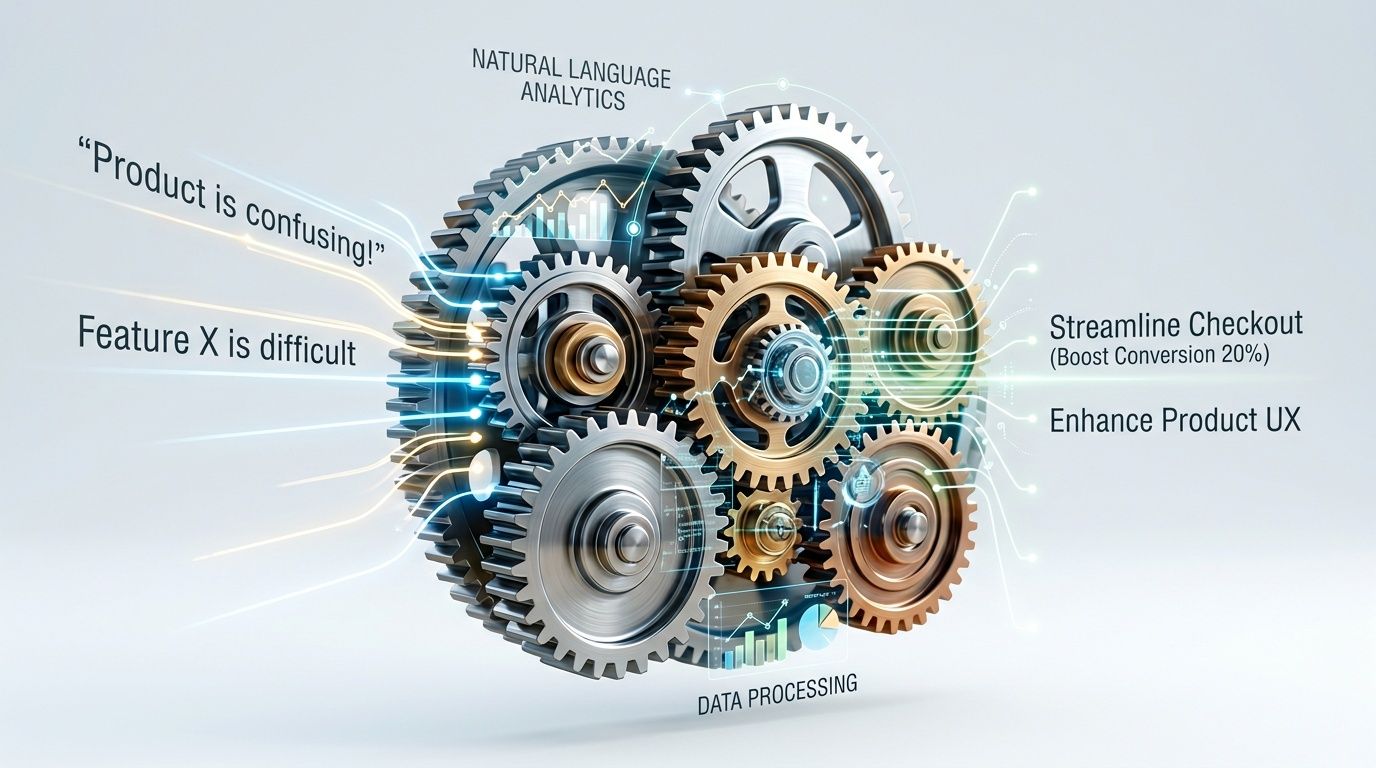
Context matters. Already , 53% of SMEs use AI chatbots for customer service, while 64% of European companies use NLP to analyze sentiment in reviews and on social media. In this context, adopting these technologies can reduce operating costs by up to 30% through the use of virtual agents, as reported by the SBA in its 2025 small business trends report.
If you sell products or services that frequently receive reviews, you have an immediate advantage here. Text analysis shows you which topics really dominate—not which ones seem to be the most talked-about to someone who reads three comments in a row.
Helpful questions:
This use case is powerful because it links the customer’s language to concrete decisions regarding product, logistics, and communication.
Here, the ROI is often faster. Support tickets reveal operational bottlenecks much more clearly than an internal meeting. If customers consistently use the same terms to report an issue, you can reorganize macro-categories, quick responses, and team priorities.
If ten customers describe the same problem in different ways, you don’t have ten exceptions. You have a process that’s speaking.
A good place to start is to analyze:
To understand how other companies set up similar projects without overcomplicating things, it can be helpful to look at some case studies of applied analytics.
Sales conversations contain a wealth of information that many small and medium-sized businesses leave entirely up to the individual salesperson’s memory. With language analysis, you can identify recurring objections, promises that work, requests for price comparisons, and signs of genuine interest.
The key here is not to look for “the perfect phrase.” Look for patterns. What topics come up before a deal falls through? What concerns do the most qualified leads keep bringing up? What words do customers who buy faster use? Natural language analytics for small businesses comes in handy when it turns scattered conversations into a reusable sales playbook.
Choosing the wrong tool costs more than the right one. Not because the software is poor, but because it forces the team to work against its own structure. For an SME, the real question isn’t “which one is the absolute best.” It’s “which option provides useful insights without creating a dependency on a technician who’s impossible to reach.”
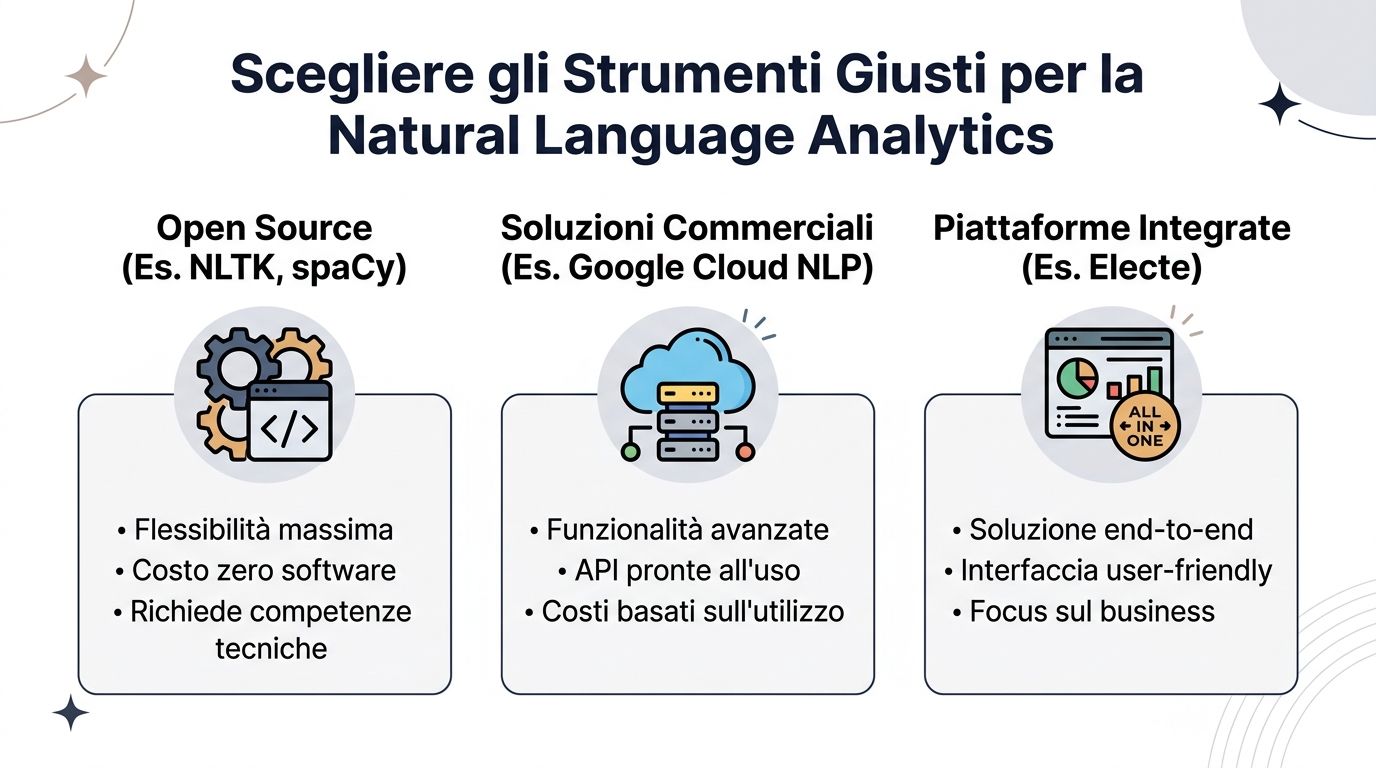
If you have in-house development expertise or a reliable technical partner, libraries like NLTK or spaCy are a good choice. They offer flexibility and control. You can adapt pipelines, customize preprocessing, and build bespoke logic.
But there is a very real downside:
| Option | Real advantage | Real trade-off |
|---|---|---|
| Open source | Maximum freedom | It requires ongoing technical expertise |
| Commercial APIs | Ready-to-use features | Variable costs and integration to manage |
| Integrated platforms | Operating speed | Less freedom with the underlying engine |
Open source is like buying a professional kitchen in parts. If you have a chef and a technician, it can be perfect. If you have a small team, you risk spending more time assembling it than serving.
Specialized APIs, such as those offered by cloud providers, are a useful middle ground. They allow you to integrate sentiment analysis, text classification, or speech-to-text into existing systems. They make sense when you already know where you want to implement them and have a well-organized application framework.
Integrated platforms are the smartest choice when the main issue isn’t the model’s capabilities, but the team’s time. A simple interface, pre-built connectors, easy-to-read dashboards, and minimal technical setup. For many small and medium-sized businesses, this is the difference between a project that gets off the ground in a few weeks and one that gets shelved.
Don't buy a Formula 1 engine if you need a van for daily deliveries.
A simple criterion for choosing:
When a text analysis project really works, the workflow is tedious in the best possible way. It’s repeatable, easy to follow, and used by the team. It doesn’t require an expert for every question, and it doesn’t turn every request into a mini IT project.
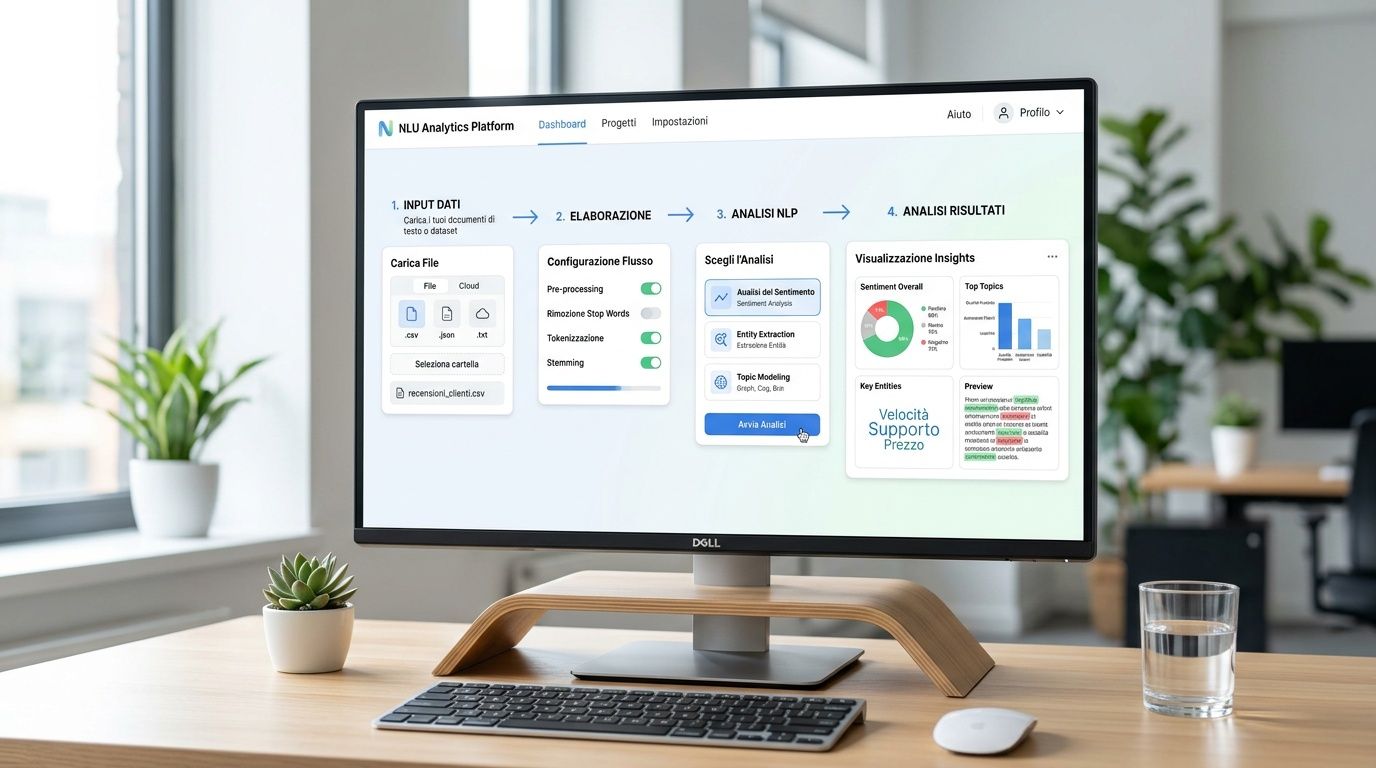
With a platform like ELECTE, the operational process can remain straightforward:
The practical value lies in how quickly you can go from raw data to a managerial discussion. If you want to understand how to structure this visual component, you’ll find a helpful guide on creating analytics dashboards on ELECTE.
SMEs are successful in adopting these workflows when they meet three criteria:
A useful dashboard doesn’t need to be flashy. It needs to help a sales, operations, or customer service manager understand where to focus their efforts before the next work cycle. This is where natural language analytics for small businesses stops being an experiment and becomes standard operating procedure.
If you focus solely on the model’s accuracy, you risk losing business. An SME doesn’t invest just to know that the algorithm is elegant. It invests to reduce friction, improve margins, and make decisions faster.
However, there is one statistic worth noting. According to NetSuite’s report on the challenges of predictive analytics, 42% of SMEs in Lombardy reported an 18% increase in profits thanks to insights derived from NLP. This does not mean that the same result is guaranteed for everyone. It means that the link between linguistic insights and financial results can be very tangible when the project is well-designed.
The right metric depends on the use case.
For customer support, look at metrics such as:
For marketing and customer experience, see:
For sales, note:
A good NLP project doesn't just tell you what customers think. It tells you which lever to pull first.
A common pitfall is working with samples that are too small. The same study notes that using data samples that are too small can lead to unreliable predictions in 30% of cases. This often happens in small and medium-sized enterprises (SMEs) when major decisions are made based on a few outlier reviews or an anomalous month.
To avoid vanity metrics, adopt three simple habits:
If the report doesn't change internal practices, it isn't generating a return on investment yet.
If you want to get off to a good start, you don’t need a massive project. You need a short, structured sequence.
A practical checklist for the first month:
This is the most practical way to put natural language analytics to work for your small business, without waiting for the “perfect project.”
Italian SMEs don’t need more hype about AI. They need a practical way to make better use of what they already have: customer feedback, team notes, support requests, and sales conversations. Within that data lie insights that help them understand what to fix, what to promote, and what to stop doing.
The Italian context makes this transformation particularly significant. In Italy, SMEs account for 99% of businesses, but barriers such as high costs—averaging €5,000 per year—and a lack of skills—with only 15% of the workforce digitally literate—have slowed the adoption of AI. In this context, platforms with scalable pricing and a no-code approach are cited as the most realistic lever for bridging this gap, as highlighted by Memra Language Services regarding the role of NLP for SMEs.
The good news is that these days you don’t need a data science team to get started. All you need is a clear business question, reasonably organized text data, and a tool that your team can actually use. This changes everything. It brings analysis closer to the people who need to make decisions.
Whether you work in retail, finance, services, or e-commerce, the advantage doesn’t come from whoever collects the most data. It comes from whoever interprets it first and acts on it most effectively. That’s where natural language analytics for small businesses becomes a real competitive advantage.
Want to turn scattered feedback into clear, actionable insights? Discover ELECTE, the AI-powered data analytics platform for SMEs designed to connect data sources, analyze natural language, and transform complex signals into quick, actionable decisions for your team.

.svg)


.svg)
.svg)