
Monday morning. The sales team presents one report, the marketing team shows another, and the administration team has a third. Everyone is talking about the “same” customers, the “same” campaigns, and the “same” revenue, but the numbers don’t add up. This isn’t a rare problem, nor is it merely a technical one. It’s an operational friction that slows down decision-making, creates avoidable disputes, and makes it harder to figure out where to actually take action.
In the Italian context, this chaos has a measurable cost. Companies that do not implement a centralized Single Source of Truth (SSoT) experience a 34% rate of incorrect strategic decisions due to duplicate and inconsistent data, while adopting an SSoT reduces this error by 62% within the first 12 months, according to this reference cited by Treccani. For an SME, the point is not “having more data.” It is being able to trust the same data across every business function.
If you’re currently evaluating analytics, automation, or AI, establishing a single source of truth isn’t a data cleanup project you can put off. It’s the foundation that makes everything else credible. When data is consistent, the business moves faster, with less friction and greater clarity.
Monday morning, sales meeting. The sales manager cites a figure from the CRM, the admin team cites another from the ERP, and the marketing team defends the data from the advertising platform. After twenty minutes, the discussion is no longer about how to grow, but about which figure is reliable.
This is how data chaos stops being an operational nuisance and becomes a managerial cost. If every important decision begins with a discussion about the sources, the company slows down in two ways: it wastes time clarifying the past and is late in taking action on the future.
In growing SMEs, this problem is common because systems expand faster than the rules that connect them. The sales team looks at the CRM, the admin team at the ERP, the e-commerce team at Shopify, and the marketing team at campaign dashboards. Each team sees a valid segment of the business. Management, however, needs a single view to make decisions about pricing, investments, business priorities, and inventory.
A Single Source of Truth serves precisely this purpose. It reduces the unnecessary complexity created by different versions of the same reality, without promising to eliminate the actual complexity of the business.
The economic impact is clear. Inconsistent data leads to manually reconciled reports, longer meetings, less reliable forecasts, and less clear accountability. The cost doesn’t appear on a specific line item in the financial statements, but it affects profit margins, decision-making speed, and the quality of execution.
There is also a second effect, one that is often underestimated. Without a shared database, even the most advanced analytics tools merely automate preexisting confusion. For an SME that wants to use autonomous AI analytics to detect anomalies, forecast demand, or assess profitability by customer, the SSoT is not a technical project that can be put off. It is the practical prerequisite that makes AI useful, accessible, and competitive.
A Single Source of Truth is the sole, authoritative reference for critical business data. It serves a very practical purpose: to ensure that sales, finance, operations, and management make decisions based on the same set of numbers.
In practice, an SSoT is an environment in which data is collected from various systems, validated, reconciled, and then published as a common foundation for reporting, forecasting, and analysis. The point is not to reduce everything to a single software solution. The point is to determine which definition of revenue, margin, active customer, or available inventory the company considers valid when making decisions.
For a business leader, this distinction matters more than the underlying technology. If the margin per channel varies across dashboards, Excel files, and the ERP system, the issue affects budget allocation, business priorities, and performance evaluation. In other words, a SSoT safeguards the quality of decisions, not just the order of the data.
There is also a strategic reason that carries more weight today than ever before. An SME can implement AI analytics tools relatively quickly, but these tools only deliver value if they process data that is consistent, up-to-date, and defined in a uniform manner. For this reason, the SSoT should be viewed as the operational foundation that makes autonomous AI analytics accessible even to organizations with limited resources.
An SSoT does not automatically correspond to a database, a CRM, or an ERP. Each of these systems captures a valid aspect of the business reality, but from a specific perspective. CRM tracks sales pipelines and activities. ERP manages orders, accounting, and inventory. The e-commerce platform tracks online behavior and transactions. Senior management, however, must be able to view the business as a coherent whole.
Another common misconception concerns timing. SSoT is not a one-time project that remains static by definition. It functions as a management discipline supported by technology, processes, and clear accountability. When channels, price lists, commercial definitions, or revenue models change, the authoritative source must be updated with the same care as a financial process.
For a manager, the definition becomes clearer if we break down the term into its three components:
A rule of thumb can help you spot this right away. If two executives calculate the same KPI using different criteria, the company still lacks a sufficiently reliable shared foundation on which to manage the business or entrust independent analysis to AI systems.
The effect is noticeable in meetings. With an SSoT, the discussion begins with the options for action. Without an SSoT, a significant portion of the time is spent verifying definitions and reconciling numbers.
Monday morning, management meeting. Sales presents a conservative forecast, marketing shows campaigns on the rise, and finance reports that margins are under pressure. The numbers all come from legitimate systems, but they don’t align closely enough to support a quick decision. At that moment, the cost isn’t just informational—it’s operational. A promotion gets launched late, a reorder is delayed, and a price adjustment remains up for debate.
A single source of truth reduces this unproductive time. When definitions, KPIs, and datasets are shared, management can focus the meeting on decisions that have a financial impact. Decision-making speed improves because the time spent on verification decreases. The quality of decisions also improves, since departments discuss the same evidence rather than partial reconstructions.
The benefit is particularly evident in recurring processes: sales forecasting, inventory planning, procurement cost control, and margin reviews by channel. Without a single source of truth, each cycle requires manual reconciliations between files, dashboards, and local reports. That work is rarely factored into the budget, but it consumes skilled labor and slows down initiatives that would have a direct impact on revenue, cash flow, or customer service.
For an SME, this matters more than it seems. A small business has less leeway to compensate for coordination errors with infrastructure, personnel, or extra time. SSoT reduces hidden waste and makes management more scalable. The same team can manage more channels, more customers, and greater complexity without increasing the number of manual checks.
The next benefit concerns how the different functions work together. Marketing, sales, and finance don’t need the same reports. They need the same underlying logic. If the definitions of a qualified lead, campaign attribution, or revenue recognition criteria change, each analysis produces a different story about the business.

A common example illustrates the point. Marketing tracks conversions from the advertising platform. Sales looks at closed opportunities in the CRM. Finance monitors revenue and cash collections. If these three levels aren’t aligned, the funnel takes on a different shape depending on which department is presenting it. The practical consequence is simple: the board struggles to determine where to invest one more euro and where to cut spending that isn’t yielding a return.
With a single source of truth, the conversation becomes more useful:
Situation: Without SSoT, With SSoT, Leads Generated, Different Definitions Across Teams, Shared Definition, Campaign Performance, Inconsistent Attribution, Aligned Interpretation, Forecast, Based on Separate Sources, Based on a Consistent Dataset, Cross-Functional Meetings, Defending the Numbers, Decisions Based on the Numbers
A shared database does not, on its own, improve managerial judgment. However, it reduces a significant amount of internal friction, and this has a direct impact on the speed of execution.
This is where the key point comes into play. The adoption of AI in Italian companies is on the rise, as noted in ICT Business’s analysis of data governance and AI, but the success of these projects depends much more on the quality of the data set than on the algorithms chosen.
For an entrepreneur or CEO, the relevant question is not whether to implement AI tools. The relevant question is whether the company has data that is consistent enough to allow an autonomous system to analyze trends, generate alerts, propose actions, or produce reports without continuous supervision. If the answer is uncertain, AI tends to accelerate the errors, ambiguities, and conflicts that are already present in decision-making processes.
That’s why SSoT should be viewed as the most accessible starting point for an SME seeking to gain a competitive advantage through autonomous analytics. First, you build a reliable foundation. Then, you entrust AI with high-return tasks, such as identifying anomalies in margins, anticipating stockouts, comparing performance across channels, or flagging deviations in KPIs before they become a financial problem.
The choice of infrastructure also affects the timeline and costs of the process. To evaluate costs and solutions for SMEs, it’s best to determine early on where to store the data, how to manage it, and which AI use cases you want to support in the medium term.
To a non-technical manager, the architecture of a single source of truth may seem like a black box. In reality, it’s a very straightforward process. Data comes in from various systems, is cleaned and standardized, is centralized in a reliable repository, and is then made available to dashboards, reports, or analytics platforms.

There are five key stages.
Value isn't created simply by collecting data. It's created when the data is made readable and meaningful for the business. This is where many SMEs take the wrong approach. They focus on the number of integrations but overlook the operational significance of the final data.
In Italy, the rate of achievement of digital goals rose from 68.1% in 2023 to 88.3% in 2025, while the IT sector recorded a 53% adoption rate of AI, according to data reported by FocusMondo. The interesting takeaway isn’t just the growth. It’s the difference between sectors. Where information density is higher, a single source of truth becomes more critical because the cost of misalignment rises rapidly.
For those evaluating the best architecture, the distinction between a structured repository and a more flexible environment is also a key factor in terms of budget and timeline. This in-depth analysis of costs and solutions for SMEs is a useful guide to help you navigate these choices.
Good architecture doesn't impress with its complexity. It reduces the number of manual steps between a business request and a reliable response.
That’s why a modern SSoT isn’t “more technology.” It’s less friction between systems, people, and decisions.
On Monday morning, the sales director looks at a pipeline that promises growth. The finance team sees delayed collections. The operations team reports orders to be fulfilled with margins under pressure. If each department is working from different numbers, the priority isn’t “getting the data in order” in an abstract sense. It’s to reduce slow decision-making, internal debates, and capital tied up in avoidable errors.
For an SME, an SSoT should be approached as a performance initiative, not as a technical reorganization. The best starting point is a process where misalignment actually costs money: inventory and sales in retail, cash flow and forecasts in finance, and pipeline and conversions in B2B. From there, you create a reliable foundation that can also support a much more strategic next step: using agents and autonomous AI analytics without feeding them contradictory data.
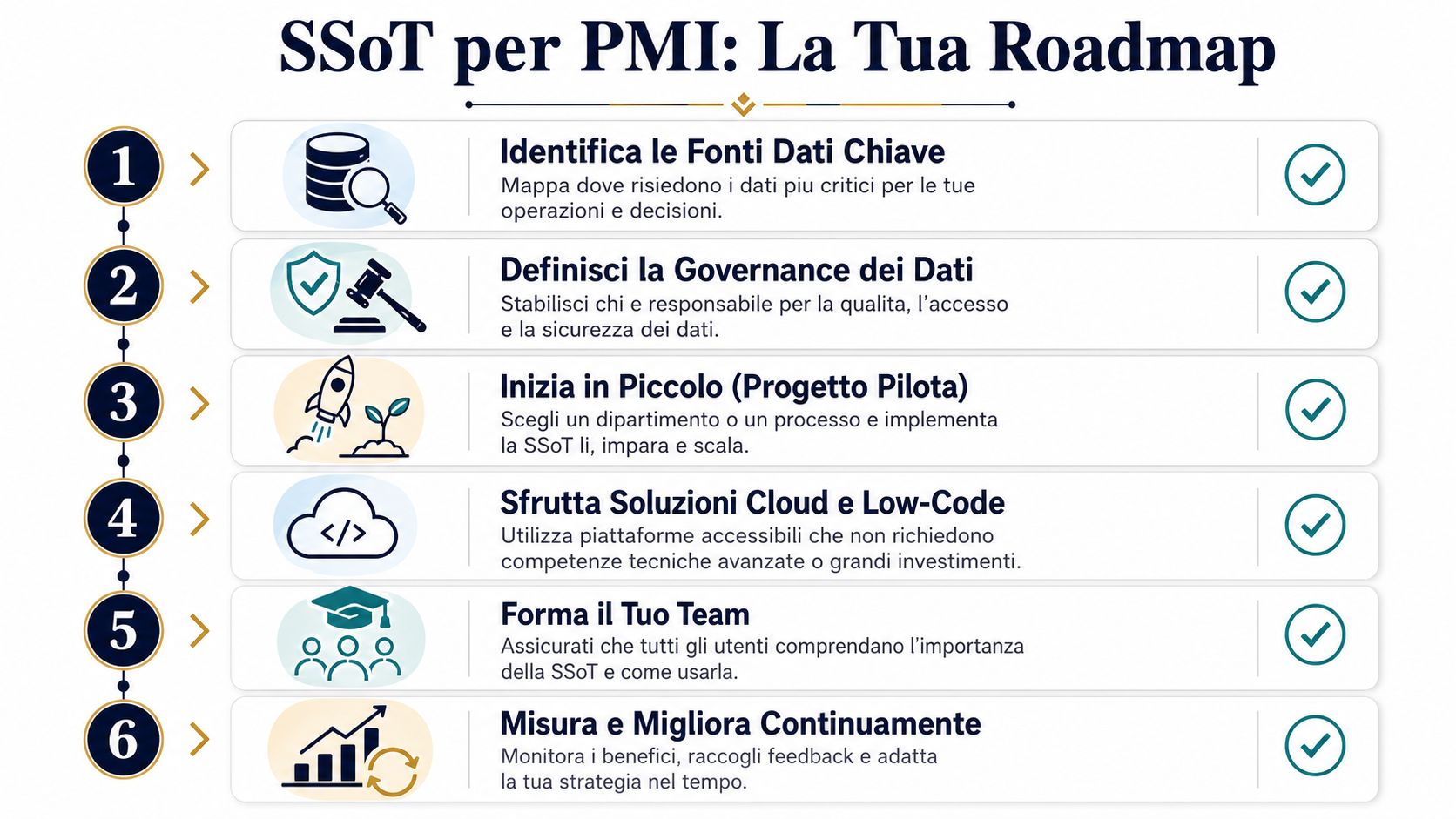
A realistic path for an SME often looks like this:
This approach accelerates adoption because it makes the value clear. People start using a SSoT when they see that consistent data reduces the need for reconciliations, clarifies responsibilities, and saves time on recurring decisions.
In SMEs, the number of available features matters less than the time that elapses between the problem arising and the first reliable response. A good initial setup should allow those leading sales, finance, or operations to understand the state of the business without having to rely on manual exports or a consultant every time.
Industry research also points in the same direction. Studies compiled by the Milan Polytechnic Observatory on the digital transformation of SMEs show that adoption yields results above all when the tools are integrated into decision-making processes and can be used by operational teams—not just by IT. For this reason, the selection criteria should be practical: clear metrics, ease of adoption, reasonable implementation times, and minimal reliance on custom development.
To organize this phase, it can be helpful to start with an ELECTE guide to process mapping, especially if you want to understand which workflows result in the most inefficiencies or require the most manual work.
Governance in an SME serves to avoid costly ambiguities. It does not require a formal committee or an extensive set of policies. It requires just a few simple decisions, assigned appropriately.
Question: Minimum required decision; Who can modify a KPI? A clearly designated manager; What is the reference system for each data point? An explicit rule; When is the data updated? An agreed-upon frequency; Who monitors anomalies? An operational owner
Practical tip: If a rule can't be explained in a single sentence to a department head, it's probably too complex to be implemented effectively.
Here’s a point that’s often overlooked. A well-managed SSoT doesn’t just improve reporting. It prepares the company to use autonomous AI-based analytics with much lower risk. If definitions, ownership, and update frequencies are unclear, even the most advanced automation will produce confusing alerts, weak forecasts, and limited trust from management.
For this reason, in SMEs, the most useful best practice is also the most accessible: start with a high-impact use case, establish minimal but consistent rules, and build a database that the business recognizes as reliable. This is how an SSoT stops being an IT project and becomes the first concrete step toward a competitive advantage in AI analytics.
The most interesting aspect of a single source of truth isn't centralization itself. It's what becomes possible afterward. When a platform connects different sources, pre-processes the data, and ensures its consistency, it can go beyond static reporting and enable continuous analysis.
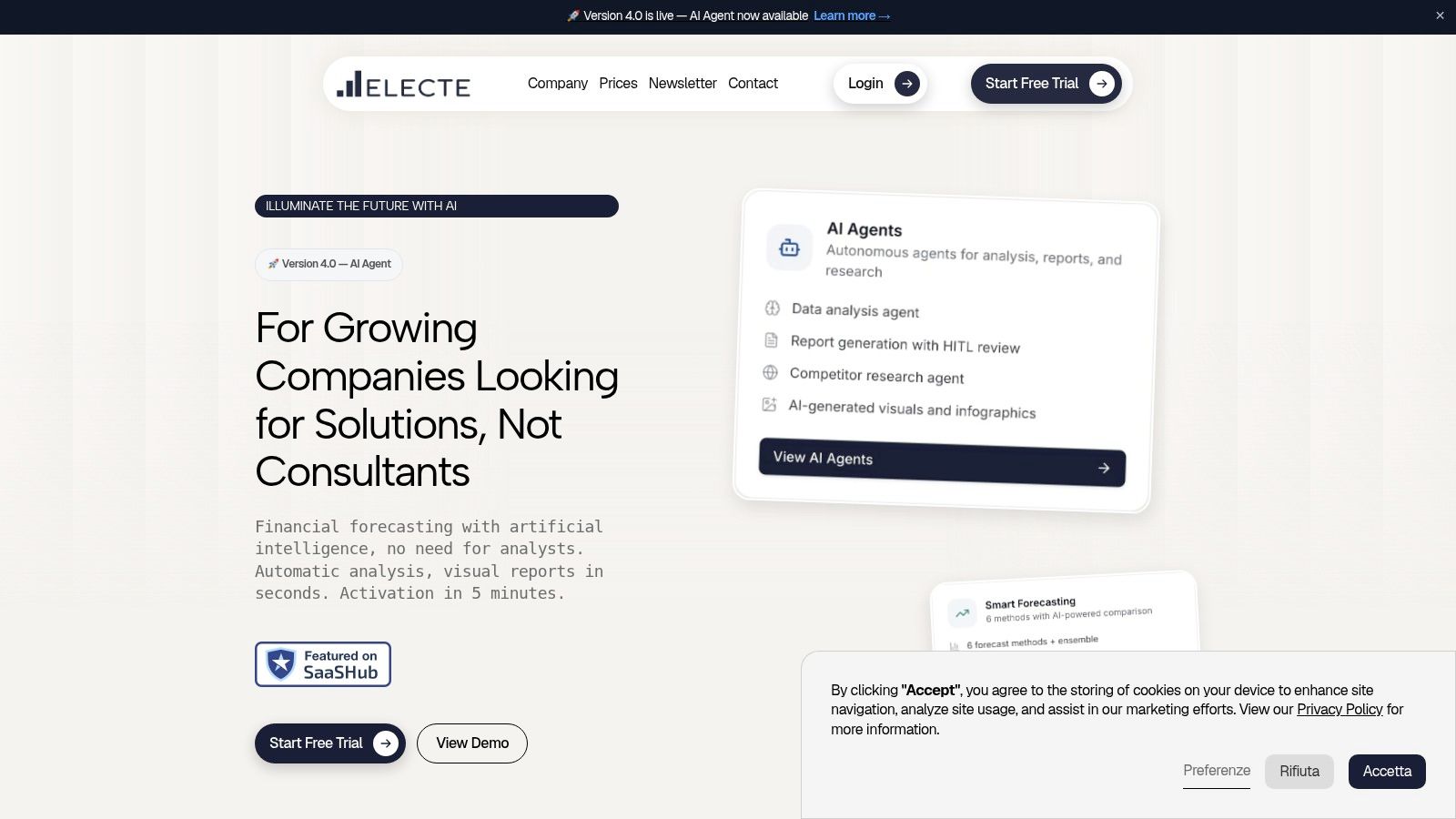
This is where ELECTE comes in—an AI-powered data analytics platform for SMEs. The idea is simple: connect CRM systems, business management software, e-commerce platforms, and other data sources; automatically consolidate the information; and use it as a reliable foundation for AI-generated reports, forecasts, and insights. In this way, the single source of truth isn’t just a well-organized database. It becomes the engine of a system that monitors the business and highlights what matters.
For business leaders, the difference is significant. Instead of asking an analyst to manually check for anomalies, trends, or changes in KPIs, monitoring can take place continuously using a database that has already been reconciled.
The adoption of advanced analytics is no longer limited to teams with deep technical expertise. Generative AI and cloud-based tools like Power BI are making data analytics accessible to small and medium-sized businesses, allowing even the smallest companies to interpret large volumes of information using simple interfaces, as described in this in-depth article on accessible digital tools for data analytics.
ELECTE fits into this trajectory with a very concrete positioning: enterprise-level analytics without enterprise-level complexity. It doesn’t require companies to become software development firms. It asks them to bring order to their key data sources and then leverage that order to gain actionable insights.
Three factors make this development particularly relevant for SMEs:
A traditional SSoT tells you where to look. An SSoT combined with autonomous analytics also begins to tell you what deserves your attention.
This is the paradigm shift that many companies don't immediately grasp. The single source of truth isn't the end goal. It's the foundation that makes AI reliable, accessible, and truly useful in day-to-day operations.
If I had to summarize the topic in a few points, these are the ones I would focus on.
That’s why a single source of truth isn’t just a luxury for large enterprises. It’s an operational choice that prepares your company to grow with greater control and less scattered effort. If you’re considering how to move from data chaos to actionable, self-generating insights, the next step is to explore a platform designed specifically for this purpose.
ELECTE transforms scattered data into a unified, readable database, then puts it to work with AI analytics, automated reports, and insights at the click of a button. If you want to understand how to build a Single Source of Truth without enterprise-level complexity, find out how ELECTE works.

.svg)


.svg)
.svg)